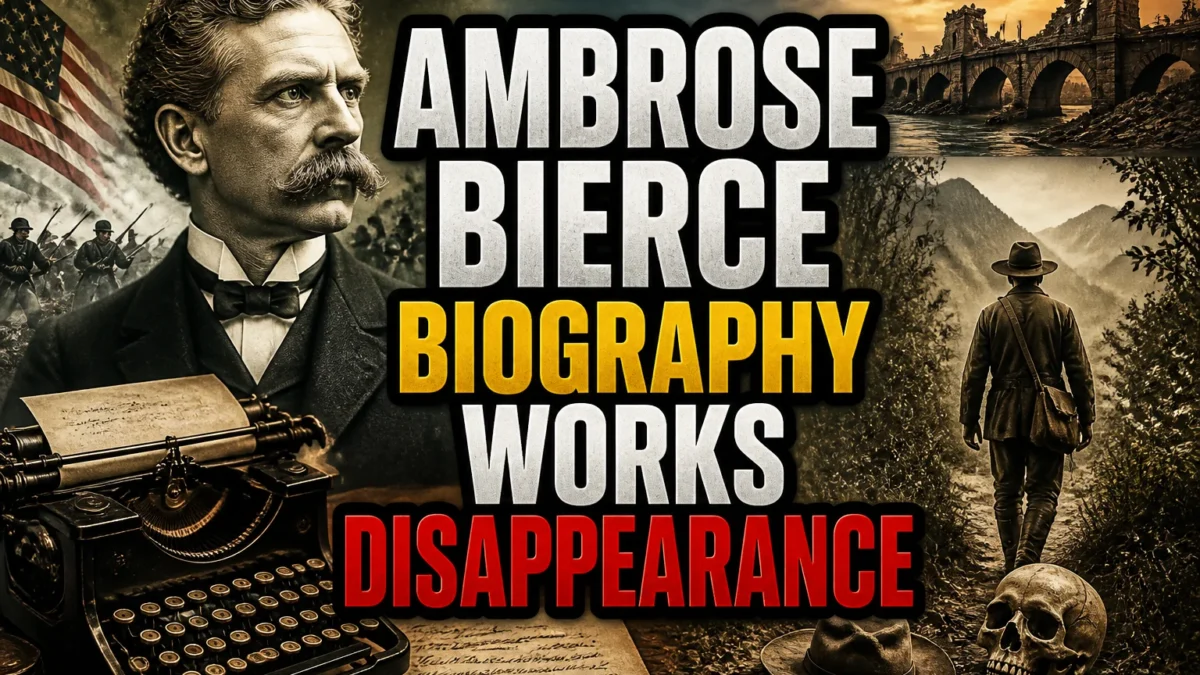
For decades, Ambrose Bierce was one of the sharpest and most feared voices in American newspapers. He was a Civil War veteran who turned battlefield horror into some of the most unsettling short fiction ever written. Then, in late 1913, at the age of 71, he headed toward revolutionary Mexico and was never reliably seen again.
That mix of literary reputation and a real, unsolved mystery has made Ambrose Gwinnett Bierce endlessly fascinating, and endlessly misunderstood. This guide walks through his life, his best-known stories, and the tangle of theories about his disappearance. Along the way, we'll separate what is documented from what is legend.
TL;DR: Ambrose Bierce was a battle-scarred Civil War veteran, brutal satirist, and master of the short story whose 1913 trip into Mexico ended in a disappearance that historians still cannot explain.
Who Was Ambrose Gwinnett Bierce?
Ambrose Gwinnett Bierce (1842 to about 1914) was an American journalist, poet, satirist, and fiction writer. Today, writer Ambrose Bierce is best remembered for "An Occurrence at Owl Creek Bridge," "The Damned Thing," and a book of acid-tongued definitions called The Devil's Dictionary. His reputation rests on a surprisingly small body of fiction and a very large body of journalism.
His name trips people up constantly. It is pronounced "beerce," rhyming with "fierce," which is why people search for "Ambrose Pierce," "Ambrose Beirce," or "Ambrose Bearce." All of those misspellings lead to the same man, so if you arrived by one of them, you're in the right place.
His middle name is often linked to Button Gwinnett, a signer of the Declaration of Independence. That connection is better described as family tradition than as something firmly documented. Either way, "Ambrose Gwinnett Bierce" is the name that appears on his work and in his biographies.
Ambrose Bierce Biography: From an Ohio Farm to the Union Army
Bierce was born on June 24, 1842, in Meigs County, Ohio, the tenth of thirteen children. His father, Marcus Aurelius Bierce, reportedly gave all of his children names beginning with the letter A. The family later settled in Kosciusko County, Indiana, where Bierce grew up on a farm with access to his father's books.
As a teenager he left home to work as a printer's devil at an antislavery newspaper in Warsaw, Indiana. That job gave him his first taste of the newsroom and of the printed word as a weapon. He also spent a year at the Kentucky Military Institute, an experience that would soon prove useful.
When the Civil War began in April 1861, Bierce enlisted in the 9th Indiana Infantry. He was still a teenager. The war would shape his writing, his outlook, and his temperament for the rest of his life.
How the Civil War Shaped Bierce the Writer
Bierce saw some of the war's hardest fighting. He served in western Virginia early on, then fought at Shiloh in April 1862, Stones River, Chickamauga, and Missionary Ridge. He was part of the Army of the Cumberland's western campaigns, which meant long marches, sudden slaughter, and a lot of waiting in between.
In June 1864, during the Atlanta campaign, he was badly wounded in the head at Kennesaw Mountain. He recovered and returned to duty, but he left the army in January 1865. He eventually held the rank of brevet major, and he later worked as a topographical officer for his former commander, General William B. Hazen.
After the war, Bierce traveled west with Hazen on an inspection tour of frontier military posts. He ended up in San Francisco, which would become his base for the next two decades. He never stopped writing about the war, though.
His best war fiction doesn't glorify combat. In "Chickamauga," a small child wanders through a battlefield without understanding what he sees. In "A Horseman in the Sky," a young Union soldier is ordered to shoot a Confederate scout who turns out to be his own father.
These stories are fiction, but they draw on what Bierce had actually lived through. His nonfiction essay "What I Saw of Shiloh" shows the same cold, observant eye. The tone is unsentimental, ironic, and unnervingly calm.
"Bitter Bierce": San Francisco, London, and the Newspaper Wars
In San Francisco, Bierce worked at the U.S. Mint while building a name as a columnist. He wrote for the San Francisco News Letter, where his column "The Town Crier" skewered politicians, preachers, and hypocrites. He moved among a lively literary circle that included Bret Harte and other writers of the Gilded Age West Coast.
He married Mary Ellen "Mollie" Day in 1871, and the couple soon went to England. There he wrote for humor magazines and published several collections under the pseudonym "Dod Grile." The nickname "Bitter Bierce" followed him from those years, and he never quite shook it.
Bierce returned to California in 1875. He briefly tried his hand at managing a mining operation in Dakota Territory around 1880, then went back to journalism. In 1887, William Randolph Hearst hired him to write for the San Francisco Examiner, where his "Prattler" column became a West Coast institution.
Hearst also used Bierce as a weapon. In 1896, Bierce was sent to Washington to help oppose a railroad refunding bill backed by Collis P. Huntington, and the bill was ultimately defeated. Bierce eventually settled in Washington, D.C., and kept writing for Hearst papers and magazines.
An Occurrence at Owl Creek Bridge: The Story That Defined Him
If you're wondering who wrote "An Occurrence at Owl Creek Bridge," the answer is Ambrose Bierce. It first appeared in the San Francisco Examiner on July 13, 1890, and was collected the next year in Tales of Soldiers and Civilians. That collection was later reissued as In the Midst of Life.
The story follows Peyton Farquhar, a Southern planter, as Union soldiers prepare to hang him from a railroad bridge in northern Alabama. Just as the rope drops, it seems to break. Farquhar tumbles into the creek, dodges gunfire, and races toward his wife and home.
Spoiler warning: the escape never happens. In the final lines, we learn that Farquhar's neck snapped at the end of the rope, and everything in between unfolded in his mind in the instant before death. Few short stories in American literature have a more famous twist.
The structure is what makes it work. Bierce opens with the hanging, flashes back to explain how Farquhar got there, and then stretches a single second into a vivid dream of survival. He plays with time more boldly than most writers of his era.
The story has had a long afterlife. A 1962 French short film, La Rivière du Hibou, adapted it faithfully and won the Academy Award for Best Live Action Short Film. The Twilight Zone then broadcast that film in 1964, introducing the story to a new generation of viewers.
The Damned Thing: Bierce's Invisible Monster
If Owl Creek Bridge is Bierce's most famous war story, "The Damned Thing" is one of his most famous horror stories. It appeared in Town Topics in December 1893 and was collected in Can Such Things Be? the same year. People searching for Ambrose Bierce's "The Damned Thing" are usually looking for this tale of an unseen predator.
The story begins with an inquest in a rural cabin. A man named William Harker reads a statement describing how his friend Hugh Morgan died during a hunting trip. Harker says something invisible attacked Morgan, and that the grass and brush moved as if something huge were passing through them.
The coroner reads from Morgan's own diary, which describes earlier encounters with a mysterious presence he called "the damned thing." The diary suggests the creature may be a color beyond the range of human sight. The jury, unconvinced, returns a verdict that Morgan was killed by a mountain lion.
That ending is part of the horror. Bierce lets the official explanation stand, even though readers have been given strong reasons to doubt it. The idea of a creature outside our perception became hugely influential in later weird fiction, and H. P. Lovecraft praised Bierce in his survey of supernatural literature.
Bierce's other eerie tales include "The Boarded Window," "The Middle Toe of the Right Foot," and "An Inhabitant of Carcosa." That last story gave later writers the name "Carcosa," which Robert W. Chambers borrowed for The King in Yellow. Bierce's ghost stories are worth reading for their economy alone.
The Devil's Dictionary and Bierce's Other Books
Bierce's most quoted work is The Devil's Dictionary. It began as a running newspaper feature and was gathered into The Cynic's Word Book in 1906. It was reissued under its better-known title in 1911 as part of his collected works.
The book defines ordinary words with savage wit. A cynic, he wrote, is "a blackguard whose faulty vision sees things as they are, not as they ought to be." Many of the definitions still land with remarkable force.
Other important books include these:
Tales of Soldiers and Civilians (1891), which contains the war stories and Owl Creek Bridge. Can Such Things Be? (1893) collects his supernatural fiction, including "The Damned Thing." Fantastic Fables (1899) offers short, cynical parables.
Bierce also wrote verse, literary criticism, and a usage guide called Write It Right (1909). Between 1909 and 1912, his Collected Works appeared in twelve volumes, a sign that he saw his legacy in book form even as newspapers made him famous.
To Which Literary Movement Did Ambrose Bierce Belong?
Bierce is most often associated with American literary realism, especially because of his unsparing Civil War fiction. His battlefield scenes strip away the heroic gloss that earlier writers had applied to combat. Some critics also see strains of naturalism in his bleak view of fate and human limits.
But he doesn't fit neatly into any one box. Bierce openly mocked the realism of writers like William Dean Howells, and he mixed in elements of Gothic and supernatural fiction. He wrote the way he lived: independent, sardonic, and unwilling to join a school.
The most honest description is that Bierce was a realist in method, a satirist by temperament, and a master of the weird tale by choice. That blend explains why his work still feels fresh. It also explains why teachers and critics keep returning to him.
Private Grief and Public Bite
Bierce's later life was marked by personal loss. He and Mollie separated in 1888. His younger son, Day, died in 1889 after a shooting connected to a romantic dispute, and his other son, Leigh, died in 1901 of pneumonia, with alcohol reportedly a factor.
Those losses shadowed everything he wrote afterward. He also remained a fierce mentor to younger writers, including the poet George Sterling, even as his public image stayed prickly. The nickname "Bitter Bierce" describes his pen better than his private generosity.
By the early 1910s, Bierce was in his seventies and living in Washington. He was asthmatic, tired of the literary marketplace, and increasingly restless. In 1913 he decided to take one more trip.
Ambrose Bierce Disappearance: What We Actually Know
In the fall of 1913, Bierce left Washington and traveled through the South, visiting Civil War battlefields where he had fought as a young man. From there he went to Texas and then crossed into Mexico, which was in the middle of a revolution. He apparently wanted to see the conflict up close, and some accounts say he attached himself to the forces of Pancho Villa as an observer.
His last known letter, dated December 26, 1913, was written from Chihuahua. Biographers say it mentioned plans to move on toward Ojinaga, a border town that became a major battleground in early 1914. After that, the trail goes cold.
In a letter to a friend, Blanche Partington, written around the time of the trip, Bierce was characteristically blunt about the risk. He wrote that if she heard of his being "stood up against a Mexican stone wall and shot to rags," she should know he thought it "a pretty good way to depart this life." It's a darkly funny line, and it has often been quoted as a clue to his state of mind.
Friends and relatives began asking questions in 1914. Inquiries by acquaintances and officials turned up rumors and secondhand stories, but no verified body, grave, or eyewitness account. That absence is the heart of the Ambrose Bierce disappearance.
Ambrose Bierce Death: Cause of Death and the Main Theories
The plain truth is that there is no confirmed cause of death for Ambrose Bierce. No body was found, no death certificate exists, and no reliable account establishes when or where he died. When reference books say "c. 1914," they're acknowledging uncertainty, not hiding a known fact.
Several theories have circulated over the years. Here are the most common, along with how much weight each can bear.
Killed in battle or executed in Mexico. This is the most widely held view. Given the violence of the revolution and Bierce's age, it's plausible that he was killed in fighting or caught up in an execution. But no evidence has surfaced that pins down a date, place, or killer.
The Ojinaga theory. Because his last letter pointed toward Ojinaga, some researchers suspect he died during or after the fighting there in January 1914. It's a logical guess based on the final letter, but it remains a guess.
Local legends in northern Mexico. Over the years, stories have surfaced of a gringo killed or buried in various Mexican towns. These tales are usually secondhand and collected decades later, so they should be treated with caution.
Suicide at the Grand Canyon. A less-supported theory suggests Bierce traveled to the Grand Canyon and took his own life. It has been repeated in popular retellings, but it has little documentary basis compared with the Mexico trail.
He lived on under another name. Occasional claims say Bierce survived and disappeared by choice. There is no credible evidence for this, and it's best classified as folklore.
Responsible biographers generally describe his fate as unknown, with death in Mexico as the most probable outcome. That isn't as satisfying as a neat answer, but it's what the record supports.
Why a Writer Who Wrote About Vanishing Vanished
One reason the story grips people is the irony. Bierce wrote several tales about people who disappear without explanation, including "The Difficulty of Crossing a Field" and "Charles Ashmore's Trail." Readers can't help drawing a line from his fiction to his fate.
But that connection is literary, not evidentiary. Bierce was writing in a time when newspapers loved mysterious disappearances, and he was a skilled manipulator of that genre. His real vanishing is a historical puzzle, not a plot twist he engineered.
His story has inspired fiction of its own. Carlos Fuentes's 1985 novel The Old Gringo imagines Bierce's final days in Mexico, and a 1989 film adaptation starred Gregory Peck. Those works are imaginative, not documentary, but they show how deeply the mystery has lodged in popular culture.
Was Ambrose Bierce Ever on House Arrest?
Some searchers ask why Ambrose was on house arrest. As far as the historical record shows, Ambrose Bierce was never placed under house arrest. No major biography describes it, and it isn't part of the standard account of his life or his Mexico trip.
If you came across the phrase in a class, a quiz, or a TV show, it may refer to a different person named Ambrose or to a fictional character. It's also possible the idea is a muddled memory of Peyton Farquhar's capture in "An Occurrence at Owl Creek Bridge." In that story, Farquhar is seized and executed, but he is a fictional character, not Bierce himself.
If you have a source that says otherwise, it's worth checking against a reliable biography. Until then, "house arrest" is best treated as a myth, or at least as something unsupported by the record.
Myths About Ambrose Bierce, Busted
Myth: Bierce was one of America's best-selling authors. In reality, Bierce was famous as a newspaper columnist and widely read in the West. His fiction earned admiration from critics, but its reputation grew much more after his death.
Myth: He was simply cruel. The nickname "Bitter Bierce" fits his public writing, but friends described a more complicated person. He supported younger writers and could be loyal and warm in private.
Myth: We know how he died. Many popular retellings say he was shot by a firing squad or killed at a particular battle. In truth, nobody has produced solid proof of how, when, or where he died.
Myth: Bierce invented the "it was all a dream" ending. The device was not new, and Bierce didn't claim it. What he did was execute it with unusual precision and psychological force in Owl Creek Bridge.
Myth: He fits neatly into one literary movement. Realism is the usual label, yet he mocked some realists and wrote horror, fable, and satire. His influence is wider than any single category suggests.
Why Ambrose Bierce Still Matters
The writer Bierce matters for reasons that go beyond his mysterious end. His war fiction helped shape how Americans think about the human cost of combat. His horror stories influenced later weird fiction, and his satire is still quoted by readers who've never heard of the San Francisco newspapers where it began.
The disappearance adds a final, unforgettable chapter. A veteran of Shiloh and Chickamauga walked into another war at 71 and was swallowed by it. We may never know exactly what happened, and that uncertainty is an honest part of his legacy.
If you're new to Bierce, start with "An Occurrence at Owl Creek Bridge," then read "The Damned Thing" and a handful of definitions from The Devil's Dictionary. You'll see why readers keep coming back, and why his final mystery refuses to fade.
Frequently Asked Questions
What is An Occurrence at Owl Creek Bridge by Ambrose Bierce about?
"An Occurrence at Owl Creek Bridge" is a Civil War short story by Ambrose Bierce, first published in 1890. It follows Peyton Farquhar, a Southern planter about to be hanged by Union soldiers in Alabama, who seems to escape and race home. The ending reveals that the escape was a vision in his mind during the moment of his death.
Who wrote An Occurrence at Owl Creek Bridge?
Ambrose Bierce wrote it. It appeared in the San Francisco Examiner on July 13, 1890, and was collected in Tales of Soldiers and Civilians in 1891. A 1962 French short film adaptation later won an Academy Award.
What happened in the Ambrose Bierce disappearance?
In late 1913, Bierce traveled through the South and Texas and crossed into Mexico during the Mexican Revolution. His last known letter was dated December 26, 1913, from Chihuahua. He was never reliably seen again, and no body or grave has been confirmed.
What was Ambrose Bierce’s cause of death?
His cause of death is unknown. There is no body, death certificate, or verified eyewitness account. Most historians think he probably died in Mexico around 1914, but that remains an inference rather than a proven fact.
To which literary movement did Ambrose Bierce belong?
Bierce is most often associated with American literary realism, especially for his unsentimental Civil War stories. Some critics also note naturalist and Gothic elements in his work. He didn't belong firmly to any one movement and even mocked some realist writers.
Why was Ambrose on house arrest?
There is no documented record that Ambrose Bierce was ever under house arrest. If you saw the phrase in a class or show, it may refer to a different person named Ambrose or to a fictional character. Peyton Farquhar's capture in Owl Creek Bridge is a plot point, not an event from Bierce's life.
What is The Damned Thing by Ambrose Bierce about?
"The Damned Thing" is a horror story first published in 1893. At an inquest, a witness claims his friend Hugh Morgan was killed by something invisible, and Morgan's diary hints at a creature of a color humans cannot see. The jury ultimately blames a mountain lion.
How do you spell and pronounce Ambrose Bierce’s name?
It's spelled B-i-e-r-c-e and pronounced "beerce," rhyming with "fierce." Many people search for it as Ambrose Pierce, Ambrose Beirce, or Ambrose Bearce, but those are misspellings of the same author.

Alex Warren
Related Articles