
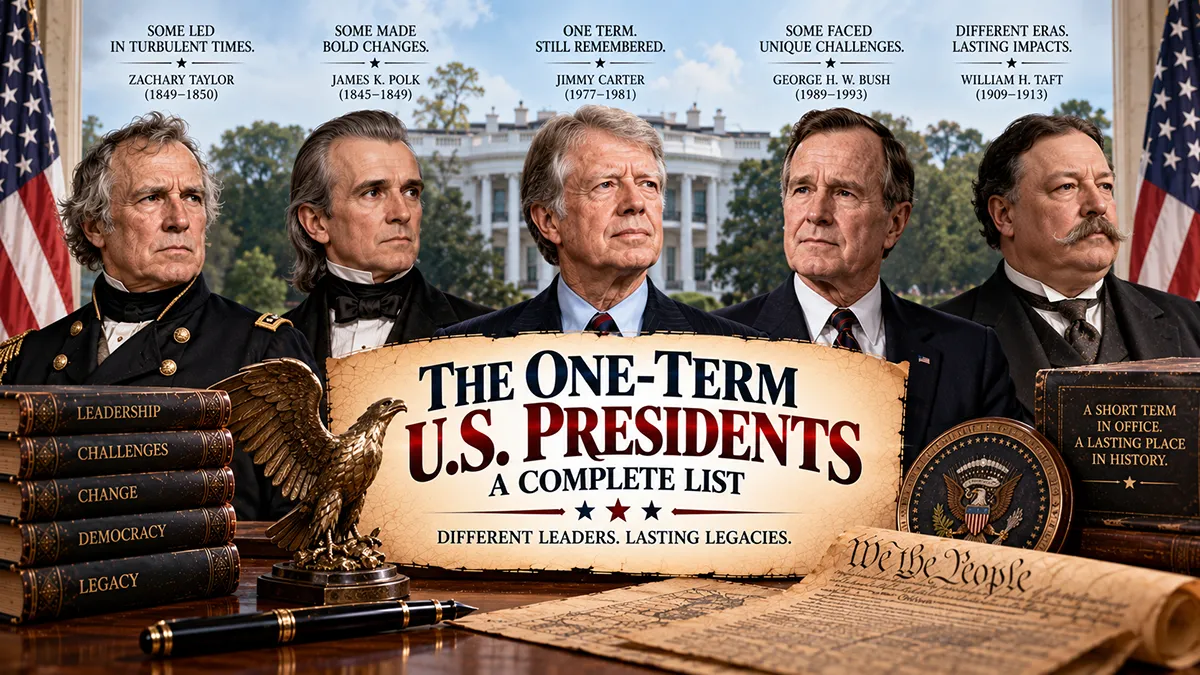
Not every occupant of the Oval Office got a second act. While two-term presidencies tend to dominate the history books, a surprisingly large number of American leaders packed their entire legacy into a single four-year term — or in a few cases, far less than that.
Some lost bruising reelection campaigns, some walked away by choice, and a few never even got the chance because they died in office.
If you’ve ever wondered how many U.S. presidents only served one term, you’re asking one of the most-searched questions in American political history.
This guide breaks down every single-term U.S. president, explains why their time in office was cut short, and clears up a few persistent myths — including the tricky cases of Grover Cleveland and Donald Trump.
TL;DR: Twenty-two of the 45 people who have served as U.S. president were one-term presidents, cut short by election defeats, personal choice, or death in office — and the reasons behind each case reveal a lot about American political history.
How Many U.S. Presidents Have Only Served One Term?
As of 2025, 45 different individuals have held the office of president (Donald Trump is counted twice, as the 45th and 47th president, since his two terms were non-consecutive). Of those 45 people, 22 served only one term in total — meaning they never won, or never got the chance to complete, a second term as president.
That’s essentially half of everyone who has ever held the job. It’s a useful number to keep in mind, because it pushes back against the assumption that most presidents comfortably serve eight years. In reality, a single presidential term has been the norm almost as often as two.
The reasons behind these one-and-done presidencies vary widely. Some presidents lost reelection outright, some declined to run again, some were pushed aside by their own political party, and a handful never lived to see a second term at all.
Why Do Some Presidents Only Get One Term?
One-term presidencies generally fall into four broad categories, and it’s worth understanding them before diving into the full list. The first and most common is straightforward electoral defeat — a sitting president runs for reelection and simply loses.
The second category is personal choice. A handful of presidents, including James K. Polk and Rutherford B. Hayes, publicly pledged to serve only one term before they were even elected, and then kept that promise.
The third category involves death in office. Four one-term presidents — William Henry Harrison, Zachary Taylor, James Garfield, and Warren Harding — died before they could complete their first term, let alone seek a second.
The fourth and final category is intra-party rejection. Presidents like John Tyler, Millard Fillmore, Franklin Pierce, and Chester Arthur all wanted to keep the job, but their own political party declined to renominate them for another run.
The Shortest-Serving Presidents
When people search for a “president short term,” they’re often really asking about the presidents whose time in office was cut dramatically short by death. William Henry Harrison holds the record here: he died just 31 days after his inauguration in 1841, making his the shortest presidency in American history.
James Garfield is a close second. He was shot by an assassin in July 1881, roughly four months into his term, and died from his wounds in September — a total of about 199 days in office.
Zachary Taylor served about 16 months before dying suddenly in July 1850, and Warren Harding served roughly two and a half years before his death in August 1923, widely attributed to a heart attack. It’s also worth noting that John F. Kennedy, though not typically labeled a “one-term president” since he was assassinated before ever facing reelection, likewise never got a second term — he served two years and ten months before his death in November 1963.
These short, unfinished presidencies are a somewhat different phenomenon from the classic one-term president who runs, loses, and moves on. Both groups, though, only ever got a single presidential term to work with.
The Full List of One-Term U.S. Presidents
Here is every U.S. president, in chronological order, who served only a single term — whether by defeat, by choice, or by fate.
1. John Adams (1797–1801)
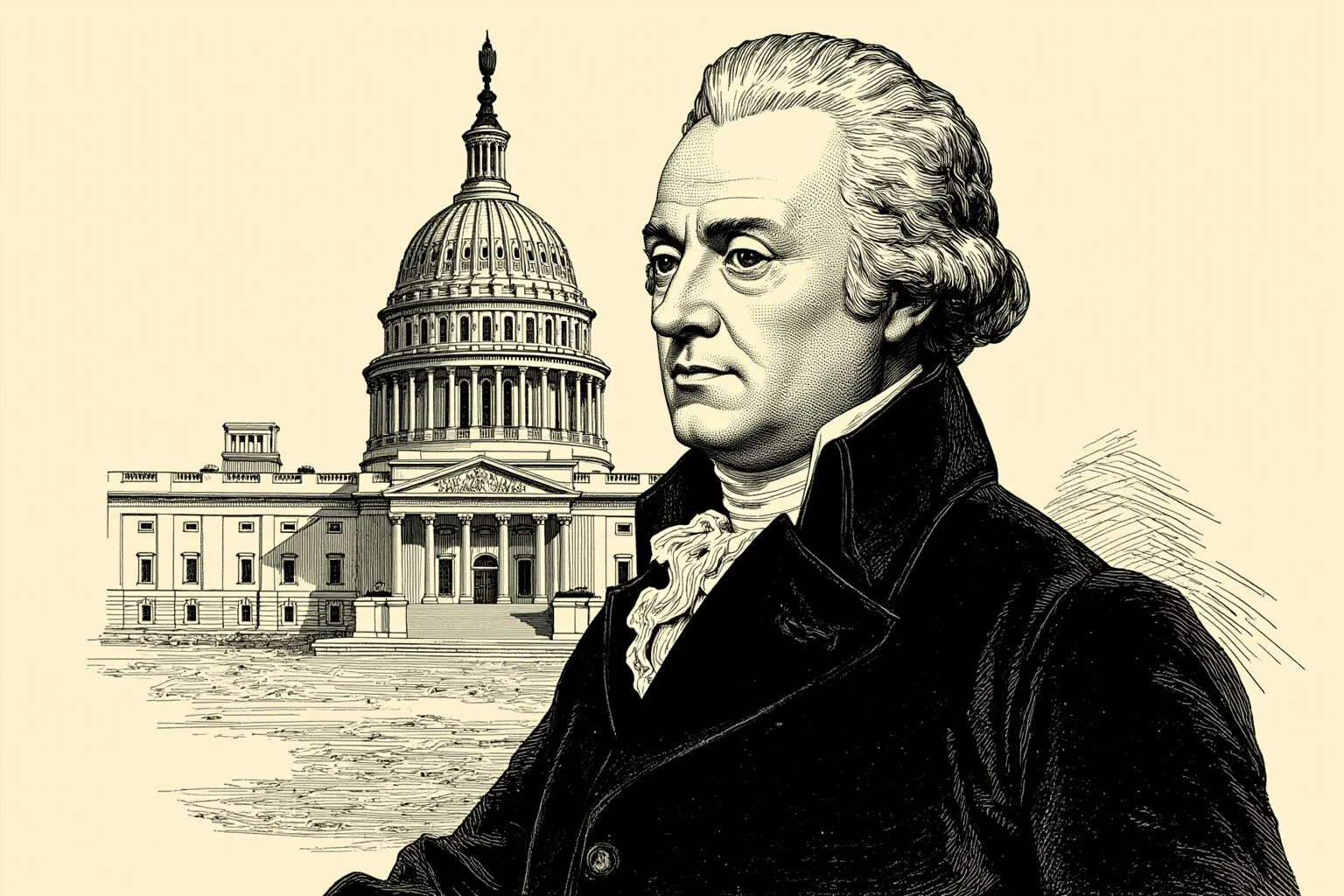
John Adams, a Federalist and Washington’s own vice president, became the second U.S. president in 1797. His single term was consumed by a bitter, undeclared naval conflict with France and deep partisan warfare at home over the Alien and Sedition Acts.
He narrowly lost the bitterly contested election of 1800 to Thomas Jefferson, his former friend turned political rival. Adams did manage one lasting legacy from his term: appointing John Marshall as Chief Justice, a decision that shaped the Supreme Court for decades.
2. John Quincy Adams (1825–1829)
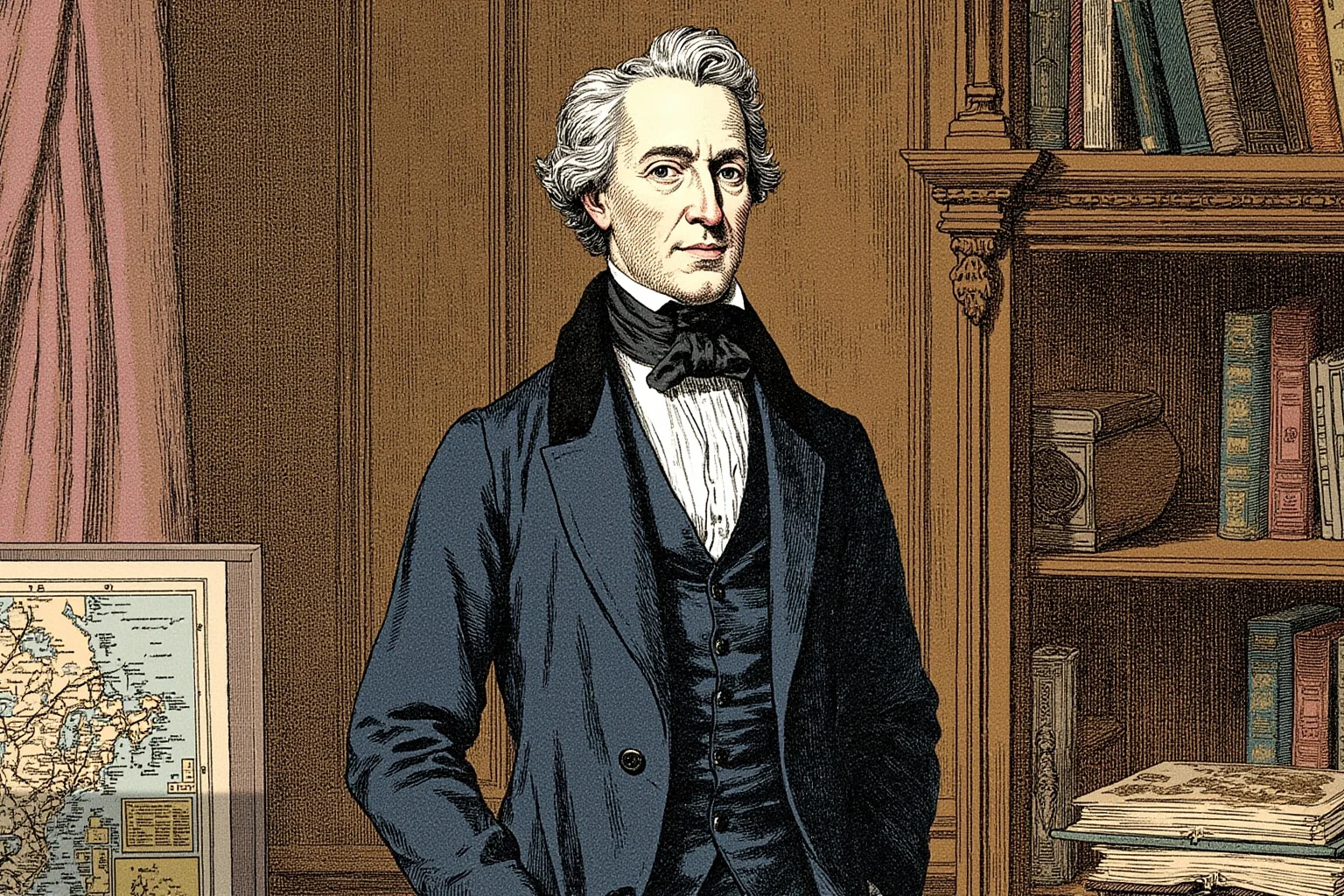
John Quincy Adams won the presidency in 1824 only after the election was thrown to the House of Representatives, since no candidate secured a majority of electoral votes. His opponents branded the outcome a “corrupt bargain,” and that cloud never fully lifted from his presidency.
He lost the 1828 rematch decisively to Andrew Jackson. Adams went on to a remarkable second act, serving nearly two decades in the House of Representatives after leaving the presidency.
3. Martin Van Buren (1837–1841)
Martin Van Buren, Andrew Jackson’s handpicked successor, took office just as the Panic of 1837 triggered a severe economic depression. His administration struggled to respond effectively, and the economic pain lingered throughout his term.
He lost the 1840 election to William Henry Harrison in the famous “log cabin” campaign, one of the first elections dominated by modern-style political imagery and slogans.
4. William Henry Harrison (1841)
William Henry Harrison, a Whig and celebrated military general, delivered the longest inaugural address in U.S. history in cold, wet weather in March 1841. He died just 31 days later, making his the shortest presidency ever recorded.
Historians long attributed his death to pneumonia contracted during that inauguration, though more recent research suggests it may have actually been typhoid fever linked to Washington’s contaminated water supply. Either way, he never had the chance to enact a single major policy.
5. John Tyler (1841–1845)
John Tyler became the first vice president to ascend to the presidency after a president’s death, taking office immediately after Harrison’s passing. His independent streak quickly alienated the Whig Party that had put him on the ticket, earning him the nickname “His Accidency.”
The Whigs refused to renominate him in 1844, and Tyler finished his term without a party base to run on. His most significant achievement came near the very end of his term: setting in motion the annexation of Texas.
6. James K. Polk (1845–1849)
James K. Polk campaigned in 1844 on an ambitious expansionist platform and publicly pledged to serve only a single term. He kept that promise, but not before overseeing one of the most consequential presidencies of the era.
Under Polk, the U.S. fought and won the Mexican-American War, settled the Oregon boundary dispute, and dramatically expanded the nation’s territory westward. He chose not to seek reelection and died just months after leaving office in 1849.
7. Zachary Taylor (1849–1850)
Zachary Taylor, a Whig and hero of the Mexican-American War, entered the presidency with little political experience. His term was cut short after roughly 16 months when he died suddenly of a severe gastrointestinal illness in July 1850.
His vice president, Millard Fillmore, stepped in to finish the term. Taylor’s brief presidency left little room for major legislative achievements of his own.
8. Millard Fillmore (1850–1853)
Millard Fillmore assumed the presidency after Taylor’s death and quickly signed the Compromise of 1850, a package of measures meant to ease growing tension between free and slave states. It included the controversial Fugitive Slave Act, which damaged his standing with many Northerners.
The deeply divided Whig Party declined to nominate him for a term of his own in 1852. Fillmore’s presidency is often cited as an example of how slavery-era compromises only delayed, rather than resolved, sectional conflict.
9. Franklin Pierce (1853–1857)
Franklin Pierce’s presidency was overshadowed almost immediately by the fallout from the Kansas-Nebraska Act, which reignited fierce national debate over slavery’s expansion. Personal tragedy also marked his term after the death of his young son shortly before his inauguration.
Pierce is often cited as the only elected U.S. president denied renomination by his own party, when Democrats turned to James Buchanan instead in 1856. His single term is generally regarded by historians as one of the era’s least successful.
10. James Buchanan (1857–1861)
James Buchanan took office in 1857 as sectional tensions over slavery were reaching a breaking point. His term ended with seven Southern states having already seceded from the Union, setting the stage for the Civil War.
Buchanan chose not to seek reelection in 1860, and he is frequently ranked by historians among the least effective U.S. presidents for his inability to address the secession crisis. He handed the unresolved conflict directly to his successor, Abraham Lincoln, one of the most recognized historical figures in American history.
11. Andrew Johnson (1865–1869)
Andrew Johnson, a Democrat who had run on Lincoln’s National Union ticket, became president after Lincoln’s assassination in April 1865. His clashes with Congress over Reconstruction policy were so severe that he became the first U.S. president to be impeached, though he survived his Senate trial by a single vote.
Johnson’s own party declined to nominate him for a full term in 1868. His presidency remains one of the most contentious in American history, largely due to his resistance to civil rights protections for newly freed Black Americans.
12. Rutherford B. Hayes (1877–1881)
Rutherford B. Hayes won one of the most disputed elections in American history in 1876, an outcome resolved only through a special congressional commission and the political deal known as the Compromise of 1877, which effectively ended Reconstruction. Hayes had pledged before the election to serve only a single term if elected.
He kept that promise and did not seek reelection in 1880. His presidency focused heavily on civil service reform and rebuilding trust in the federal government.
13. James A. Garfield (1881)
James Garfield’s presidency was tragically brief. He was shot by a disgruntled office-seeker in July 1881, only about four months after taking office, and died of complications in September, having served roughly 199 days total.
His assassination helped spur the civil service reforms his successor would later champion. Garfield’s term ranks among the shortest in American presidential history.
14. Chester A. Arthur (1881–1885)
Chester Arthur ascended to the presidency after Garfield’s assassination, and few expected much from a man closely tied to the old patronage-based political machine. He surprised critics by signing the Pendleton Civil Service Reform Act, a major step toward merit-based federal hiring.
Despite that record, Republicans declined to renominate him in 1884, and Arthur’s single term ended quietly. His reform legacy, however, outlasted his brief time in office.
15. Benjamin Harrison (1889–1893)
Benjamin Harrison, grandson of William Henry Harrison, served a single term marked by the Sherman Antitrust Act and the admission of six new states to the Union. His presidency also saw rising tension over tariffs and government spending.
He lost his 1892 reelection bid to Grover Cleveland, the very man he had defeated four years earlier — making Cleveland the only president in U.S. history to serve two non-consecutive terms, at least until 2025.
16. William Howard Taft (1909–1913)
William Howard Taft was handpicked by Theodore Roosevelt as his successor, but the two men soon split over policy direction. That rift led Roosevelt to run as a third-party candidate in 1912, dividing the Republican vote and handing the election to Woodrow Wilson.
Taft finished a distant third in that race. He later became Chief Justice of the Supreme Court, making him the only person in American history to lead both the executive and judicial branches.
17. Warren G. Harding (1921–1923)
Warren Harding won the presidency in 1920 on a promise to return the country to normalcy after World War I. He died suddenly in August 1923, believed to be from a heart attack, after roughly two and a half years in office.
His reputation suffered posthumously when the Teapot Dome bribery scandal came to light, implicating members of his administration. Harding never had the opportunity to seek, let alone win, a second term.
18. Herbert Hoover (1929–1933)
Herbert Hoover took office in March 1929, just months before the Wall Street Crash triggered the Great Depression. His administration’s response was widely seen by voters as too slow and too limited given the scale of the economic catastrophe.
He lost the 1932 election in a landslide to Franklin D. Roosevelt. Hoover’s single term remains closely associated in public memory with the depths of the Depression.
19. Gerald Ford (1974–1977)
Gerald Ford holds a unique place on this list: he is the only person to become president without ever being elected president or vice president by voters. He was appointed vice president after Spiro Agnew’s resignation, then ascended to the presidency when Richard Nixon resigned in 1974.
Ford’s controversial pardon of Nixon weighed heavily on his political standing. He lost narrowly to Jimmy Carter in 1976, the only time he ever ran for the presidency in his own right.
20. Jimmy Carter (1977–1981)
Jimmy Carter’s single term was shaped by an energy crisis, high inflation, and the prolonged Iran hostage crisis, all of which battered his approval ratings. He did notch a genuine diplomatic success with the Camp David Accords between Egypt and Israel.
Carter lost in a 1980 landslide to Ronald Reagan. He went on to one of the most active and respected post-presidencies in American history, including being awarded the Nobel Peace Prize in 2002.
21. George H. W. Bush (1989–1993)
George H. W. Bush presided over the peaceful end of the Cold War and led a broad international coalition to a decisive victory in the Gulf War. Domestically, though, he faced criticism after breaking his famous “no new taxes” pledge during budget negotiations.
He lost the 1992 election to Bill Clinton in a three-way race that also included independent candidate Ross Perot. His single term is often reassessed by historians as more consequential in foreign policy than it appeared at the time.
22. Joe Biden (2021–2025)
Joe Biden, the oldest person ever inaugurated president, led the country through the tail end of the COVID-19 pandemic and pushed through major infrastructure and climate legislation. His term also saw significant inflation and ongoing political polarization.
Biden withdrew from the 2024 presidential race after mounting pressure within his own party, ending his own bid for a second term before voters even went to the polls. He was succeeded by Donald Trump, who won a second, non-consecutive term in office.
Myth-Busting: Grover Cleveland, Donald Trump, and the “One-Term” Question
A lot of confusion around this topic centers on Grover Cleveland and, more recently, Donald Trump. Cleveland is famous for being the answer to the trivia question “has there ever been a single president who served two non-consecutive terms?” — and the answer, for over a century, was yes, just him.
Cleveland won the presidency in 1884, lost his 1888 reelection bid to Benjamin Harrison, then came back and won again in 1892. Because he served two separate terms in total, Cleveland is not counted as a one-term president, even though his two terms weren’t back-to-back.
Donald Trump followed a strikingly similar path more than a century later. He served one term from 2017 to 2021, lost his 2020 reelection bid, and then won a second, non-consecutive term beginning in 2025 — making him only the second president in American history, after Cleveland, to pull off that particular comeback.
Because of that return to office, Trump’s first term alone doesn’t make him a genuine one-term president in the traditional sense, even though it’s sometimes referenced that way in casual conversation. Historically accurate lists of single-term presidents, like this one, reflect a president’s complete record in office rather than any single stretch of it.
What One-Term Presidencies Tell Us About American History
Looking at this list as a whole, a few patterns stand out. Economic crises are a recurring theme — Van Buren, Hoover, and George H. W. Bush all struggled against downturns that voters ultimately blamed them for.
War and its aftermath show up repeatedly too, from the undeclared conflict with France under John Adams to the Gulf War under Bush. And several presidents, from Polk to Hayes to Biden, remind us that a short presidency isn’t automatically a failed one — sometimes it’s simply the term a leader chose to serve.
Whether cut short by the ballot box, by party politics, or by fate itself, these one-term presidents remain a permanent and revealing part of the American story. Their single terms, however brief, still shaped the country in ways that outlasted their time in office.
Frequently Asked Questions
How many single term presidents of the US have there been?
Of the 45 individuals who have served as U.S. president, 22 served only a single term in total. That includes presidents who lost reelection, chose not to run again, were denied renomination by their own party, or died in office before completing a full term.
Which US presidents only served one term because they lost reelection?
Presidents defeated in their reelection bids include John Adams, John Quincy Adams, Martin Van Buren, Benjamin Harrison, William Howard Taft, Herbert Hoover, Jimmy Carter, George H. W. Bush, and Gerald Ford (who lost his only run for the office in 1976).
Which presidents chose not to run for a second term?
James K. Polk and Rutherford B. Hayes both pledged before their elections to serve only one term and kept that promise. James Buchanan also declined to seek reelection, and Joe Biden withdrew from the 2024 race, ending his own bid for a second term.
Which presidents served only one term because they died in office?
William Henry Harrison, Zachary Taylor, James Garfield, and Warren Harding all died during their first term, never getting the chance to seek reelection. Harrison's 31-day presidency remains the shortest in U.S. history.
Is Grover Cleveland considered a one-term president?
No. Grover Cleveland served two separate, non-consecutive terms (1885–1889 and 1893–1897), making him the 22nd and 24th president. Because he served twice in total, he isn't classified as a one-term president, even though neither of his terms was immediately followed by another.
Is Donald Trump a one-term president?
Trump served one term from 2017 to 2021 after losing the 2020 election, but he won a second, non-consecutive term beginning in 2025. Like Grover Cleveland before him, his overall record of two separate terms means he isn't accurately described as a one-term president.
What is the shortest presidential term in US history?
William Henry Harrison served the shortest term, dying just 31 days after his 1841 inauguration. James Garfield's term was also extremely brief at about 199 days before his death from an assassin's wounds in 1881.

Alex Warren
Related Articles