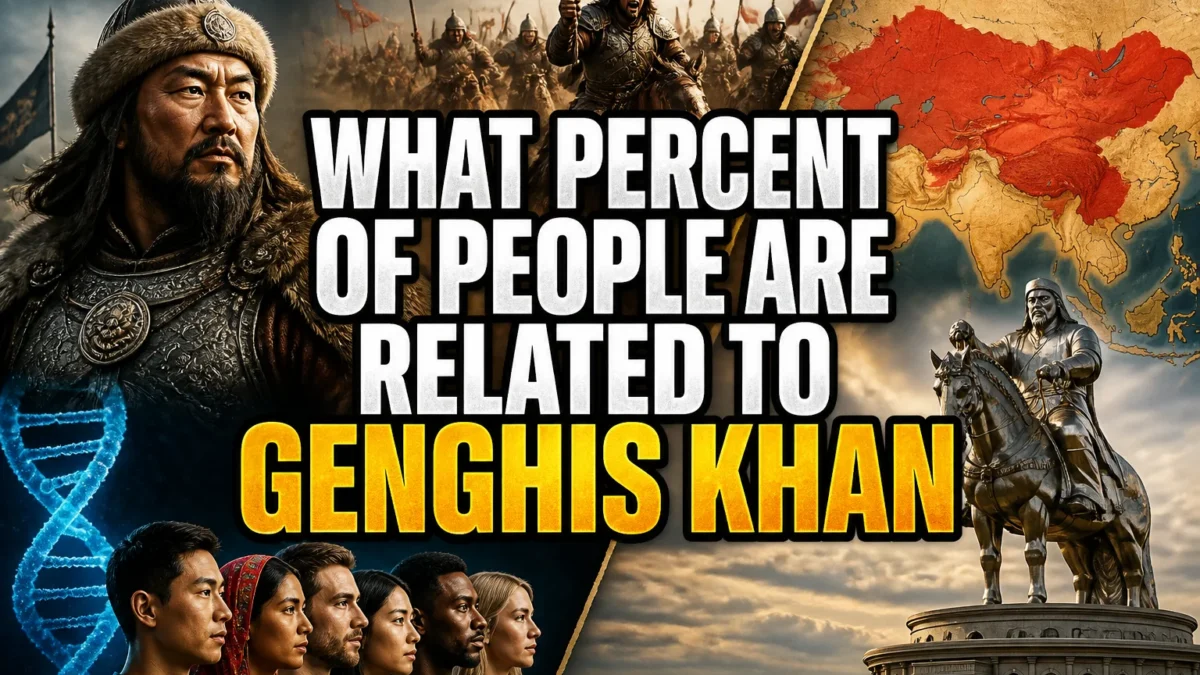
You’ve probably seen the claim: roughly one in every 200 men alive today carries a Y chromosome linked to Genghis Khan. It’s one of history’s most-shared “fun facts,” and one of the most frequently garbled.
So what percent of people are related to Genghis Khan, really? This post separates what geneticists actually found from what the internet added, and explains why your odds of descending from him may be higher than you’d guess, just not in the way the viral version suggests.
TL;DR: A real genetic lineage carried by about 0.5% of the world’s men (roughly 1 in 200) is often linked to Genghis Khan’s family, but it is a male-line statistic rather than proof that 0.5% of everyone descends from him, and the link to Genghis himself remains unproven.
What Percent of People Are Related to Genghis Khan? The Short Answer
The most-cited figure is about 0.5% of the world’s male population, or roughly 1 in 200 men. A 2003 genetic study put that at around 16 million men alive at the time.
That statistic comes from a Y-chromosome survey, so it counts only men who carry one particular paternal lineage. Women have no Y chromosome and were not counted. Spread across all of humanity, men and women together, the share of people carrying this lineage works out to roughly a quarter of one percent.
Here’s the catch that most headlines skip. Carrying that lineage is not the same thing as being related to Genghis Khan, and not carrying it doesn’t rule out descent from him. We’ll unpack both halves below.
Where the Genghis Khan DNA Statistic Actually Comes From
The number traces back to a 2003 paper titled “The Genetic Legacy of the Mongols,” published in the American Journal of Human Genetics. The research team, which included Tatiana Zerjal and Chris Tyler-Smith, analyzed Y chromosomes from more than 2,000 men across dozens of populations in Asia.
Y chromosomes pass from father to son almost unchanged, picking up only occasional small mutations. That makes them useful for tracing paternal lines, much like a surname that follows the male line.
The team noticed something unusual. One cluster of closely related Y-chromosome types appeared in about 8% of the men sampled across a huge region stretching from the Pacific coast of Asia to the Caspian Sea. Geneticists call this pattern a “star cluster,” because many slightly different variants radiate out from one founding type, like rays from a star.
A star cluster is a signature of rapid expansion. It suggests a single male ancestor whose sons, and their sons, had far more surviving children than average.
Using mutation rates, the researchers estimated that the founder lived in Mongolia roughly a thousand years ago, give or take several centuries. That timing and geography matched the rise of the Mongol Empire in the thirteenth century, so the authors suggested the lineage might be tied to Genghis Khan or his close male relatives. Note the careful wording: it was a hypothesis, not a proof.
How Much of the Population Is Related to Genghis Khan? Breaking Down the Numbers
The percentages get mixed up constantly, so let’s sort them out. The roughly 8% figure applies to men in a specific region of Asia, not to the world.
The 0.5% figure applies to men worldwide, and it is an extrapolation from the groups that were sampled. Estimates like this carry real uncertainty, because they depend on how well those samples represent everyone else.
The quarter-of-one-percent figure for all people is simple arithmetic. Since about half of humans are men, a lineage carried by 0.5% of men is carried by about 0.25% of all people. Applied to a population of around eight billion, that suggests on the order of 20 million carriers today, though that is a back-of-the-envelope estimate rather than a measured count.
Frequencies also vary sharply by place. The lineage is far more common among men in Mongolia and Central Asia than elsewhere, and in some groups, such as the Hazara of Pakistan, a sizeable minority of men carried it in the original sample. Outside Asia it appears only rarely.
So if you’re asking what percentage of the population is related to Genghis Khan through this lineage, the answer runs from nearly zero in many parts of the world to several percent or more in parts of Central Asia. The global average hides enormous regional differences.
How Many People Did Genghis Khan Have? Wives, Children, and Dynasties
If you’re wondering how many children Genghis Khan had, the honest answer is that nobody knows. The surviving sources name some of them, but they are incomplete, were written decades after the events, and focus on the sons who mattered politically.
His first wife, Börte, bore the four sons who dominate the history books: Jochi, Chagatai, Ögedei, and Tolui. Mongol and Persian accounts also mention daughters and other wives, including Khulan and the Tatar sisters Yesui and Yesugen. The Persian chronicler Rashid al-Din, writing under Mongol rule in the early fourteenth century, describes a large household of wives and consorts.
Claims that Genghis personally fathered hundreds or thousands of children are not documented in reliable sources. They are inferences drawn from the genetic data, not entries in any historical record.
The more plausible explanation is dynastic. Genghis’s sons and grandsons, rulers such as Batu, Hulagu, Möngke, and Kublai, commanded vast territories, large households, and enormous prestige. Marco Polo reportedly credited Kublai with 22 sons by his wives, though Polo’s account has its own reliability problems.
Descendants of Genghis, often called the Golden Family, held power for centuries. They ruled the Yuan dynasty in China until 1368, the Golden Horde across the western steppe, the Ilkhanate in Persia, and the Chagatai Khanate in Central Asia. Genghisid khans still reigned in Crimea until Russia annexed the khanate in 1783.
High status meant many wives, and the sons of powerful men were more likely to survive and have large families of their own. Historians also generally acknowledge that conquest brought coerced relationships, as it did in most medieval warfare. Combined over many generations, elite polygyny and political success can turn one male line into millions.
Is the Lineage Really Genghis Khan’s? What We Still Can’t Prove
This is the part the viral version leaves out. Nobody has identified Genghis Khan’s own Y chromosome, because his burial place has never been confirmed. Medieval sources say the burial was kept secret, and searches for the tomb continue.
Without his remains, or those of a verified male-line relative from his era, scientists cannot make a direct match. The link is circumstantial: right region, right period, and the right kind of expansion pattern.
The founder of the star cluster could just as easily be a paternal ancestor of Genghis. Mongol tradition traces the Borjigin clan back through earlier figures such as Khabul Khan, and every male-line descendant of those men would share the same Y chromosome. Dating margins are also wide, often spanning centuries, so the founder could predate Genghis by a good stretch.
Then there’s the Jochi question. Börte had been captured by the Merkits not long before Jochi was born, and Mongol sources show that his paternity was questioned, including by his brother Chagatai. Genghis is reported to have accepted Jochi as his son, and historians generally treat the matter as unresolved.
If Jochi were not Genghis’s biological son, his many male-line descendants, including rulers of the Golden Horde, would carry a different Y chromosome. That’s one reason the genetics can’t be read as a simple family tree of Genghis’s heirs.
Later studies of Central Asian populations, including work on Kazakh clans, have raised the possibility that the cluster’s history is older or more complicated than first thought. Science here is still evolving, so treat any confident “Genghis Khan gene” label with caution.
Genetic vs. Genealogical Descent: Why Your Chance of Relation May Be Higher Than You Think
Here’s where the “more likely than you realized” part becomes interesting. Y-chromosome carriers are only a thin slice of the people who might descend from Genghis Khan.
The Y chromosome follows a single path through your family tree: father to father to father. Go back 27 to 32 generations, roughly 800 years, and you have well over a hundred million ancestor slots on paper. The Y line occupies exactly one of them.
Of course, you can’t have more distinct ancestors than there were people alive. The world’s population around 1200 was only a few hundred million, so family trees overlap heavily, a phenomenon sometimes called pedigree collapse.
That overlap has a surprising consequence. A 2004 study by Rohde, Olson, and Chang in the journal Nature modeled recent common ancestry and concluded that the most recent common ancestor of everyone alive today may have lived only a few thousand years ago. Go back a little further, and in their model every person with living descendants is an ancestor of everyone alive.
Real populations mix less freely than models assume, because geography and culture create barriers. Still, a 2013 study by Peter Ralph and Graham Coop found that people across Europe share many common ancestors within just the past thousand years. The same logic applies across Eurasia, where Mongol rule linked distant regions.
Genghis Khan lived about 800 years ago, and his descendants spread across a huge part of Eurasia. It is therefore statistically plausible that a significant share of people in the region, and perhaps beyond, have him somewhere in their family tree. That is a reasoned possibility, not a measured result, and no one has published a reliable percentage.
There is one more twist. Having an ancestor is not the same as carrying their DNA. Because of how recombination shuffles genes, you inherit DNA from only a fraction of your genealogical ancestors, and beyond roughly ten generations most of them contributed nothing to your genome.
So even if Genghis Khan is in your family tree, you probably carry none of his DNA, except possibly through the Y chromosome for men on an unbroken paternal line. “Genghis Khan blood” is a figure of speech, not a biological category.
Genghis Isn’t the Only “Super-Ancestor” in the Data
Genghis Khan, one of the most recognized historical figures of all time, is the most famous example of a Y-chromosome star cluster, but he isn’t the only one. A 2006 study reported a lineage associated with Niall of the Nine Hostages, a semi-legendary Irish king, found in roughly one in five men in northwest Ireland. That attribution is also debated, and the lineage may belong to a wider dynastic family.
Another example comes from northern China. A 2005 study traced a lineage carried by an estimated 1.5 million men to a founder who lived several centuries ago, possibly connected to the Aisin Gioro, the Qing dynasty’s imperial clan.
The pattern repeats because the cause is social, not biological. Powerful men in many societies had multiple wives and more surviving children, and their sons inherited status and often did the same. Over centuries, that snowballs into a lineage far larger than ordinary families produce.
This context helps keep the Genghis story in proportion. His lineage is remarkable mainly because of the scale of the empire, built by one of the greatest military leaders in history, that carried it across a continent.
Myths About Genghis Khan’s DNA, Busted
Myth: 0.5% of everyone is related to him. The 0.5% figure refers to men carrying a specific paternal lineage, and the share of all people is closer to 0.25%. It is also not the percentage of Genghis Khan descendants, because it only captures those with an unbroken father-to-son line, so it both undercounts true descendants and may include men who descend from a shared ancestor rather than from Genghis himself.
Myth: Genghis personally fathered 16 million people. The 16 million figure describes men alive in the early 2000s who carry the lineage, after roughly eight centuries of descendants having descendants. Nothing in the historical record suggests he fathered anything close to that number himself.
Myth: A DNA test can confirm it. Consumer tests can report your Y-chromosome haplogroup, and the broad group that contains the star cluster, often called C2 or C-M217, is common across Mongolia and Central Asia. Being in that group doesn’t mean you belong to the star cluster, and even the cluster can’t be tied to Genghis by DNA alone.
Myth: Everyone in Asia has Genghis blood. About 8% of men in the sampled region carried the lineage, which is significant but nowhere near universal. Many Asian populations show it rarely or not at all.
Myth: The spread was purely about violence. Conquest-era coercion was real, but so were legitimate marriages, political alliances, and the simple advantages of belonging to a ruling family. Historians and geneticists generally point to a mix of these factors rather than a single cause.
So What Are Your Chances? A Practical Take
If you’re a man with Mongolian or Central Asian paternal ancestry, your odds of carrying the star-cluster lineage are meaningfully higher than average, though still far from certain. A detailed Y-chromosome test can tell you whether you fall into the broader haplogroup, and specialist analysis can look for the finer cluster. Women can learn about this line only by testing a father, brother, or other paternal relative.
Some communities also keep their own records. In Kazakh tradition, families known as the “white bone” claim descent from Genghis Khan and have long preserved genealogies. Such records are valuable cultural history, though like all medieval genealogies they deserve careful scrutiny.
For everyone else, the chance of relation to Genghis Khan is real but unquantifiable. Population-genetics logic says a notable portion of Eurasians may share him as an ancestor, yet no test can show it, and for most people it would not mean inheriting any of his DNA.
The Bottom Line on Genghis Khan’s Descendants
The famous number is real, but it is narrower than the headlines suggest. About 0.5% of the world’s men carry a Y-chromosome lineage whose age and spread fit the Mongol Empire, and the leading hypothesis ties it to Genghis Khan’s family. Whether it traces to the great khan himself is still unproven.
The bigger takeaway may be the broader one. Over eight centuries, family trees spread and tangle in ways that make “distant royal ancestor” far less exotic than it sounds. You may well be related to Genghis Khan, you just can’t prove it, and neither can anyone else.
Frequently Asked Questions
What percent of people are related to Genghis Khan?
The most-cited statistic is that about 0.5% of the world’s men, roughly 1 in 200, carry a Y-chromosome lineage linked to the Mongol era and often associated with Genghis Khan’s family. Because only men were counted, the share of all people carrying it is closer to 0.25%. The actual share who descend from him in the genealogical sense is probably higher, but no one has measured it.
How many people have Genghis Khan blood?
A 2003 study estimated about 16 million men carried the lineage at the time, and applying the same proportion to today’s population suggests roughly 20 million. Those are rough estimates, and the link to Genghis himself is a hypothesis rather than a proven fact. “Blood” is also a figure of speech, since descent doesn’t guarantee you carry any of his DNA.
What percentage of the world is descended from Genghis Khan?
No reliable figure exists. The 0.25% to 0.5% numbers refer only to carriers of one paternal DNA lineage, not to all descendants. Population-genetics models suggest many more people could have him somewhere in their family tree, but that can’t be tested or turned into a precise percentage.
How many children did Genghis Khan have?
Nobody knows for certain. Sources name four sons with his first wife Börte, plus daughters and children by other wives, but the records are incomplete. Claims of hundreds or thousands of children are inferences from genetic data, not documented history.
Can a DNA test show I’m related to Genghis Khan?
Not definitively. A Y-chromosome test can place a man in a haplogroup common in Mongolia and Central Asia, and specialized analysis might identify the star-cluster lineage. Even then, Genghis Khan’s own DNA has never been identified, so the connection remains a well-supported hypothesis rather than a confirmed match.
Is the Genghis Khan DNA lineage found outside Asia?
It is concentrated in Mongolia and Central Asia and extends across a wide region of Asia, with frequencies varying greatly by population. Outside Asia it is rare. Movements of people over the centuries mean it can turn up elsewhere at low frequencies.

Alex Warren
Related Articles