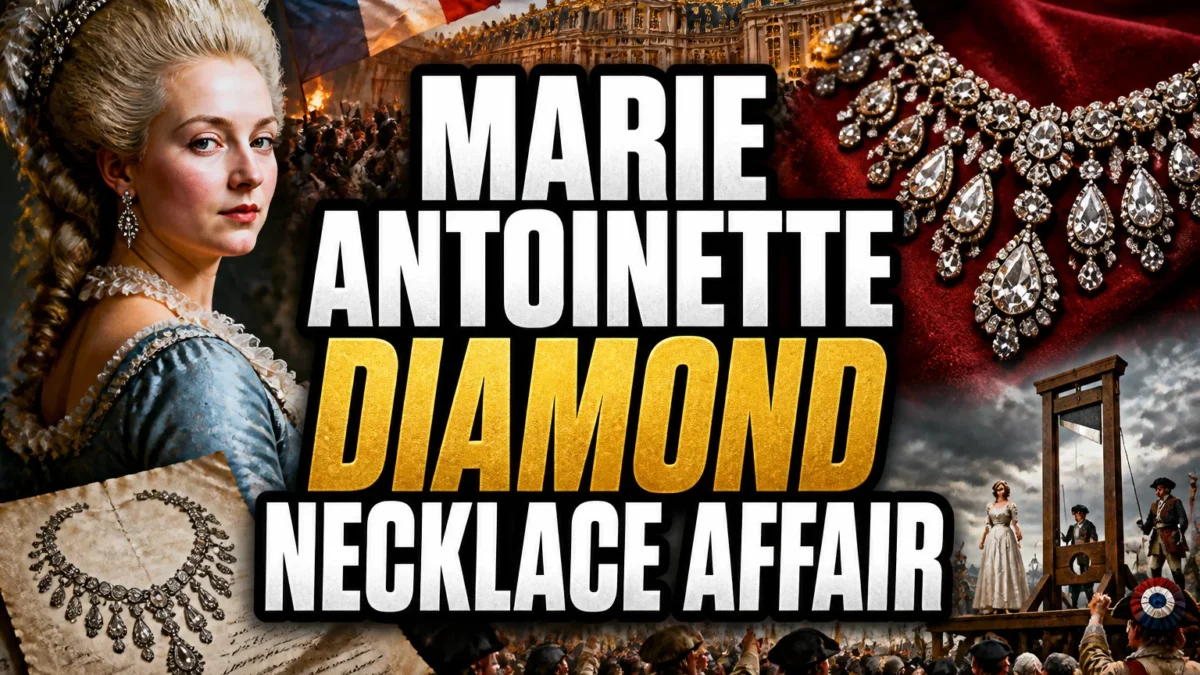
Few jewels in history have caused as much trouble as one that never touched the neck it was made for. The affair of the diamond necklace turned a dazzling piece of jewelry, an ambitious cardinal, and a talented con artist into one of the most talked-about scandals of eighteenth-century France. At the center of it stood a queen who, by nearly every serious account, had no idea it was happening.
Today the Marie Antoinette necklace story is often told as a simple tale of royal greed. The reality is stranger and more interesting. Let's untangle what is documented, what is disputed, and what later writers added to the legend.
TL;DR: The diamond necklace scandal was a con run by Jeanne de La Motte that fooled Cardinal de Rohan, and although Marie Antoinette was almost certainly innocent, the affair badly damaged her public image in the years before the Revolution.
What Was the Affair of the Diamond Necklace?
The affair of the diamond necklace, also called the diamond necklace affair, the necklace affair, or the Queen's Necklace affair, was a fraud scandal that played out in Paris and Versailles between 1784 and 1786. A small circle of swindlers used forged letters and a staged nighttime meeting to convince Cardinal Louis de Rohan that Marie Antoinette secretly wanted a spectacular diamond necklace. They told him she needed his help to buy it on credit without the king knowing.
The jewelers were never paid, the necklace disappeared, and the cardinal was arrested in front of the entire court. When the case went to trial, the proceedings put the queen's name at the center of a very public mess.
The most important fact to hold onto is this: Marie Antoinette never ordered, received, or wore the necklace. She was impersonated, and her name and handwriting were forged. Yet the diamond necklace scandal Marie Antoinette is remembered for did lasting harm to her reputation anyway.
The Setting of the Diamond Necklace: A Jewel Nobody Could Afford
To understand the scam, start with the jewel itself. The necklace was created by the Parisian court jewelers Charles Auguste Böhmer and Paul Bassenge. According to the traditional account, they assembled it over years, hoping to sell it to Louis XV as a gift for his favorite, Madame du Barry.
The design was less a single strand than a cascade. Accounts describe several rows of large diamonds, with festoons, pendants, and tassels hanging from them. The commonly cited figures are about 647 diamonds weighing roughly 2,800 carats, with a price of around 1.6 million livres, though sources vary slightly.
Then Louis XV died in 1774, and the sale collapsed. Böhmer and Bassenge were left holding an enormous piece of unsold inventory, reportedly purchased on credit. They spent years trying to find a royal buyer, and their desperation is the first essential piece of the setting of the diamond necklace story.
The wider setting mattered just as much. France in the 1780s was financially strained, partly by the costs of supporting the American Revolution. A jewel priced like a small fleet of ships was not just expensive; it was politically radioactive.
Marie Antoinette and the Diamond Necklace: Did She Want It?
By the usual account, Böhmer pitched the necklace to the new king and queen after Louis XVI took the throne. One widely repeated story says Louis XVI offered to buy it for his wife and that she refused, saying the money would be better spent on a warship. This anecdote comes largely from memoirs written later, notably those associated with Madame Campan, so it is best treated as a plausible tradition rather than a certified quotation.
What we can say is that Marie Antoinette did buy jewelry, including from Böhmer, which helps explain why the jewelers kept hoping she might want the necklace. We can also say that no credible evidence shows she ever commissioned or agreed to buy this one. Historians have generally concluded that she had no part in the scheme.
Her reputation, however, had a head start in the wrong direction. By the mid-1780s, scandal sheets and pamphlets already portrayed her as frivolous, spendthrift, and politically meddling. When a story surfaced that the queen had secretly bargained for a million-livre necklace, many readers were primed to believe it.
The Cardinal Who Wanted Back In
The target of the con was Louis de Rohan, a prince-cardinal from one of France's most powerful families. He was Bishop of Strasbourg and Grand Almoner of France, and earlier he had served as ambassador to Vienna from 1772 to 1774. The posting had gone badly.
Maria Theresa, Marie Antoinette's mother, disliked Rohan and thought poorly of his conduct in Vienna. Marie Antoinette absorbed that hostility, and after he returned she famously kept him at a distance, declining to speak to him in public. For a man who craved political influence, that coldness was a wound.
That made him vulnerable. A man desperate to win back the queen's favor would be eager to believe she secretly wished to forgive him. Historians still debate whether Rohan was simply foolish, deeply gullible, or ambitious enough to ignore warning signs.
Jeanne de La Motte: The Schemer at the Center
The mind behind the plot was Jeanne de Saint-Rémy de Valois, known as the Comtesse de La Motte. Born in 1756 into poverty, she claimed descent from an illegitimate branch of the Valois kings. That pedigree earned her a small royal pension and a toehold in court circles, though never real wealth.
She married Nicolas de La Motte, a gendarme who styled himself a count, and the couple moved around the edges of Versailles looking for patrons. By 1784 Jeanne had become acquainted with Rohan. She hinted that she was a trusted confidante of the queen and could carry messages in both directions.
There is no solid evidence that Marie Antoinette ever received Jeanne as an intimate. The entire arrangement rested on Rohan's willingness to believe what she told him. Jeanne supplied letters, supposedly from the queen, and Rohan answered with eager devotion.
The Grove of Venus: A Midnight Impersonation
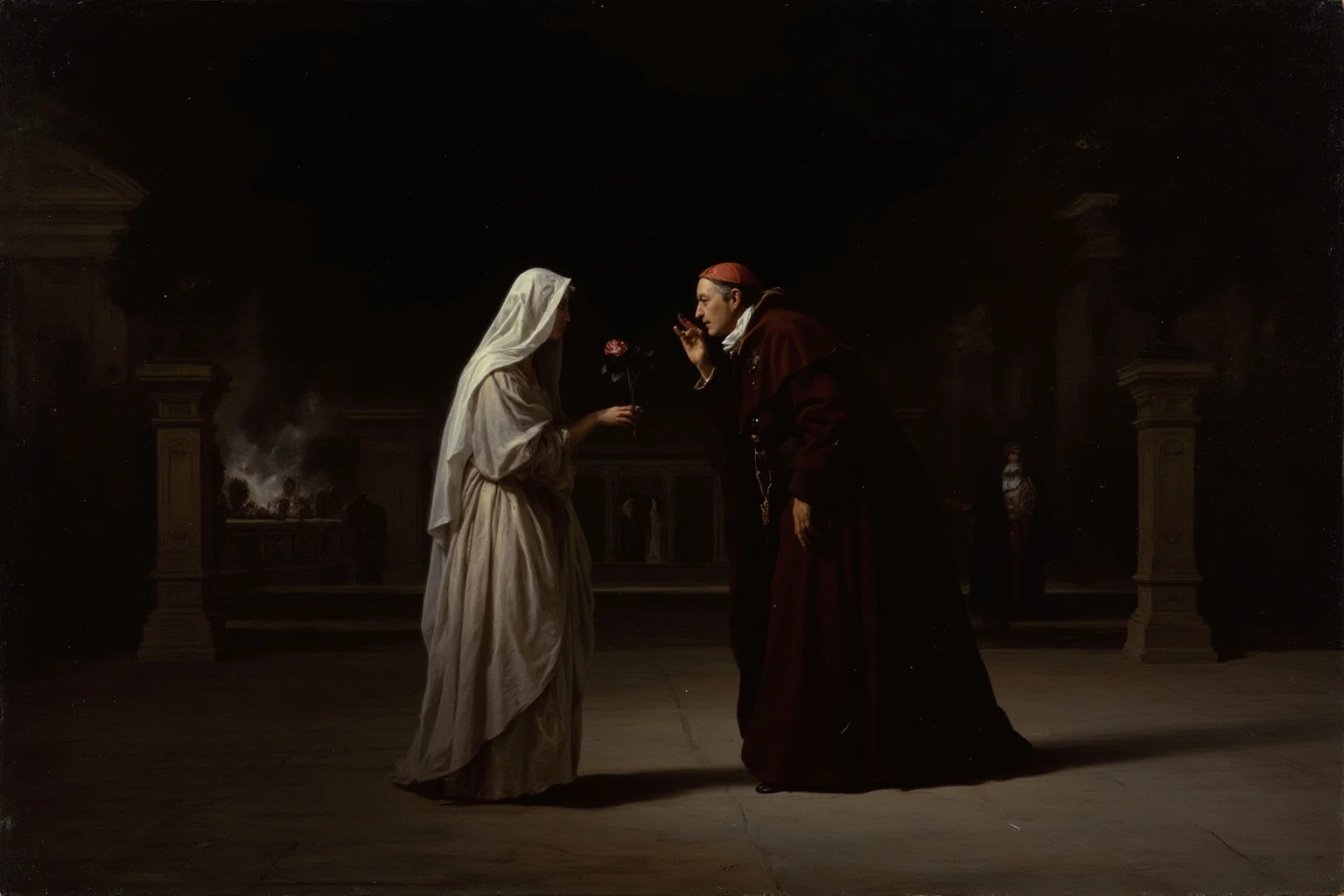
The boldest moment of the scheme came on a summer night in August 1784. Rohan was told the queen would meet him briefly in the gardens of Versailles, in a shaded spot known as the Grove of Venus. The woman he met was Nicole Leguay, later called the Baroness d'Oliva, who reportedly resembled the queen enough to pass in the dark.
The meeting was short and carefully managed. Nicole handed him a rose and spoke only a few words suggesting the past could be forgotten. Then, according to the standard account, approaching voices interrupted and the party hurried away.
That was all Rohan needed. He left convinced that the queen had privately forgiven him, and from that point he trusted Jeanne's messages almost completely. Everything afterward, including the necklace, grew from that single staged encounter.
The Forged Contract and the Handover
In early 1785, Jeanne told Rohan that the queen wished to acquire the diamond necklace but could not openly pay for it. She said Marie Antoinette wanted the cardinal to negotiate as her secret intermediary, with payment in installments. Rohan met with the jewelers and agreed to the terms.
The contract carried marginal approvals supposedly in the queen's hand. The signature read "Marie Antoinette de France," a form a queen would not normally use. The forgery was the work of an associate, Rétaux de Vilette, and Louis XVI is reported to have noticed the error when the documents were later examined.
On February 1, 1785, the necklace was handed over. Rohan delivered it to a man at Jeanne's residence in Versailles who was posing as a messenger from the queen. The jewels were soon taken apart, and Nicolas de La Motte is said to have sold stones in London.
The Unraveling: An Arrest in the Hall of Mirrors
The first installment was due in August 1785, and the con began to fray. Rohan could not pay, and a forged note urging the jewelers to wait did not hold up for long. Böhmer grew anxious and eventually approached the queen's household. The queen reportedly responded with bewilderment, since she knew nothing about the purchase.
On August 15, 1785, the feast of the Assumption, Rohan was summoned to the king's study while dressed in his full pontifical robes. He was questioned by Louis XVI and Marie Antoinette, and shortly afterward he was arrested at Versailles in front of the assembled court. He was taken to the Bastille.
The arrest was dramatic, but historians often view it as a miscalculation. Humiliating a cardinal of the Rohan family in public made him a figure of sympathy. It also turned a private fraud into a public contest between the crown and the aristocracy.
Jeanne was arrested a few days later, and others in the circle were swept up as well. These included the famous occultist Cagliostro, who had been a friend of the cardinal. Investigators began piecing together the forged letters, the false messenger, and the midnight meeting.
The Trial That Embarrassed the Crown
Rohan asked to be tried by the Parlement of Paris rather than by the king's own justice. The decision turned the case into a spectacle. Legal briefs known as mémoires judiciaires circulated widely and sold in large numbers, giving the public a detailed, gossipy view of life among the elite.
The verdict came on May 31, 1786. Rohan was acquitted, as were Cagliostro and Nicole Leguay. Jeanne was sentenced to be whipped, branded with a V (for voleuse, thief), and imprisoned for life in the Salpêtrière. Nicolas de La Motte, who had fled to England, was sentenced in absentia to the galleys. Rétaux de Vilette was banished.
Much of Paris reportedly celebrated Rohan's acquittal. To many, it looked like a rebuke of the crown. Louis XVI nevertheless stripped the cardinal of his office and exiled him to an abbey, which further cemented the view that the king had overreached.
Aftermath: Branding, Escape, and Pamphlets
Jeanne's punishment was carried out in June 1786. Accounts say she struggled violently, and that the brand did not land as intended. Whatever the specifics, her sentence became its own sensation.
In 1787 she escaped from the Salpêtrière and made her way to England. There she published memoirs that painted herself as a victim and blamed the queen, spinning lurid insinuations. Those claims, including the suggestion of an intimate relationship with Marie Antoinette, have no credible evidence behind them and are widely regarded as self-serving fabrication.
Jeanne died in London in 1791 after a fall from a window, reportedly while trying to evade creditors. Rohan eventually left France and died in 1803 in the German territory of Baden. The jewelers Böhmer and Bassenge were financially ruined.
Why the Diamond Necklace Scandal Hurt Marie Antoinette
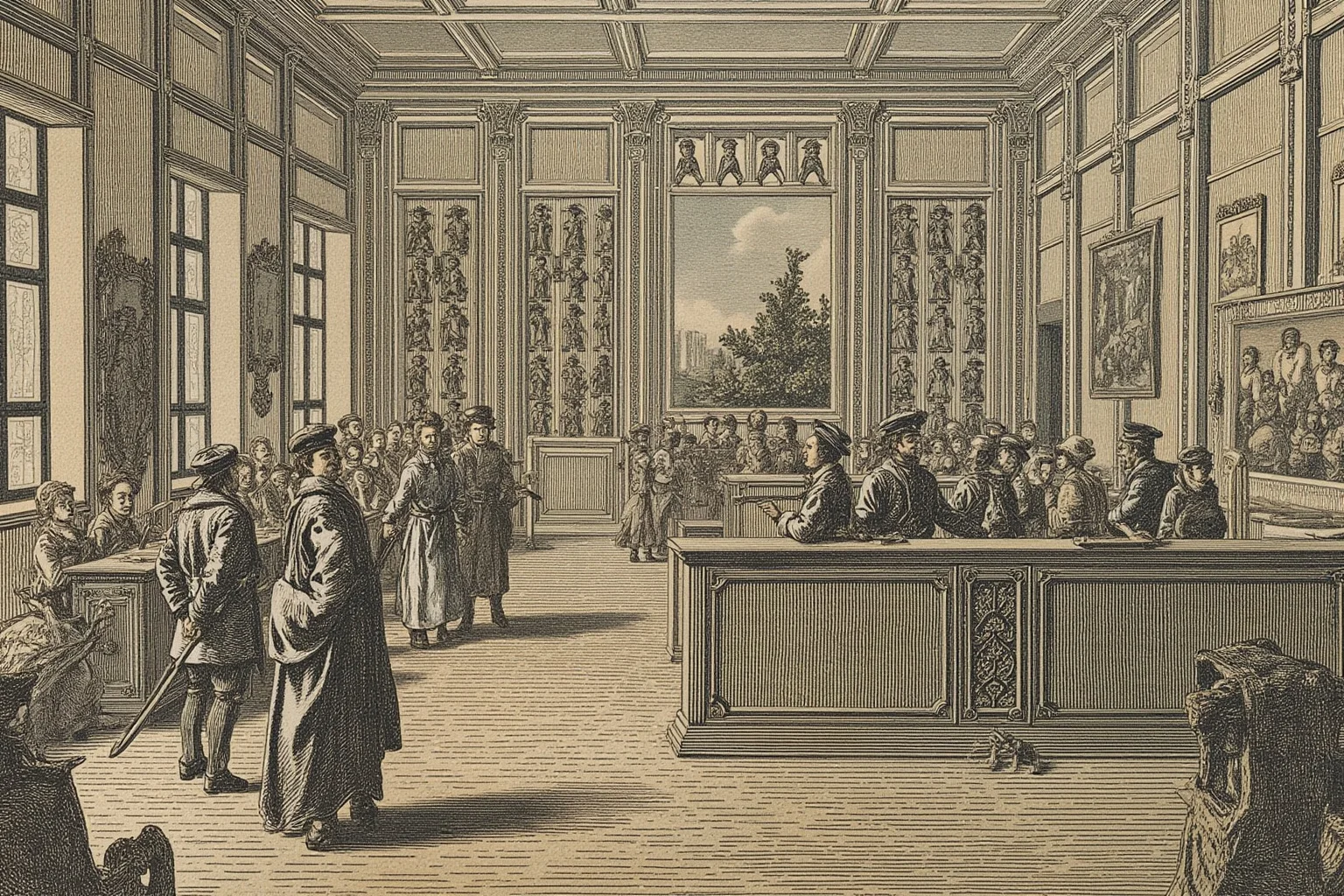
The uncomfortable truth is that the queen was innocent and still lost. The trial established, in a public forum, that a prince-cardinal could believe Marie Antoinette would meet him secretly at night and arrange an off-the-books jewel purchase. Even an acquittal for Rohan suggested to many readers that the story was plausible.
The affair also fed an existing market for hostile pamphlets. Writers had been mocking the queen for years, and now they had a real scandal to build on. The cartoonish image of an extravagant queen grew heavier even though the actual facts pointed the other way.
There was a second cost. The case exposed how little the public trusted the royal court, and how readily the nobility rallied around one of its own against the throne. Louis XVI's handling of the arrest made the monarchy look both heavy-handed and ineffective.
Did the Necklace Affair Cause the French Revolution?
You will sometimes read that the diamond necklace affair caused the Revolution. Thomas Carlyle gave the story a vivid retelling in the nineteenth century, and Napoleon is often credited with saying something similar, though such attributions are best handled with caution. Goethe, too, is reported to have seen the affair as an ominous sign.
Most historians would put it differently. The Revolution grew out of deep financial crisis, political conflict over taxation and representation, social tensions, and Enlightenment ideas. The necklace scandal did not cause any of those things.
What it did was erode the prestige of the monarchy at a vulnerable moment. It was a symptom and an accelerant rather than a root cause. By 1789 the Estates-General was meeting, and by 1793 both Louis XVI and Marie Antoinette had been executed.
Myth-Busting the Marie Antoinette Diamond Necklace Story
Myth: Marie Antoinette ordered the necklace
No reliable evidence supports this. The documents were forged, the meeting in the grove was staged, and the queen's alleged handwriting came from a forger. The scandal depended on her name, not her participation.
Myth: She secretly had a relationship with Cardinal de Rohan
This rumor circulated in pamphlets, but nothing credible backs it up. The cardinal was in disfavor, and historians generally agree that the queen disliked him. The "relationship" was part of the con, not a real event.
Myth: The Queen's Necklace still exists
The necklace was dismantled soon after it was taken, and its stones were sold off. There is no surviving intact original to see in a museum. Replicas and later fictional versions are another matter entirely.
Myth: The scandal is where "Let them eat cake" comes from
There is no evidence that Marie Antoinette said it. A similar line appears in Rousseau's Confessions, written when she was a child, and it is attributed there to an unnamed "great princess." It is a separate legend that tends to get tangled together with the necklace story.
What Happened to the Necklace and Marie Antoinette's Real Diamonds?
The stones from the Queen's Necklace were scattered, and the jewelers never recovered their loss. Pieces were reportedly sold in London, and the trail disappears into the broader diamond market. No complete reconstruction of the original has ever been proven.
Marie Antoinette did own genuine jewels, and some have an authenticated history. Before the royal family's attempted flight in 1791, she arranged for a number of her jewels to be sent out of France. Some later passed through royal family collections, and in 2018 a pearl and diamond pendant associated with her sold at auction for a very large sum.
That means a Marie Antoinette diamond can be a real object, but it is almost never the necklace from the scandal. If you see a piece marketed as "the" diamond necklace of Marie Antoinette, treat it with healthy skepticism.
The Lasting Lesson of the Necklace Affair
The conflict of the necklace, as some retellings call it, is partly a story about fraud and partly a story about perception. A small group of schemers exploited a lonely cardinal and a famous queen's name. The consequences spread far beyond the people who committed the crime, much as a later French scandal, the Dreyfus Affair, would split the country over a false accusation.
It is also a reminder to separate documented history from a good story. The records show a forged contract, a staged meeting, and a trial that embarrassed the crown. They do not show a queen secretly plotting for diamonds.
The affair of the diamond necklace endures because it combines glamor, deception, and historical timing. Marie Antoinette never wore the necklace, but its shadow followed her all the way to the scaffold in 1793.
Frequently Asked Questions
What was the affair of diamond necklace?
The affair of the diamond necklace was a fraud scandal in France between 1784 and 1786. Jeanne de La Motte and her associates tricked Cardinal Louis de Rohan into buying an extremely expensive diamond necklace on credit, using forged letters and a staged meeting to convince him he was acting for Marie Antoinette. The jewelers were never paid, and the resulting trial seriously damaged the queen's reputation even though she was not involved.
Did Marie Antoinette actually buy the diamond necklace?
No. Marie Antoinette never ordered, received, or wore the necklace. According to a tradition recorded in later memoirs, she had earlier declined the jewelers' attempts to sell it to her, though that anecdote should be treated with some caution. Historians generally agree she was unaware of the scheme until the jewelers raised the matter in 1785.
Who was behind the diamond necklace scandal?
The main schemer was Jeanne de Saint-Rémy de Valois, Comtesse de La Motte. She was assisted by her husband Nicolas, by Rétaux de Vilette, who forged the queen's handwriting, and by Nicole Leguay, who impersonated the queen in the gardens of Versailles. Cardinal de Rohan was the victim of the con, though he was tried as well.
What happened to Cardinal de Rohan?
Rohan was arrested at Versailles on August 15, 1785, and held in the Bastille. He chose to be tried by the Parlement of Paris, which acquitted him on May 31, 1786. Louis XVI nevertheless removed him from office and exiled him to an abbey, and he later died in Baden in 1803.
What happened to Jeanne de La Motte?
Jeanne was convicted, sentenced to be whipped and branded, and imprisoned for life at the Salpêtrière. She escaped in 1787 and fled to England, where she published memoirs blaming the queen. She died in London in 1791 after a fall from a window.
Did the diamond necklace scandal cause the French Revolution?
Not by itself. The Revolution grew out of financial crisis, political conflict, and broader social change. The scandal did damage the monarchy's prestige and Marie Antoinette's image, which made those pressures harder to manage.
Does the diamond necklace of Marie Antoinette still exist?
No intact original is known to survive. The necklace was taken apart soon after it left the jewelers' hands, and the stones were reportedly sold, including in London. Some genuine jewels owned by Marie Antoinette do survive, but they are not the necklace from the scandal.

Alex Warren
Related Articles