
In 1429, France was losing a war it had been fighting for nearly a century. An English king had been proclaimed heir to the French throne, Paris sat in English hands, and the city of Orléans was under siege. Then a seventeen-year-old farm girl from a village of a few hundred people walked into the middle of it.
The story of Joan of Arc and the Hundred Years War usually gets flattened into legend — the saint, the martyr, the girl on the white horse. The documented history is stranger, messier, and far more interesting, and it begins in a small town on the edge of the kingdom.
TL;DR: A teenage peasant girl from a small French village helped break the siege of Orléans and crown a king, tipping the Hundred Years' War toward France before she was captured and burned at the stake at about nineteen.
The Hundred Years War, in Plain Terms
The Hundred Years' War was not one continuous conflict. It was a series of campaigns between the English and French crowns that ran, with long pauses, from 1337 to 1453 — one hundred and sixteen years, despite the round number in the name.
The root cause was dynastic. When the French king Charles IV died in 1328 without a male heir, Edward III of England claimed the throne through his mother, Isabella. French nobles crowned Philip VI of Valois instead, and the argument turned into a war over land, money, and the French crown itself.
By the 1420s, England had the upper hand. Henry V's victory at Agincourt in 1415 shattered French chivalry, and the 1420 Treaty of Troyes disinherited the French dauphin, Charles, naming Henry and his heirs as successors to the French throne.
Then, within two months of each other in 1422, Henry V and Charles VI both died. An infant, Henry VI, was now the nominal king of both realms, while in France a rival faction backed the dauphin Charles from the city of Bourges.
Why France Was Losing Before Joan Arrived
The strategic picture in 1428 was bleak for the dauphin. English and Burgundian forces controlled Paris, Normandy, and much of the north and east, while Charles's court at Bourges was short on money and credibility.
In October 1428, English troops laid siege to Orléans, the last major city blocking the road into the dauphin's heartland. If Orléans fell, the Loire valley would open up, and Charles's claim to the throne would look effectively finished.
The siege dragged on for months. The English commander, the Earl of Salisbury, was killed by a cannonball in November 1428, and his successor, the Earl of Suffolk, could not fully close the ring around the city. Even so, the defenders were running low, and French relief attempts had failed.
The Small Town Joan of Arc Came From
Joan was born around 1412 in Domrémy, a farming village of a few hundred people in the Meuse valley. The village lay in the Duchy of Bar, technically part of the Holy Roman Empire but firmly inside the French cultural and political orbit.
Her family were not destitute peasants. Jacques d'Arc was a reasonably prosperous tenant farmer and a village official, and Joan grew up with land, livestock, and a place in the community. She likely never learned to read or write, and she signed documents with a cross or a mark.
What she did learn was prayer and farm work. Her mother, Isabelle Romée, taught her the basic devotions of a rural Catholic household, and Joan later described her childhood as an ordinary one.
The war reached Domrémy anyway. The village was raided and burned in 1428, and the family fled to the nearby town of Neufchâteau for a time. That experience shaped how Joan understood the conflict she would later enter.
Voices, Visions, and a Claim of Divine Mission
Around the age of thirteen, Joan later said, she began hearing voices and seeing visions. She identified them as Saint Michael, Saint Catherine of Alexandria, and Saint Margaret.
At her trial she refused to describe the apparitions in detail, saying she had been forbidden to. What she did say was that the voices told her to help the dauphin, to raise the siege of Orléans, and to see him crowned at Reims.
Whether these were genuine religious experiences, a psychological phenomenon, or a young woman's way of articulating a conviction she already held is not something history can settle. What is documented is that she acted on them with a persistence that wore down every official who tried to send her home.
From Domrémy to Vaucouleurs
In 1428 or early 1429, Joan traveled to Vaucouleurs, a nearby garrison town, and asked its commander, Robert de Baudricourt, to send her to the dauphin. He sent her away without a second thought.
She came back, and this time she had supporters. Two local men, Jean de Metz and Bertrand de Poulengy, were convinced enough to escort her, and Baudricourt eventually relented and provided a small escort of his own.
The journey to Chinon, where the dauphin's court was based, took about eleven days and crossed hostile territory. Joan reportedly cut her hair short and dressed in men's clothing for the ride, a practical decision for a young woman traveling with soldiers through contested country.
The Meeting at Chinon and the Test at Poitiers
Joan arrived at Chinon in late February or early March 1429. According to her own later testimony, she met the dauphin and told him something privately that visibly moved him — the content of that conversation has never been established.
The famous version of the story, in which Charles hides among his courtiers and Joan picks him out instantly, comes from later chronicles. It is a great scene, but it does not appear in the earliest accounts, so it is best treated as legend rather than record.
Before she was given any troops, Charles sent her to Poitiers to be examined by a panel of theologians. They questioned her about her faith and her claims and reportedly found her sincere, though the inquiry was never a formal canonization process.
What Did Joan of Arc Achieve? The Actual Scorecard
This is where the legend usually outruns the record. Joan did not win the Hundred Years' War, and she did not fight alone; she was one part of a French military effort that included capable commanders such as the Duke of Alençon and Jean de Dunois.
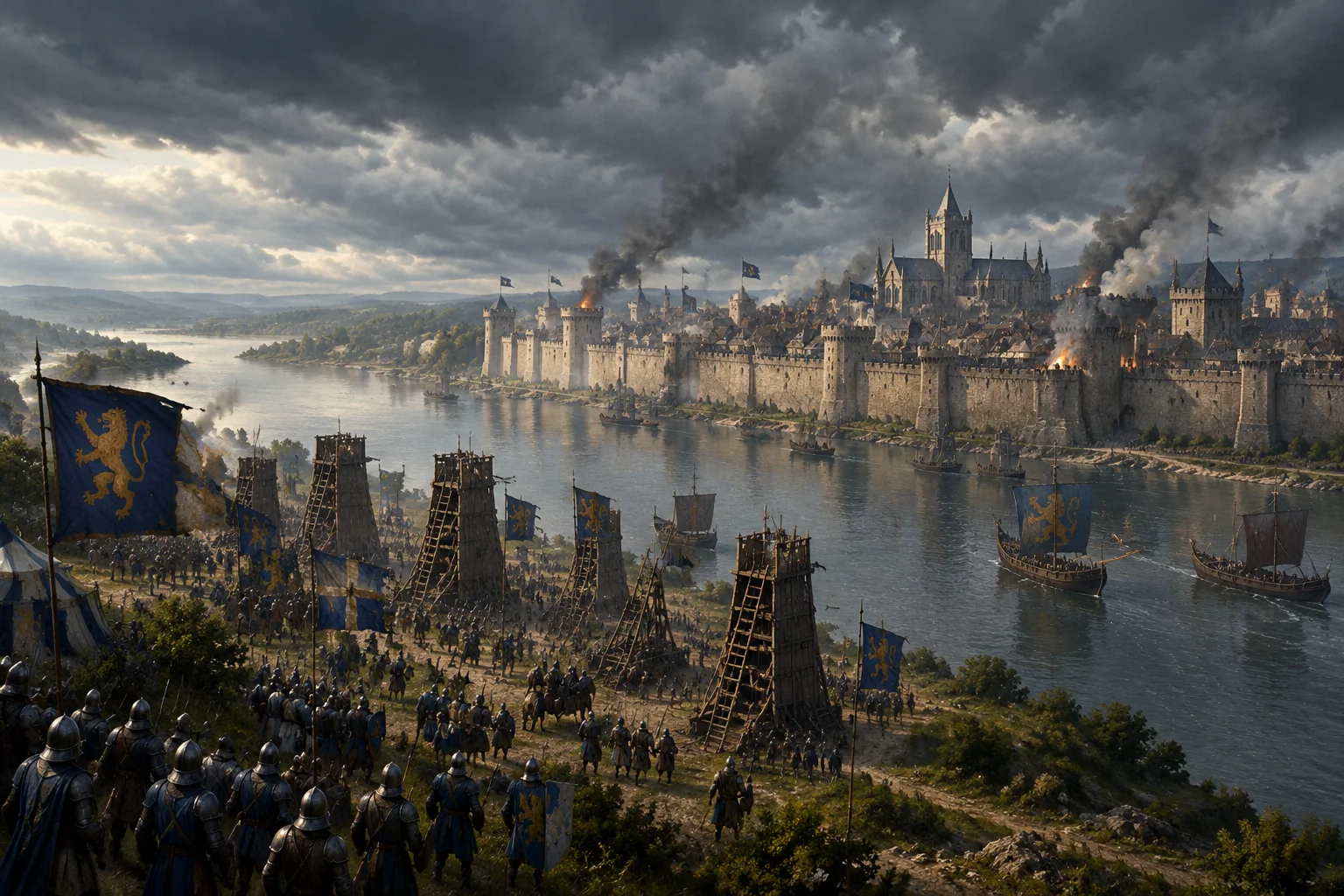
What she did do was concrete. She arrived at Orléans in late April 1429 with a relief force, pushed for aggressive action where the French had been passive, and the siege was lifted on May 8, 1429, after more than six months.
She then took part in the Loire campaign at Jargeau, Meung, and Beaugency. It culminated in the Battle of Patay on June 18, 1429, a rout of an English field army that cleared the road to Reims.
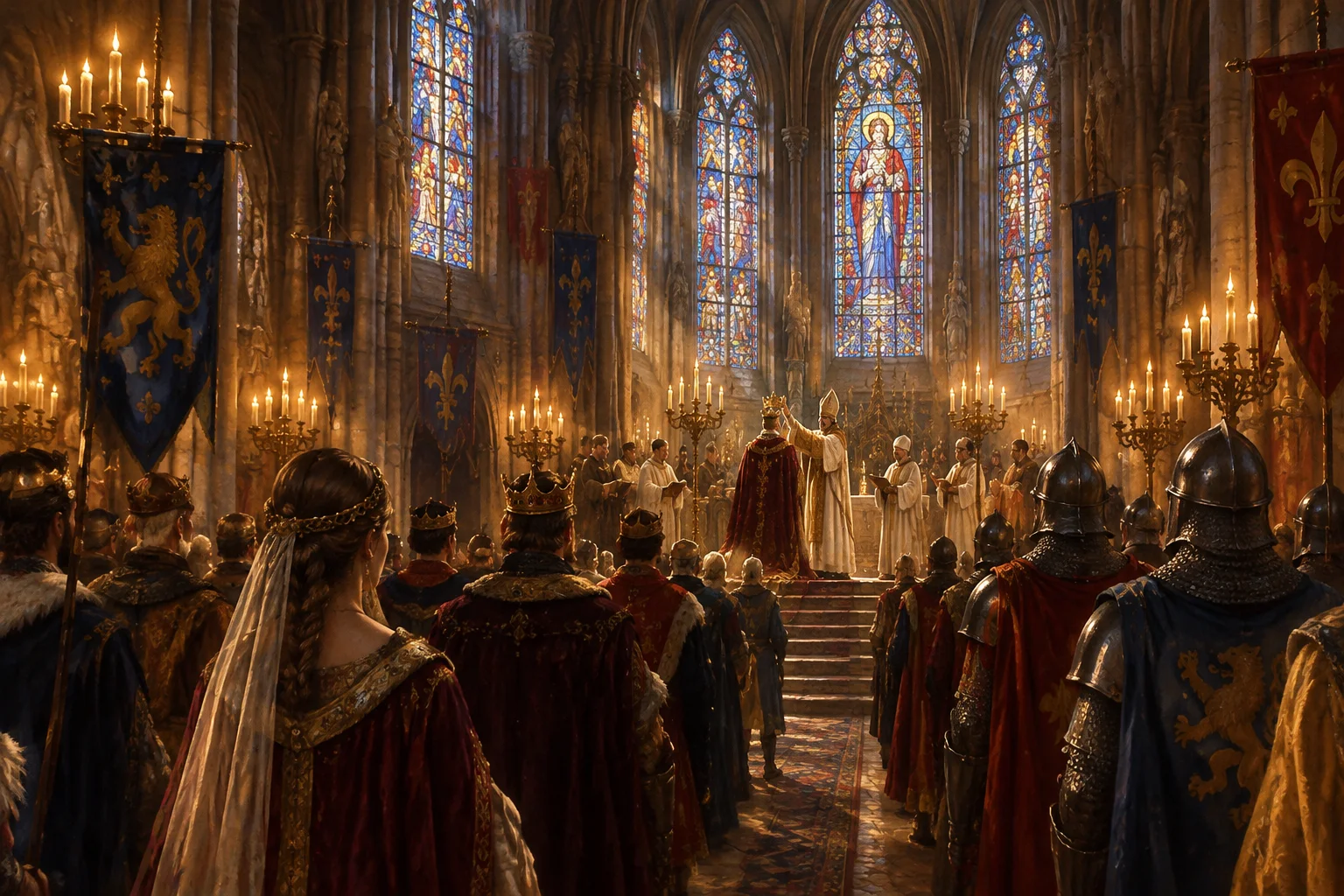
On July 17, 1429, Charles VII was crowned in Reims Cathedral, with Joan standing nearby holding her banner. In a war fought largely over who had the legitimate right to be king, that ceremony mattered as much as any battlefield victory.
So the honest answer to what did Joan of Arc achieve is this: she helped break a siege, helped win a campaign, and made a coronation possible. In doing so, she shifted the political momentum of a war that had been going the other way for a generation.
Did Joan of Arc Pretend to Be a Man?
Short answer: no. Joan wore men's clothing, kept her hair short, and wore armor, but she never claimed to be male, and everyone around her — allies, enemies, and judges alike — knew she was a woman.
She called herself la Pucelle, the Maid, and the French court promoted that image deliberately. Her enemies likewise referred to her as a girl and a woman, usually while mocking or condemning her.
The clothing itself had practical and religious dimensions. Armor requires a padded undergarment, riding long distances in a skirt was impractical, and traveling with a military escort as an unaccompanied young woman was dangerous. At her trial she also said her voices had instructed her to dress this way.
Cross-dressing carried serious weight in medieval theology, drawing on biblical prohibitions, and her judges used it as a capital charge. It was also the technical reason she was condemned at the end, since resuming male clothing after her abjuration was treated as relapse into heresy.
The Capture at Compiègne
After the coronation, the momentum stalled. Charles VII was cautious about pressing on, and the push toward Paris in September 1429 ended in failure, with Joan wounded in the leg during the assault.
In May 1430, Joan went to help defend Compiègne, which was under attack by Burgundian forces. During a sortie on May 23, she was pulled from her horse and captured by Burgundian troops.
Her capture set off a long negotiation over her fate. Charles VII made no serious attempt to ransom her, and the Burgundians eventually sold her to the English, who wanted her tried in a way that would discredit both her and the coronation she had made possible.
The Trial at Rouen
Joan was tried at Rouen in 1431 before an ecclesiastical court presided over by Pierre Cauchon, the Bishop of Beauvais and a committed supporter of the English cause. The proceedings had a political purpose from the first day.
The charges centered on heresy: her claims of direct communication with saints, her wearing of men's clothing, and her refusal to submit her judgment to the Church. She was interrogated repeatedly over several months and, by most accounts, held up remarkably well under pressure.
On May 24, 1431, she was taken to a cemetery at Saint-Ouen and threatened with immediate execution. She signed an abjuration, agreeing to submit to the Church and to stop wearing male clothing.
Execution at Rouen, May 30, 1431
A few days after her abjuration, Joan was found wearing men's clothing again. The accounts differ on why, with explanations ranging from a deliberate choice to a trap laid by her guards, and the court declared her a relapsed heretic.
On May 30, 1431, she was burned at the stake in the Old Market Square in Rouen. She was about nineteen years old.
The executioner, Geoffroy Thérage, was later reported to have said that he feared for his own soul because of what he had done. That testimony comes from the later rehabilitation proceedings, so it should be read as a remembered statement rather than a contemporary record.
What the Hundred Years War Did After Joan Died
Joan's death did not end the war. It continued for another twenty-two years, and the French won it largely through factors she had no part in.
In 1435, the Burgundians switched sides and signed the Treaty of Arras with Charles VII, removing England's most valuable ally. Charles then reformed his army and finances through the 1440s, creating standing companies and a professional artillery corps.
The war ended with the French victory at Castillon in 1453, leaving England holding only Calais. Joan had been dead for more than two decades by then.
That said, the psychological shift she helped trigger was real. Before Orléans the dauphin's cause looked lost, and after Reims he was a crowned king with a functioning court and an army that had started winning.
The Rehabilitation Trial of 1456
In 1450, Charles VII ordered an inquiry into Joan's trial, and in 1456 a papal commission formally nullified the 1431 verdict. She was declared to have been condemned unjustly.
The rehabilitation was partly political, since Charles had an interest in clearing the name of the woman who had crowned him. It also produced the most detailed surviving testimony about her life, and the witness statements from Domrémy, Vaucouleurs, and Orléans underpin most modern biographies.
Joan was beatified in 1909 and canonized in 1920 by Pope Benedict XV. Her feast day is May 30.
Common Myths About Joan of Arc
Myth: she was an illiterate peasant who could barely ride a horse. Reality: she was a farmer's daughter rather than an aristocrat, but she rode well enough to keep up with a cavalry army and learned to handle weapons and armor quickly.
Myth: she was burned as a witch. Reality: the formal charges were heresy and relapse into heresy, though accusations about superstition and a local fairy tree did appear in the proceedings.
Myth: she won the Hundred Years' War single-handedly. Reality: she was decisive at a crucial moment, but the war was won by French commanders, diplomats, and tax reforms over the following two decades.
Myth: her heart survived the fire. Reality: that story comes from later accounts and has no reliable contemporary basis.
Why "Jon de Arc" and Other Spellings Show Up
The name people search for as Jon de Arc is simply a modern misspelling of Joan of Arc, and it is an understandable one. The English Joan is a translation of the French Jeanne, and the surname appears in several forms in the surviving sources.
Joan herself, if she wrote anything at all, would have written Jehanne. Contemporary documents refer to her as Jehanne d'Arc, Jehanne Darc, and most often simply as la Pucelle, the Maid.
D'Arc may not even be a true surname in the modern sense. Her father appears in records as Jacques d'Arc or Jacques Darc, and the family name may derive from a place or a nickname rather than a hereditary line. Joan of Arc is a later English convention.
Joan of Arc in the Hundred Years War: Why She Still Matters
The reason Joan of Arc and the Hundred Years War are inseparable in popular memory is that she arrived at the exact moment the outcome was still genuinely undecided. Her intervention did not win the conflict, but it broke a losing streak at the worst possible time for England.
She also became a symbol that outlived her by centuries. For the French monarchy she legitimized a contested king, for the English she was a problem to be disposed of and then forgotten, and for later ages she became whatever each era needed.
The historical Joan is harder to pin down than any of those versions. She was a specific young woman from a specific village who said specific things under oath and acted with a stubbornness her contemporaries found either holy or infuriating.
What We Know Versus What We Assume
The best sources for Joan's life are the transcripts of her 1431 trial and the witness testimony from the 1456 rehabilitation. Both are shaped by their purposes, one by a hostile court and the other by people with an interest in vindicating her.
That means some questions simply do not have clean answers. We do not know what she told Charles at Chinon, we do not know exactly why she resumed male clothing in May 1431, and we cannot verify her inner experience of the voices.
What we can say with confidence is narrower but still remarkable. She existed, she led troops, she was captured, tried, and executed, and the momentum of the war changed during her year of activity.
Closing: The Teenager Who Changed the Momentum
Joan of Arc was about seventeen when she reached Orléans and about nineteen when she died. In between, she did something almost nobody in her position should have been able to do: she persuaded a demoralized court to hand her an army and gave a divided country something to rally around.
She did not end the Hundred Years' War, and she did not live to see France win it. What she did was turn a defensive, losing war into one that could still be won, and then pay for it with her life.
That is the part worth remembering. Not the stained-glass version, but the teenager from a small town who refused to be told no.
Frequently Asked Questions
What is the connection between Joan of Arc and the Hundred Years War?
Joan of Arc entered the Hundred Years War in 1429, when France was losing and the city of Orléans was under English siege. She helped break that siege, took part in the Loire campaign, and made it possible for Charles VII to be crowned at Reims. Her intervention did not end the war, but it reversed the political momentum and gave the French cause a legitimacy it had been missing.
Did Joan of Arc pretend to be a man?
No. Joan wore men's clothing, cut her hair short, and wore armor, but she never claimed to be male and never tried to pass as one. Everyone around her, from the French court to her English judges, knew she was a woman and referred to her as the Maid. Her clothing was partly practical for riding and fighting and partly, as she told her trial, a matter of religious instruction.
What did Joan of Arc achieve?
She helped lift the siege of Orléans in May 1429, took part in the Loire campaign that ended with the rout at Patay, and stood beside Charles VII at his coronation in Reims that July. Beyond the battlefield, she restored confidence to a demoralized faction and legitimized a disputed king. She did not win the Hundred Years' War, which continued until 1453, long after her death.
Where was Joan of Arc from?
She was born around 1412 in Domrémy, a small farming village of a few hundred people in the Meuse valley. The village lay in the Duchy of Bar, on the border between French and imperial territory, and it was raided and burned during the war. Her family were tenant farmers rather than the poorest peasants, and her father held a minor village office.
Is it ‘Jon de Arc’ or ‘Joan of Arc’?
'Joan of Arc' is the standard English spelling, and 'Jon de Arc' is a common modern misspelling. Joan is the English form of the French Jeanne, and she herself would most likely have written Jehanne. Contemporary documents refer to her as Jehanne d'Arc, Jehanne Darc, or simply la Pucelle, meaning the Maid.
How old was Joan of Arc when she died?
Joan was burned at the stake in Rouen on May 30, 1431, at about nineteen years old. She had been roughly seventeen when she arrived at Orléans in 1429, which means her entire public career lasted a little over two years. Her age is one of the reasons her story has remained so striking.
Did Joan of Arc actually win the Hundred Years’ War?
No, and the idea that she did is a popular oversimplification. The war continued for twenty-two years after her death and was ultimately decided by the Treaty of Arras in 1435, French military and tax reforms, and the final victory at Castillon in 1453. Joan's contribution was to turn a losing war into a winnable one at a critical moment.
Why was Joan of Arc executed?
She was tried by an ecclesiastical court at Rouen in 1431, presided over by Bishop Pierre Cauchon, a supporter of the English cause. The formal charges were heresy, including her claims of direct divine guidance and her wearing of men's clothing. After she signed an abjuration and then resumed male clothing, the court declared her a relapsed heretic and sentenced her to death.

Alex Warren
Related Articles