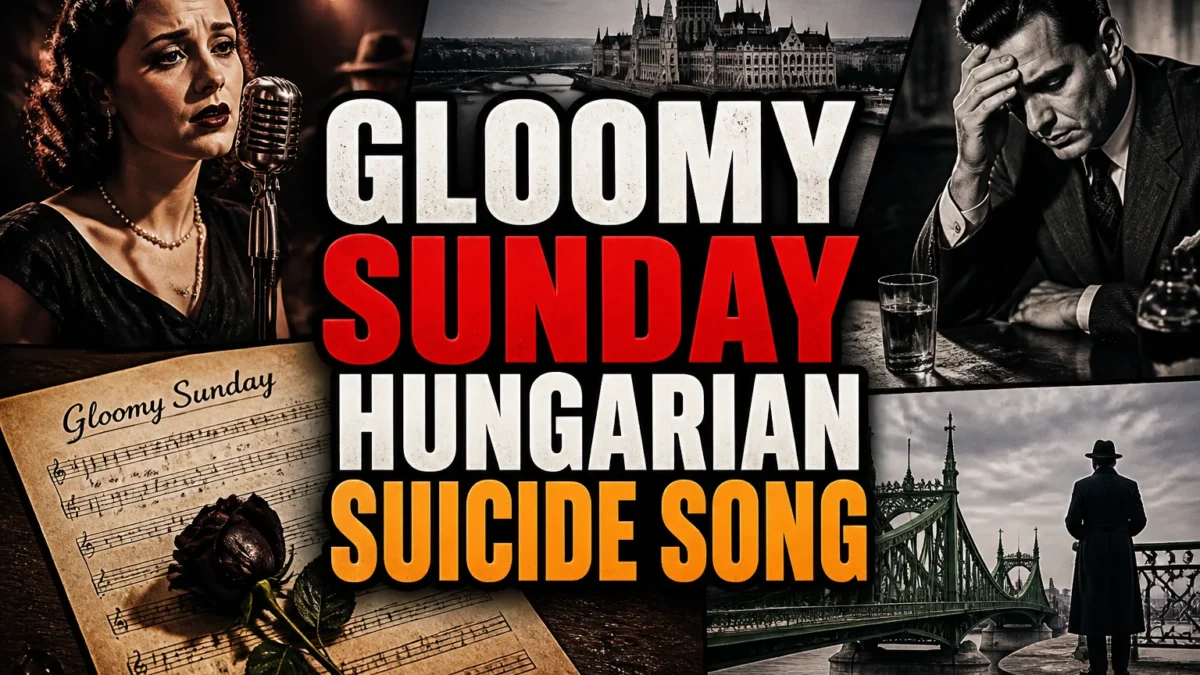
Few songs carry a reputation as heavy as “Gloomy Sunday.” Composed in Budapest in 1933, the melody became world-famous as the “Hungarian suicide song” — a tune supposedly so bleak that it drove listeners to end their own lives. Newspapers in the 1930s reported a wave of deaths linked to it, and the story has never quite gone away.
The trouble is that the legend and the history are not the same thing. Behind the dark Sunday song sits a real composer, a real poet, a disputed radio ban, and a great deal of Depression-era sensationalism. This post separates what can actually be documented from what has simply been repeated often enough to sound like fact.
TL;DR: “Gloomy Sunday” is a genuine 1933 Hungarian song by Rezső Seress whose reputation as a suicide-inducing tune came largely from 1930s press hype, not from any proven power in the music itself.
What Is “Gloomy Sunday”? The Song Behind the Legend
“Gloomy Sunday” is the English title of “Szomorú vasárnap,” a song written in Hungary in 1933. The melody came from pianist and composer Rezső Seress, while the words were written by the poet László Jávor. Translated literally, the Hungarian title means “Sad Sunday.”
Musically, it is a slow ballad in a minor key, built on a mournful, descending melodic line that rises and falls like a sigh. Lyrically, it follows a grieving narrator who spends a lonely Sunday waiting for a lover who has died. That combination of sound and subject is what earned it the nickname “the dark Sunday song” and, later, the far more marketable label “the Hungarian suicide song.”
It is worth saying plainly at the outset: there is no evidence that the song has any supernatural or medical power over listeners. What it does have is one of the most effective publicity stories in the history of popular music.
The Origins: Rezső Seress and the Birth of the Song in 1933
Rezső Seress was born in Budapest in 1899 and made his living as a largely self-taught pianist in the city’s cafés and restaurants. He was not a trained composer in the classical sense, and much of his work grew out of improvisation at the keyboard. According to the most commonly told account, he wrote the melody in 1933 while recovering from the collapse of a relationship.
The song’s first incarnation had different words — Seress’s own, under the title “Vége a világnak,” which means “The World Is Ending.” It was his friend and collaborator László Jávor who rewrote the text into the version the world would come to know as “Szomorú vasárnap.” The song was recorded in Hungary in 1933 and became a local hit almost immediately.
Details of the composition process vary between accounts, and the more romantic versions deserve caution. What is solid is the year, the city, and the two men whose names are attached to the song.
The Budapest Coffee House Where the Song Was Born
Budapest in the 1930s was a city of coffee houses, and live music was part of daily life in them. Seress worked for years as a house pianist, most famously at the Kispipa restaurant, where patrons would request songs and where his own composition became a fixture.
This setting matters for understanding the song’s character. It was written to fill a room, to hold the attention of people drinking coffee and arguing about politics, and to make them quiet. That is a long way from the occult object the legend turned it into.
The coffee house also explains how the song spread so quickly. Sheet music sold by the thousand, other pianists learned it by ear, and within a year or two it had travelled well beyond the Hungarian capital.
Gloomy Sunday 1933: The Lyrics and What They Actually Say
Jávor’s lyrics are not a suicide note. They are a poem about grief, spoken by someone who cannot let go of a dead lover.
The narrator describes a Sunday alone, waiting for someone who will never return, and imagines his own funeral. He asks mourners to pray for him and to tell his lost love that he is at peace. The final stanza suggests that the whole scene may have been a dream, and that the singer is still alive.
That structure matters for anyone searching out the gloomy Sunday meaning. The song is a romantic elegy, written in a tradition that runs through Hungarian and wider European poetry of the nineteenth and early twentieth centuries. Longing to rejoin a dead beloved is a literary convention, not an instruction.
Why Hungary’s Suicide Rate Was So High in the 1930s
To understand why the legend took hold, you have to understand the country it came from. Hungary in the 1930s had one of the highest suicide rates in Europe, a figure that had been climbing for years and peaked during that decade.
The reasons were economic and political as much as personal. The Great Depression hit Hungarian agriculture and industry hard, and the country was still living with the consequences of the Treaty of Trianon, which had stripped away the majority of its pre-war territory after the First World War. National humiliation and rural poverty made for a grim national mood.
Against that backdrop, a sad song and a few reported suicides could easily be connected in a headline. The context does not make the connection true, but it explains why readers found it believable.
How the “Hungarian Suicide Song” Legend Began
The suicide stories began appearing in the Hungarian press in the mid-1930s, within a couple of years of the song’s release. Reports described people who had allegedly taken their own lives while the song played, or who had left the sheet music nearby. These accounts were vivid, short, and rarely followed up.
One widely repeated tale involves a woman who drowned herself in the Danube with the sheet music in her hand. Another describes a man who shot himself after asking a band to play the tune. Neither story has been traced to a primary record in the way a historian would require.
What made the stories stick was not their evidence but their timing. They arrived in a decade when newspapers were competing hard for readers, and a song that seemed to kill people was an irresistible hook. Once the phrase “the Hungarian suicide song” was in print, it travelled faster than any correction could.
The “17 Suicides” Claim: What the Evidence Really Shows
The number most often attached to the legend is seventeen — the claim that at least seventeen suicides in Hungary were linked to “Gloomy Sunday.” This figure traces back to 1930s press coverage and has been recycled in books, documentaries, and online articles ever since. No independent researcher has been able to verify it against surviving records.
There is also a statistical reality the legend usually leaves out. A country the size of Hungary, with a suicide rate among the highest in Europe, would record hundreds of deaths by suicide every year in that period. Inevitably, a handful would occur while the most popular song in the country was playing somewhere nearby.
Correlation is not causation, and here even the correlation is shaky. The honest position is that some contemporaneous reports of song-linked deaths may have been genuine, many were probably embellished, and the total has never been substantiated.
Why the Legend Spread So Fast Beyond Hungary
Several forces pushed the story well past Hungary’s borders. The Great Depression had made despair a global subject, so a “suicide song” matched the mood of the moment. Radio and the record industry were turning music into mass media for the first time, which meant a single tune could reach millions within months.
There was also a marketable exoticism at work. A Hungarian song becoming an international hit was news in itself, and the suicide angle gave foreign correspondents an easy frame. Reporters did not need proof; they needed a colourful paragraph, and the song supplied one.
The result was a feedback loop. Each new article treated earlier articles as sources, and the legend hardened into something that looked like established fact. That is how a piece of Budapest café music became a global urban legend.
The Bans: Hungary, the BBC, and the “Forbidden Song”
One of the most repeated claims is that “Gloomy Sunday” was banned. Different versions of the story place the ban in different countries, and the details rarely survive scrutiny.
In Hungary, press reports from the 1930s say that police asked broadcasters to stop playing the song, and some accounts describe an outright prohibition. The documentary basis for a formal, nationwide ban is thin. It is safer to say the song was discouraged than to say it was outlawed.
The BBC is the other great claimant, and it is often stated that the corporation banned “Gloomy Sunday” in 1936 because it was too depressing. BBC archivists have said they can find no record of such a ban, although the corporation did discourage gloomy material during the Second World War for morale reasons. Some American radio stations reportedly pulled the record too, which is plausible given how the story was being reported at the time.
Gloomy Sunday in America: Sam Lewis, Paul Robeson, and the English Lyrics
The song crossed the Atlantic in 1936, and it arrived with new words. American lyricist Sam M. Lewis wrote an English version that kept the melancholy but softened some of the Hungarian original’s directness. His adaptation is the one most English-speaking listeners know.
Recordings followed quickly. Hal Kemp’s orchestra had a hit with it in 1936, and Paul Robeson recorded a version the same year that gave the song a dignified, almost hymn-like weight. Paul Whiteman’s orchestra and, a few years later, Artie Shaw also cut versions, and the tune settled into the repertoire as a standard rather than a novelty.
The American career of the song is a useful reality check on the legend. If the tune genuinely drove listeners to their deaths, the country that embraced it most enthusiastically would have shown the pattern. It did not.
Szomorú Vasárnap vs. Gloomy Sunday: What Changed in Translation
The English lyrics are not a literal translation, and the differences are worth noting. Lewis reshaped the imagery, softened some of the original’s darker phrasing, and made the song fit the conventions of American popular songwriting.
The Hungarian original is more direct about death and mourning, and its narrator speaks to the dead more intimately. The English version leans harder on atmosphere, memory, and the dream framing that became so famous.
Neither version is a call to self-harm, but the two songs do have different emotional temperatures. The Hungarian one feels like a vigil, while the American one feels like a reverie.
Billie Holiday and the Version That Defined the Song
The most influential recording came from Billie Holiday in 1941. Her reading is slow, restrained, and devastating in a way that has nothing to do with curses — it is simply one of the great vocal performances of its era.
Columbia, her label, was reportedly uneasy about releasing a song with such a reputation. The record’s release was delayed, which only added to its mystique and, in the long run, to its sales.
Holiday’s version is also the source of the “dream” ending many listeners associate with the song. The final verse reveals that the funeral and the grief were imagined, and that the singer is awake after all. It is a strange, haunting twist that turns a death wish into something closer to a ghost story.
The Death of Rezső Seress and the “Curse”
Rezső Seress survived the Second World War, having been conscripted into forced labour during the Holocaust era in Hungary. He continued to work as a musician in Budapest, though his later years were difficult and the fame of his one great song did not translate into comfort.
He died in Budapest on 11 January 1968, at the age of 68, after jumping from a window at a hospital where he was being treated. His death is routinely cited as proof that the song carried a curse. That is a very large conclusion to draw from an elderly man’s final illness.
Seress’s death came thirty-five years after the song was written. If a melody could curse its author, the mechanism would need to be remarkable indeed, and no one has ever offered one.
Other Artists Who Took On the Dark Sunday Song
“Gloomy Sunday” never really left the repertoire, and each generation of singers has found something different in it. Sarah Vaughan, Mel Tormé, and Ray Charles all recorded versions, treating it as a torch song rather than a horror story.
Later interpreters pushed it further. Sinéad O’Connor, Marianne Faithfull, Elvis Costello, Diamanda Galás, and Heather Nova have all covered it, often leaning into the song’s gothic reputation. Björk’s version, recorded for a 1990s tribute project, is one of the most widely heard modern readings.
The range of these performances is itself an argument against the legend. The same song that supposedly drove people to despair has also been a vehicle for some of the most beautiful singing of the past eighty years.
The 1999 Film and the Song’s Modern Revival
In 1999, the German director Rolf Schübel released “Gloomy Sunday – Ein Lied von Liebe und Tod,” based on Nick Barkow’s novel. The film sets the song in a Budapest restaurant in the 1930s and weaves it into a story of love, jealousy, and the approaching war.
The movie brought the song to a new audience and, inevitably, revived the old stories. It also helped cement the modern image of the tune as the ultimate sad song, complete with candlelit cafés and doomed romance.
For all its liberties, the film captures something true about the song’s place in Hungarian culture. It belongs to the world of the Budapest coffee house, where a pianist could hold a room in silence with a few bars of minor-key melody.
Common Myths About the Gloomy Sunday Suicide Song, Debunked
Myth one is that the song was banned worldwide. In reality, there is firm evidence of restrictions in only a few places, and even the famous BBC ban is undocumented.
Myth two is that the composer was the song’s first victim. Seress did die by suicide decades later, but he was 68, in poor health, and the gap between the song and his death is thirty-five years.
Myth three is that the original Hungarian lyrics are a suicide note. They are an elegy, and the narrator survives at the end of the poem.
Myth four is that the song has been proven to cause deaths. No study, no coroner, and no historian has ever established such a link, and the mechanism would be unprecedented in medical literature.
Why the Song Can’t Actually Cause Suicide
The central myth deserves a direct answer. There is no credible evidence that “Gloomy Sunday” has ever caused a suicide, and no known mechanism by which a song could.
Suicide is complex, shaped by mental illness, isolation, financial ruin, and a hundred other factors that no melody can supply. What researchers do study is the “Werther effect,” the tendency for certain kinds of media coverage to influence vulnerable people. Notably, that research points to news reporting and portrayal, not to music itself.
If anything, sad music often helps people process grief rather than deepen it. Many listeners describe the song as cathartic, even comforting, which is exactly what you would expect from a well-crafted elegy.
What “Gloomy Sunday” Really Means Today
The gloomiest thing about “Gloomy Sunday” is not the song. It is the way a beautiful piece of music was turned into a warning label by a press culture that valued a good story over an accurate one.
The song’s actual meaning is gentler and more universal than the legend allows. It is about missing someone, about the silence of a Sunday when you are alone, and about the odd comfort of imagining that the pain is only a dream.
That is why it has lasted. Not because it kills, but because it understands something about being human that most pop songs never get near.
How to Listen to Gloomy Sunday Today
If you want to hear the song for yourself, the easiest starting point is Billie Holiday’s 1941 recording, which is widely available on streaming services and on countless jazz compilations. Paul Robeson’s 1936 version offers a very different, more solemn reading of the same material.
For the Hungarian original, look for recordings of “Szomorú vasárnap” rather than the English-language versions. They reveal how much the song changed in translation and how much of its reputation was built on the English-language framing.
Listen with the legend switched off. What remains is a melancholy standard, written by a café pianist in a difficult decade, that somehow outlived both its composer and its scandal.
The Enduring Mystery of the Dark Sunday Song
“Gloomy Sunday” is a real song with a real history: written in Budapest in 1933, carried around the world by records and radio, and recorded by some of the greatest voices of the twentieth century. The suicide legend is a real phenomenon too, but it is a phenomenon of journalism rather than of music.
The two stories have been tangled together for so long that untangling them can feel like spoiling the fun. It is not. The truth is more interesting, because it shows how easily a myth can be manufactured and how long it can survive after the evidence has quietly fallen away.
Listen to the Billie Holiday version, or Robeson’s, or the original Hungarian recording, and you will hear what the fuss was about. It is not a curse. It is a song about grief, sung beautifully, and that has always been enough.
Frequently Asked Questions
Is Gloomy Sunday really the gloomy Sunday suicide song that drove people to their deaths?
There is no verified evidence that “Gloomy Sunday” ever caused a suicide. The “gloomy Sunday suicide song” label grew out of 1930s newspaper reporting in Hungary, where a handful of deaths were loosely linked to the tune. Hungary already had one of Europe’s highest suicide rates at the time, so a small number of cases involving a hugely popular song is not surprising. The famous figure of seventeen linked suicides has never been substantiated against primary records.
What is Gloomy Sunday about?
The song is an elegy. Its narrator spends a lonely Sunday waiting for a lover who has died, imagines his own funeral, and asks mourners to pray for him. The closing verse suggests the whole scene may have been a dream, meaning the singer is still alive. It is a song about grief and longing, not a suicide note.
Who wrote Gloomy Sunday, and when?
The melody was written by Hungarian pianist Rezső Seress, with lyrics by the poet László Jávor, in Budapest in 1933. Its original Hungarian title is “Szomorú vasárnap,” which literally means “Sad Sunday.” It was first recorded in Hungary in 1933 and became a hit there before spreading internationally.
Was Gloomy Sunday actually banned?
The ban story is more complicated than it is usually presented. Hungarian press reports from the 1930s say police discouraged broadcasters from playing it, and some accounts claim an outright prohibition, but firm documentary evidence is thin. The often-repeated BBC ban of 1936 has no record in the corporation’s archives, though the BBC did discourage gloomy songs during the Second World War. Some American stations reportedly pulled the record as well.
Did Rezső Seress die by suicide?
Yes. Seress died in Budapest on 11 January 1968, at the age of 68, after jumping from a hospital window where he was being treated. However, this happened thirty-five years after he wrote the song, and he was elderly and in poor health. His death is often cited as proof of a curse, but it is not evidence of one.
What is the most famous recording of Gloomy Sunday?
Billie Holiday’s 1941 recording for Columbia is generally considered the definitive version. Her label was reportedly uneasy about releasing a song with such a dark reputation, and the release was delayed. Other notable recordings include Paul Robeson’s 1936 version, Hal Kemp’s 1936 hit, Artie Shaw’s 1940 reading, and later covers by Sarah Vaughan, Ray Charles, Sinéad O’Connor, and Björk.

Alex Warren
Related Articles