

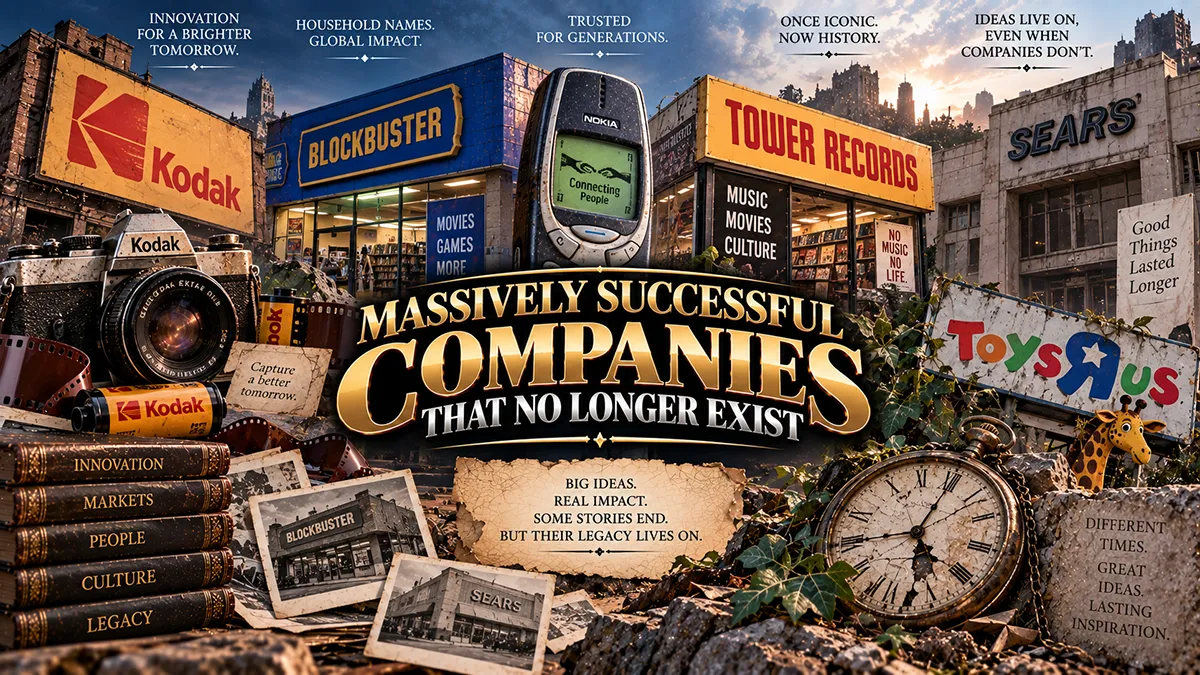
Walk through any mall built before 2000, and you’ll probably spot at least one empty storefront that used to house a name everyone recognized.
History is full of famous businesses that once seemed untouchable — chains with thousands of locations, banks that seemed too big to fail, and tech firms that defined an entire decade — only to vanish within a few short years.
Some of these dead brands collapsed almost overnight, while others faded slowly through a long string of bankruptcies, mergers, and quiet closures.
This list looks at 25 of the biggest, most surprising examples of companies that no longer exist in their original form. Some were undone by fraud, some by disruption, and some simply couldn’t keep up with the times.
Along the way, we’ll bust a few myths about what “going out of business” actually means — much like the collective false memories behind the Mandela Effect — since plenty of these brands technically live on as logos owned by someone else entirely.
TL;DR: Even the most dominant companies in history — from Pan Am to Lehman Brothers to Toys “R” Us — can collapse when debt, fraud, or disruption catches up with them, and many “dead” brands still exist today only as names licensed to entirely new owners.
Why Do Even the Biggest Companies Fail?
It’s tempting to assume that massive scale equals safety, but business history says otherwise. Some of the largest defunct companies on this list didn’t fail because they were poorly run in the traditional sense; they failed because leadership took on too much debt, ignored a changing market, or in a few infamous cases, committed outright fraud.
Others were simply overtaken by a competitor or a new technology that made their entire business model obsolete.
There’s also a difference between a company that closed and one that just changed shape. Many famous companies that went out of business didn’t disappear so much as get absorbed, renamed, or stripped for parts.
A brand name can survive for decades after the original company behind it has been liquidated, sold off in pieces, or merged into something unrecognizable.
That distinction matters a lot when people search for whether a specific company is still in business. Sometimes the honest answer is “the name exists, but the company you remember does not.” Keep that in mind as you go through the list below, because it applies to more of these brands than you might expect.
1. Pan American World Airways (Pan Am)

Pan Am practically invented the idea of glamorous international air travel after its founding in 1927. It was the first airline to fly the Boeing 747 and for decades symbolized American aviation at its most sophisticated. A combination of deregulation, rising fuel costs, heavy debt, and the devastating 1988 Lockerbie bombing of Flight 103 eroded the airline’s finances beyond repair.
Pan Am shut down for good in December 1991, ending a 64-year run. The name has been revived a few times since for smaller ventures, but none carried the scale or prestige of the original airline.
2. Trans World Airlines (TWA)

TWA built its reputation in the mid-20th century partly through its association with owner Howard Hughes, becoming one of America’s premier long-haul carriers. Deregulation in the late 1970s and a series of costly leveraged buyouts left the airline drowning in debt through the 1990s. After a final bankruptcy filing, American Airlines acquired TWA’s assets in 2001, and the TWA name disappeared from the skies for good.
3. F.W. Woolworth Company
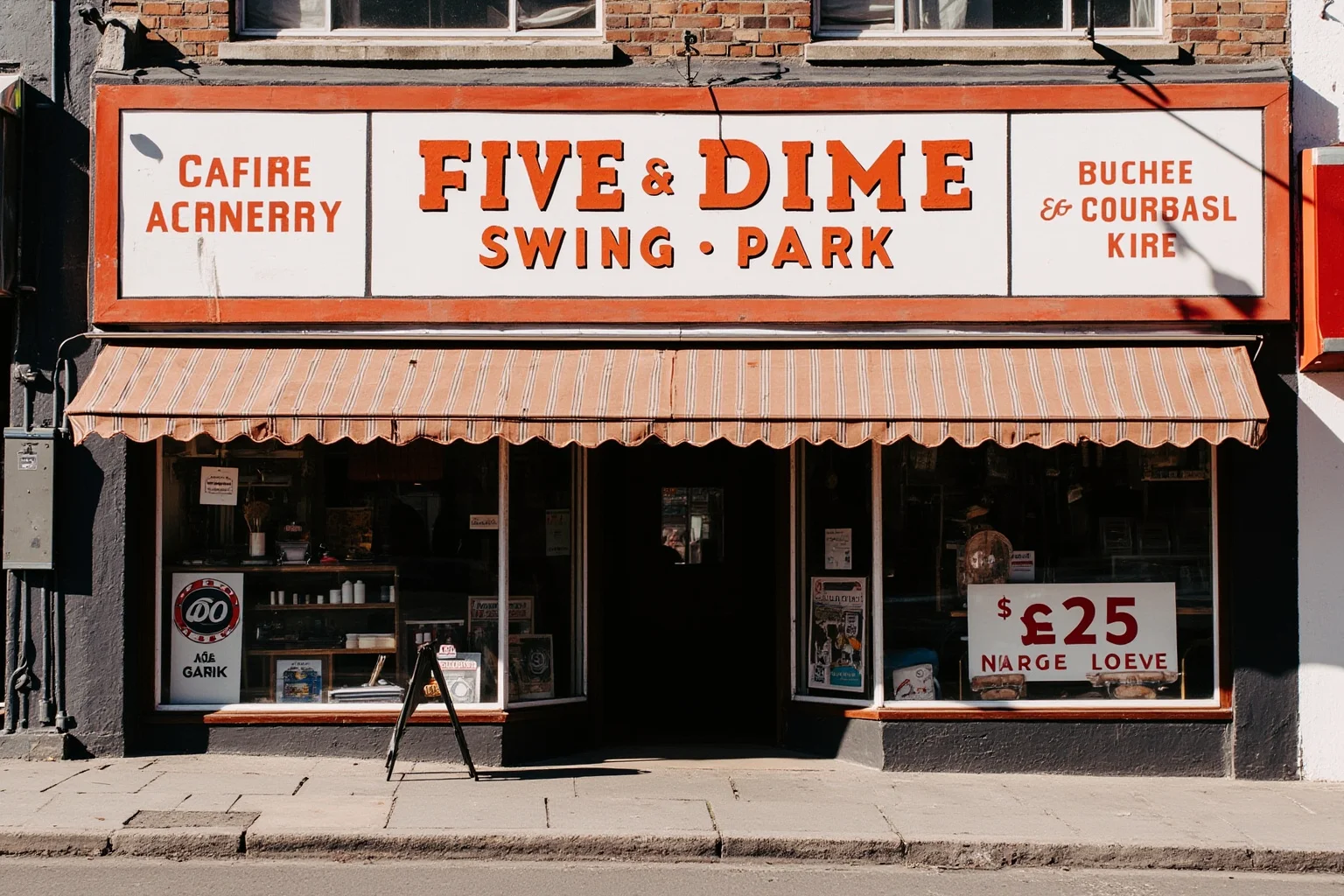
Founded in 1878, Woolworth’s pioneered the “five-and-dime” retail format that once anchored downtowns across America and Britain. At its peak it operated thousands of stores worldwide and was a household name for generations. The American parent company restructured in 1997, dropped the Woolworth name entirely, and rebranded around its Foot Locker division; the separate UK arm, Woolworths plc, later collapsed in its own right in 2008-2009.
4. Montgomery Ward

Montgomery Ward launched in 1872 as one of the first mail-order catalog retailers in the United States, later expanding into department stores nationwide. Competition from discount chains and changing shopping habits pushed the company into decline through the late 20th century. The original department store chain closed its doors in 2001, though the name has since been licensed for an unrelated online furniture retailer.
5. Blockbuster Video

At its 2004 peak, Blockbuster operated roughly 9,000 stores and was synonymous with Friday-night movie rentals. The rise of Netflix’s mail and streaming services, plus late fees that frustrated customers, ate away at its business model. Blockbuster filed for bankruptcy in 2010, and most corporate stores closed within a few years, leaving a single famous franchise location in Bend, Oregon as a nostalgic holdout.
6. Toys “R” Us
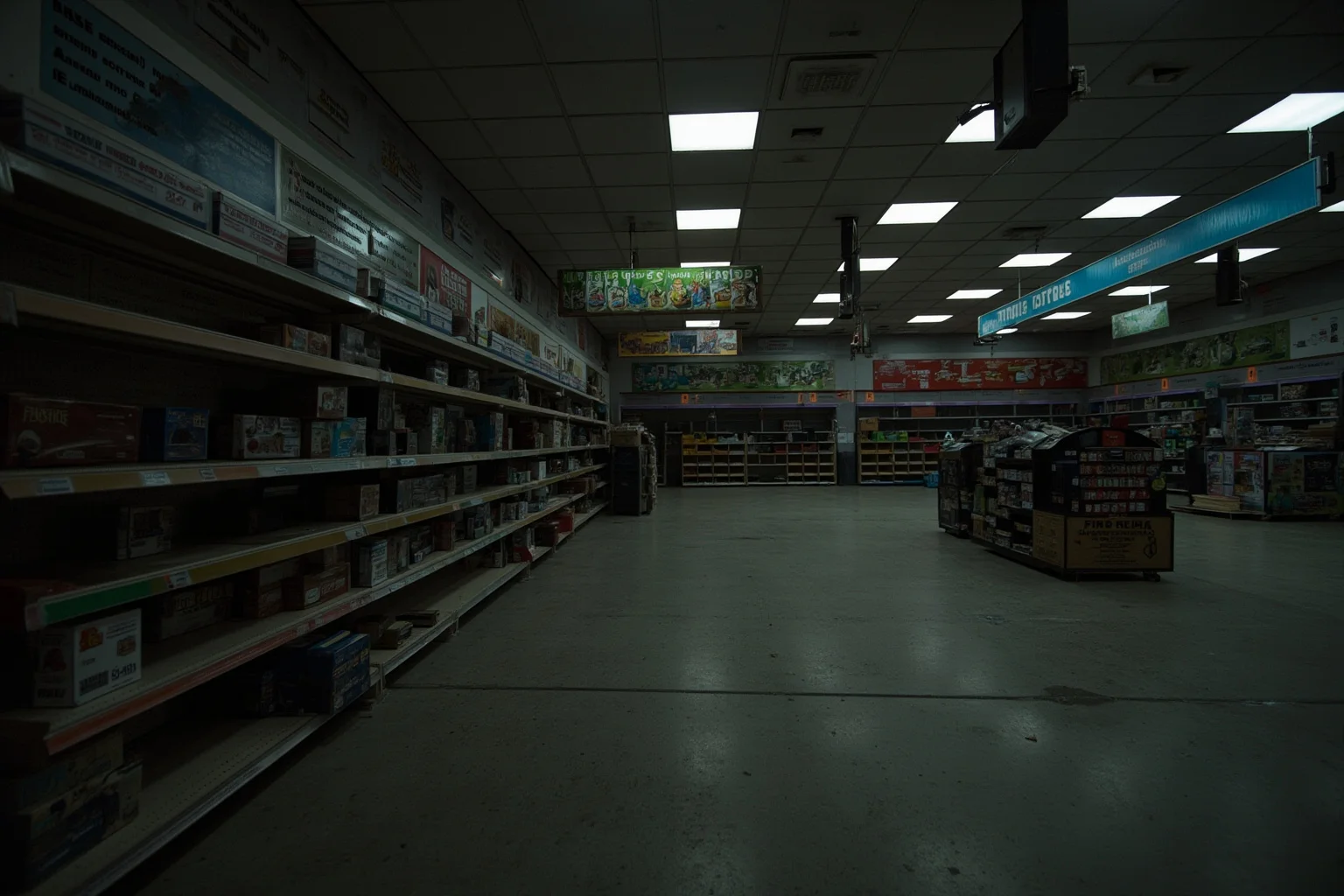
Toys “R” Us grew from a single Washington, D.C. store in the late 1950s into the dominant toy retailer in America, instantly recognizable thanks to its Geoffrey the Giraffe mascot. A 2005 leveraged buyout loaded the company with billions in debt it could never fully escape. Toys “R” Us filed for bankruptcy in 2017 and liquidated most of its US stores the following year, though the brand has since reappeared in limited retail partnerships.
7. Circuit City
Circuit City helped define big-box electronics retail after its founding in 1949, at one point ranking as one of the largest consumer electronics chains in the US. Poor strategic decisions, including a much-criticized move to lay off experienced sales staff, weakened its competitive edge against Best Buy. The company filed for bankruptcy in 2008 and liquidated its remaining stores in early 2009.
8. RadioShack
RadioShack was once the go-to spot for electronics parts, early home computers, and gadgets, tracing its roots back to 1921. Changing retail habits and increased competition from big-box and online retailers led to a steep decline in the 2010s. The company filed for bankruptcy in both 2015 and 2017, closing nearly all of its physical stores, though the brand still exists today as a mostly online retailer.
9. Borders Books & Music

Borders grew into the second-largest bookstore chain in the United States after opening its first store in 1971. A slow response to online retail, combined with a poorly timed outsourcing deal that handed its e-commerce business to Amazon for years, left it unable to compete. Borders filed for bankruptcy in 2011 and liquidated all of its remaining stores that same year.
10. Compaq Computer Corporation

Compaq was once the world’s largest seller of personal computers, founded in 1982 and known for building some of the first true IBM PC-compatible machines. Intense price competition and a costly acquisition of Digital Equipment Corporation strained the company through the late 1990s. Hewlett-Packard acquired Compaq in 2002, and by 2013 HP had fully retired the Compaq brand.
11. Netscape Communications

Netscape Navigator was the browser that introduced millions of people to the World Wide Web after its 1994 launch. Microsoft’s decision to bundle Internet Explorer for free with Windows triggered the infamous “browser wars,” and Netscape’s market share collapsed through the late 1990s. AOL purchased the company in 1998, and the Netscape browser was officially discontinued in 2008.
12. Polaroid Corporation

Polaroid revolutionized photography in 1948 with the first instant camera, becoming a cultural icon for decades. The rise of digital photography devastated demand for instant film, and the company filed for bankruptcy in 2001 and again in 2008. The original Polaroid Corporation was dissolved, though the brand name has since been licensed to various companies making instant cameras and accessories.
13. Enron

Enron rose to become the seventh-largest company in the United States by revenue during the late 1990s, built largely on energy trading. Investigators later revealed that much of its reported profit was fabricated through elaborate accounting fraud designed to hide debt. The scandal became public in late 2001, and Enron filed for what was then the largest bankruptcy in US history.
14. Lehman Brothers
Lehman Brothers had operated as a major Wall Street investment bank since 1850, surviving depressions, wars, and multiple recessions. Heavy exposure to subprime mortgage securities left it dangerously overleveraged heading into 2008. Its bankruptcy filing that September remains the largest in US history and is widely seen as the moment the global financial crisis went into freefall.
15. Bear Stearns

Bear Stearns had been a respected investment bank since 1923, but by early 2008 its heavy bets on mortgage-backed securities had left it dangerously exposed. A rapid loss of confidence among clients and lenders triggered a liquidity crisis in March 2008. The Federal Reserve helped broker an emergency sale to JPMorgan Chase at a fraction of the company’s former value, effectively ending Bear Stearns as an independent firm.
16. Washington Mutual

Washington Mutual, or WaMu, had grown into the largest savings and loan institution in the United States by the mid-2000s. Aggressive subprime and adjustable-rate mortgage lending left it critically exposed when the housing market collapsed. Regulators seized the bank in September 2008, marking the largest bank failure in US history, and its assets were sold off to JPMorgan Chase.
17. WorldCom

WorldCom grew rapidly through the 1990s into one of the largest telecommunications companies in America. In 2002, investigators uncovered massive accounting fraud used to inflate profits and hide billions in expenses. The scandal led to a bankruptcy filing, and the company was later reorganized as MCI before eventually being absorbed into Verizon.
18. Arthur Andersen

Arthur Andersen had been one of the “Big Five” global accounting firms since its founding in 1913, respected for decades as a symbol of auditing integrity. Its role in auditing Enron’s fraudulent books led to a 2002 criminal conviction for obstruction of justice, later overturned on appeal in 2005. By then the damage was done, and the firm had effectively collapsed, with most of its partners and clients scattering to other accounting firms.
19. Standard Oil
John D. Rockefeller built Standard Oil into the dominant force in the American oil industry after founding it in 1870. Its market control was so extensive that the US Supreme Court ordered it broken up under antitrust law in 1911, splitting it into 34 separate companies. Several of today’s largest energy companies, including ExxonMobil and Chevron, trace their roots directly back to that breakup.
20. Pontiac
Pontiac had been a General Motors brand since 1926, known for performance cars like the GTO and Firebird. As GM restructured through its 2009 bankruptcy, the company decided to discontinue several underperforming brands to cut costs. Pontiac officially ended production in 2010, closing out an 84-year run.
21. Oldsmobile
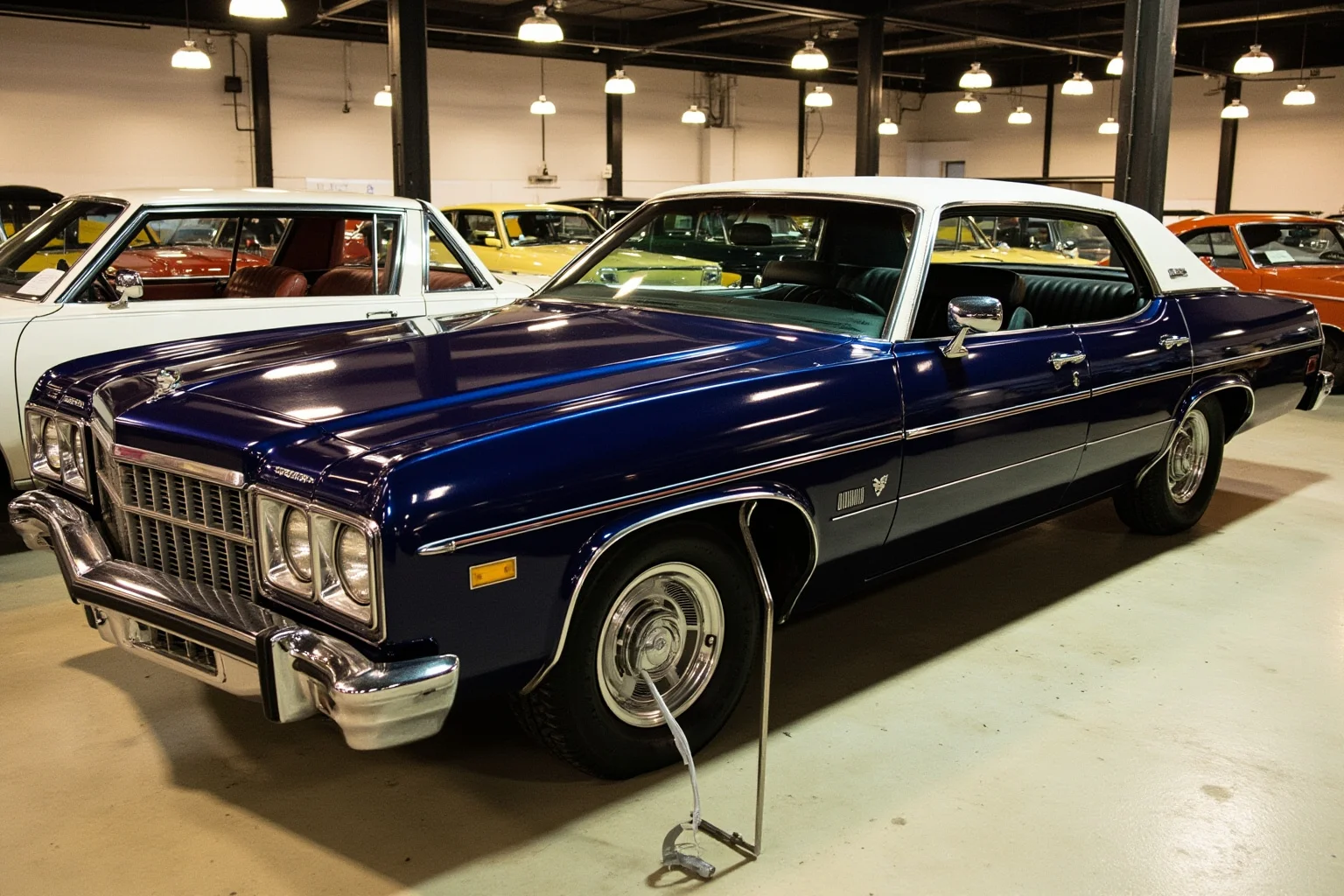
Oldsmobile traced its history back to 1897, making it one of the oldest automobile brands ever sold in the United States. Overlapping product lines within GM’s brand portfolio made Oldsmobile increasingly redundant by the late 1990s. GM discontinued the brand in 2004, well before its own broader restructuring later in the decade.
22. Saturn Corporation
GM launched Saturn in 1985 as a separate, innovation-focused brand meant to compete more directly with Japanese automakers. Despite early enthusiasm, Saturn never became consistently profitable within GM’s larger structure. It was one of the brands cut during GM’s 2009 bankruptcy restructuring, and production ended in 2010.
23. Tower Records

Tower Records became one of the largest music retail chains in the world after opening its first proper store in 1960. The rise of digital downloads and declining CD sales through the early 2000s crushed its core business. The company filed for bankruptcy twice, in 2004 and 2006, before liquidating its US stores entirely, though the name has since resurfaced through online licensing deals.
24. Kmart and Sears Holdings
Kmart traced its roots to 1899, while Sears had been an American retail institution since 1892; the two merged in 2005 to form Sears Holdings. Years of underinvestment in stores, combined with debt taken on by its hedge-fund ownership, left the combined company unable to compete with Walmart and Amazon. Sears Holdings filed for bankruptcy in 2018, and the vast majority of Kmart and Sears locations have since closed under new owner Transformco.
25. Barneys New York

Barneys built a reputation as one of America’s premier luxury department stores after opening in 1923. Rising rents, heavy debt, and shifting luxury shopping habits pushed the retailer into financial distress by the late 2010s. Barneys filed for bankruptcy in 2019, closed its physical stores, and its brand name was later licensed to Authentic Brands Group for future use.
How to Tell If a Company Is Still in Business
Given how many of these once-dominant names still show up on packaging, websites, or store signs, it’s worth knowing how to check if a company is still in business in any meaningful sense. A quick search of a company’s official investor relations page, if it’s publicly traded, will usually confirm whether it’s still filing with regulators. For US companies, the SEC’s EDGAR database is a reliable way to check recent filings.
For smaller or local businesses, your state’s Secretary of State business registry can confirm whether a company is still legally registered and active. Sites like the Better Business Bureau can also show whether a business has recently closed, changed names, or accumulated unresolved complaints. It’s also worth simply checking recent news coverage, since major closures are almost always reported before they show up anywhere official.
This matters for brand-name recognition too. A store or logo you remember from childhood might technically still exist as an active trademark, even if the actual company running it went through bankruptcy, liquidation, and a full change of ownership years ago.
The Legacy of Brands That No Longer Exist
What’s striking about this list is how few of these companies vanished without a trace. Most left behind a logo, a nostalgic memory, or in some cases an entirely new business that simply bought the rights to an old name. That’s part of what makes dead brands so fascinating to revisit: the story rarely ends as cleanly as “it closed and disappeared.”
There are broader lessons here too. Heavy debt from buyouts, failure to adapt to new technology, and outright fraud show up again and again across totally different industries, from airlines to accounting firms. The next time a seemingly unstoppable company makes headlines, these 25 examples are a good reminder that scale alone has never guaranteed survival.
Frequently Asked Questions
What are some famous brands that no longer exist?
Some of the most famous brands that no longer exist in their original form include Pan Am, TWA, Blockbuster, Toys "R" Us, Circuit City, Borders, Compaq, Polaroid, Enron, Lehman Brothers, and Woolworth's. Many of these names still appear on products or storefronts today, but the original companies behind them were liquidated, merged, or restructured long ago.
Is Sears still in business?
Sears technically still exists, but only a small handful of stores remain open under parent company Transformco after Sears Holdings filed for bankruptcy in 2018. The retail giant that once anchored American malls for over a century has effectively ceased to exist in its former scale.
Did Which Wich go out of business?
No, Which Wich Superior Sandwiches has not gone out of business; the sandwich chain, founded in Dallas in 2003, continues to operate franchise locations. Like many restaurant chains, it has closed individual underperforming locations over the years, but the company itself remains active.
Is Big Buildings Direct out of business?
There isn't reliable, verified evidence confirming that Big Buildings Direct has permanently closed. If you're considering doing business with a company like this, it's worth checking its current status directly through the Better Business Bureau, recent customer reviews, and your state's business registry before assuming it is or isn't still operating.
What are some examples of corporations that failed spectacularly?
Enron, Lehman Brothers, WorldCom, and Washington Mutual are among the most dramatic examples of corporate failure in modern history. Enron and WorldCom collapsed due to accounting fraud, while Lehman Brothers and Washington Mutual failed due to excessive exposure to risky mortgage-backed investments during the 2008 financial crisis.
Are companies still going out of business in 2025?
Yes, business closures and bankruptcies happen every year, including in 2025, as retailers, restaurant chains, and other companies continue to face pressure from rising costs, changing consumer habits, and e-commerce competition. The specific companies affected change from year to year, so it's best to check current business news for the latest closures.

Alex Warren
Related Articles





