

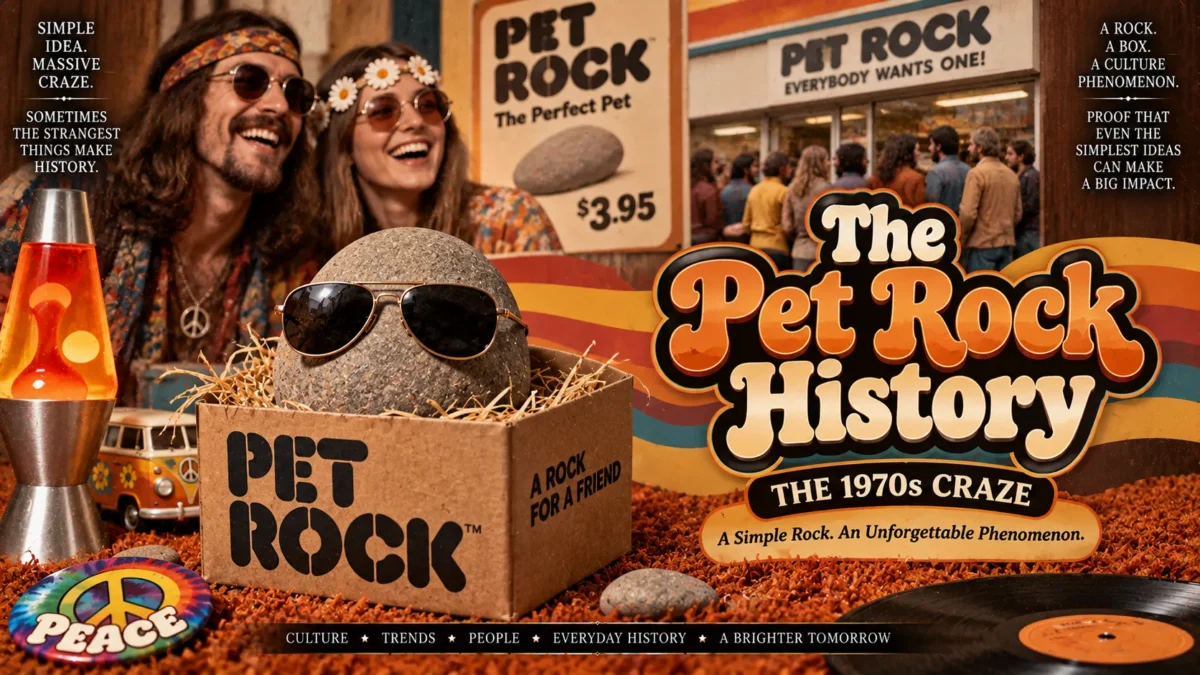
In the fall of 1975, Americans lined up to buy a pet that never had to be fed, walked, bathed, or taken to the vet. It didn’t bark, shed, or need a leash. It was, quite literally, a rock — sitting in a straw-lined cardboard box with breathing holes punched into the lid, as if it might suffocate.
The pet rock craze sounds like a joke because, in many ways, it was one. But it’s also one of the most studied marketing success stories of the 20th century, a case where clever packaging and a sense of humor turned a literal piece of gravel into a must-have novelty item.
Here’s the real history of the pet rock, separating the documented facts from the decades of retellings that have blurred the story.
TL;DR: The pet rock was a 1975 novelty gift invented by advertising man Gary Dahl, and it became a massive 1970s craze not because of the rock itself but because of the humor-driven packaging, instruction booklet, and media buzz built around it.
What Was a Pet Rock, Exactly?
At its core, a pet rock was nothing more than a smooth, ordinary stone. It was sold in a small cardboard carrying case designed to look like a pet carrier, complete with air holes and a bed of straw for the “pet” to rest on.
What made it a product rather than a literal rock you picked up in your backyard was everything surrounding it. Buyers received a tongue-in-cheek instruction manual explaining how to care for, train, and even discipline their new companion.
The rock did nothing. That was the entire point, and it’s exactly what made 70s pet rocks such an effective piece of comedy disguised as a consumer product.
The Man Behind the Rock: Who Invented the Pet Rock?
The history of the pet rock begins with Gary Dahl, an advertising copywriter working in Los Gatos, California. Dahl is widely credited as the creator of the pet rock, and the timeline is well documented by contemporary news coverage from 1975.
Dahl wasn’t a toy designer or a novelty manufacturer. He worked in advertising, which is precisely why the product succeeded — he understood that people don’t buy objects, they buy stories, jokes, and feelings.
When people ask when the pet rock was invented, 1975 is the answer supported by the historical record. Dahl developed the concept, wrote the accompanying material, and began selling the rocks that same year in the San Francisco Bay Area before the idea spread nationally.
The Bar Napkin Origin Story
According to accounts Dahl gave in interviews at the time, and which have been repeated widely ever since, the idea reportedly came out of a conversation with friends at a bar. The story goes that Dahl was joking about how much trouble real pets were — the feeding, the cleaning, the vet bills — while a rock demanded absolutely nothing.
It’s worth noting that origin stories like this one tend to get polished and simplified with every retelling over fifty years. The broad strokes — a joking conversation about low-maintenance pets — are consistent across period sources, but readers should treat the exact dialogue and details as part of marketing folklore rather than a verbatim transcript.
What is well documented is that Dahl moved quickly from the joke to an actual product, sourcing plain stones and building a comedic brand identity around them.
The Care and Feeding of a Pet Rock
The real genius of the pet rock wasn’t the stone. It was the booklet that came with it, titled “The Care and Feeding of a Pet Rock.”
Written in the deadpan style of a real pet training manual, the booklet walked new owners through teaching their rock various “tricks.” Commands like “sit” and “stay” were technically always successful, since a rock cannot do anything else, and the humor came from treating an inanimate object with total sincerity.
This is the piece of pet rock marketing that turned a $0.99 landscaping stone into a $3.95 novelty item people were happy to pay for. Buyers weren’t purchasing a rock — they were purchasing a joke they could share with friends, and the booklet was the punchline delivery system.
Packaging Was the Product
Anyone studying pet rock marketing today will find that the packaging did almost all of the heavy lifting. The rocks themselves, according to widely reported accounts from the period, were plain gray stones sourced from a beach in Rosarito, Mexico, bought inexpensively in bulk.
Dahl designed a small box resembling a pet carrier, complete with straw bedding and ventilation holes cut into the cardboard. It looked, at a glance, like packaging for a small living creature, which was exactly the visual joke Dahl was going for.
This is often cited as an early, highly visible example of a product where branding and presentation created essentially all of the perceived value. The rock cost pennies; the story wrapped around it is what people were actually buying.
When Were Pet Rocks Popular? The Timeline of a Craze
So when were pet rocks popular, exactly? The craze was concentrated almost entirely within a single stretch of 1975, making it one of the fastest-moving fads of the decade.
Dahl began selling the novelty regionally in California in the spring and summer of 1975. The product gained wider attention after being picked up by gift retailers and covered by national press, including major newspapers and magazines eager to write about an offbeat, feel-good business story.
By the fall of 1975, pet rocks 1970s sales had reportedly reached into the hundreds of thousands, with some period accounts describing sell-out inventory at gift shops heading into the holiday season. The 1970’s pet rock frenzy was, in short, largely a phenomenon of a few months rather than a multi-year trend.
Why 1975 Was the Perfect Moment for a Joke Pet
The 1970s pet rock craze didn’t happen in a vacuum. The mid-1970s were a genuinely heavy period in American life, following the Watergate scandal, the end of the Vietnam War, and an energy crisis that had driven up gas prices and stoked economic anxiety — some of the most memorable events of the decade.
Against that backdrop, a cheap, funny, low-stakes gift item offered something rare: a shared joke that cost less than five dollars and asked nothing of anyone. Novelty and gag gifts have always found footing during uncertain times, and the pet rock arrived at a moment when people were primed for something silly.
It also helped that the mid-1970s gift and novelty market was already primed for quirky, inexpensive items sold near cash registers and in gift shop displays, giving the pet rock an existing distribution path to ride.
The Great Pet Rock Sell-Off: Numbers Behind the Fad
Exact sales figures for the pet rock vary depending on the source, and readers should treat precise numbers with some caution since they were largely self-reported by Dahl and repeated in press coverage rather than verified through independent audits. That said, contemporary reporting from 1975 consistently describes sales in the hundreds of thousands of units within just a few months.
Some accounts from the period put total sales figures at over a million units by the end of the year, with Dahl himself becoming something of a minor celebrity and reportedly earning substantial income from the product in a very short window. Whatever the exact figure, there’s little dispute that the pet rock was, for a brief stretch, one of the best-selling novelty items in the country.
Retailers scrambled to stock the item through the holiday shopping season, and Dahl was featured in national media discussing the runaway success of his creation.
Why the Craze Crashed as Fast as It Rose
Fads, by definition, don’t last, and the pet rock is often cited as a textbook example of how quickly a novelty item can lose steam. By early to mid-1976, demand had dropped off sharply.
Part of the reason is simple market saturation. Once nearly everyone who wanted a pet rock as a gag gift had already bought or received one, there was little reason for repeat purchases, since the product had no ongoing use, refill, or upgrade cycle the way many toys do.
Competing novelty items and imitators also flooded the market once the pet rock’s success became public knowledge, diluting the joke and making it feel less fresh. Once a gag becomes overexposed, it tends to stop being funny, and that appears to be largely what happened here.
Myths About the Pet Rock, Debunked
One persistent myth is that the pet rock was the first novelty gag gift ever sold, when in reality joke and novelty items had existed in gift shops for decades before 1975. What made the pet rock notable wasn’t originality of concept but the scale and speed of its marketing-driven success.
Another common claim is that Gary Dahl became permanently wealthy from the pet rock and lived off the profits for the rest of his life. In fact, most accounts indicate the windfall was short-lived, tied almost entirely to the several months the craze was at its peak, and Dahl continued working in advertising and later co-wrote business and marketing books well afterward.
A third misconception treats the pet rock as a simple, almost accidental hit. The available record instead points to a deliberate marketing exercise, complete with branded packaging, a humor manual, and calculated media outreach, rather than a fluke.
The Marketing Lessons Business Schools Still Teach
Business and marketing courses have referenced the pet rock for decades as a case study in perceived value. It’s frequently used to illustrate how storytelling, humor, and presentation can create demand for a product with essentially no functional utility.
The lesson usually isn’t “you can sell anything,” but something more specific: packaging and narrative can be the actual product, while the physical item is almost incidental. That’s a genuinely useful, transferable idea in advertising, and it’s part of why pet rock marketing still gets referenced in modern discussions of branding.
It also stands as an early example of a fad amplified by media coverage rather than paid advertising alone, since much of the pet rock’s exposure came from newspapers and talk shows treating it as a curious human-interest story.
The Pet Rock’s Legacy in Pop Culture
Even though the original craze faded within a year, the pet rock never fully disappeared from American pop culture memory. It’s regularly invoked as shorthand for 1970s kitsch, alongside items like mood rings, lava lamps, and Chia Pets — all fixtures of the most memorable pop culture moments of the 1970s.
Later novelty products, from Tamagotchis to various as-seen-on-TV gadgets, are sometimes compared to the pet rock when critics want to point out that a product’s hype outpaces its actual usefulness. The phrase “pet rock” itself has become a small piece of cultural shorthand for any product that seems to sell purely on marketing.
The pet rock also occasionally resurfaces in retrospectives on the decade, documentaries about advertising history, and museum exhibits covering 1970s consumer culture, keeping the story alive well beyond its original moment.
Pet Rocks Today: Nostalgia, Collectibles, and Copycats
Original 1975 pet rocks, complete with their period packaging and the original care booklet, occasionally show up at collectible shops, estate sales, and online marketplaces. Condition and completeness of the original box and manual tend to matter far more to collectors than the rock itself, which makes sense given how the product was always about presentation.
Modern novelty companies have released updated versions of the pet rock over the years, often leaning into nostalgia for the original 1970s pet rock rather than trying to reinvent the joke. These newer versions rarely reach anything close to the original’s cultural footprint, but they demonstrate how durable the basic idea remains as a gag gift.
The continued interest in the history of pet rocks says something about how fondly people remember 1970s novelty culture, even decades after the actual buying frenzy ended.
Final Thoughts: The Rock That Rolled Into History
The pet rock succeeded because it never pretended to be more than it was. It was a joke, sold honestly as a joke, wrapped in packaging clever enough to make millions of people want to be in on it.
Looking back at pet rocks in the 70s, the real story isn’t about a rock at all. It’s about how a well-told joke, backed by smart packaging and the right cultural moment, can turn into one of the most talked-about consumer products of a decade.
Frequently Asked Questions
When were pet rocks popular?
Pet rocks were popular for a fairly short but intense window in 1975, with the craze building over the summer and peaking during the holiday shopping season that year. Demand dropped off sharply by early to mid-1976, making it one of the fastest rising and falling novelty fads of the decade.
When was the pet rock invented?
The pet rock was invented in 1975 by advertising executive Gary Dahl in Los Gatos, California. He developed both the product and its accompanying humor booklet that same year before it spread to gift shops nationwide.
Who came up with the idea of the pet rock?
Gary Dahl, a California-based advertising copywriter, is credited with creating the pet rock. According to accounts he gave at the time, the idea grew out of a joking conversation about how low-maintenance a rock would be compared to a real pet.
Why did pet rocks become so popular in the 1970s?
Pet rocks succeeded largely because of clever packaging, a humorous instruction manual, and media coverage that turned a plain stone into a shared cultural joke. The lighthearted, cheap novelty also resonated with a country looking for something fun amid the economic and political anxieties of the mid-1970s.
Why did the pet rock craze end so quickly?
The novelty wore off once nearly everyone who wanted one already owned it, and the market quickly became flooded with imitation products. Since the pet rock had no ongoing use or upgrade cycle, there was little reason for repeat purchases once the initial gag had run its course.
Are pet rocks still sold today?
Yes, various companies have released modern versions of the pet rock as nostalgic novelty items, though none have matched the scale of the original 1975 craze. Original vintage pet rocks with intact packaging and booklets are also sought after by collectors.

Alex Warren
Related Articles





