
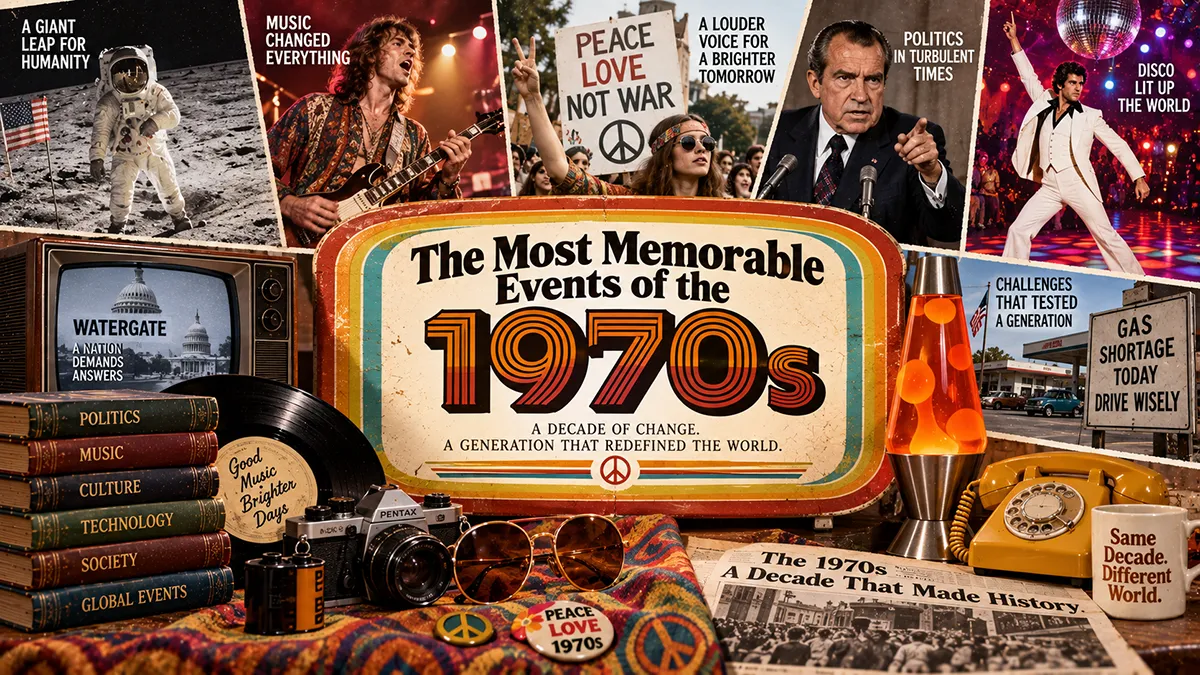
Ask ten people what the 1970s were known for and you’ll probably get ten different answers. Some will talk about bell-bottoms, disco balls, and Star Wars. Others will bring up Watergate, the Vietnam War’s bitter end, or long lines at the gas pump. That’s the thing about the 1970s — it was a decade of contradictions, where cultural celebration and political disillusionment happened side by side, a sharp departure from the more buttoned-up mood of life in the 1950s.
This guide walks through the major events of the 70’s, the political turning points, and the pop culture moments that made the decade so unforgettable. Whether you’re researching 1970s history for school, reminiscing about what was popular in the 70s, or just curious what happened in the seventies, you’ll find a comprehensive, no-fluff rundown below — and if you want to see how this decade fits into the bigger picture, check out our overview of major historical time periods and eras.
TL;DR: The 1970s were defined by political upheaval like Watergate and Vietnam’s end, landmark social change, an energy crisis, and a pop culture explosion of disco, blockbuster movies, and new technology that still shapes daily life today.
What Made the 1970s Such a Pivotal Decade
The 1970s picked up right where the turbulent 1960s left off, but with a different mood. The idealism of the previous decade gave way to something more skeptical and street-level. Americans watched a president resign, a war end in defeat, and an economy struggle through inflation and an energy crisis.
At the same time, this was a decade of genuine progress and reinvention. Civil rights gains expanded, environmental protections took root, and technology quietly laid the groundwork for the digital age. Pop culture in the 70’s exploded with disco floors, blockbuster cinema, and the first home video games, giving the decade a soundtrack and a look that still feels instantly recognizable.
Understanding the 1970s means holding both sides at once: the crisis and the creativity, the cynicism and the color. Below are the events, movements, and cultural moments that made the era so significant.
The Most Memorable Events of the 1970s
1. Kent State Shootings Intensify Anti-War Anger (1970)
In May 1970, Ohio National Guard troops opened fire on Kent State University students protesting the expansion of the Vietnam War into Cambodia. Four students were killed and nine wounded, an event that shocked the country and galvanized the anti-war movement.
It became one of the defining images of early 1970s America, showing how deeply the Vietnam War had divided the nation. Campus protests spread nationwide almost immediately afterward.
2. The Beatles Officially Split (1970)
The breakup of the Beatles in 1970 marked the symbolic end of the 1960s cultural moment. Paul McCartney’s announcement that he was leaving the band closed one chapter of pop culture and opened another.
Solo careers from Lennon, McCartney, Harrison, and Starr would go on to shape 1970s music in their own right. It’s a reminder that even the biggest cultural institutions of one decade don’t always survive into the next.
3. The Voting Age Drops to 18 (1971)
The 26th Amendment, ratified in 1971, lowered the voting age from 21 to 18 nationwide. The logic was simple and widely supported: if young men could be drafted to fight in Vietnam, they should be able to vote too.
This was one of the fastest constitutional amendments ever ratified, taking just over three months. It reshaped American elections for the rest of the decade and beyond.
4. The Watergate Scandal Begins (1972)
In June 1972, five men were arrested breaking into the Democratic National Committee headquarters at the Watergate complex in Washington, D.C. What looked like a minor burglary unraveled into the biggest political scandal in modern American history.
Investigative reporting and congressional hearings slowly exposed a web of abuse of power tied directly to President Nixon’s re-election campaign. It remains one of the most significant political events of the 1970s.
5. The Munich Olympics Massacre (1972)
The 1972 Munich Olympics were meant to showcase unity and athletic achievement. Instead, Palestinian militants from the group Black September took Israeli athletes and coaches hostage, resulting in the deaths of eleven Israeli team members, a German police officer, and five of the attackers.
The tragedy permanently changed how the world approached security at major international events. It remains one of the darkest moments in Olympic history.
6. Title IX Becomes Law (1972)
Title IX of the Education Amendments prohibited sex-based discrimination in federally funded education programs, including athletics. It dramatically expanded opportunities for girls and women in school sports across the United States.
The law’s effects took years to fully materialize, but its passage in 1972 is widely regarded as one of the most important legal shifts of the decade for gender equality.
7. The Paris Peace Accords and US Withdrawal From Vietnam (1973)
In January 1973, the United States, North Vietnam, South Vietnam, and the Viet Cong signed the Paris Peace Accords, officially ending direct American combat involvement in Vietnam. Combat troops withdrew from Vietnam that spring after nearly a decade of deep national division.
The war didn’t fully end for Vietnam itself, but for many Americans, this marked the beginning of the country’s long process of reckoning with the conflict.
8. Roe v. Wade Is Decided (1973)
In January 1973, the U.S. Supreme Court ruled in Roe v. Wade that the Constitution protected a woman’s right to choose to have an abortion, establishing a legal framework that would remain in place for decades. The decision became one of the most consequential and debated rulings in American legal history.
It sparked ongoing political and social debate that continued to shape American politics for the rest of the century and beyond.
9. The OPEC Oil Embargo and Energy Crisis (1973)
In late 1973, OPEC nations imposed an oil embargo on the United States and other countries in response to their support of Israel during the Yom Kippur War. Gas prices spiked, fuel shortages led to long lines at filling stations, and many states introduced rationing measures.
The crisis reshaped American attitudes toward energy consumption and pushed automakers toward smaller, more fuel-efficient cars. It’s one of the clearest examples of how global politics reshaped everyday American life in the 1970s.
10. Nixon Resigns the Presidency (1974)
Facing near-certain impeachment over the Watergate scandal, Richard Nixon announced his resignation on August 8, 1974, becoming the first U.S. president to resign from office. Vice President Gerald Ford was sworn in the next day and later granted Nixon a controversial pardon.
This event remains one of the biggest events of the 1970s and a defining moment in American political history, permanently altering public trust in government.
11. The Fall of Saigon Ends the Vietnam War (1975)
On April 30, 1975, North Vietnamese forces captured Saigon, and the South Vietnamese government surrendered. Images of helicopters evacuating people from the U.S. embassy rooftop became some of the most iconic and sobering photographs of the decade.
The fall of Saigon marked the definitive end of the Vietnam War, a conflict that had shaped American politics and culture since the 1960s.
12. Microsoft Is Founded (1975)
Bill Gates and Paul Allen founded Microsoft in 1975, initially focused on writing software for early personal computers. At the time, few people could have predicted how much this small company would eventually reshape global technology.
It’s a quiet but hugely significant entry on any list of 1970s historical events, marking the start of the personal computing revolution.
13. America Celebrates Its Bicentennial (1976)
July 4, 1976, marked 200 years since the signing of the Declaration of Independence, and the United States threw a nationwide celebration. Tall ships sailed into New York Harbor, fireworks lit up cities coast to coast, and communities held parades and festivals.
After years of division over Vietnam and Watergate, the Bicentennial offered a rare moment of shared national pride in the middle of the decade.
14. Apple Computer Is Founded (1976)
Steve Jobs, Steve Wozniak, and Ronald Wayne founded Apple in a California garage in 1976. Their first product, the Apple I, was a niche hobbyist computer, but it planted the seed for what would become one of the most influential companies in history.
Alongside Microsoft’s founding the year before, this is one of the clearest signs that the 1970s quietly set the stage for the technology-driven decades that followed.
15. Star Wars Redefines Blockbuster Cinema (1977)
George Lucas’s Star Wars premiered in May 1977 and became a cultural phenomenon almost overnight. It changed how Hollywood approached merchandising, special effects, and franchise filmmaking, influencing the entertainment industry for generations.
It’s impossible to talk about entertainment in the 70s without mentioning Star Wars — it remains one of the most referenced pieces of 1970s pop culture to this day.
16. Elvis Presley Dies (1977)
Elvis Presley, one of the most influential musicians of the 20th century, died at his Graceland home in August 1977 at age 42. His death shocked fans worldwide and marked the end of an era for early rock and roll.
Decades later, his influence on music and pop culture from the 70s remains impossible to overstate.
17. The Camp David Accords Are Signed (1978)
In September 1978, President Jimmy Carter brokered a historic peace framework between Egyptian President Anwar Sadat and Israeli Prime Minister Menachem Begin at Camp David. It led to a formal peace treaty between Egypt and Israel the following year, the first of its kind between Israel and an Arab nation.
The accords stand out among 1970s world events as a genuine diplomatic breakthrough during an otherwise tense decade for international relations.
18. The Jonestown Massacre (1978)
In November 1978, over 900 members of the Peoples Temple cult died in Jonestown, Guyana, in a mass murder-suicide ordered by cult leader Jim Jones. It remains one of the largest mass deaths of American civilians in a single incident in modern history.
The tragedy prompted widespread public reckoning with the influence of cult movements during the decade.
19. The Iran Hostage Crisis Begins (1979)
In November 1979, Iranian militants stormed the U.S. Embassy in Tehran and took 52 American diplomats and citizens hostage, holding most of them for 444 days. The crisis dominated headlines through the end of the decade and into the early 1980s, becoming a defining moment in U.S.–Middle East relations.
It’s frequently cited as one of the most significant events closing out the 1970s and shaping the tone of American foreign policy afterward.
20. The Three Mile Island Nuclear Accident (1979)
In March 1979, a partial meltdown at the Three Mile Island nuclear plant in Pennsylvania became the most serious commercial nuclear accident in U.S. history at that point. While studies found limited direct health effects, the incident badly shook public confidence in nuclear energy.
It remains a landmark moment in the history of American energy policy and environmental awareness.
21. The Sony Walkman Launches (1979)
Sony released the Walkman in Japan in 1979, letting people listen to music on cassette tapes wherever they went for the first time. It quietly revolutionized how people experienced music in public and previewed the personal technology boom to come.
It’s a small but telling example of how everyday life and technology were shifting fast by the end of the decade.
22. Margaret Thatcher Becomes UK Prime Minister (1979)
While the United States dealt with its own political turbulence, Britain elected Margaret Thatcher, one of history’s most powerful women, as its first female prime minister in 1979. Her rise marked a significant shift toward conservative economic policy in the UK that would influence Western politics well into the 1980s.
It’s a good reminder that 1970s world events extended far beyond America’s borders, with major political shifts happening across the globe.
70s Pop Culture: Disco, Blockbusters, and Everyday Style

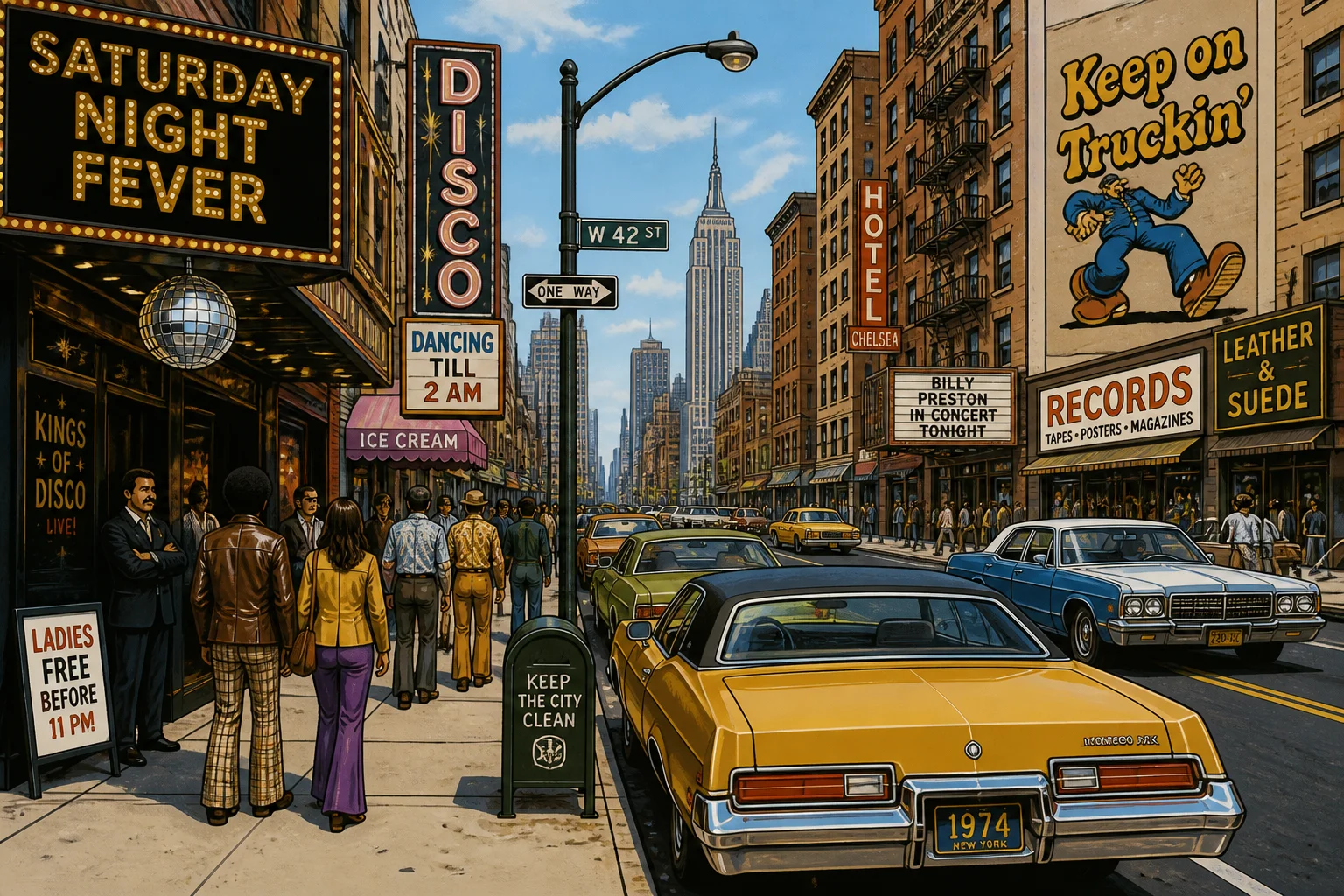
No discussion of pop culture in the 70’s is complete without disco. Born in underground clubs in the early part of the decade, disco exploded into the mainstream with movies like Saturday Night Fever and artists like Donna Summer, the Bee Gees, and ABBA dominating the charts.
Television was just as influential. Shows like All in the Family, MAS*H, and Happy Days tackled everything from social issues to nostalgic comfort viewing, often in the same TV season. Sesame Street, which debuted in 1969, became a fixture of American childhood throughout the decade.
Fashion in the 70s leaned bold: bell-bottoms, platform shoes, leisure suits, and wide collars defined the look of the era. Combined with feathered hairstyles and mood rings, 70s style has become an instantly recognizable aesthetic that pop culture continues to reference and revive today.
Technology and Everyday Life in the 1970s
Beyond Microsoft and Apple, the 1970s saw major shifts in how ordinary people lived. Video games entered living rooms with Pong and the Atari 2600, kicking off the home gaming industry that would grow into a multibillion-dollar business.
The energy crisis pushed changes to everyday habits, from lower highway speed limits to smaller cars. Meanwhile, the rise of cable television, early computers, and personal audio devices like the Walkman hinted at the more connected, tech-driven decades still to come.
Household life also shifted with more women entering the workforce and evolving family structures reflected in sitcoms and news coverage alike. These weren’t headline-grabbing events, but they quietly reshaped daily American life just as much as the political news did.
Political and Social Movements That Defined the Decade
The 1970s were a hotbed of activism building on the momentum of the 1960s. The women’s liberation movement gained major legislative ground with Title IX and continued to push for equal rights, including the (ultimately unratified) Equal Rights Amendment.
Environmentalism also came into its own. The first Earth Day was held in 1970, and the decade saw the creation of the U.S. Environmental Protection Agency along with landmark laws like the Clean Air Act and Endangered Species Act.
LGBTQ+ rights activism grew rapidly following the Stonewall uprising of 1969, with pride marches and advocacy organizations expanding through the decade. Native American activism, disability rights advocacy, and continued civil rights organizing also marked the era’s broader push for social change.
Why the 1970s Still Resonate Today
It’s easy to see the 1970s as simply the decade sandwiched between the revolutionary 1960s and the flashy 1980s. But look closer, and it’s clear the seventies did some of the heaviest lifting in shaping the modern world.
Watergate reshaped how Americans view political power and press accountability. The Vietnam War’s end changed U.S. foreign policy for a generation. And the quiet founding of companies like Apple and Microsoft in someone’s garage or dorm room ended up defining the technology most of us use every single day.
Add in a soundtrack of disco and classic rock, a wardrobe of bell-bottoms and platform shoes, and blockbuster films that changed how movies get made, and you have a decade that was equal parts crisis and creativity. That combination is exactly why the 1970s remain endlessly fascinating to revisit.
Frequently Asked Questions
What were the major events of the 70’s?
The major events of the 70's include the Kent State shootings, the Watergate scandal and Nixon's resignation, the end of the Vietnam War, Roe v. Wade, the 1973 OPEC oil embargo, the Camp David Accords, the Jonestown massacre, and the Iran hostage crisis. Pop culture milestones like the Star Wars premiere and the rise of disco are often included alongside these political and social turning points.
What happened in 1970 in American history?
In 1970, the Kent State shootings occurred after National Guard troops fired on anti-war protesters, killing four students. That same year, the Beatles officially broke up, and the first Earth Day was held, marking the start of the modern environmental movement in the United States.
What was the 70s known for?
The 70s are best known for major political upheaval like Watergate and the Vietnam War's end, alongside a vibrant pop culture scene featuring disco music, bell-bottom fashion, and blockbuster films like Star Wars. It was also a decade of significant social change, including the women's rights and environmental movements.
What war happened in the 70s?
The Vietnam War, which had begun in the 1950s, dominated the early 1970s until U.S. combat troops withdrew in 1973 following the Paris Peace Accords. The war fully ended in April 1975 when North Vietnamese forces captured Saigon.
What was popular in the 70s?
Disco music, platform shoes, bell-bottom jeans, and mood rings were hugely popular in the 70s. On screen, audiences flocked to films like Star Wars and Saturday Night Fever, while television hits like MAS*H and Happy Days drew massive weekly audiences.
What was happening in 1978?
1978 saw the signing of the Camp David Accords, a landmark peace framework between Egypt and Israel brokered by President Jimmy Carter. That same year, the tragic Jonestown massacre took place in Guyana, and disco culture was at its commercial peak.
What major events happened in 1970?
Key events of 1970 include the Kent State shootings, the breakup of the Beatles, and the first Earth Day. The Vietnam War also remained a dominant and divisive issue throughout American politics and culture that year.
How did the Vietnam War affect politics during the 1970s?
The Vietnam War deeply shaped politics during the 1970s, fueling widespread protests, the lowering of the voting age to 18, and growing public distrust of government institutions. Its unpopular and drawn-out conclusion in 1975 influenced U.S. foreign policy decisions for years afterward.

Alex Warren
Related Articles