

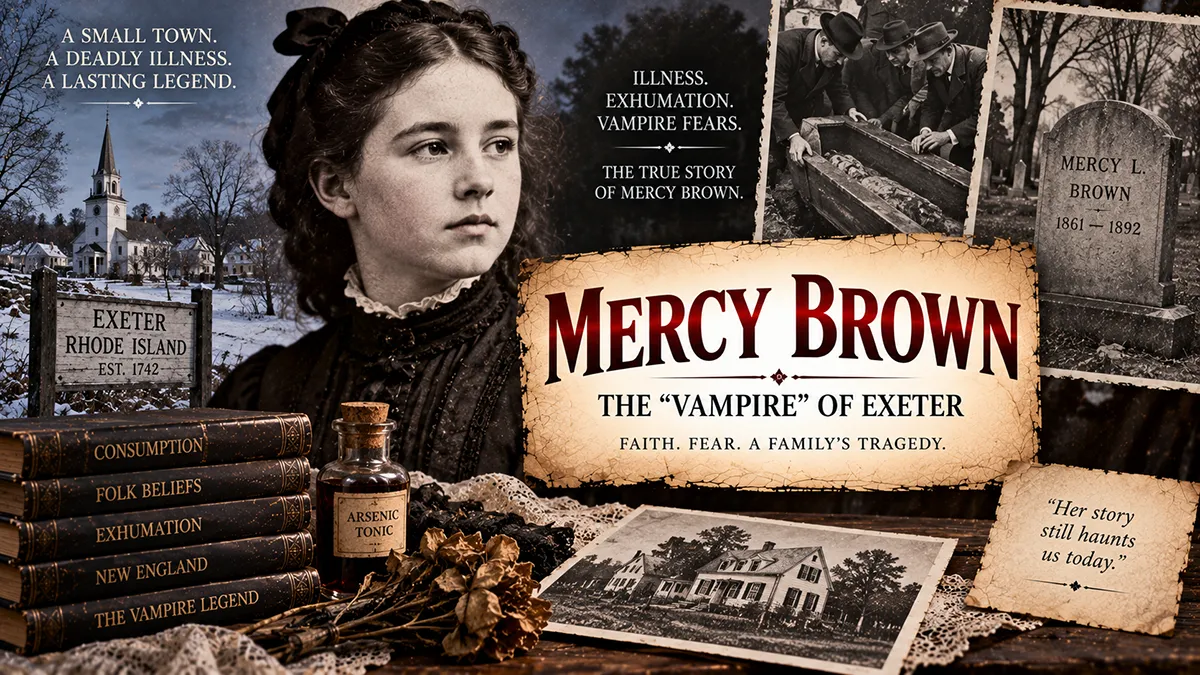
In the winter of 1892, a small farming community in Exeter, Rhode Island did something that sounds like it belongs in a horror novel. Neighbors dug up the bodies of a mother and her two daughters, cut open the chest of the most recently deceased, and burned her heart and liver to ash.
The girl at the center of it all was nineteen-year-old Mercy Lena Brown, and her story would go on to become the most famous vampire case in American history.
TL;DR: Mercy Brown was a real Rhode Island teenager who died of tuberculosis in 1892 and was exhumed by fearful neighbors convinced she was draining the life from her surviving brother, a case now known as the Mercy Brown vampire incident.
This is not a ghost story dreamed up for Halloween. It’s a documented historical event, covered by newspapers of the day, rooted in genuine grief, bad science, and a folk belief system that had been quietly circulating through rural New England for over a century. Let’s separate what actually happened from what legend has added along the way.
Who Was Mercy Brown?
Mercy Lena Brown was born around 1873 in Exeter, Rhode Island, a rural farming town southwest of Providence. She was the daughter of George T. Brown, a local farmer, and lived an otherwise unremarkable life typical of a young woman in 19th-century New England. Searches for “mercy l brown” or “mercy lena brown” usually turn up the same person, since her middle name, Lena, is how she’s formally identified on genealogical and cemetery records.
Her death at just nineteen years old was, by itself, tragically common for the era. What made her case extraordinary was everything that happened to her body after she died, and the community panic that led up to it.
Some modern searchers even mistype her name as “marcy brown” or garble her name into “mercy myrtle,” likely a mix-up with her middle name Lena or simple mishearing of the story passed around campfires and podcasts. Either way, they’re almost always looking for the same Exeter, Rhode Island teenager.
The Brown Family’s Run of Tragedy
To understand why Mercy Brown was exhumed, you have to understand what had already happened to her family. Consumption, the 19th-century name for tuberculosis, had torn through the Browns for nearly a decade before Mercy died. It wasn’t an isolated loss; it was a slow-motion catastrophe that the family and their neighbors watched unfold in real time.
Mercy’s mother, Mary Eliza Brown, died of consumption in December 1883. The following year, in June 1884, Mercy’s older sister Mary Olive Brown died of the same disease. Then, in early 1892, Mercy herself grew ill and died on January 17, 1892, after a rapid decline that some accounts describe as an unusually aggressive, “gallery” form of the disease.
Meanwhile, Mercy’s brother, Edwin Brown, was also sick with consumption and getting weaker by the week. In a household that had already buried a wife and two daughters to the same illness, fear and desperation were running high. Neighbors began to talk, and their theory wasn’t medical. It was folkloric.
Consumption, Fear, and the Logic of the ‘Vampire’
Germ theory existed by 1892, but it hadn’t fully filtered down into the daily beliefs of every rural community, and tuberculosis was still poorly understood by ordinary people watching entire families waste away.
What they saw was a pattern: one family member died, then another close to them sickened and died the same way, seemingly drained of life. In the absence of a clear medical explanation, some New England communities reached for an older folk belief instead.
The idea wasn’t quite the fanged, coffin-dwelling vampire of Bram Stoker’s novel. Instead, rural New England folklore held that a deceased family member, especially one who had died of consumption, could continue to drain vitality from surviving relatives, causing them to sicken in turn.
The remedy prescribed by this folk tradition was to exhume the body, examine it for signs that it was somehow still “feeding,” and if suspicious signs were found, to burn the heart and sometimes other organs.
This wasn’t unique to the Browns or even to Rhode Island. Similar cases had already played out earlier in Exeter itself, in nearby Rhode Island towns like Foster, and across Connecticut and Vermont throughout the 1700s and 1800s. Mercy Brown’s case simply happened late enough, and was documented well enough, to become the one history remembers best.
The Exhumation at Chestnut Hill
By March 1892, Edwin Brown’s condition had worsened, and pressure from concerned neighbors and relatives convinced George Brown to allow an exhumation.
On March 17, 1892, a group that included neighbors, a local doctor, and a newspaper reporter gathered at the Chestnut Hill Baptist Church Cemetery in Exeter to dig up the bodies of Mary Eliza, Mary Olive, and Mercy Brown.
The first two exhumations found exactly what you’d expect after eight and nine years in the ground: skeletal remains in advanced decomposition, showing no unusual signs whatsoever. Mercy’s body, however, was a different story, and it’s the detail that turned a private family tragedy into a national news item.
Mercy had died only about two months earlier, in the depths of a New England winter, and her body had been kept in an above-ground receiving tomb rather than buried immediately in frozen ground.
When her coffin was opened, her body was still largely intact, and according to the accounts of those present, some blood was still found in her heart and liver. To grieving, frightened neighbors already primed to look for signs of the supernatural, this looked like proof.
What the ‘Evidence’ Actually Meant
Here’s where the myth-busting matters most. A local physician, Dr. Harold Metcalf, was present at the exhumation and reportedly told the group exactly what was really going on: Mercy’s body was well-preserved because of the cold weather and the conditions of her storage, not because of any supernatural cause.
Bodies kept in cold, above-ground vaults during winter decompose far more slowly than those buried in the ground during warmer months, a straightforward fact of basic physiology and thermodynamics.
Unfortunately, Dr. Metcalf’s explanation didn’t stop what happened next. The group removed Mercy’s heart and liver, burned them on a rock near the cemetery, and mixed the ashes with water to create a folk remedy. Edwin Brown, still gravely ill, was reportedly given this mixture to drink in hopes it would cure him.
It didn’t work. Edwin Brown died of tuberculosis about two months later, on May 2, 1892, despite the ritual performed on his sister’s remains. The tragedy that had already claimed three members of the Brown family claimed a fourth before that spring was over.
How the Story Became National News
What sets the Mercy Brown vampire incident apart from earlier, similar New England cases is documentation. The Providence Journal covered the exhumation just two days later, on March 19, 1892, under a headline describing the exhumation as a test of “a horrible superstition.”
That framing is worth noting, because even at the time, the newspaper treated the ritual with a degree of skepticism rather than presenting it as confirmed vampirism.
The story spread beyond Rhode Island, picked up by other regional papers curious about the strange ritual playing out in a small farming town. It’s precisely this contemporary news coverage that allows historians today to reconstruct the case with more confidence than earlier, less-documented New England vampire panics from the 1700s and early 1800s.
Mercy Brown and the Bram Stoker Connection
One detail that fuels a lot of the modern fascination with Mercy Brown is her possible link to Bram Stoker’s Dracula, published five years later in 1897.
Researchers examining Stoker’s surviving notes have found a newspaper clipping referencing the Mercy Brown case among his research materials, now held at Rockefeller Library at Brown University.
This is a genuinely documented connection, not internet folklore. However, it’s important to be precise about what it does and doesn’t prove.
Having a clipping in his research files shows Stoker was likely aware of the case while working on Dracula, but there’s no direct evidence that Mercy Brown specifically inspired any particular character, scene, or plot point in the novel.
Stoker drew from a wide range of European vampire folklore, Eastern European legends, and gothic fiction predating his own work by decades.
The most honest way to describe the connection is that Mercy Brown’s story was likely one ingredient among many that fed into Stoker’s broader research, rather than the singular inspiration for Dracula itself.
Mercy Brown’s Grave Today
Mercy Brown’s grave remains in the Chestnut Hill Baptist Church Cemetery in Exeter, Rhode Island, sometimes listed on historical cemetery registries as Historical Cemetery Exeter #22. It has become something of a pilgrimage site for people fascinated by New England folklore, true crime history, and the broader American vampire legend.
That popularity has come with real costs. Visitors have chipped pieces off her original headstone as souvenirs over the decades, prompting preservation efforts and repairs to protect what remains of the historic marker. Anyone visiting the mercy brown grave today should treat it as what it is: a real cemetery holding the remains of a real teenager and her family, not a roadside attraction.
Local historical societies and cemetery preservation groups have occasionally had to remind visitors that the site deserves the same respect as any other historic grave. Reports of flowers, coins, and small trinkets left at the headstone are common, a modern echo of how seriously people still take her story more than a century later.
The ‘Lady in Brown’ Legend
Alongside the documented historical facts, a separate ghost story has grown up around Exeter’s rural roads: the “Lady in Brown.” According to local legend, a woman in a brown or dark dress has been spotted walking along roads near Exeter’s old cemeteries at night, sometimes said to vanish when approached.
It’s worth being clear-eyed about this one. The “Lady in Brown” is a piece of local ghost lore, likely inspired by or blended with the Mercy Brown story because of the surname coincidence, rather than a documented historical account tied to any verified sighting or record.
It sits in the same category as many regional ghost legends: a colorful piece of folklore that adds atmosphere to the historical case but isn’t itself part of the verified 1892 record.
Rhode Island’s Wider Vampire Panic
Mercy Brown wasn’t an isolated incident, and understanding that context is key to telling her story honestly. New England, and Rhode Island in particular, experienced a string of similar cases stretching back to at least the late 1700s, largely driven by tuberculosis outbreaks within tightly connected rural families.
One of the earliest and most severe cases involved the Tillinghast family of Exeter in the 1790s, where a farmer reportedly lost several children to consumption and came to believe one deceased daughter was preying on the others. Similar exhumation rituals were documented in Foster, Rhode Island, and across the border in Connecticut and Vermont throughout the 19th century.
A notable Connecticut case came to light through archaeology rather than newspapers. In the 1990s, excavation of an abandoned family cemetery in Griswold, Connecticut, uncovered a skeleton, nicknamed “JB-55,” whose ribcage had been deliberately rearranged after death in a pattern consistent with the same anti-vampire folk ritual.
So while Rhode Island vampire lore often centers on Mercy Brown, she represents the last and most publicized chapter of a much older regional tradition, not its origin point.
Separating the Folklore From the Facts
It’s easy for a case like this to drift into either extreme: dismissing it as a silly superstition unworthy of serious attention, or treating it as genuine evidence of the supernatural.
Neither extreme does justice to what actually happened. Mercy Brown was a real person who died of a real, well-understood disease, and the exhumation was a real folk ritual carried out by grieving, frightened people acting on the best information available to them at the time.
The “evidence” used to justify the ritual, blood in the heart and an unusually preserved body, has a fully natural explanation rooted in the season and storage conditions of her remains, exactly as Dr. Metcalf reportedly pointed out at the time.
Modern audiences sometimes want the case to be spookier than it actually is, layering on ghost sightings, curses, or supernatural embellishments that have no basis in the 1892 newspaper record. The real story is compelling enough without needing to be exaggerated.
What makes Mercy Brown’s case genuinely remarkable is the collision it represents: a centuries-old European folk belief about the restless dead, transplanted into rural New England, colliding head-on with a disease that 19th-century medicine still couldn’t fully explain or treat. That collision, not any actual vampirism, is the real history worth remembering.
Why the Mercy Brown Story Still Resonates
More than 130 years later, the mercy brown vampire incident remains one of the most searched and retold pieces of American folklore history, and it’s easy to see why.
It has all the ingredients of a great story: a real grave you can visit, a documented newspaper account, a tragic family history, and a tantalizing, if unproven, link to one of the most famous novels ever written.
It also offers something more valuable than a good scare: a window into how communities cope with incomprehensible loss.
The Brown family’s neighbors weren’t cruel or foolish; they were desperate people using the only framework available to them to make sense of a disease that was killing their friends and family with no visible cause.
Tuberculosis alone claimed an estimated one in seven of all deaths in the United States and Europe during the 19th century, making it a far more prevalent “monster” than any vampire.
Mercy Brown’s story endures because it captures that fear so vividly, preserved in a real cemetery, a real newspaper clipping, and a real family’s grief. Approaching her story with curiosity and respect, rather than sensationalism, is the best way to honor what actually happened in Exeter in the winter of 1892.
Visiting Responsibly
If you’re planning to visit the Chestnut Hill Baptist Church Cemetery in Exeter, Rhode Island, it helps to remember this is an active historic cemetery, not a tourist installation. Local preservation groups ask visitors to avoid touching or removing anything from Mercy Brown’s headstone, given the damage past visitors have already caused.
Respectful visits, quiet observation, and leaving the site exactly as you found it help ensure this piece of history remains accessible for future generations of curious travelers and researchers. It’s a small gesture, but one that matters for preserving a genuinely important piece of American folklore history.
Frequently Asked Questions
What was the Mercy Brown vampire incident?
The Mercy Brown vampire incident refers to the March 1892 exhumation of Mercy Brown and two of her deceased family members in Exeter, Rhode Island. Fearful that a dead relative was causing her surviving brother Edwin's tuberculosis, neighbors dug up the bodies, found Mercy's remains unusually well-preserved due to cold winter storage, and burned her heart and liver in a folk ritual meant to cure Edwin. He died of tuberculosis anyway about two months later.
Who was Mercy Brown?
Mercy Lena Brown was a nineteen-year-old woman from Exeter, Rhode Island, who died of tuberculosis (then called consumption) on January 17, 1892. She became the central figure in New England's most famous documented vampire panic after her exhumed body appeared unusually preserved, leading neighbors to believe she was supernaturally draining her brother's health.
Was Mercy Brown actually a vampire?
No. There is no credible historical evidence that Mercy Brown was a vampire in any supernatural sense. The well-preserved condition of her body at exhumation had a natural explanation: she had been dead only about two months and stored above ground during a cold New England winter, which slows decomposition significantly.
Where is Mercy Brown’s grave located?
Mercy Brown is buried in the Chestnut Hill Baptist Church Cemetery in Exeter, Rhode Island, sometimes listed as Historical Cemetery Exeter #22. The site is a real, active historic cemetery and visitors are asked to treat the grave and headstone with care and respect.
Did Mercy Brown inspire Bram Stoker’s Dracula?
It's possible but unconfirmed. A newspaper clipping about the Mercy Brown case was found among Bram Stoker's research notes, held at Brown University, showing he likely knew of the case while writing Dracula in the mid-1890s. However, there's no direct evidence she specifically inspired any character or scene, since Stoker drew from many European vampire traditions.
What is the ‘Lady in Brown’ legend?
The 'Lady in Brown' is a local Rhode Island ghost story describing a woman in a dark dress reportedly seen walking near cemeteries around Exeter at night. It is a separate piece of folklore, likely linked in popular imagination to Mercy Brown's surname, rather than a documented part of the 1892 historical record.
Why do some people search for ‘Mercy Myrtle’ or ‘Marcy Brown’?
These are common misspellings or misrememberings of Mercy Brown's name. Her actual middle name was Lena, so 'Mercy Myrtle' appears to be a mix-up of that detail, while 'Marcy Brown' is simply a frequent typo of 'Mercy Brown.'

Alex Warren
Related Articles





