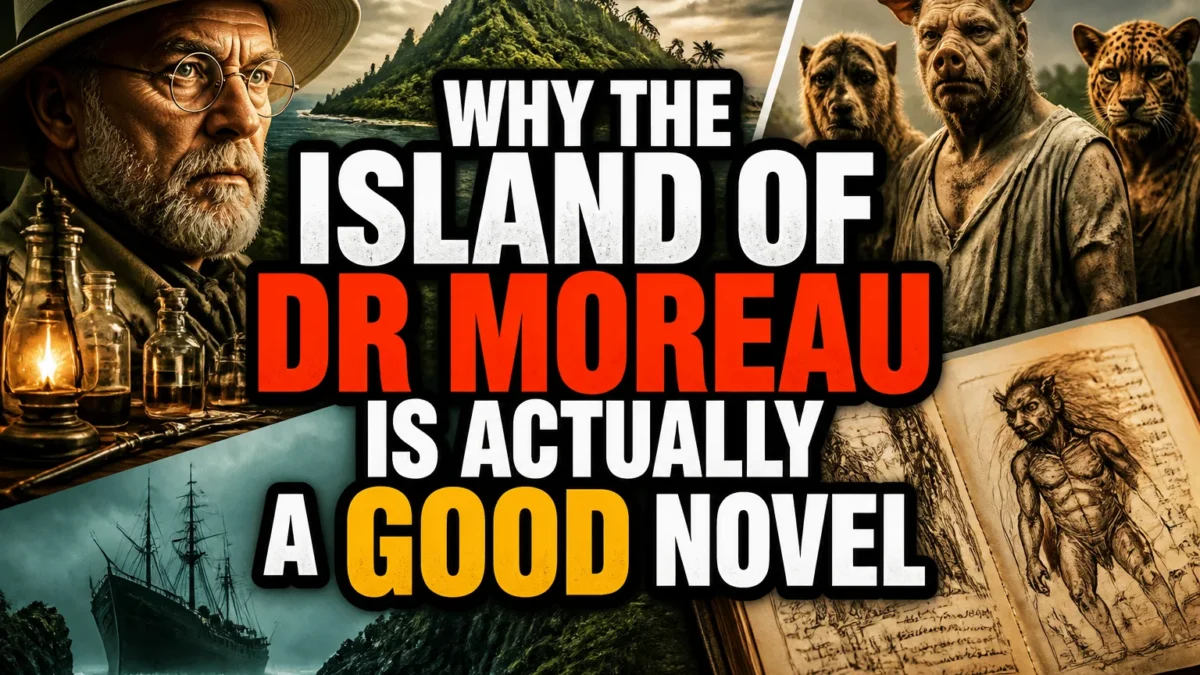
Few books in the science fiction canon get as unfairly dunked on as The Island of Dr Moreau. Mention it in a bookstore and someone will inevitably bring up one of the terrible film adaptations, not the lean, unsettling novel H.G. Wells published in 1896. That reputation problem is exactly why it's worth revisiting the actual text.
Wells wrote this book before The War of the Worlds and before the twentieth century decided what science fiction was supposed to look like. What he produced is short, strange, and far more philosophically loaded than its B-movie afterlife suggests. This piece walks through why the island is a genuinely good novel, what it's really about, and what most casual summaries get wrong.
TL;DR: The Island of Dr Moreau is a tightly constructed 1896 fable about cruelty, evolution, and human arrogance whose ideas have outlived every flawed film version of it.
The Reputation Problem: Why So Many Readers Underrate It
Most people who think they know The Island of Dr Moreau have never actually read it. They've seen a poster, a clip, or a review of one of the movie versions, and they've absorbed a vague idea that the book is cheap shock material. That assumption does real damage to the novel's standing, because the book is doing something much more deliberate than gore for its own sake.
The bigger issue is timing. Wells wrote this novel early in his career, right as he was inventing and defining a genre that didn't yet have a name. Readers expecting the polished plotting of a modern thriller often bounce off the book's spare, almost clinical prose and its grim, unresolved ending.
Then there's the adaptation problem in its most extreme form. The 1996 film version is legendary less for its story than for its chaotic production, and that notoriety has effectively replaced the book in the public imagination. A novel shouldn't be judged by a film it never asked to become.
What the 2021 Edition Changed (and Why It Mattered)
Search interest in "the island of dr moreau 2021" usually leads to a specific edition rather than a new story. In 2021, Penguin Classics published a new edition of the novel with an introduction by novelist China Miéville. That edition put the book back in front of serious literary readers and reframed it as a text about power, bodies, and control.
This matters because the 2021 framing pushed back on decades of genre snobbery. Miéville's introduction connects the novel's vivisection imagery to real Victorian anxieties about animal experimentation and empire. Readers who picked up that edition often came away startled by how modern the book feels.
What Is The Island of Doctor Moreau Actually About?
Strip away the horror-movie baggage and the plot is simple and brutal. A shipwrecked Englishman named Edward Prendick is rescued at sea and eventually deposited on a remote island in the Pacific. There he discovers that a physiologist, Dr. Moreau, has been surgically reshaping animals into humanlike forms.
The creatures Moreau produces are called Beast Folk, and they live under a set of recited laws designed to suppress their animal instincts. Prendick slowly realizes that Moreau is not a misunderstood genius but a man conducting suffering without consent, purely to satisfy his own curiosity. The novel ends with Prendick's rescue and a return to England he can no longer tolerate.
That's the answer to "what is the island of doctor moreau about" at the plot level, but the book means far more than its premise. Wells is asking what happens when intelligence is unmoored from ethics, and whether the line between human and animal is as firm as we like to believe.
How to Summarize the Novel Without Flattening It
Any summary of the island of dr moreau risks turning a disturbing story into a tidy moral. The short version: a scientist isolates himself on an island, performs invasive experiments on animals to make them humanlike, and is eventually killed by the creatures he mutilated. Prendick survives, but his view of humanity never recovers.
What a plot summary can't capture is the book's relentless atmosphere. Wells builds dread through small details, like the Beast Folk's whispered recitation of the Law and Prendick's growing suspicion that the island's rules are already collapsing. The tension isn't about jump scares; it's about the slow realization that no one here is truly in control.
There's also a structural cleverness worth noting. The story is framed as a discovered account, which lends it a documentary, almost forensic feel. That device lets Wells make the reader complicit, turning us into someone reading about atrocities long after they happened.
The Plot Beats Readers Remember Most
Certain scenes in the book tend to stick with people long after they finish it. The moment Prendick first hears the creatures in the jungle, half-human sounds that don't fit any category, is a masterclass in unease. The revelation of what Moreau actually does in his laboratory is delivered with restraint rather than gratuitous detail.
The Law itself is another unforgettable element. The Beast Folk chant rules like "Not to go on all fours" and "Not to eat meat," mantras meant to keep their animal nature suppressed. Those chants are both darkly funny and deeply sad, and they capture the novel's central tension between instinct and imposed order.
Why the Science Still Resonates

Wells trained as a biologist under T.H. Huxley, a major Victorian advocate of evolutionary theory, and that background shows on every page. The novel engages seriously with the scientific debates of its era, including the emerging understanding of heredity and the ethics of experimentation on living creatures. It isn't fantasy dressed as science; it's science turned into nightmare.
The book's central question, whether an organism can be fundamentally reshaped into something else, has only become more relevant. Modern conversations about gene editing, cloning, and animal testing echo Moreau's controversies almost verbatim, minus the island. Wells anticipated the moral unease that accompanies every new biological capability.
What makes the science work as fiction is that Wells never overexplains it. He gives you just enough Victorian physiology to make the horror plausible, then lets your imagination do the rest. That restraint is why the novel still feels dangerous rather than dated.
The Real Target: Cruelty and the Cost of Curiosity
Moreau is one of literature's great villains precisely because he doesn't see himself as one. He is curious, patient, and utterly indifferent to the pain he causes, which makes him far scarier than any cackling madman. Wells based the character partly on the cultural fear of scientists who treat living creatures as raw material.
The novel's cruelty isn't just on the doctor's operating table. It also indicts Prendick, whose first instinct is often self-preservation, and the wider society that produced a man like Moreau in the first place. In that sense, the book is less about a monster than about the system that allows monsters to work undisturbed.
This is why the ending matters so much. Prendick doesn't return home to a comfortable moral order; he returns to a society he can no longer distinguish from the Beast Folk. The implication is uncomfortable and unforgettable. We are all only a few removed habits away from the things Moreau made.
The Law of the Beast Folk and the Illusion of Control
Moreau's authority depends on ritual repetition, not genuine transformation. The Beast Folk obey the Law because they've been conditioned to, and the moment their instincts resurface the entire system becomes fragile. Wells uses this to suggest that control over living things is always temporary and often delusional at the scale Moreau attempts.
The novel's politics are inseparable from its biology here. Victorian Britain ruled a vast empire partly through elaborate displays of order, and Moreau's island is a miniature version of that same logic taken to its extreme. The Law is a colonial catechism, and it fails exactly the way imposed rule eventually does.
For modern readers, this thread is what elevates the book from creature feature to genuine literature. It's not interested in whether the Beast Folk are monsters. It's interested in what happens to the people who decide they have the right to make them.
What a Careful Island of Dr Moreau Review Gets Right
A good review of the island of dr moreau tends to focus less on shock value and more on structure. The novel is short, tightly paced, and remarkably disciplined for a Victorian adventure story. There is almost no filler, and every chapter advances the creeping sense that something fundamental has gone wrong with the natural order.
Critics also consistently praise the ending, which refuses to offer easy consolation. Wells doesn't let Prendick recover, and he doesn't let the reader off the hook either. That bleakness is a feature, not a flaw, and it's a big part of why the book has survived while dozens of its contemporaries have faded.
The one legitimate criticism a fair review might raise is that some of Wells's prose feels old-fashioned to contemporary eyes. But the same charge applies to most 1890s fiction, and it has little to do with whether the story still works today. It does.
Common Misconceptions That Spoil the Book's Reputation
A recurring myth is that the novel is primarily a gorefest. In truth, Wells is remarkably restrained, and the most disturbing moments are implied rather than depicted. The horror lives in implication, which is precisely why the book remains effective.
Another misconception is that Moreau is presented as a misunderstood visionary. He isn't. Wells makes clear that the doctor's methods are unjustifiable, even as he lets Moreau articulate his own logic. That nuance is often lost in adaptation, where villains tend to become simpler.
A third error is treating the novel as a simple warning about technology. That reading isn't wrong, exactly, but it undersells the book. Wells is at least as interested in cruelty, empire, and the psychology of control, which is what makes the story feel like more than a fable about science.
How the Book Compares to Wells's Other Novels
The Island of Dr Moreau sits between The Time Machine and The War of the Worlds, and it shares DNA with both. Like The Time Machine, it uses a speculative premise to examine social hierarchy, and like The War of the Worlds, it turns a scientific idea into visceral drama. It's arguably the darkest and most intimate of the three.
What sets it apart is scale. Wells's other novels often operate on a grand, civilizational canvas, whereas Moreau confines itself to one island and a small cast. That compression makes it his most claustrophobic and, in some ways, his most psychologically precise work.
Readers who enjoy the book often go on to seek out The Invisible Man and The Time Machine for the same reason. Wells at his best takes one impossible idea and follows it relentlessly to its social and emotional consequences.
The Legacy: How the Novel Shaped Science Fiction
Moreau's influence on science fiction is difficult to overstate. The "mad scientist on an isolated island" template runs from pulp stories to modern horror cinema, and biopunk, body horror, and even cyberpunk owe debts to its central image. Every story about a creator who loses control of his creations is in conversation with Wells.
The novel also helped establish a durable ethical question for the genre: what do we owe to the things we create? That question powers everything from Frankenstein riffs to debates about artificial intelligence, and Moreau asks it without offering an answer.
Its afterlife in film, comics, and radio has kept the title alive even when the adaptations have been poor. Ironically, that same afterlife is why so many people underestimate the original. The book deserves better than its adaptations, and that's increasingly what new readers discover.
Why It Still Works: A Short List of Enduring Strengths
One of the book's greatest strengths is efficiency. Wells tells a complete story of deep moral weight in a fraction of the length most modern novels would use, and he never wastes a scene. That makes it a fantastic introduction to classic science fiction for readers wary of long Victorian texts.
Another strength is its moral seriousness. The novel refuses easy villains and easy heroes, giving both Moreau and Prendick uncomfortable complexity. It's a book that respects the reader enough to leave contradictions unresolved.
Finally, its prescience keeps it alive. Every new debate about genetic engineering, animal suffering, or the responsibilities that come with scientific power makes the novel feel more current, not less. That's the strongest possible sign that a book has earned its place.
Should You Read It? A Fair Assessment for Modern Readers
If you like short, idea-dense books that linger in your mind, The Island of Dr Moreau is an easy recommendation. It's roughly the length of a novella, readable in a weekend, and it rewards rereading because its themes deepen once you know how the story ends. It is not a cheerful book, and it isn't meant to be.
Readers who prefer character-driven fiction might find Prendick a somewhat thin narrator, which is a fair observation. Wells is more interested in ideas and atmosphere than in richly drawn personalities, and that's a stylistic choice, not a failure.
If you've only encountered this story through a movie, the novel is worth meeting on its own terms. Start with the 2021 Penguin Classics edition if you want helpful context, or a reliable annotated edition if you prefer notes alongside the text. Either way, you'll likely finish it wondering why it took so long to read.
Final Thoughts: A Good Novel, Not Just an Important One
The Island of Dr Moreau isn't just historically important; it's a genuinely good, tightly built piece of storytelling. It asks hard questions about cruelty, identity, and scientific arrogance, and it refuses to let its readers off the hook. That combination is rare in any century.
Its reputation as a trashy shocker is a misunderstanding inherited from bad adaptations, not from the text itself. Read the book and you'll find restraint, moral complexity, and a formal control that puts most modern imitators to shame. The island is smaller than its myth, and the novel is far better than its reputation.
Frequently Asked Questions
What is the isle of dr moreau about, in simple terms?
The isle of dr moreau is about a shipwrecked Englishman, Edward Prendick, who ends up on a remote island run by the physiologist Dr. Moreau. Moreau performs invasive surgical experiments on animals to make them humanlike, creating the so-called Beast Folk, and the novel follows Prendick as he realizes the island's order is collapsing. It's a short, dark story about cruelty, scientific arrogance, and the unstable line between human and animal.
Is The Island of Dr Moreau considered a good novel?
Yes. Modern critics and literary readers generally regard it as one of H.G. Wells's strongest early novels, praising its tight structure, moral seriousness, and its prescient treatment of scientific ethics. Its reputation sometimes suffers because so many of its film adaptations have been poor, but the book itself is widely respected.
What genre is the island dr moreau book usually classified as?
It is typically classified as science fiction, and it's often described as one of the founding texts of the genre alongside Wells's The Time Machine and The War of the Worlds. It also blends elements of horror, adventure, and social satire, which is part of why it resists easy categorization.
Is the island of dr moreau 2021 a new book or a new edition?
It is a new edition. In 2021, Penguin Classics published The Island of Dr Moreau with an introduction by author China Miéville, which reframed the novel for contemporary readers. The story itself is unchanged from Wells's original 1896 text.
How long does it take to read The Island of Dr Moreau?
The novel is fairly short, similar in length to a novella, and most readers finish it in a few hours to a weekend. That compact length makes it a popular starting point for readers new to classic science fiction.
Does the island of dr moreau review well today?
Yes. Contemporary reviews of the island of dr moreau tend to emphasize its atmosphere, its ethical questions, and its disciplined pacing rather than shock value. Some critics note that its Victorian prose can feel old-fashioned, but that is rarely treated as a serious flaw.
What is a short summary of the island of dr moreau?
In a short summary of the island of dr moreau, Prendick is rescued from a shipwreck, brought to an island, and discovers that Dr. Moreau is transforming animals into humanlike creatures through cruel experiments. The Beast Folk live under a recited Law that suppresses their instincts, but the order breaks down and Moreau is killed by his own creations. Prendick is rescued but returns to England unable to see humanity the same way.
Why is the novel still relevant in the twenty-first century?
It remains relevant because its core questions about genetic engineering, animal experimentation, and the ethics of controlling living things have only become more pressing. Every new debate about biotechnology or scientific responsibility echoes the novel's central conflicts, which is why readers keep returning to it.

Alex Warren
Related Articles