

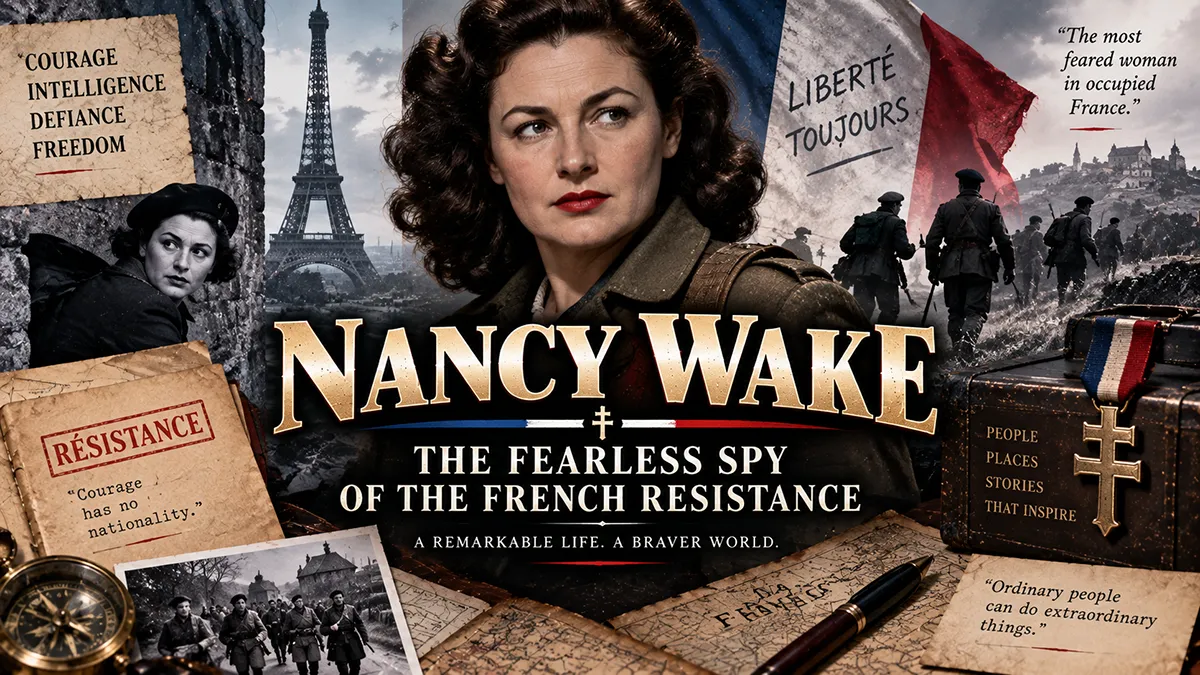
Picture a Gestapo officer slamming his fist on a desk, demanding to know why his men can’t catch one woman. That woman was Nancy Wake, a New Zealand-born adventurer turned wartime courier who slipped through Nazi checkpoints so often they gave her a nickname of grudging respect: the White Mouse.
By the time the war ended, she was one of the most decorated servicewomen the Allies produced, and one of the very few people the Gestapo genuinely feared.
Her story has been retold so many times, in books, documentaries, and even a Netflix-adjacent dramatization, that fact and legend have started to blur together. This guide walks through who Nancy Wake really was, what she actually did with the Special Operations Executive (SOE), and how her remarkable life eventually came to an end.
TL;DR: Nancy Wake was a New Zealand-born SOE agent and French Resistance courier whose daring escapes made her the Gestapo’s most wanted spy, and she went on to become one of WWII’s most decorated Allied women before dying in London in 2011.
Who Was Nancy Wake? A Quick Answer
So, who was Nancy Wake, exactly? She was born Nancy Grace Augusta Wake on August 30, 1912, in Wellington, New Zealand, and raised mostly in Sydney, Australia. Long before the war, she was a headstrong young journalist who happened to be living in Europe when Adolf Hitler’s shadow started spreading across the continent.
When France fell in 1940, Wake threw herself into resistance work, first as a courier smuggling escaped soldiers to safety, then as a fully trained secret agent for Britain’s SOE. She’s often searched online under the misspelling “Nany Wake,” but there is only one Nancy Wake in the history books, and her real name and story are far more interesting than any typo.
Nancy Wake’s Early Life: From Wellington to the World
Nancy Wake’s early life gave few obvious hints of the danger she would later court. She was the youngest of six children, and her family relocated from New Zealand to Sydney’s North Shore when she was still a toddler. Her father eventually returned to New Zealand alone, leaving her mother to raise the children in Australia, a household Wake later described as strict and unhappy.
As a teenager, she ran away from home more than once, chasing independence rather than any grand cause. She trained as a nurse before deciding that journalism suited her restless nature far better, and by her early twenties she had saved enough money to leave Australia for good.
She traveled first to New York, then London, before settling into freelance journalism in Paris in the early 1930s. It was a decision that placed her right in the path of history.
Becoming a Journalist in a World on Fire
Working for Hearst newspapers, Wake reported from across Europe during a decade when the continent was quietly rearming for catastrophe. She traveled to Vienna and Berlin in the early 1930s and witnessed Nazi street violence against Jewish citizens firsthand, an experience she later cited as the moment her politics hardened into fierce anti-fascism.
This wasn’t abstract news to her; it was something she watched happen in real streets, to real people. That early exposure to Nazi brutality shaped the choices she would make once war actually arrived on her doorstep.
Marriage, Marseille, and the Fall of France
In 1939, Wake married Henri Fiocca, a wealthy French industrialist based in Marseille. It was a glamorous match by any measure, and for a brief moment it looked like she might settle into a comfortable, ordinary life.
That plan collapsed within months. Germany invaded France in 1940, the country split into an occupied north and the collaborationist Vichy south, and Wake, living in Marseille, found herself in prime position to help.
She began working as a courier for an escape network, using her charm, her fluent French, and her willingness to take enormous risks to move money, messages, and eventually people. Her job was to help Allied airmen and escaped prisoners of war cross into neutral Spain before the Gestapo or Vichy police could catch them.
The White Mouse: How Nancy Wake Outran the Gestapo

Wake became so effective, and so consistently unreachable, that the Gestapo gave her a nickname: la souris blanche, the White Mouse. It was meant as an insult about how she kept slipping through their fingers, but it stuck as a badge of honor.
By 1943, reports vary on the exact figure, but she was reportedly one of the most wanted individuals on the Gestapo’s list in southern France, with a substantial bounty placed on her capture. Her network moved hundreds of escapees to safety before French authorities and German intelligence finally closed in on the operation.
When the escape line was betrayed, Wake had to become a fugitive herself rather than just a helper of fugitives. Her husband Henri chose to stay behind in Marseille, a decision that would carry a terrible cost.
Escape Over the Pyrenees
Getting out of France was its own ordeal. Wake made several attempts to cross the Pyrenees into Spain, and was arrested and briefly held by French police along the way before talking her way free using a cover story.
She eventually succeeded, trekking through the mountains on a route designed to avoid German patrols, and made it to Britain in 1943. She would not learn until after the war that Henri Fiocca had been captured, tortured, and executed by the Gestapo for refusing to reveal her whereabouts.
It’s a detail that’s often skipped over in the more swashbuckling retellings of her story, but it’s an essential piece of who she was. Her later ferocity as an agent came from real, personal loss.
Nancy Wake and the SOE: Training for War
Once in Britain, Wake didn’t sit out the rest of the war behind a desk. She was recruited by the Special Operations Executive, the British organization created specifically to run sabotage and resistance operations inside occupied Europe.
Nancy Wake’s SOE training was rigorous by any standard: parachute jumps, weapons handling, unarmed combat, demolitions, and clandestine radio work. Instructors reportedly noted her toughness and competitiveness, traits that had clearly been there all along, just waiting for a proper outlet.
She trained alongside a small number of other women being prepared for fieldwork in France, part of the F Section of SOE that ran networks independent of the Free French. This wasn’t ceremonial training either; agents who washed out or froze under pressure were quietly reassigned, because the real fieldwork was lethal.
Parachuting Back Into France: WW2 Nancy Wake in Action
In the spring of 1944, ahead of the D-Day landings, Wake parachuted into the Auvergne region of central France to work with the Maquis, the loosely organized bands of rural resistance fighters. Her role combined courier work, liaison duties between British command and Maquis leaders, and helping organize the delivery of weapons dropped by Allied planes.
She worked alongside SOE organizer Captain John Farmer and Maquis commander Henri Tardivat, helping coordinate a fighting force that swelled to thousands of men by the summer of 1944. When German forces destroyed her group’s codebooks in a raid, Wake reportedly cycled a punishing round trip of roughly 500 kilometers over two days to reach another radio operator and re-establish contact with London, a feat that became one of the defining stories of her wartime service.
Her unit’s Maquis fighters tied down and harassed German units in the region during the critical weeks after the Normandy invasion, disrupting reinforcements at a moment when every delay mattered. This was the sharp end of what “WW2 Nancy Wake” actually looked like in practice: not a single glamorous mission, but months of grinding, dangerous logistics work under constant threat of discovery.
Fact or Legend? The Stories That Followed Her
Nancy Wake’s own postwar memoir and later interviews are the source of some of the most dramatic stories told about her, including an account of killing a German sentry with her bare hands to protect a mission. It’s a claim that comes primarily from Wake herself and has been repeated in countless retellings since, but like many wartime special-operations stories, it isn’t independently documented in surviving official records.
That doesn’t mean it’s false, and Wake was hardly someone prone to exaggeration about her own courage; if anything, she tended to downplay danger. It simply means readers should treat it, and a handful of other especially cinematic anecdotes from her life, as her own testimony rather than settled historical fact confirmed by outside sources.
What is well documented, through SOE records and awards citations, is that she carried out sustained, high-risk resistance work over a period of years, survived direct pursuit by the Gestapo, and played a real logistical role in supporting Maquis operations in 1944. The verified record alone is impressive enough without needing embellishment.
Medals, Recognition, and a Complicated Peace

After the war, Wake was recognized by multiple Allied governments for her service. Britain awarded her the George Medal, the United States gave her the Medal of Freedom, and France awarded her the Croix de Guerre, reportedly with three palms over the years, along with other honors.
Curiously, Australia was slow to formally recognize her. It wasn’t until 2004 that she was made a Companion of the Order of Australia, a gap she pointed out publicly and with characteristic bluntness over the years.
She briefly continued intelligence-adjacent work after the war before remarrying in 1957, this time to a former RAF officer named John Forward. The couple moved to Australia, where Wake ran a hotel for a time and made a few unsuccessful attempts at entering politics, standing for a conservative party in federal elections without winning a seat.
Later Life, Struggles, and Quiet Years
Wake’s later decades weren’t especially glamorous, and that’s worth acknowledging rather than glossing over. After John Forward’s death in 1997, she eventually returned to live in Britain, and by the early 2000s her finances had grown tight enough that she made the difficult decision to sell her war medals at auction to help fund her retirement.
She spent her final years living partly on charitable support at a hotel in London, a modest ending for someone who had once been worth a literal bounty to the Gestapo. Even then, she remained sharp-tongued and unsentimental in interviews, famously unimpressed by fame and unwilling to romanticize the war she’d lived through.
How Did Nancy Wake Die?
So how did Nancy Wake die, after everything she survived during the war? She died of natural causes on August 7, 2011, at Kingston Hospital in London, at the remarkable age of 98.
Her death came peacefully, decades removed from the danger of occupied France, which is its own quiet testament to just how much she’d managed to outlast. In keeping with her wishes, her ashes were later scattered near Montluçon in the Auvergne region of France, the same countryside where she had once organized Maquis fighters and outran German patrols.
It was a fitting final resting place, returning her, in a sense, to the landscape where her wartime legend had been made.
Nancy Wake’s Legacy Today
Nancy Wake’s story continues to resonate because it resists easy categorization. She wasn’t a soldier by training, a spy by ambition, or a hero by design; she was a journalist who got angry at what she saw happening in Europe and decided to do something concrete about it.
Museums in Australia and New Zealand hold pieces of her story, biographies and documentaries keep her name circulating, and military historians still study the Auvergne Maquis operations she supported as a case study in resistance logistics. She’s frequently cited alongside other SOE women like Violette Szabo and Odette Sansom, though each of their stories played out very differently.
What set Wake apart, even among that remarkable group, was the sheer length of her exposure to danger, stretching from her early courier work in 1940 through her SOE fieldwork in 1944. Few agents operated under threat for that long and lived to tell the tale, let alone lived to tell it for another six decades afterward.
Final Thoughts
Nancy Wake’s life doesn’t need Hollywood embellishment to be extraordinary, and that’s really the myth worth busting here. The verified record, courier work under occupation, a harrowing escape over the Pyrenees, formal SOE training, and real fieldwork with the Maquis in 1944, is already the stuff of genuine history rather than legend.
Where the stories go further, like the bare-handed sentry account, they deserve to be read as her own vivid recollection rather than confirmed fact, without that caveat diminishing what she plainly did accomplish. Either way, the White Mouse earned her place as one of the Second World War’s most fearless and consequential agents.
Frequently Asked Questions
Who was Nancy Wake?
Nancy Wake was a New Zealand-born journalist who became a French Resistance courier and later a trained Special Operations Executive (SOE) agent during WWII. Known by the Gestapo as the White Mouse, she helped Allied escapees flee occupied France and later supported Maquis fighters in the Auvergne region ahead of D-Day.
What did Nancy Wake do with the SOE?
Nancy Wake trained with Britain's SOE in weapons, sabotage, and parachuting before being dropped into occupied France in 1944. She served as a courier and liaison for a Maquis resistance network, helping coordinate weapons drops and famously cycling roughly 500 kilometers to restore radio contact after codebooks were destroyed.
How did Nancy Wake die?
Nancy Wake died of natural causes on August 7, 2011, at Kingston Hospital in London, at the age of 98. Per her wishes, her ashes were later scattered near Montluçon in France's Auvergne region, where she had worked with the Maquis during the war.
What was Nancy Wake’s early life like?
Born in Wellington, New Zealand, in 1912, Nancy Wake was raised largely in Sydney, Australia, after her family relocated when she was a toddler. She left home as a teenager, trained briefly as a nurse, then moved into journalism, eventually working as a freelance reporter across Europe in the 1930s.
Is “Nany Wake” a different person from Nancy Wake?
No, "Nany Wake" is simply a common misspelling of Nancy Wake, the WWII resistance courier and SOE agent. There is only one historical figure behind the name.
Did Nancy Wake really kill a German sentry with her bare hands?
This story comes primarily from Nancy Wake's own postwar accounts and memoir rather than independently verified official records. It may well be true given the nature of her fieldwork, but historians generally treat it as her personal testimony rather than confirmed documented fact.
What awards did Nancy Wake receive for her wartime service?
Nancy Wake received Britain's George Medal, the United States' Medal of Freedom, and France's Croix de Guerre, among other honors. Australia recognized her much later, appointing her a Companion of the Order of Australia in 2004.

Alex Warren
Related Articles





