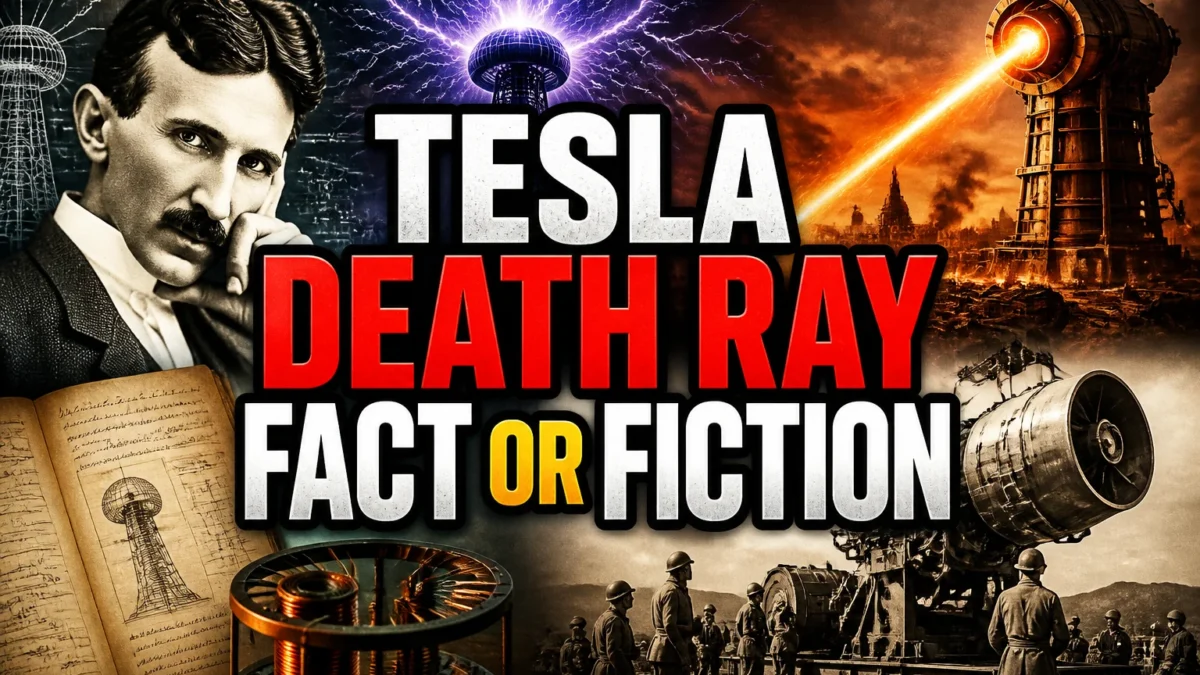
Nikola Tesla is one of history's most fascinating and misunderstood figures. His genuine contributions to electrical engineering transformed the modern world, but his later years were marked by increasingly fantastical claims. Among the most enduring is the idea that he invented a "death ray" capable of destroying armies and aircraft from hundreds of miles away.
The story of the Tesla death ray sits at the intersection of real science, Cold War paranoia, and the public's appetite for genius-madman mythology. Understanding what Tesla actually proposed, what he built, and what remained speculation is essential to separating fact from fiction.
TL;DR: Tesla never built or demonstrated a working death ray, but he did genuinely propose a particle-beam weapon concept in the 1930s that influenced later military research and remains unproven to this day.
What Was Tesla's Death Ray?
The term "death ray" was not coined by Tesla himself. It emerged in the early 20th century as a popular phrase for any directed-energy weapon that could supposedly kill at a distance. Newspapers and pulp fiction of the 1920s and 1930s used the phrase freely, blurring the line between science and sensationalism.
Tesla's version was different from the ray guns of science fiction. He described a device that would accelerate microscopic particles to enormous speeds and project them in a narrow beam. This was not a laser or a heat ray, but an early conceptual ancestor of what we now call a particle-beam weapon.
He called it a "teleforce" or "peace ray," and he insisted it was purely defensive. According to Tesla, it could bring down aircraft and stop invading armies at a nation's borders, making war obsolete by making offense impossible. Whether he ever had the engineering to build it is another matter entirely.
1. Tesla's Early Reputation Was Built on Real Genius
Before any death ray talk, Tesla earned his fame through legitimate, world-changing inventions. His alternating current (AC) induction motor and polyphase system formed the backbone of modern electrical grids. The 1893 World's Columbian Exposition in Chicago showcased AC power to millions, cementing his reputation.
His work on wireless power transmission and radio-frequency oscillators was genuinely ahead of its time. The Tesla coil, still used in classrooms and laboratories today, came from this period of intense experimentation. These real achievements made it easier for the public to believe almost anything he later claimed.
That credibility is precisely why the death ray story took hold. A lesser inventor's claims might have been dismissed outright, but Tesla had already proven he could think decades ahead of his peers.
2. The Particle Beam Concept Was Scientifically Plausible in Theory
Tesla's teleforce idea was not pure fantasy. Physicists today acknowledge that charged particle beams can carry destructive energy over distance, at least in principle. The challenge has always been the enormous power requirements and the difficulty of keeping a beam focused through the atmosphere.
In a vacuum, particle acceleration is well understood and used in research and medicine. In open air, however, particles scatter, lose energy, and interact with atmospheric molecules. Tesla's descriptions were vague on how he would overcome these fundamental obstacles.
This gap between theoretical possibility and practical engineering is the heart of the debate. A concept can be scientifically sound in outline while remaining utterly unbuildable with the technology of its time.
3. The 1934 Article That Launched the Legend
Tesla's death ray entered public consciousness through a 1934 piece in the New York Times and other outlets. The articles reported that Tesla had developed a new kind of weapon that could destroy aircraft at a distance of 250 miles. The claim was startling and immediately captured international attention.
Tesla described the device as using a beam of concentrated particles, not a ray of light or heat. He reportedly offered it to several governments, including the United States and the Soviet Union, as a defensive weapon. No government ever confirmed purchasing or building such a device.
The timing mattered enormously. The rise of air power and the fear of bombing raids made a weapon that could stop aircraft extremely attractive to military planners. Tesla's announcement fed directly into those anxieties.
4. Tesla Offered the Weapon to Multiple Governments
In the mid-1930s, Tesla approached several nations with his teleforce proposal. He reportedly sent detailed offers to the United States, Britain, France, and the Soviet Union. The Soviet Union's interest, in particular, has fueled decades of speculation.
There is some evidence that Soviet officials inquired about the technology, but no verified record shows they received a working design. Tesla's papers and correspondence suggest he was seeking funding rather than delivering a finished product. He was, in effect, pitching an idea he believed he could build.
This pattern was consistent with Tesla's later career. He often announced breakthroughs before they existed, hoping to attract backers who would fund the development work. The death ray fit that pattern perfectly.
5. No Working Death Ray Was Ever Demonstrated
This is the crucial fact that cuts through most of the mythology. Despite years of claims, Tesla never publicly demonstrated a working death ray. There are no photographs, no test results, and no independent witnesses to a functioning device.
His laboratory experiments with high-voltage oscillators and wireless energy were real, but they were not weapons. The leap from a laboratory spark to a battlefield beam weapon is enormous. Tesla never showed the world a single prototype that bridged that gap.
Without a demonstration, the death ray remains a claim rather than an invention. That distinction is exactly what separates historical fact from legend.
6. The FBI Seized Tesla's Papers After His Death
Tesla died in 1943 at the Hotel New Yorker, largely penniless and alone. Shortly afterward, the U.S. government's Office of Alien Property took possession of his personal papers and effects. This seizure has fueled countless conspiracy theories.
In reality, the seizure was driven by wartime security concerns and questions about Tesla's estate. The government wanted to review his technical documents for anything of military value. After review, the papers were eventually returned to his family and later housed in the Nikola Tesla Museum in Belgrade.
The fact that officials examined his work does not mean they found a death ray. It means they were thorough about a famous inventor's legacy during wartime.
7. The "Peace Ray" Was Presented as a Defensive Weapon
Tesla consistently framed his teleforce as a weapon of peace, not conquest. He argued that if every nation could defend its borders with an impenetrable beam, wars of invasion would become pointless. It was a utopian argument wrapped around a devastating technology.
This framing was partly strategic and partly sincere. Tesla had long dreamed of using technology to end warfare, dating back to his early ideas about wireless energy and global communication. The death ray was, in his mind, the ultimate deterrent.
The irony is that a defensive weapon capable of destroying any approaching aircraft would also be a terrifying offensive tool if one side possessed it alone. Tesla's peace logic rested on the idea that everyone would have it, which never happened.
8. The Death Ray Was Not a Laser
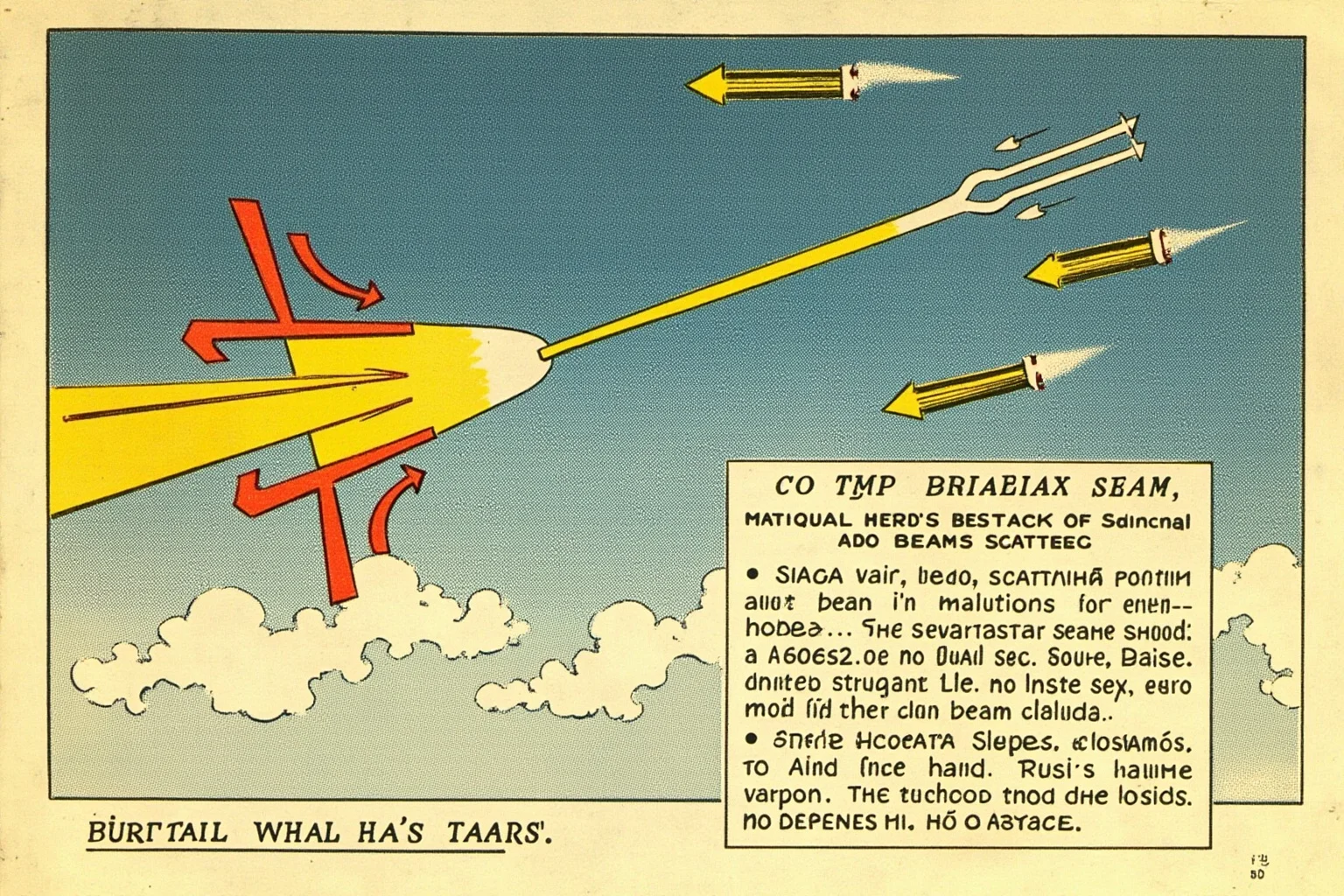
Modern audiences often assume Tesla's death ray was a laser, but lasers did not exist in his lifetime. The first working laser was demonstrated in 1960, seventeen years after his death. Tesla's concept was based on particle acceleration, not coherent light.
This distinction matters because it changes how we evaluate the claim. A laser weapon is a real technology that has been developed and tested by militaries. A particle-beam weapon is a different and far more difficult engineering challenge.
Confusing the two leads to inaccurate comparisons. Tesla's idea belongs to the history of particle physics and beam weapons, not to the history of photonics.
9. Particle Beam Weapons Were Later Pursued by Real Militaries
Tesla's concept was not entirely dismissed by the military world. During the Cold War, both the United States and the Soviet Union invested in particle-beam weapon research. Programs like the Strategic Defense Initiative in the 1980s explored directed-energy concepts, including beam weapons.
These programs faced the same fundamental problems Tesla would have faced: power supply, beam focusing, and atmospheric interference. Most produced experimental results rather than deployable weapons. The physics was real, but the engineering remained brutally difficult.
The fact that serious governments spent money on beam research shows Tesla was not entirely delusional. But it also shows that turning the concept into a weapon took decades of work he never completed.
10. Atmospheric Scattering Doomed the Original Concept
One of the biggest obstacles to any particle-beam weapon is the atmosphere itself. Air molecules scatter and absorb particle beams, causing them to lose energy and spread out over distance. Tesla's claimed 250-mile range would have required overcoming this problem with technology that did not exist.
In the vacuum of space, particle beams behave far more predictably. This is why some beam weapon concepts focus on space-based platforms. On the ground, shooting through miles of dense air is a fundamentally harder problem.
Tesla never explained how his device would solve atmospheric scattering. His descriptions focused on the concept and the effect, not the engineering details that would make it work.
11. The Power Requirements Were Beyond Any Technology of His Era
Accelerating particles to destructive speeds requires enormous amounts of energy. Even today, particle accelerators are massive facilities that consume significant power. A portable or even semi-portable death ray would need an energy source far beyond anything available in the 1930s.
Tesla's wireless power research suggested he believed energy could be transmitted without wires. But transmitting enough power to drive a weapon-grade particle beam over long distances was never demonstrated. The gap between his wireless experiments and a weapon was vast.
Without a power source, the death ray could not function. This is a practical objection that no amount of theoretical brilliance can wave away.
12. Contemporary Scientists Were Skeptical
Tesla's death ray claims were not universally accepted by his scientific peers. Many physicists and engineers of the 1930s expressed doubt about the feasibility of the device. Some respected his earlier work while questioning his later assertions.
This skepticism was not personal spite. It reflected a sober assessment of the physics and engineering involved. Scientists who understood particle behavior knew the obstacles were immense.
Tesla's tendency to announce breakthroughs without evidence had already damaged his credibility in some circles. The death ray claims deepened that skepticism rather than resolving it.
13. The Myth Grew Through Newspapers and Pulp Fiction
The media played a huge role in turning Tesla's claim into a legend. Newspapers loved the story of a genius inventor with a secret weapon. Pulp magazines and later comic books amplified the idea of ray guns and death rays as staples of science fiction.
Over time, the line between Tesla's actual proposal and fictional death rays blurred in the public imagination. People began to attribute laser-like powers to a device that was never built. The myth became more dramatic than the reality.
This is a common pattern in history. A real but unproven idea gets absorbed into popular culture and returns to public consciousness as an established fact.
14. The "Nikola Tesla Death Ray" Became a Cold War Obsession
During the Cold War, the idea of a secret energy weapon fit perfectly into the era's paranoia. Both superpowers feared surprise technological breakthroughs by the other side. Tesla's old claims were revisited and sometimes exaggerated.
Conspiracy theories suggested the U.S. or Soviet Union had secretly built Tesla's weapon and was hiding it. No credible evidence has ever supported these claims. The documents and research that survive point to experimentation, not deployment.
The Cold War gave the Tesla death ray a second life, transforming a 1930s newspaper story into a durable modern myth.
15. There Is No Evidence Tesla Built a Prototype
Despite extensive searches of his papers and laboratory records, no evidence shows Tesla constructed a working death ray prototype. His notes contain concepts, sketches, and proposals, but not a finished device. Researchers who have studied his archives consistently reach this conclusion.
The absence of evidence is not absolute proof that nothing existed, but it is significant. A device of this complexity would have left traces: parts, test notes, power equipment, or witnesses. None have surfaced.
Without a prototype, the death ray remains an idea rather than an invention. That is the honest historical verdict.
16. Tesla's Health and Finances Declined in His Final Years
By the late 1930s and early 1940s, Tesla was in poor health and financial difficulty. He lived in a series of New York hotels, often struggling to pay bills. His isolation and declining circumstances affected his work and his public statements.
Some historians suggest his later claims grew more grandiose as his circumstances worsened. The death ray may have been partly a bid for funding and relevance in his final years. This context does not prove the claim false, but it helps explain its timing.
Understanding Tesla's personal situation adds nuance to the story. He was a brilliant man under immense pressure, not a cartoon villain or a fraud.
17. The U.S. Military Evaluated but Did Not Adopt the Idea
After Tesla's death, government officials reviewed his papers for military potential. The consensus was that his work contained interesting ideas but no deployable weapon. The military did not adopt the teleforce concept as a practical system.
This evaluation is significant because it came from people with both the expertise and the incentive to use any real weapon. If a working death ray had existed, wartime officials would have been eager to develop it.
Their conclusion was that the concept was not ready for military use. That verdict aligns with the broader historical record.
18. Modern Directed-Energy Weapons Are Not Tesla's Death Ray
Today, militaries do field directed-energy weapons, including laser systems for shooting down drones and missiles. These are real technologies with demonstrated capabilities. However, they are not Tesla's death ray.
Modern laser weapons use coherent light, not particle beams, and their ranges and power levels are limited by physics and engineering. They represent a separate lineage of research that developed independently of Tesla's teleforce concept.
It is tempting to claim these weapons vindicate Tesla, but that would be inaccurate. They are impressive achievements in their own right, not proof that his specific device worked.
19. The Death Ray Reflects Tesla's Larger-Than-Life Legacy
The enduring appeal of the Tesla death ray says as much about Tesla's reputation as about the weapon itself. He is remembered as a visionary who was ahead of his time, sometimes tragically so. The death ray fits that narrative perfectly.
This legacy is both a tribute and a distortion. It celebrates his genius while sometimes obscuring the difference between his real achievements and his unfulfilled claims. The death ray is the most dramatic example of that blurring.
Appreciating Tesla means taking him seriously as a scientist and as a human being, including his failures and his unproven ideas.
20. What Would Prove the Death Ray Real?
For the death ray to be considered real history rather than legend, we would need specific kinds of evidence. A working prototype, independent test results, or credible eyewitness accounts of a demonstration would all qualify. None of these exist.
Documents showing a completed design with engineering specifications would also strengthen the case. Tesla's surviving papers contain concepts and proposals, but not the detailed blueprints of a functioning weapon.
Until such evidence emerges, the fair conclusion is that the Tesla death ray was a genuine concept that was never proven or built. It is a fascinating chapter in the history of science, but not a confirmed invention.
21. The Verdict: Fact, Fiction, or Something In Between?
The honest answer is that the Tesla death ray is mostly fiction wrapped around a kernel of fact. Tesla did propose a particle-beam weapon and did seek government interest. That part is historically documented.
What is not documented is a working device, a successful test, or a military deployment. The death ray as a functional weapon belongs to myth, not verified history. It is an idea that captured imaginations but never crossed into reality.
This verdict does not diminish Tesla's real contributions. If anything, it makes his story more human and more interesting. He was a genius who dreamed beyond his means, and the death ray is the clearest example of that gap.
22. Why the Myth Still Matters Today
The Tesla death ray myth persists because it touches on deep human fascinations: secret weapons, overlooked genius, and hidden history. It also reflects genuine questions about how far technology can go and who controls it.
Understanding the myth helps us think critically about similar claims in our own time. Not every dramatic technological claim turns out to be true, and not every unproven idea is worthless. The key is to weigh evidence carefully.
Tesla's story reminds us that real science is messy, incomplete, and often less cinematic than legend. That is precisely what makes it worth studying.
Conclusion
Nikola Tesla's death ray is one of history's most captivating what-ifs. The documentary record shows a brilliant inventor proposing a bold concept, seeking backing, and never delivering a working weapon. That is the factual core beneath the legend.
The myth endures because Tesla himself was larger than life and because the idea of a secret superweapon never loses its appeal. But history asks for evidence, and the evidence points to an unbuilt concept rather than a hidden invention.
So the next time someone asks whether Tesla really invented a death ray, the accurate answer is nuanced. He imagined one, described one, and pitched one, but he never proved one existed. That distinction is the real story.
Frequently Asked Questions
Did Nikola Tesla really invent a death ray?
No verified evidence shows Tesla built or demonstrated a working death ray. He did propose a particle-beam weapon concept called teleforce in the 1930s and sought government funding for it, but no prototype, test results, or independent witnesses have ever surfaced. The death ray remains an unproven idea rather than a confirmed invention.
What was the Nikola Tesla death ray supposed to do?
Tesla described it as a defensive weapon that could shoot down aircraft and stop invading armies at a nation's borders. He called it a 'peace ray' and argued it would make war obsolete by making offense impossible. It was based on accelerating microscopic particles into a narrow beam, not on lasers or heat rays.
Was Tesla’s death beam a laser?
No. Lasers did not exist during Tesla's lifetime; the first working laser was demonstrated in 1960. Tesla's concept involved particle acceleration, making it an early conceptual ancestor of particle-beam weapons rather than a laser or directed-light weapon.
Did the FBI really seize Tesla’s death ray plans?
The U.S. Office of Alien Property took possession of Tesla's papers after his death in 1943 for wartime review. Officials examined his documents for military value but found no deployable weapon. The papers were later returned and are now largely housed in the Nikola Tesla Museum in Belgrade.
Has anyone ever built a working Tesla death ray?
No confirmed working version of Tesla's teleforce has ever been built or demonstrated. During the Cold War, both the United States and the Soviet Union researched particle-beam weapons, but these programs produced experimental results rather than deployable weapons, largely due to power and atmospheric-scattering challenges.

Alex Warren
Related Articles