

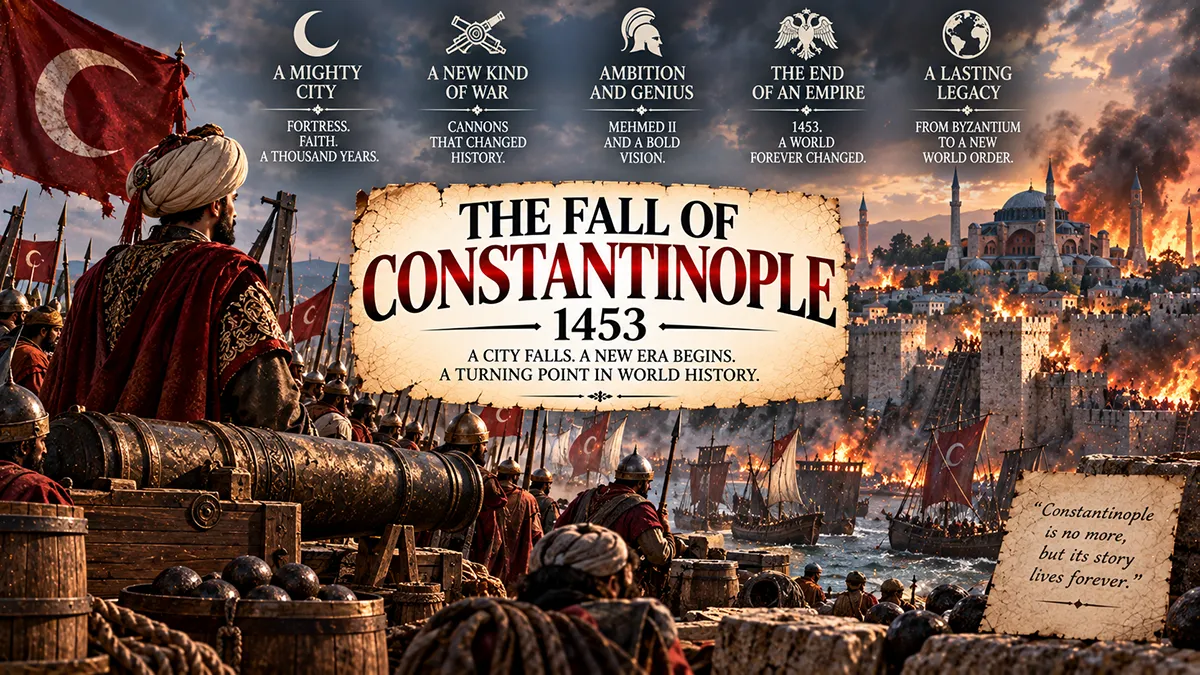
On the morning of May 29, 1453, the ancient walls of Constantinople—walls that had withstood every siege, every barbarian horde, every desperate attempt to break through for over a millennium—finally crumbled. Not to arrows, not to battering rams, not to the slow grinding pressure of time, but to thunder.
A 26-ton bronze cannon, positioned on the walls of the Blachernae district, unleashed a shot that shattered the masonry of the Theodosian fortifications.
In the gap it tore, Ottoman janissaries poured through like water through a broken dam. The city that had been the capital of the Roman Empire for 1,100 years, the crown jewel of Christendom, the “New Rome” that defined an entire civilization, fell in a single morning.
The last emperor, a young man of twenty-six named Constantine XI Palaiologos, threw off his imperial regalia and charged into the battle in plain armor. He was never seen again. The body was never found. In its place, a new capital was born, and the world as everyone knew it was irrevocably divided.
A Thousand Years of Decline
The fall of Constantinople was not a single event but the culmination of centuries of slow hemorrhage. The Byzantine Empire, the eastern continuation of Rome, had once stretched from the Atlantic to the Euphrates. By the late fourteenth century, it had been reduced to a rump state clinging to the city and a few scattered territories in the Peloponnese and along the Aegean coast.
The empire’s decline was not the result of a single catastrophe but of a long accumulation of misfortunes: the Fourth Crusade’s sack of 1204, which shattered the state and allowed the Latin Empire to occupy the capital for fifty-seven years; the Mongol invasions that destroyed the empire’s eastern provinces; the rise of the Ottoman Turks in Anatolia, which steadily encircled the city from the east and south; and the Black Death, which struck in 1347 and 1349, reducing the population and crippling the tax base.
By the early fifteenth century, Constantinople was a shadow of its former glory. Its population, which had once exceeded a million, had dwindled to perhaps thirty to fifty thousand.
The city’s legendary Theodosian Walls—three parallel lines of fortification stretching for over six miles, built in the early fifth century under Emperor Theodosius II—remained, but the empire that they protected was a fraction of its former self. The Palaiologos dynasty, which had ruled since 1261, was deeply divided by civil wars and religious schisms.
The question of whether to accept the union of the Greek Orthodox Church with Rome, proposed at the Council of Florence in 1439, tore the population apart. Most Greeks viewed union with the papacy as a betrayal of their faith, yet it was the only diplomatic lever the emperors had to secure Western military aid. The aid never came.
The Last Emperor
Constantine XI Palaiologos, the final emperor, ascended the throne in 1449 after the death of his brother, John VIII. He was a capable and determined ruler, but he inherited a state that was essentially a city-state with a few outlying territories.
His primary task was to hold the city against the Ottoman Empire, which under his father’s reign had already conquered much of Thrace and pressed against the walls of Constantinople itself. Constantine’s best diplomatic achievement was a brief truce with Sultan Murad II, who agreed in 1444 not to besiege the city.
But in 1451, Murad died, and his son, Mehmed II, ascended the Ottoman throne at the age of nineteen. The truce evaporated.
Sultan Mehmed II: The Young Conqueror
Mehmed II, known to the Turks as Mehmed al-Fatih (“Mehmed the Conqueror”), was unlike any Ottoman sultan before him. Brought up in a court that was simultaneously a military camp and a scholarly institution, he was fluent in several languages, well-read in philosophy, and possessed of an almost obsessive intellectual curiosity.
He was also, by all accounts, a man of extraordinary ambition and impatience. His father, Murad II, had been a capable but cautious ruler. Mehmed was none of these things.
Upon his accession in 1451, Mehmed’s first act was to build a massive fortress called Rumeli Hisarı (the Fortress of Europe) on the European side of the Bosphorus, directly opposite the Ottoman fortress of Anadolu Hisarı on the Asian side.
Together, the two castles strangled the strait, allowing the Ottomans to control all naval traffic into and out of the Black Sea and, by extension, to threaten Constantinople from the north as well as the south. The message was unmistakable: the city was now in a vise.
Mehmed also invested heavily in artillery. He recruited a Hungarian cannon-maker named Urban (or Orban), a brilliant engineer who had previously offered his services to the Byzantine court.
The Byzantines, lacking the funds, turned him away. Urban went to Mehmed, who paid him handsomely. The result was the “Great Bombard,” a cannon that could fire a 26-pound iron projectile over a mile. No fortification in the world was designed to withstand such a weapon.
The Siege Begins: April 1453
On April 2, 1453, Mehmed II led an army estimated at 80,000 to 100,000 men—Ottoman regulars, Janissary infantry, Anatolian levies, and allied contingents—against the walls of Constantinople.
The Byzantine garrison numbered perhaps 7,000 to 10,000, including a small force of Western European mercenaries and volunteers led by the Genoese condottiero Giovanni Giustiniani.
The ratio was staggering: roughly ten to one, and the defenders were further weakened by plague, which had ravaged the city in the preceding months.
The siege unfolded in a grim rhythm. The Ottoman artillery, including the Great Bombard and a battery of smaller guns, began pounding the Theodosian Walls from the first day. The walls, ancient and massive, were not designed to resist sustained bombardment.
Day after day, the stone cracked and crumbled. The defenders, under the command of Constantine himself, worked in the night to repair the damage, filling gaps with timber, earth, and even their own bodies’ worth of determination. Giustiniani’s mercenaries held the most exposed sections, particularly the land wall near the Blachernae district.
Mehmed also attempted a naval assault, bringing his fleet into the Golden Horn, the natural harbor that protected the city’s northern side. The defenders had anticipated this, stretching a massive iron chain across the entrance to the Horn to block the Ottoman galleys.
But on the night of April 22, in a remarkable feat of engineering, Mehmed ordered 70 of his ships to be dragged overland on greased logs, rolling them on a specially prepared track from the Sea of Marmara, around the tip of the Galata peninsula, and into the open end of the Golden Horn.
By dawn, the Ottoman fleet was inside the harbor, in front of the chain, and the northern walls of the city were now under direct naval fire. The psychological blow was enormous.
Desperate Measures
Constantine and Giustiniani responded with a combination of engineering and audacity. They launched a fleet of small, shallow-draft vessels loaded with Greek fire—the infamous incendiary weapon that had protected the city for centuries—into the Ottoman ships at anchor in the Horn.
The attack succeeded, burning or sinking several Ottoman vessels and forcing the fleet to withdraw temporarily. But it was a delaying action, not a solution. The city’s resources were finite, and the Ottoman pressure was constant.
Mehmed, for his part, attempted to lure the garrison out by feigning a withdrawal. The Byzantines, wisely, did not take the bait. He also sent emissaries offering generous terms—preservation of the city’s churches, autonomy for the Greek population, even the emperor’s continued rule. Constantine refused. The terms, he reportedly said, were acceptable only to those who had not yet seen the walls crumbling.
The Final Night and the Fall: May 29, 1453
By late May, the walls in the Blachernae section were in ruins. The Ottoman artillery had reduced them to rubble. On the night of May 28, the defenders worked through the darkness to shore up the gaps, building a wooden palisade and an earthen rampart behind the ruined stone.
Giustiniani, exhausted and ill, had fallen from a fever. Constantine, the last emperor, personally directed the repairs and encouraged the men.
At approximately 4:00 a.m. on May 29, the Ottoman attack began. Mehmed ordered a three-pronged assault. The first wave, a force of Anatolian auxiliary troops, was thrown against the walls as a feint. They were repulsed with heavy casualties.
The second wave, the elite Janissary corps, struck the weakened section of the Blachernae walls where the Great Bombard had done its work. The third wave, a contingent of Alans (Circassian mercenaries), was sent against the land wall near the Kerkoporta gate, a section the defenders had neglected because it was considered too minor to warrant serious attention.
The Alans found a section of wall that had been partially dismantled for repair but not fully re-erected. A small group climbed over the broken masonry and opened the gate.
The Janissaries followed. The sound of the gate opening, the clash of steel, the cries of men—these broke the last of the defenders’ resolve. Giustiniani, still weakened by fever, was struck by three arrows and a lance blow to the head. He was carried from the field, and he died within the day.
Constantine, seeing the breach, led a final charge into the Ottoman lines. He fought until he was cut down. His body was never recovered. Some accounts say his armor was found, but no one could confirm it was his. The last emperor of Rome died nameless in the mud, his regalia discarded, his identity lost.
The city was taken. Mehmed entered through the Blachernae gate. The Hagia Sophia, the great cathedral that had stood for nearly a thousand years, was converted to a mosque.
The population was not massacred—Mehmed, pragmatic and calculating, needed the city’s craftsmen, scholars, and merchants. But the city was looted, its wealth seized, its institutions dismantled. A new capital was being born.
The Aftermath and Rebirth
The fall of Constantinople was not the end of the world, but it was the end of a world. The Byzantine Empire, the last remnant of the Roman state, ceased to exist.
The Ottoman Empire, now a true Mediterranean power with a capital at the crossroads of Europe and Asia, would go on to conquer much of the Balkans, the Levant, and North Africa over the following centuries.
For Christendom, the loss was both military and psychological. The fall confirmed a fear that had haunted European rulers for decades: that the Ottoman threat was not merely a border dispute but an existential challenge.
The loss of Constantinople also disrupted the overland trade routes to the East, contributing to the European drive for sea routes to India and the Spice Islands—a factor, among many, in the Age of Exploration.
The city itself was reborn as Istanbul, a name derived from the Greek “eis tin Polin” (into the city), which had been in colloquial use for centuries. Mehmed invested heavily in its reconstruction, building mosques, madrasas, a grand bazaar, and a new palace complex on the site of the old Byzantine palaces.
The city’s population, depleted by the siege, was replenished through the forced migration of Muslims from Anatolia and the Balkans. Within a generation, Istanbul was a thriving metropolis of several hundred thousand, a city of minarets and markets that would remain the Ottoman capital for four centuries.
The Greek Orthodox population was not destroyed. The Ecumenical Patriarchate was restored, and the Patriarch was granted a degree of autonomy under Ottoman rule. The Greek language, liturgy, and scholarly tradition survived, carried forward by a dispersed community that would prove essential to the Greek War of Independence in 1821.
Historical Legacy
The fall of Constantinople in 1453 stands as one of the great turning points in world history, a hinge upon which the medieval and modern eras pivoted. It ended the longest-lived Christian empire, disrupted the trade networks that had sustained European commerce, and placed a rising Islamic power at the very threshold of the continent.
It prompted the Ottoman drive into the Balkans, the Habsburg-Ottoman wars that would define European politics for three centuries, and the eventual European scramble for alternative sea routes that transformed the global economy.
Yet the fall was also a moment of profound continuity. The city that fell in 1453 rose again within a decade, and the civilization it represented—Greek, Roman, Christian, and, increasingly, Ottoman—was not erased but layered.
The Hagia Sophia, the Great Mosque, the cisterns, the walls themselves, all bear the palimpsest of successive empires. The fall of Constantinople did not end history; it began a new chapter in it, one whose reverberations are still felt in the politics, identities, and memories of the Mediterranean world today.

Alex Warren
Related Articles





