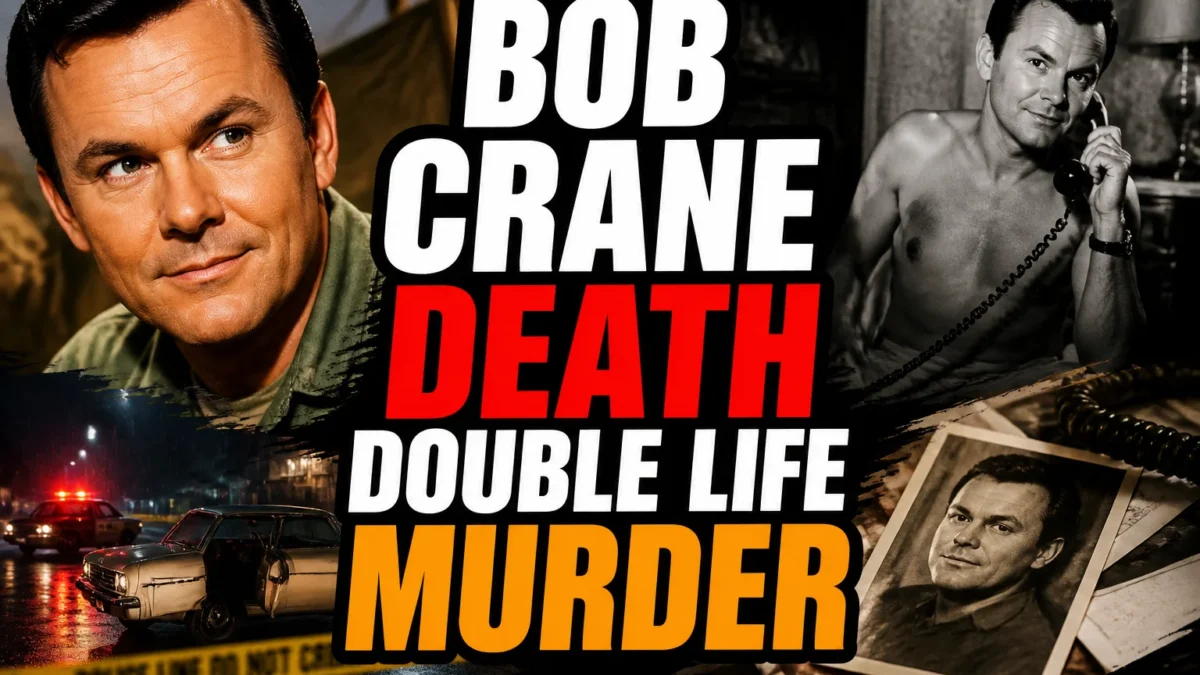
For millions of TV viewers in the 1960s, Bob Crane was the ultimate everyman. As Colonel Robert Hogan on Hogan's Heroes, he was witty, resourceful, and relentlessly likable—a sitcom star who seemed to have it all. Behind the scenes, though, Crane's life was spiraling into a double existence that would end in one of Hollywood's most disturbing unsolved murders. His story is a cautionary tale about fame, obsession, and the dark side of the sexual revolution.
When Bob Crane was found bludgeoned to death in a Scottsdale, Arizona motel room in June 1978, the headlines screamed of a bizarre sex scandal. But the real story is far more complex—and far more tragic—than the tabloid version. This post explores Crane's rise to stardom, his secret compulsions, the evidence that pointed to his friend John Henry Carpenter, and why the case remains officially unsolved decades later.
TL;DR: Bob Crane's 1978 murder in a Scottsdale motel remains unsolved, but the evidence strongly suggests his friend John Henry Carpenter was responsible, following years of Crane's secret sex addiction and home-video obsession.
Who Was Bob Crane? The Man Behind Colonel Hogan
Robert Edward Crane was born in Waterbury, Connecticut, in 1928. After a stint as a drummer and radio host in Los Angeles, he landed the role that would define his career: Colonel Robert Hogan on Hogan's Heroes, which premiered on CBS in 1965. The show ran for six seasons and made Crane a household name.
Off-screen, Crane was a charismatic but complicated man. He was married to his high school sweetheart, Anne Terzian, for nearly two decades, and they had three children together. To the public, he was a devoted family man and a beloved TV star.
But Crane harbored a secret life. He was a compulsive womanizer who became increasingly obsessed with photography and, later, home videotape—technologies that were cutting-edge in the 1970s. According to friends and biographers, he used these tools to document his sexual encounters with numerous women.
This double life was not just a private indulgence. It became the central thread of the investigation into his death, and it shaped how the media covered the case for decades.
The Double Life: Sex, Videotape, and Obsession
In the 1970s, the sexual revolution was in full swing, and Bob Crane embraced it enthusiastically. After his divorce from Anne in 1978, he moved into a swinging bachelor lifestyle in Los Angeles. He frequented clubs, hosted parties, and cultivated a network of women. Though the sexual revolution of the 1970s was distinct from earlier cultural shifts, it's worth noting that even the deadliest plagues that shaped human history often emerged from similar periods of social upheaval and changing norms.
What set Crane apart was his technological enthusiasm. He was an early adopter of Sony's U-matic videocassette recorder, a bulky machine that allowed him to tape hours of footage. He used it not only for professional auditions but also to record sexual encounters, sometimes with multiple women at once.
Crane's friend John Henry Carpenter, a onetime Sony sales representative, was instrumental in helping him acquire and use this equipment. Carpenter was a heavy-set, soft-spoken man who shared Crane's interests in photography and electronics. The two men became close, and Carpenter often accompanied Crane on his escapades.
Their friendship was unusual and intense. Some friends described Carpenter as subservient to Crane, while others saw a more equal bond. But the relationship would become the focal point of the murder investigation.
The Final Days: Scottsdale, June 1978
In June 1978, Bob Crane traveled to Scottsdale, Arizona, to perform in a dinner theater production of Beginner's Luck. He had been dating a woman named Patricia Olson, and he was staying at the Winfield Place Apartments, a modest complex with a pool and a small apartment unit.
On the evening of June 28, Crane had dinner with friends and returned to his apartment. He made a series of phone calls, including one to his son Robert Jr. He also called Patricia Olson, who was in Los Angeles. Sometime after midnight, he went to sleep.
The next morning, Crane failed to show up for a scheduled rehearsal. A friend, Victoria Berry, went to check on him and found his body in the bed. He had been beaten to death with a blunt object—later determined to be a piece of camera equipment or a tripod. There was blood on the walls, and the room showed signs of a violent struggle.
Notably, there was no sign of forced entry. Crane's wallet and watch were untouched, ruling out a simple robbery. The murder weapon was never definitively identified, but investigators believed it was a heavy, cylindrical object. The scene suggested Crane knew his attacker and may have let him in.
How Did Bob Crane the Actor Die? The Official Findings
So how did Bob Crane the actor died? The official autopsy concluded that he died from a fractured skull caused by a single, powerful blow to the head, though there were multiple wounds. The coroner ruled the death a homicide. The time of death was estimated at around 2:00 a.m. on June 29, 1978.
The initial investigation focused quickly on John Henry Carpenter. Carpenter had flown to Scottsdale to visit Crane just days before the murder. He had been seen with Crane at a local restaurant and had stayed with him at the apartment. Carpenter claimed he left Scottsdale on the morning of June 28, but his alibi was shaky.
Crucially, Carpenter's rental car was found to have blood and brain tissue in the trunk. The blood type matched Crane's. However, the forensic technology of the 1970s was not advanced enough to make a definitive DNA match, and the evidence was deemed insufficient for an arrest at the time.
The case went cold for more than a decade. Then, in 1992, a Scottsdale detective reopened the investigation. Advances in DNA testing allowed a more precise analysis of the blood evidence. The results showed that the DNA from the car trunk matched Bob Crane's with a high degree of probability.
Carpenter was arrested and charged with first-degree murder in 1994. The trial was a media circus, filled with salacious details about Crane's sex life and the videotapes. In the end, the jury deadlocked, and Carpenter was acquitted. He died in 1998, maintaining his innocence.
The Evidence Against John Henry Carpenter
The prosecution's case against Carpenter was built on several key pieces of evidence. First, there was the blood in his rental car, which he claimed came from a nosebleed—an explanation that strained credulity given the quantity. Second, there were Carpenter's conflicting statements about his whereabouts on the night of the murder.
Third, there was the matter of the murder weapon. Investigators found that a tripod or a piece of camera equipment could have caused the injuries, and Carpenter had access to such items. Fourth, there were the phone records: Carpenter had called Crane's apartment repeatedly in the days before the murder, suggesting an obsessive attachment.
Finally, there was the psychological profile. Carpenter was described by acquaintances as jealous and possessive of Crane. Some suggested he resented Crane's success with women and felt increasingly marginalized as Crane's career declined.
Despite all this, the jury could not reach a unanimous verdict. The defense argued that the blood evidence was contaminated and that the prosecution was relying on character assassination. The acquittal left the case officially unsolved.
The Sexual Revolution and the Dark Side of Fame
Bob Crane's story cannot be understood without the context of the 1970s sexual revolution. It was a time when traditional moral boundaries were being challenged, and celebrities often led the way in experimenting with new freedoms. But for Crane, that freedom became a trap.
His compulsive behavior alienated his family and friends. His first wife, Anne, divorced him in 1978 after discovering his secret tapes. His second wife, Patricia Olson, reportedly knew about his lifestyle but tolerated it to a degree. Still, the tapes and the rumors followed him.
In many ways, Crane was a victim of his own appetites. The technology that he embraced—videotape—became the very thing that exposed his private life to public scrutiny. It also became the weapon that killed him, according to investigators.
The case also highlights the dangers of celebrity obsession. Fans and media were fascinated by the sordid details, often at the expense of the real tragedy: a man was brutally murdered, and his killer was never brought to justice.
The Aftermath: Family, Legacy, and Unanswered Questions
After the acquittal, Bob Crane's family was left without closure. His son Robert Crane Jr. has spent years trying to keep his father's case in the public eye. He has written a memoir, Crane: Sex, Celebrity, and My Father's Unsolved Murder, and has appeared in documentaries about the case.
Robert Jr. believes Carpenter was guilty. He has pointed to the blood evidence and Carpenter's lies as proof. But he also acknowledges that the case may never be officially solved. The Scottsdale Police Department has never formally closed the investigation, but no new suspects have emerged.
Crane's legacy is complicated. Hogan's Heroes remains a beloved classic, and his performance as Colonel Hogan is still fondly remembered. But his death has overshadowed his career, turning him into a punchline for late-night comedians and a cautionary tale for aspiring stars.
In 2016, a documentary called The Case of the Murdered Magnificence revisited the case, and in 2023, a podcast series examined it anew. Each retelling brings new attention, but no new answers.
Was Bob Crane's Murder Connected to His Double Life?
Many theories have circulated about why Crane was killed. The most obvious is that his killer was someone from his secret life—perhaps a jealous lover, a rival, or a blackmailer. But the evidence points most strongly to Carpenter, who was part of that life. Some have speculated that Crane's tapes contained footage of powerful people, which could have made him a target. However, no credible evidence supports this.
Another theory suggests that Crane's womanizing angered a husband or boyfriend, leading to a crime of passion. But there is no evidence of such a person. The police never found any other viable suspect.
The most plausible explanation remains that Carpenter, who was with Crane shortly before the murder, killed him in a fit of rage or jealousy. The blood in the car, the tripod, and the lies all point to him. But without a confession or a conviction, the case remains open.
The Technology That Defined the Case

Bob Crane's murder was one of the first high-profile cases to involve home video technology. The Sony U-matic recorder he used was a bulky, expensive device that few people owned in the early 1970s. Crane was an early adopter, and he used it to tape everything from auditions to sexual encounters.
This technology played a dual role. It allowed Crane to indulge his compulsions, and it also created a trail of evidence that helped investigators. The tapes were used in court to paint a picture of Crane's lifestyle, which may have prejudiced the jury against him.
In a way, Crane was a victim of his own gadgetry. Without the tapes, his double life might have remained hidden, and the murder might have been investigated differently. But the tapes made him a target—both for blackmailers and for a killer.
The Cultural Impact: From Sitcom Star to True Crime Icon
Bob Crane's death has become a staple of true crime culture. His story has been told in books, documentaries, and podcasts. It has been referenced in TV shows like Seinfeld and The Simpsons. The irony is that Crane, who was known for playing a prisoner of war who outsmarts his captors, became a prisoner of his own secrets. For those interested in how historical events are misremembered, our post on 22 'facts' of American history that are totally wrong offers similar insights into popular myths.
His case also highlighted the dangers of the celebrity sex tape, long before TMJ and the internet. Crane's tapes were not meant for public consumption, but they became evidence in a murder trial. The media exploited them for ratings, and the public devoured the salacious details.
Today, the case is a reminder that fame can be a double-edged sword. It can bring adoration and wealth, but it can also attract predators and destroy lives. Bob Crane learned that lesson the hard way.
The Unsolved Mystery: Why the Case Remains Open
The Bob Crane murder case remains open because the evidence, while compelling, was not enough to secure a conviction. The DNA match was strong but not definitive by 1990s standards. The blood in Carpenter's car could have been contaminated. The jury was not convinced beyond a reasonable doubt.
Moreover, the case was complicated by the victim's lifestyle. Defense attorneys argued that Crane's promiscuity meant there could have been other suspects—a jealous husband, a spurned lover, a business rival. The prosecution could not rule these out definitively.
As a result, the case file remains in Scottsdale, waiting for a break. Advances in forensic science, such as touch DNA, could potentially provide new leads if any evidence remains. But the chances of a resolution are slim. For a scientific perspective on how environmental factors can lead to mysterious deaths, consider the strange case of Gloria Ramirez's toxic blood.
For the family, the lack of closure is a lifelong burden. Robert Crane Jr. has said that he does not expect the case to be solved, but he continues to speak out to keep his father's memory alive—both as a victim and as a human being.
Remembering Bob Crane: Beyond the Murder
It is easy to remember Bob Crane only for his sordid death. But he was also a talented actor and a pioneering radio personality. He was nominated for two Emmy Awards for Hogan's Heroes and was loved by his co-stars. He had a gift for comedy and a natural charisma that made him a star.
His story is also a reminder that celebrities are human beings with flaws and demons. Crane's compulsions were extreme, but they were part of a larger cultural moment that encouraged excess. He was not a monster; he was a man who lost control.
As we look back on his life, we should remember the laughter he brought to millions. His death was disturbing, but his life was more than the sum of his secrets. That is the legacy his family hopes to preserve.
The Enduring Mystery of Bob Crane's Death
Bob Crane's murder remains one of Hollywood's most confounding unsolved cases. The evidence points to John Henry Carpenter, but a jury acquitted him. The double life that made Crane a target also made him a cultural punchline. And the technology that he loved became the instrument of his death.
For true crime enthusiasts, the case is a fascinating study in forensic science, celebrity culture, and the limits of the justice system. For historians, it is a window into the sexual revolution and its consequences. For his family, it is a wound that never fully healed.
What do you think happened to Bob Crane? The mystery endures, and the truth may never be known. But by examining the facts and avoiding sensationalism, we can honor the memory of a man who was more than just a headline.
Frequently Asked Questions
How did Bob Crane the actor died?
Bob Crane died on June 29, 1978, in Scottsdale, Arizona, from a fractured skull caused by a blunt-force trauma to the head. He was found in his apartment, the victim of a homicide. The murder weapon was never definitively identified, but investigators believed it was a piece of camera equipment or a tripod. The case remains officially unsolved.
Who was the prime suspect in Bob Crane’s murder?
John Henry Carpenter, a friend and business associate of Crane's, was the prime suspect. He was arrested and charged with the murder in 1994 after DNA evidence linked blood in his rental car to Crane. However, the jury deadlocked, and Carpenter was acquitted. He died in 1998, maintaining his innocence.
What was Bob Crane’s double life?
Bob Crane led a secret life as a compulsive womanizer and sex addict. In the 1970s, he used early videotape technology to record his sexual encounters with numerous women. This double life was exposed after his death and became a central focus of the murder investigation and media coverage.
Why was Bob Crane’s murder never solved?
The murder remains unsolved because the evidence, while compelling, was not enough to secure a conviction. DNA technology in the 1990s was not as advanced, and the defense raised doubts about contamination and alternative suspects. The jury deadlocked, leading to Carpenter's acquittal, and no other suspects have been identified.

Alex Warren
Related Articles