

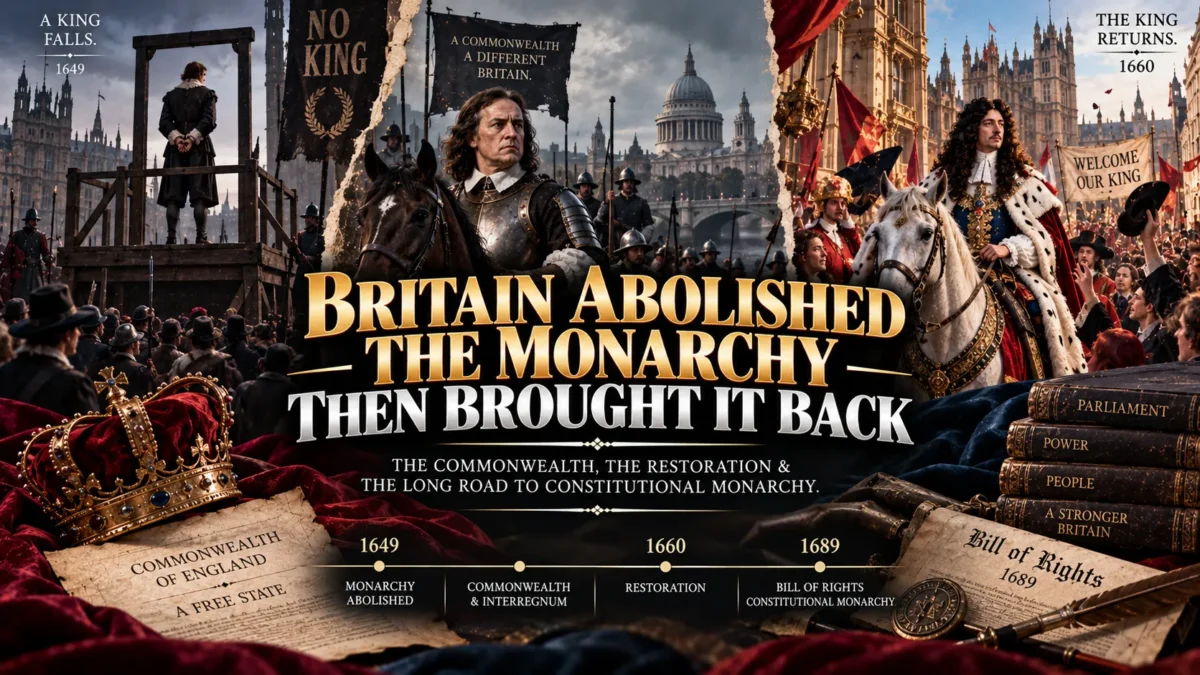
It sounds like a trivia question designed to trip people up: did Britain really get rid of its monarchy at some point, only to turn around and welcome it back? The answer is yes, and it’s one of the wildest chapters in English history. For eleven years in the mid-1600s, there was no king or queen sitting on the English throne at all.
This isn’t ancient legend or a footnote buried in obscure archives. It’s a well-documented period known as the Interregnum, and it still shapes how people argue about the monarchy today.
So let’s walk through what actually happened, when royal power really started slipping away, and why, after abolishing the monarchy once, Britain chose to bring it back.
TL;DR: England genuinely abolished the monarchy in 1649 after executing Charles I, tried an 11-year republic that struggled without him, and restored the Crown in 1660 — but royal power had already been eroding for centuries before that, and it kept shrinking afterward into the ceremonial role we see today.
What “Abolishing the Monarchy” Actually Meant in 1649
The idea of England abolishing the monarchy sounds almost too dramatic to be true, but it happened in the aftermath of the English Civil War.
After years of fighting between King Charles I and Parliament, Charles was captured, tried, and executed for treason in January 1649. That single act changed everything about how England was governed.
Just weeks later, the surviving members of Parliament — known as the Rump Parliament — formally declared that the office of king was “unnecessary, burdensome, and dangerous.” In March 1649, they passed legislation abolishing the monarchy outright. England was declared a republic, known as the Commonwealth of England.
This wasn’t a symbolic gesture or a temporary suspension of royal duties. It was a genuine constitutional rupture. The monarchy was legally dissolved, the House of Lords was abolished alongside it, and the country was, for the first time in its history, governed without a crowned head of state.
The Execution of Charles I and the Birth of the Commonwealth
Charles I’s downfall wasn’t sudden. It followed nearly a decade of civil war rooted in disputes over religion, taxation, and how much power a king should hold versus Parliament. Charles believed strongly in the divine right of kings, the idea that his authority came directly from God and answered to no earthly institution.
Parliament, and the Parliamentarian army led by figures like Oliver Cromwell, disagreed rather forcefully. After Charles lost the war and was captured, he was tried by a specially convened court on charges of tyranny. He was found guilty and beheaded outside Banqueting House in London on 30 January 1649.
His execution marked the true end of monarchy in England, at least for the time being. It’s worth noting this was deeply controversial even among Parliament’s own supporters, and many people at the time were horrified by the killing of an anointed king, regardless of their politics.
Life Without a King: England’s Republican Experiment
Once the monarchy was abolished, England needed a new system of government, and this is where things got complicated. The Commonwealth period initially handed power to Parliament and a Council of State, but instability and infighting quickly became the norm.
By 1653, Oliver Cromwell had grown frustrated with Parliament’s inefficiency and dissolved it by force. He was installed as Lord Protector, a role that gave him monarch-like authority in nearly everything but name.
Some historians describe this Protectorate as a monarchy in disguise, complete with Cromwell living in royal palaces and being addressed with considerable ceremony.
Cromwell died in 1658, and his son Richard Cromwell briefly succeeded him as Lord Protector. Richard lacked his father’s military backing and political skill, and his short, shaky tenure exposed just how fragile the republic really was without strong leadership holding it together.
Why the Republic Struggled
England’s experiment with no monarchy at all didn’t fail because people secretly longed for royal pageantry. It failed largely because the institutions meant to replace the Crown couldn’t agree on how to govern or maintain order.
The army, Parliament, and various political and religious factions were constantly at odds. Puritan-influenced restrictions, including the famous banning of Christmas celebrations and theatre closures, also made the Commonwealth deeply unpopular with ordinary people who felt their daily lives were being policed.
By 1659, with Richard Cromwell gone and no clear leadership structure left standing, the country was edging toward chaos. Senior army officers and political leaders increasingly saw a return to monarchy, under careful new terms, as the only realistic way to stabilize the nation.
The Restoration: Bringing Back the Monarchy in 1660
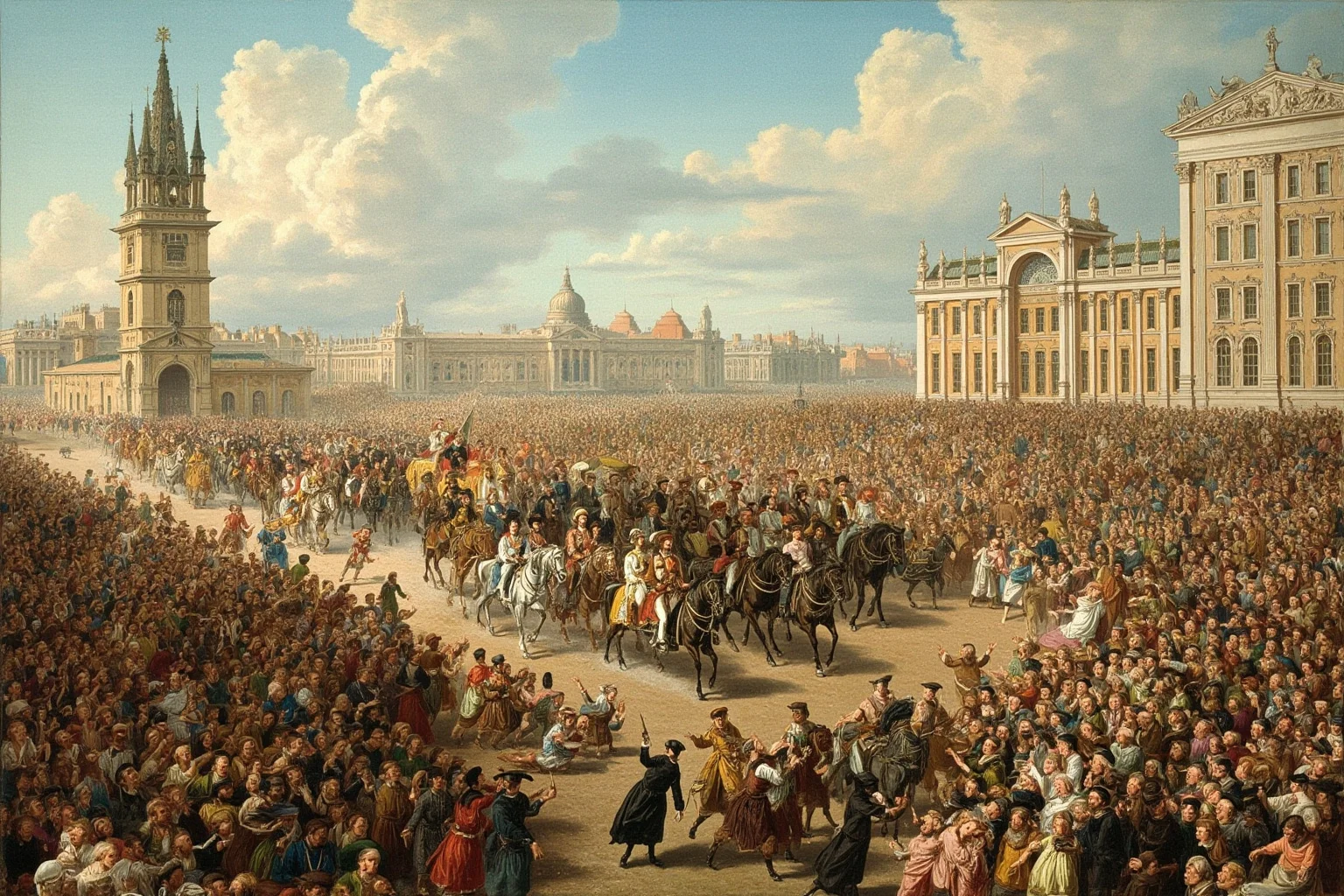
General George Monck played a decisive role in what followed, marching his forces to London and helping arrange the recall of a fuller Parliament. This body invited Charles I’s exiled son to return from the Netherlands and reclaim the throne. Charles II accepted, and the monarchy was formally restored in 1660.
This moment, known as the Restoration, wasn’t a simple reset to how things were before 1649. Charles II returned under an understanding, shaped by the Declaration of Breda, that there would be a degree of reconciliation and limits on retribution, though the men who had signed his father’s death warrant were treated as exceptions.
Parliament had tasted what it meant to rule without a monarch, and that experience left a lasting mark. Even though the Crown came back, it returned into a political landscape that had changed permanently, one where Parliament’s role could never again be casually dismissed by a king who believed his power was unlimited.
When Did the King of England Lose Power? A Longer Story Than 1649
If you’re asking when did the king of England lose power, 1649 is a dramatic answer, but it’s not really the complete story. Royal authority in England had been eroding gradually for centuries before Charles I ever lost his head, and it kept eroding long after his son got the throne back.
The process of when England’s monarchy lost power stretches across hundreds of years of political maneuvering, rebellion, and legal reform. Understanding this bigger picture is essential to answering why does the British monarchy still exist today, because the answer lies in adaptation rather than survival by accident.
Magna Carta to Civil War: The Slow Erosion of Royal Power
The first major dent in unchecked royal authority came in 1215, when King John was forced by rebellious barons to sign Magna Carta. This document didn’t create democracy overnight, but it established the revolutionary principle that even a king was bound by certain laws and couldn’t act with total impunity.
Over the following centuries, Parliament slowly grew from an occasional advisory body into an institution kings genuinely needed, particularly for approving taxation. By the time the Stuart kings arrived in the early 1600s — the same era in which England’s fledgling Jamestown colony across the Atlantic was enduring its own brutal ordeal, the Starving Time — Parliament expected to be consulted on major decisions, and clashes over that expectation directly fueled the tensions that led to civil war.
So when people search for when did the English monarchy lose power, or when did English royalty lose power more broadly, the honest answer is that it happened in stages. Magna Carta, the rise of Parliament, the Civil War, and later reforms each chipped away at royal authority rather than any single event ending it all at once.
The Glorious Revolution and Constitutional Monarchy
After the Restoration, things still weren’t fully settled. Charles II’s brother, James II, alarmed Parliament with his Catholicism and authoritarian tendencies, and in 1688 he was removed in a largely bloodless takeover known as the Glorious Revolution.
William III and Mary II were invited to take the throne jointly, but only after agreeing to the Bill of Rights of 1689. This landmark document limited royal power significantly, banning the monarch from raising taxes or maintaining a standing army without Parliament’s consent, and it’s often cited as the true legal turning point for when did the king of England stop having power in any absolute sense.
From this point forward, England (and later the United Kingdom) operated under what historians call a constitutional monarchy. The monarch still reigned, but Parliament increasingly ruled, and that balance has continued shifting toward Parliament and elected government ever since.
When Did the British Monarchy Start? A Quick Origins Note
It’s worth pausing on when did the British monarchy start, since the answer depends on how you define “start.” Some historians point to Alfred the Great in the late 800s as the first ruler to meaningfully unify English territories under one crown.
Others credit Æthelstan, Alfred’s grandson, with becoming the first king to rule a fully unified England around 927 AD. The Norman Conquest of 1066 is another commonly cited starting point, since it began the continuous royal line that, through various branches and successions, connects to the monarchy of today.
Whichever starting point you prefer, the throne existed for many centuries with near-total royal authority before Magna Carta, the Civil War, and the Glorious Revolution gradually transformed it into something far more limited.
Why Does the British Monarchy Still Exist Today?
Given that England once abolished the monarchy entirely and Parliament has spent centuries stripping away royal power, it’s a fair question to ask why does the British monarchy still exist at all. Part of the answer is that the Restoration proved deeply unpopular alternatives could make people cling to tradition, even a heavily reformed version of it.
Another part is that the monarchy successfully reinvented itself. Rather than clinging to absolute power and risking repeated crises, the Crown gradually accepted a ceremonial and symbolic role, leaving actual governance to elected Parliament. This adaptability is arguably the single biggest reason the institution survived where other European monarchies were later abolished outright.
Supporters also point to the monarchy’s role in tourism, national identity, and continuity, along with its politically neutral function as head of state. Critics counter that a hereditary role in a modern democracy is difficult to justify on principle, regardless of how limited its actual power has become.
Could the UK Abolish the Monarchy Again?
Modern calls to abolish the monarchy, or specifically to abolish the royal family’s official constitutional role, aren’t new, and groups advocating for a republic have existed in the UK for decades. Organizations campaigning for this today generally argue that an unelected hereditary head of state sits uneasily alongside modern democratic values.
Polling on this question tends to fluctuate depending on current events, public sentiment toward specific royals, and broader political mood, so it’s inaccurate to claim there’s settled or overwhelming public consensus in either direction. Abolishing the UK monarchy today would require significant constitutional change, since the Crown is woven into the structure of Parliament, the judiciary, and the armed forces in ways that go well beyond ceremonial appearances.
Realistically, any move toward abolishing the British monarchy in the present day would likely require a referendum and extensive legal reform, rather than the kind of parliamentary declaration and violent upheaval that ended it in 1649. History suggests dramatic, forced endings tend to create as many problems as they solve, which is a lesson the architects of the Commonwealth learned the hard way.
What the 1649 Experiment Actually Teaches Us
The most important myth to bust here is the idea that Britain has always had a monarchy in some unbroken, untouchable form. It hasn’t. The country tried life with no monarchy at all, and that experiment offers a genuinely useful case study for anyone debating the monarchy’s future today.
The Commonwealth period showed that removing a king doesn’t automatically produce stable government; new institutions still need legitimacy, competent leadership, and public buy-in. At the same time, the Restoration showed that bringing a monarchy back doesn’t have to mean restoring absolute power, since Charles II returned into a much more constrained role than his father ever accepted.
In many ways, the pattern set in the 1600s, gradual limitation rather than sudden abolition, is exactly how the monarchy’s power kept shrinking afterward, right through to the ceremonial institution recognized around the world today.
The Bigger Picture on Ending the Monarchy
When people talk about ending the monarchy today, they’re usually discussing something quite different from what happened in 1649. Modern republican movements in the UK generally aren’t proposing anything resembling a trial and execution; they’re arguing for a peaceful, legal transition to an elected head of state.
That distinction matters historically, because the monarchy abolished in the 17th century was abolished through revolutionary force during a period of war and deep national division. Any future move toward a republic would almost certainly look completely different, shaped by referendum, legislation, and public debate rather than conflict.
Understanding that history doesn’t settle the modern debate one way or the other, but it does offer useful context. Britain has already lived through the removal of its monarchy once, and that experience continues to inform how seriously, or cautiously, people treat the idea of trying it again.
Final Thoughts
The story of England abolishing its monarchy, only to invite it back eleven years later, is a genuine reminder that nothing about the British constitution has ever been fixed in stone. Royal power has been challenged, limited, executed, restored, and steadily reduced across roughly eight centuries of legal and political change.
Whether you view the modern monarchy as a beloved institution worth preserving or an outdated relic worth abolishing, its survival owes far more to adaptation than to any myth of permanence. That’s a far more interesting story than “Britain has always had a king or queen,” and it’s one worth knowing before wading into today’s debates about the Crown’s future.
Frequently Asked Questions
When did the king of England lose power?
There's no single date, but the most significant turning points were 1649, when Charles I was executed and the monarchy was formally abolished, and 1689, when the Bill of Rights following the Glorious Revolution legally limited the monarch's authority over taxation and the military. Royal power had already been eroding gradually since Magna Carta in 1215, and it continued shrinking well after 1689 into the ceremonial role seen today.
When was the monarchy actually abolished in England?
The English monarchy was formally abolished in March 1649, shortly after King Charles I was executed for treason. England was declared a Commonwealth, or republic, and remained without a monarch until the Restoration in 1660.
Why did England bring the monarchy back after abolishing it?
The republic struggled with political instability, competing factions, and weak leadership after Oliver Cromwell's death in 1658. By 1660, Parliament and military leaders judged that restoring the monarchy, under a Crown with reduced authority, offered the best path to national stability.
When did the British monarchy start?
This depends on definition: some historians point to Alfred the Great in the late 9th century, others to Æthelstan around 927 AD as the first ruler of a unified England, and others to the Norman Conquest of 1066, which began the continuous royal lineage connected to today's monarchy.
Why does the British monarchy still exist today?
The monarchy survived largely by adapting into a ceremonial, politically neutral institution rather than clinging to absolute power. Its continued existence is often credited to tradition, national identity, and constitutional convenience, though it remains a subject of ongoing public debate.
Could the UK abolish the monarchy today?
It's possible in theory, but it would require major constitutional reform and most likely a public referendum, since the Crown is embedded in Parliament, the courts, and the armed forces. Public opinion on abolishing the monarchy fluctuates and there is no settled consensus either way.

Alex Warren
Related Articles





