

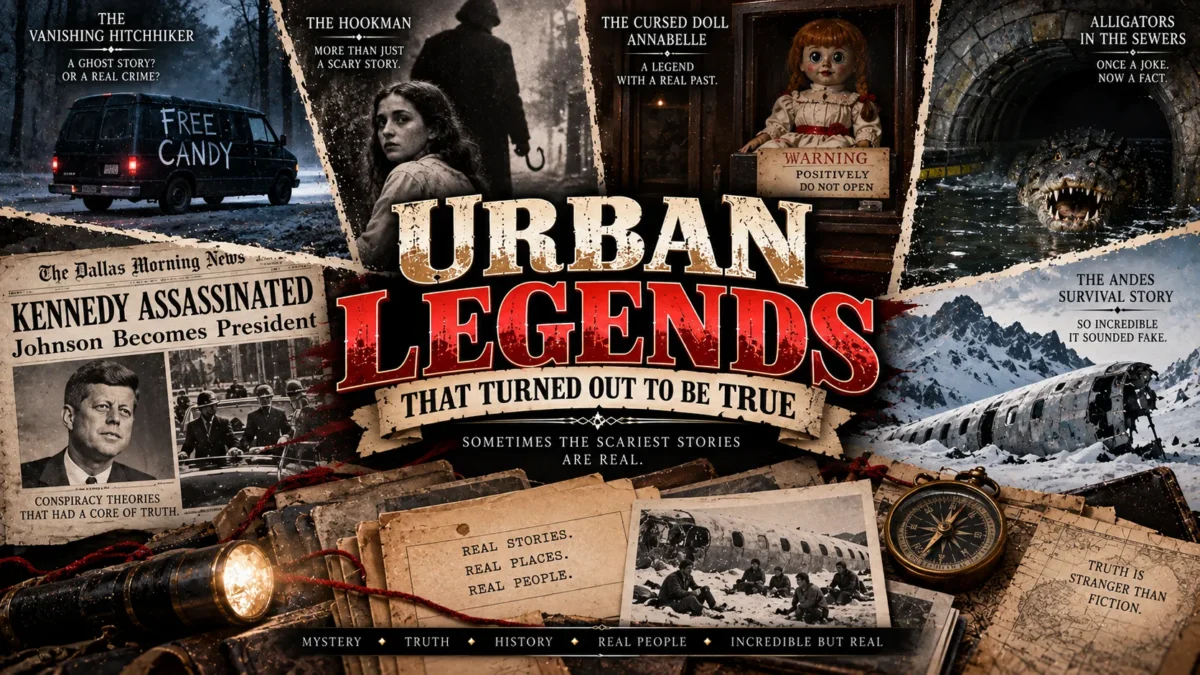
Every town has one: a story about a killer in the woods, a haunted house, or a secret that’s too strange to be made up. Most of these tales get filed under “urban legend” and dismissed as campfire fiction.
But history has a funny habit of proving the skeptics wrong, and a surprising number of these stories turn out to be rooted in real, documented events.
This list digs into genuine cases where the legend and the historical record actually line up, along with a few notes on how to separate mostly true stories from the ones that are pure invention.
Some of these urban myths examples were exaggerated over decades of retelling, but their cores are verifiably real. Others are almost exactly as strange as the rumor suggested.
TL;DR: Many famous urban myths sound too outlandish to be true, but a surprising number — from poison rings to secret WWII deception units — are grounded in real, documented history.
What Actually Counts as an Urban Legend?
Folklorists generally define an urban legend as a story, often presented as true, that spreads person to person and evolves with each retelling.
The term itself was popularized in the 1960s and 1970s by folklorists like Jan Harold Brunvand, who studied how these stories moved through modern communities the way older myths and fairy tales moved through rural ones.
That’s part of why people ask when and where urban legends originated — the phenomenon is ancient, but the label is fairly modern.
The key feature of a true urban legend isn’t that it’s false. It’s that it travels by word of mouth, gets attached to a local setting, and picks up new details every time someone tells it.
That structure is exactly why some of the mythical urban legends on this list started as real news stories and slowly transformed into something almost unrecognizable.
Why Are Urban Legends So Popular?
Part of the appeal is psychological. Urban legends tap into shared fears — contamination, strangers, hidden danger in ordinary places — and wrap them in a story that feels personal because it’s supposedly happened “near here.” Researchers who study folklore note that this local specificity is what makes legends feel more credible than a generic scary story.
There’s also a kernel-of-truth effect at play. When a legend is loosely based on a real crime, disaster, or scandal, it inherits a sense of legitimacy that pure fiction never gets.
That’s precisely why so many of the greatest urban legends in circulation today can be traced back to an actual historical incident, even if the details have drifted over the years.
1. The Poison Ring of Renaissance Italy
Stories of secret poisoners selling untraceable death in a bottle sound like classic urban myth material. In 17th-century Italy, however, court records describe a woman named Giulia Tofana who allegedly ran a network selling a poison known as Aqua Tofana, disguised as cosmetics, to women seeking to escape abusive husbands.
Historians debate exactly how large her network was, since much of what survives comes from later retellings and trial testimony. But the Italian authorities did investigate and execute a woman under this name in the 1650s, which anchors the legend in a real criminal case rather than pure invention.
2. The Bloody Benders of Kansas
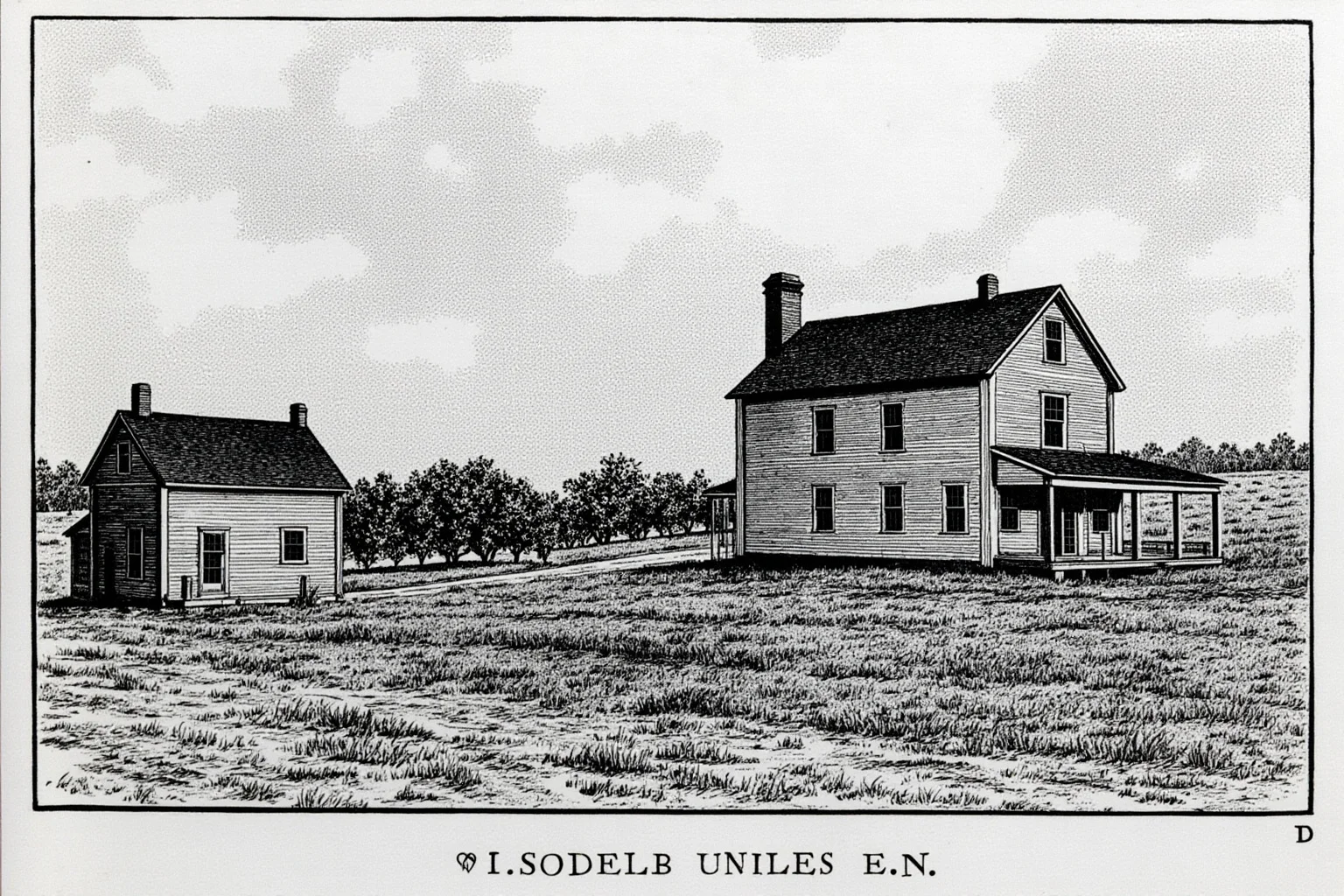
The legend of a homestead where travelers checked in and never checked out sounds like classic ghost-story fodder. In 1870s Kansas, the Bender family ran an inn along a well-traveled trail where several guests mysteriously vanished.
When investigators finally searched the property, they found human remains buried in the orchard and garden. The family fled before they could be arrested, and their fate was never conclusively confirmed, which is part of why their story still circulates as regional folklore.
3. Typhoid Mary and the Invisible Killer

The idea of a person who spreads disease everywhere she goes without ever getting sick herself sounds like a modern horror movie pitch. Mary Mallon, a cook working in early 20th-century New York, was in fact an asymptomatic carrier of typhoid fever linked to multiple outbreaks.
Health officials forcibly quarantined her twice, and her case became a landmark in the history of public health and disease carriers. “Typhoid Mary” entered the language as shorthand for anyone who unknowingly spreads trouble, proof that some urban legends that are true come straight out of epidemiology textbooks.
4. The Ghost Army of World War II

The rumor of an entire fake army — complete with inflatable tanks, fake radio traffic, and sound trucks blasting recorded engine noise — sounds like something dreamed up decades later. The U.S. Army’s 23rd Headquarters Special Troops, nicknamed the Ghost Army, really did use these exact tactics to deceive German forces about troop movements in Europe.
Their operations remained classified for decades after the war, which only fueled speculation before the full story became public. It’s one of the clearest cases of a seemingly mythical urban legend being official military history all along.
5. Operation Mincemeat’s Corpse With a Cover Story

The premise sounds absurd: British intelligence supposedly planted fake documents on a dead body and let it wash ashore to trick the Nazis. That is, in broad strokes, exactly what happened in 1943, when British intelligence used the body of a deceased man, fitted with a fabricated identity and false invasion plans, to mislead German forces about the location of the Allied invasion of Sicily.
The deception is well documented in British wartime records and later intelligence histories. It stands as one of history’s strangest confirmed cases where reality outpaced the rumor mill.
6. The Radium Girls and Their Glowing Secret

Stories about factory workers who glowed in the dark after painting watch faces with luminous paint sound like an urban myth built for shock value. In the early 20th century, young women employed at watch-dial factories were instructed to point their radium-laced paintbrushes with their lips, exposing them to dangerous radiation.
Many developed severe bone and jaw diseases, and several died from radiation poisoning before the companies acknowledged the danger. Their subsequent lawsuits helped establish modern workplace safety and labor protections in the United States.
7. Sewer Alligators Beneath New York City
The legend of alligators lurking in city sewers has been repeated for so long that most people assume it’s pure fabrication. In February 1935, however, the New York Times reported that teenagers pulled a live alligator out of a Harlem sewer drain, apparently after it had escaped or been released as an exotic pet.
That single documented event does not prove a thriving underground alligator population exists today, and no credible evidence supports that broader claim. It does show how one real, verified incident can snowball into a much bigger legend over the following decades.
8. The Villisca Axe Murders
A small-town mass murder that was never solved is exactly the kind of story that mutates into local legend, and the 1912 Villisca, Iowa case did just that. Six members of the Moore family and two houseguests were killed with an axe in their home, and despite an intense investigation, no one was ever convicted.
The case remains officially unsolved, which is part of why it has generated so much folklore and speculation over the past century, much like the enduring mystery surrounding the Lost Colony of Roanoke. The underlying crime, however, is thoroughly documented in period newspapers and court records.
9. Charlie No-Face, the Green Man of Pennsylvania
Stories about a disfigured man who wandered rural roads at night terrified generations of teenagers in western Pennsylvania. The legend was based on a real person, Raymond Robinson, who was severely disfigured in a childhood electrical accident and later took nighttime walks along a local highway to avoid public reactions during the day.
Local drivers who spotted him in their headlights spread stories that eventually detached from the real, quite sympathetic man behind them. His story is a reminder that some famous urban myths started as unkind rumors about a real, living person.
10. The New Orleans Axeman
A serial killer who allegedly promised to spare any household playing jazz music on a certain night sounds almost too theatrical to be real. Yet New Orleans newspapers in 1918 and 1919 did report a string of axe murders attributed to an unidentified assailant, and a letter purportedly from the killer promising to spare jazz-loving households was published and taken seriously by a frightened public.
The killer’s identity was never confirmed, and some historians question whether all the attributed murders were connected. The documented panic and news coverage, however, are entirely real.
11. Spring-Heeled Jack’s Victorian Panic
Before modern urban legends, Victorian England had its own version: a mysterious figure said to leap incredible heights, breathe fire, and terrorize pedestrians at night. Newspaper reports from the 1830s through the 1870s describe genuine public panic and multiple witness accounts describing an assailant with an unusually athletic, frightening appearance.
No one was ever definitively identified as Spring-Heeled Jack, and some sightings were almost certainly copycats or misidentifications. The documented mass hysteria and press coverage, though, make this one of the earliest well-recorded cases of a legend growing directly out of real public fear.
12. The Boy in the Box

The unsolved case of an unidentified child found in a cardboard box near Philadelphia in 1957 became a haunting piece of local folklore for decades. Investigators pursued thousands of leads without success, and the case remained one of the city’s most notorious cold cases for over sixty years.
In 2022, authorities finally identified the child using advanced DNA analysis, closing one chapter of a story that had circulated as local legend for generations. It’s a rare case where persistent forensic science eventually caught up with a decades-old mystery.
13. The Amityville Horror House

Many people ask whether the town in the Amityville Horror was based on a true story, and the honest answer is a mix of both. The Long Island house was the real site of a 1974 mass murder in which Ronald DeFeo Jr. killed six family members, a crime confirmed through trial records and DeFeo’s own conviction.
The haunting elements that made the story famous came later, when a subsequent family claimed the house was plagued by paranormal activity, claims that were never independently verified and were later disputed by several investigators. So the murders are real history, while the haunting remains firmly in the realm of unverified legend.
14. Cropsey of Staten Island

Generations of Staten Island kids grew up hearing about “Cropsey,” a boogeyman blamed for missing children in local folklore. The legend gained a disturbing real-world anchor when Andre Rand, a former groundskeeper at a shuttered institution, was convicted in connection with the disappearance of children from the area in the 1980s and 1990s.
Rand’s case doesn’t confirm every version of the Cropsey legend that circulated among children, many of which were clearly exaggerated. It does show how a real criminal investigation and decades of local rumor became permanently tangled together.
15. The Bunny Man of Fairfax County
A figure in a rabbit costume attacking people with an axe sounds like pure campfire invention, yet Fairfax County, Virginia police records from 1970 describe two separate reports of a man in a rabbit costume threatening people, in one case with a hatchet. Both incidents were documented by local police at the time, making this one of the more oddly specific true urban legends on record.
The suspect was never definitively caught or identified in connection with later, more elaborate versions of the story. The original 1970 police reports, however, are real historical documents, not folklore.
16. The Toxic Lady of Riverside

The case of Gloria Ramirez, a California patient who reportedly caused hospital staff to fall ill in her emergency room in 1994, sounds like science fiction. Multiple hospital workers did report symptoms including dizziness and fainting after exposure to her, and the case was investigated by toxicologists and covered extensively in medical literature.
Several competing scientific explanations were proposed, ranging from chemical reactions in her body to mass psychogenic illness among staff, but no single cause was ever conclusively proven. It remains one of the strangest documented medical mysteries in American emergency medicine.
17. The Secret Train Platform Under the Waldorf Astoria

Rumors of a hidden subway platform beneath a famous hotel, built for a paranoid president, sound like conspiracy theory material. Grand Central Terminal does contain a disused platform beneath the Waldorf Astoria, historically linked to security arrangements for Franklin D. Roosevelt, who used a private rail car due to his mobility limitations from polio.
Railway historians and Grand Central’s own archives confirm the platform’s existence and its connection to presidential-era security needs. The full extent of its historical use is less flashy than legend suggests, but the underlying infrastructure is entirely real.
18. Tulip Mania’s Economic Madness

The idea that 17th-century Europeans once traded entire estates for a single flower bulb sounds like an exaggerated morality tale. Dutch tulip mania in the 1630s was a real speculative bubble, and contract prices for rare bulbs did reach extraordinary levels before the market collapsed in 1637.
Modern economic historians note that some retellings overstate how widespread and catastrophic the crash actually was for the average Dutch citizen. The core event, a genuine speculative bubble in tulip bulb futures, is well documented in period records.
19. Joseph Merrick, “The Elephant Man”
Before he became the subject of stage plays and films, Joseph Merrick was a real man in Victorian London whose severe physical deformities made him a target of exploitative sideshow exhibitions. Medical records from the Royal London Hospital, where he eventually found refuge, document his condition and the doctors who studied and cared for him.
Over time, sensationalized retellings blurred the line between the documented man and a more mythologized “monster” figure used in freak-show advertising. His real medical history, preserved in hospital archives, remains distinct from the exaggerated legend built around him.
20. The Dyatlov Pass Incident

A group of experienced hikers found dead under bizarre circumstances in the Russian mountains has fueled decades of speculation about government cover-ups and supernatural forces, making it one of the most enduring scary stories that are based on real life. In 1959, nine hikers did die in the Ural Mountains, and Soviet investigators closed the case citing an unknown “compelling force,” a vague conclusion that only deepened public suspicion.
Decades later, a 2019 Russian investigation and subsequent scientific studies pointed to a slab avalanche and resulting panic as the most plausible explanation. The deaths themselves are thoroughly documented; it’s the cause that remained genuinely mysterious for so long.
21. The Mothman of Point Pleasant

Sightings of a strange winged creature in Point Pleasant, West Virginia became one of America’s most famous urban myths after 1966. What’s less mythologized is the real tragedy connected to it: the December 1967 collapse of the Silver Bridge, which killed 46 people, ranks among the worst man-made disasters in history, and became permanently linked to the earlier Mothman sightings in local memory and popular retellings.
Engineering investigations attributed the bridge collapse to a metal fatigue defect in a single eyebar, a mundane but well-documented structural failure. The creature sightings themselves were never verified, but the bridge disaster that fused with the legend is tragically real history.
22. The Men in Black

Stories of mysterious government agents silencing witnesses after unusual sightings sound like textbook conspiracy folklore. Declassified U.S. Air Force records confirm that Project Blue Book and related programs really did send government personnel to investigate and, in some cases, discourage publicity around reported unidentified aerial phenomena between the 1940s and 1960s, an era also shaped by the climate of government secrecy chronicled in how the Red Scare changed the country.
The more sinister, coat-and-sunglasses version of the legend grew substantially beyond what the declassified records support. Still, the basic premise of government investigators visiting witnesses is documented fact, not pure invention.
Telling Fact From Folklore
Looking across these cases, a pattern emerges: the most common urban myths that are true tend to start as ordinary news stories — a crime, a disease outbreak, a wartime operation, an accident — that get retold so many times the original facts blur into something stranger. The legend usually keeps a real event’s emotional core while discarding its inconvenient, mundane details.
This is also why dedicated fact-checking sites exist. A well-sourced website for urban legends, such as Snopes, cross-references news archives, court records, and official statements to separate documented history from invented embellishment. When you’re trying to figure out whether any legend belongs on a list of real urban legends, tracing it back to a primary source is always the most reliable method.
Not every spooky story deserves this benefit of the doubt, of course. Plenty of famous urban myths, like vanishing hitchhikers or bans on flashing headlights to avoid gang initiation rites, have been thoroughly debunked despite decades of confident retelling. The lesson from this list isn’t that every legend is secretly true — it’s that history is often strange enough on its own, without any embellishment needed at all.
Frequently Asked Questions
Are urban legends real?
Some are, and some aren't. Most urban legends are exaggerated retellings that spread through word of mouth, but a meaningful number — like Typhoid Mary, the Ghost Army, or the Villisca axe murders — are rooted in documented historical events, even if details were embellished along the way.
When and where did urban legends originate?
The phenomenon of orally transmitted, locally set cautionary tales is ancient, but the specific term "urban legend" was popularized by folklorists, notably Jan Harold Brunvand, starting in the 1960s and 1970s as scholars studied how these modern stories spread through communities.
Why are urban legends so popular?
Urban legends tap into common fears and feel more believable because they're set in familiar, local settings. Many also grow out of a real historical event, which gives them a kernel of credibility that pure fiction usually lacks.
What’s the difference between an urban legend and a myth?
Traditional myths are usually ancient, tied to religion or cosmology, and passed down over centuries. Urban legends are typically modern, set in everyday contemporary life, and spread rapidly through word of mouth, media, or the internet rather than ancient oral tradition.
Was the town in the Amityville Horror based on a true story?
Partly. The house is real, and it was the site of a genuine 1974 mass murder committed by Ronald DeFeo Jr. The haunting claims that made the story famous came from a later family and were never independently verified.
How can I check if an urban legend is true?
Trace the story back to its original source, such as period newspaper archives, court records, or official reports, rather than relying on retellings. Fact-checking websites dedicated to investigating urban legends, like Snopes, are also useful starting points for cross-referencing claims.

Alex Warren
Related Articles





