

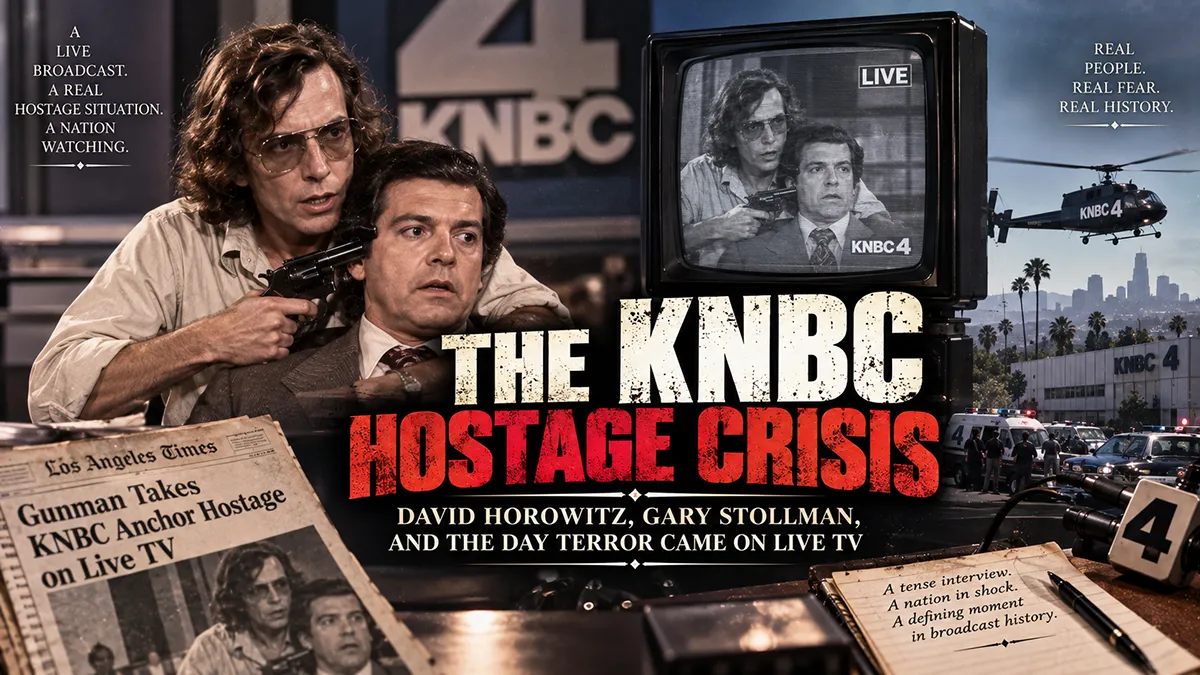
Live television has produced plenty of awkward moments, but few compare to what happened inside a Burbank studio in 1981.
A consumer reporter beloved for helping ordinary people get refunds and justice suddenly found himself staring down a gunman, mid-broadcast, with cameras still rolling.
It sounds like the plot of a thriller, yet it’s a documented piece of TV history involving David Horowitz, the consumer advocate, and a troubled young man named Gary Stollman.
This story has become the stuff of late-night internet rabbit holes, partly because so much of it feels like one of those historical events that sound too crazy to be true, and partly because the trail on one of its central figures goes cold. Let’s separate what’s actually known from what’s rumor, and walk through how the whole thing played out.
TL;DR: In 1981, consumer advocate David Horowitz was taken hostage live on KNBC by Gary Stollman, a young man demanding airtime to air grievances involving his father, and while Horowitz’s career recovered fully, Stollman’s later life remains largely undocumented.
What Happened at KNBC in 1981: A Quick Overview
David Horowitz was in the middle of taping or broadcasting his consumer affairs segment at KNBC’s studios in Burbank when a young man named Gary Stollman made his way onto the set.
According to contemporary news accounts, Stollman was armed and demanded to be given airtime, essentially hijacking the broadcast to read a personal statement to the public.
What followed was a tense, on-camera standoff that blurred the line between a news broadcast and a hostage negotiation. Viewers watching KNBC that day were not seeing a scripted news story; they were watching a real crisis develop in real time, which was almost unheard of on local television at that point.
The incident ended without anyone being killed, and Horowitz went on to have a long career afterward. But the episode left a lasting mark on television history as one of the earliest instances of an actual hostage crisis unfolding live in front of a broadcast audience.
Who Was David Horowitz, the Consumer Advocate?
It’s worth pausing here because there are two well-known people named David Horowitz, and they are frequently confused online. This story is not about the conservative political writer and activist of the same name.
This David Horowitz was a consumer advocate and television news anchor, born in 1937, who built his reputation helping everyday viewers fight back against scams, faulty products, and unresponsive companies.
Before becoming a household name in consumer journalism, Horowitz worked as a news anchor and reporter, eventually landing at KNBC in Los Angeles. His approachable, no-nonsense style made him a trusted figure for viewers who felt powerless against big businesses or bureaucratic runarounds.
His reputation as a consumer champion is exactly why the 1981 incident felt so jarring to audiences at the time. This was a man known for solving other people’s problems on air, suddenly thrust into a life-threatening problem of his own, broadcast to the very audience that trusted him.
Inside “Fight Back! with David Horowitz”
Horowitz’s signature show, “Fight Back! with David Horowitz,” became a syndicated hit that ran for roughly two decades, stretching from the late 1970s into the mid-1990s. The format was simple but effective: Horowitz and his team investigated consumer complaints, confronted companies, and helped regular people get resolutions they couldn’t get on their own.
The show’s catchphrase-like format made “fight back” almost synonymous with Horowitz himself, and it’s a big reason people still search for the show decades later. It tapped into a very real frustration people had with warranties, refunds, and shady business practices, giving them a televised advocate.
The 1981 hostage incident actually happened around his consumer reporting work at KNBC, not during a taping of the syndicated “Fight Back!” show itself, though the two are often mentioned together because Horowitz was already known nationally for that consumer advocacy brand by the time the crisis occurred.
Who Is Gary Stollman?
Gary Stollman was a young man in his early twenties at the time of the incident, and public information about his life before that day is limited. News coverage from 1981 described him as someone dealing with significant personal distress, and his actions that day appeared to be driven by a desire to publicly air a personal grievance rather than any political or criminal motive tied to Horowitz specifically.
Horowitz, in other words, wasn’t necessarily the intended target of Stollman’s anger. He appears to have been, in a sense, in the wrong studio at the wrong time, a broadcaster with a live platform that Stollman wanted access to.
This detail matters because it reframes the story. It wasn’t a targeted attack on a consumer advocate for his work; it was someone using a famous, trusted TV personality’s platform as a way to be heard.
The Live Hostage Situation, Minute by Minute
Accounts from the time describe Stollman entering the KNBC facility and confronting Horowitz while cameras were active, holding him at gunpoint and refusing to let him leave. The situation escalated quickly from an interruption into a genuine hostage crisis, with station staff, security, and eventually law enforcement responding as the standoff continued.
What made the moment so unusual for television history is that portions of the tense exchange were seen by viewers before the feed was cut or the situation was contained. It was an early, unsettling example of a real crime and potential tragedy playing out through the same screens that normally carried commercials and community news.
Horowitz, by most accounts, stayed relatively composed under enormous pressure, which likely helped keep the situation from escalating further. Broadcasters and station security at the time had little precedent for handling an armed intruder on a live set, since studio security protocols in that era weren’t built for this kind of scenario.
The Gary Stollman Letter: What It Said and Why
Central to Stollman’s demands was a desire to have a personal letter read or broadcast to the public. Reports from the period indicate the letter centered on Stollman’s relationship with his father and long-standing personal grievances, rather than any broader political statement.
It’s important to be careful here, because exact wording from the letter isn’t something that can be reliably quoted decades later without risking distortion of the original text. What multiple period accounts agree on is that the letter was deeply personal, emotionally raw, and aimed at being heard by an audience Stollman felt he couldn’t otherwise reach.
The letter has become one of the most searched-for details of this story precisely because it explains Stollman’s motive. He didn’t appear to want money, a political platform, or fame; he wanted a very personal message delivered publicly, using KNBC’s airwaves as the delivery mechanism.
Who Was Max Stollman?
Max Stollman is identified in period reporting as Gary Stollman’s father, and the elder Stollman’s relationship with his son appears to be the emotional core of the entire incident. The dynamic between father and son is described in accounts as strained, which lines up with the personal, grievance-driven nature of the letter Gary wanted broadcast.
Beyond that connection, detailed, verifiable biographical information about Max Stollman is not widely documented in accessible historical records. This is part of why searches for “Max Stollman” often lead back to the same handful of contemporary news summaries rather than a fuller biography.
What can be said with reasonable confidence is that the father-son relationship was the motivating force behind the hostage situation, not any dispute involving Horowitz, KNBC, or the news industry itself.
How the Standoff Ended
The crisis eventually came to a close without anyone being killed, which is itself notable given how volatile hostage situations involving firearms can become. Law enforcement negotiators and station personnel worked to de-escalate the confrontation, and Stollman was ultimately taken into custody.
Horowitz walked away physically unharmed, though understandably shaken by an ordeal that had played out in front of live cameras. The broadcast, which had briefly turned into real breaking news about the station’s own studio, returned to normal programming once the situation was resolved.
For a local news operation in 1981, this kind of ending, no fatalities, a peaceful resolution, and a return to regular programming, was as good an outcome as anyone could have hoped for once the standoff began.
The Legal and Psychiatric Aftermath
Following his arrest, Stollman’s case moved through the legal system, and reports from the era indicate that his mental state was a significant factor in how authorities and the courts handled the matter. This is consistent with how similarly distressed individuals were often processed by the criminal justice system during that period, with psychiatric evaluation playing a central role.
Detailed court records from a case this old aren’t easily accessible to the general public, which limits how precisely we can describe the exact legal outcome, sentencing, or treatment path that followed. What is consistent across available historical summaries is that this was treated as a mental health-related crisis rather than a premeditated criminal plot against Horowitz or KNBC.
That distinction matters for understanding the story accurately. It wasn’t an assassination attempt or a targeted act of violence against a media figure; it was widely characterized as a personal breakdown that spilled into a public, televised setting.
What Happened to Gary Stollman? Is He Still Alive Today?
This is the question that drives a lot of the ongoing interest in this story, and honestly, it’s the hardest one to answer with certainty. There is no widely available, verified public record clearly documenting Gary Stollman’s life, whereabouts, or status in the years and decades since the 1981 incident.
Searches for “is Gary Stollman still alive” or “Gary Stollman today” tend to circle back to the same limited set of period news reports about the hostage situation itself, without a reliable, sourced update on his later life. Online forums and true-crime discussion threads sometimes speculate about what became of him, but speculation isn’t the same as documented fact.
In the interest of accuracy, the honest answer is that Gary Stollman’s current status is unconfirmed based on publicly available, credible sources. Anyone claiming definitive knowledge of what happened to him afterward should be treated with healthy skepticism unless they can point to a verifiable record.
David Horowitz’s Life and Career After the Incident
Despite the terrifying experience, David Horowitz’s career as a consumer advocate continued for many more years. “Fight Back! with David Horowitz” kept airing well into the 1990s, and he remained one of the most recognizable consumer journalists in American television.
Horowitz continued his advocacy work beyond his flagship show as well, staying associated with consumer protection efforts and maintaining the trust he’d built with audiences over decades. He passed away in 2016, remembered primarily for his decades of consumer journalism rather than for the frightening incident that briefly interrupted his career.
It says something about his resilience, and perhaps about how the public separated the man from the incident, that most retrospectives on his career treat the hostage situation as a single dramatic chapter rather than a defining one. His legacy remains tied far more to helping consumers than to surviving a gunman on live television.
Why This Moment Still Matters in TV History
Beyond the personal drama, the KNBC incident is a genuinely significant moment in broadcast history, sitting alongside other biggest events in American history that quietly reshaped how institutions operate. It happened during an era before 24-hour cable news, before the internet, and long before newsroom security protocols were designed with active-threat scenarios in mind.
It’s often cited alongside other early examples of real violence or crisis intruding on live broadcasts, moments that forced television stations to rethink studio access and security. In that sense, the Horowitz-Stollman incident sits at an interesting intersection of media history and the broader conversation about safety in live broadcasting environments.
It also stands as an early example of how a deeply personal crisis, one person’s psychological distress and family conflict, can end up becoming a very public spectacle simply because of proximity to a media platform. That tension between private pain and public broadcast is something newsrooms still grapple with today.
Separating Fact From Myth
Given how long ago this happened and how thin the documentation is in places, it’s easy for exaggerated or invented details to creep into retellings online. Some versions of this story inflate the danger, invent dialogue, or claim certainty about Stollman’s later life that simply isn’t supported by available records.
The myth-busting version of this story is simpler and more grounded: a distressed young man forced his way into a live broadcast to deliver a personal message about his father, a hostage situation briefly played out on camera, it ended without loss of life, and the consumer advocate at the center of it went on with a long, respected career. Everything beyond that core sequence, especially claims about Stollman’s fate decades later, should be treated as unverified.
That’s a reasonable place to land on a story this old and this thinly documented outside of the initial news cycle. Curiosity about “what happened to Gary Stollman today” is understandable, but the responsible answer is that it remains genuinely unknown based on public information.
Final Thoughts
The David Horowitz and Gary Stollman story endures because it combines real human drama with the eerie novelty of live television gone wrong, in the same way stories like Harrison Okene’s survival at the bottom of the ocean remind us that reality can be stranger than fiction. It’s a reminder that even a show built around helping people fight back against everyday injustices can, without warning, become the site of a much more serious crisis.
What we can say with confidence is limited but meaningful: Horowitz survived, his career flourished for decades afterward, and the incident became a strange footnote in broadcast history. What happened to Gary Stollman in the years since remains, as far as public records show, an open question rather than a settled fact.
Frequently Asked Questions
What was David Horowitz’s Fight Back! show about?
"Fight Back! with David Horowitz" was a syndicated consumer affairs television show that ran from the late 1970s into the mid-1990s. Horowitz and his team investigated consumer complaints, confronted businesses on behalf of viewers, and helped everyday people resolve disputes over refunds, warranties, and faulty products.
Was David Horowitz actually taken hostage on live TV?
Yes. In 1981, David Horowitz was taken hostage during a live broadcast at KNBC's Burbank studios by a young man named Gary Stollman, who was demanding airtime to deliver a personal statement. The standoff was resolved without anyone being killed, and Horowitz continued his television career afterward.
Who is Gary Stollman?
Gary Stollman was the young man who took David Horowitz hostage at KNBC in 1981. Contemporary reports describe him as being in personal and emotional distress at the time, motivated primarily by a desire to publicly address grievances involving his father rather than any grudge against Horowitz or the station.
Is Gary Stollman still alive today?
There is no reliable, publicly available record confirming Gary Stollman's current status, so it isn't possible to say with certainty whether he is alive today. Most information available about him is limited to news coverage from the 1981 incident, and later details about his life remain unverified.
What happened to Gary Stollman after the hostage situation?
Following his arrest, Stollman's case appears to have involved psychiatric evaluation, consistent with how his mental state was reported to be a central factor in the incident. Detailed court and medical records from a case this old aren't easily accessible publicly, so his precise long-term outcome isn't clearly documented.
Who was Max Stollman?
Max Stollman was identified in period news coverage as Gary Stollman's father. The strained relationship between them appears to be the emotional motivation behind Gary's demand to broadcast a personal letter, though detailed biographical records about Max Stollman himself are limited.
What did the Gary Stollman letter say?
Reports from 1981 indicate the letter was a personal, emotionally charged statement primarily about Stollman's relationship with his father, rather than a political or criminal manifesto. The exact original wording isn't reliably preserved in accessible public sources, so it should not be quoted as verbatim fact.
Is the consumer advocate David Horowitz the same person as the political writer David Horowitz?
No, they are two different people who happen to share a name. The consumer advocate and former news anchor David Horowitz, born in 1937, hosted "Fight Back!" and is the person involved in the 1981 KNBC hostage incident, while the political commentator and author David Horowitz is a separate, unrelated public figure.
Is there a Gary Stollman Wikipedia page with more details?
There isn't a well-established, detailed Wikipedia page dedicated solely to Gary Stollman, which is part of why reliable information about his later life is hard to find. Most available details come from news archives covering the 1981 incident rather than an ongoing, updated biographical record.

Alex Warren
Related Articles





