

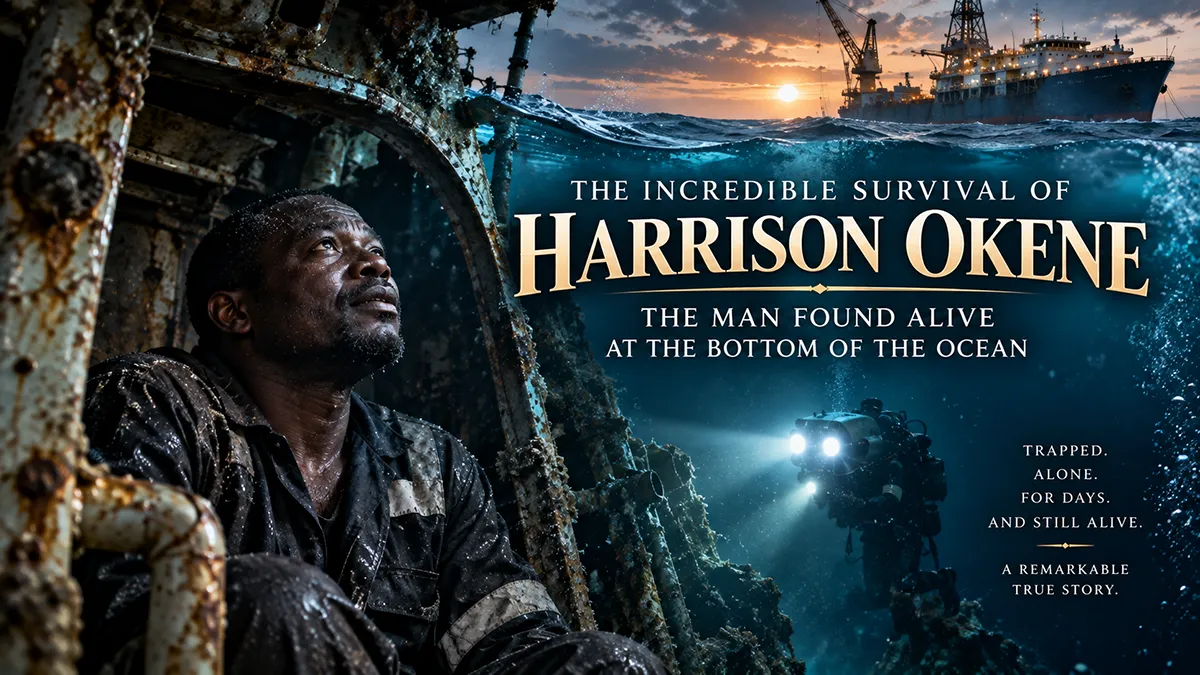
Imagine waking up in complete darkness, water rising around you, with no idea which way is up. Now imagine staying alive like that for nearly three full days, sitting in an air pocket the size of a small closet, thirty meters beneath the surface of the Atlantic Ocean. That is not a movie pitch — it is the true story of Harrison Okene, a Nigerian ship’s cook whose survival in 2013 became one of the most astonishing rescue stories in modern maritime history.
His name is often misspelled online as “harison okene,” and his story is sometimes mixed up with unrelated survival tales and other “is he still alive” searches. This article separates fact from confusion, walks through exactly what happened aboard the tugboat Jascon-4, and explains what Harrison Okene’s life has looked like in the years since.
TL;DR: Harrison Okene survived roughly 60 hours trapped in an air pocket 30 meters underwater after his tugboat capsized off Nigeria in 2013, and he was pulled out alive by divers who had come looking only for bodies.
Who Is Harrison Okene?
Harrison Okene was working as the cook aboard the tugboat Jascon-4 in May 2013, a job that put him on the water off the coast of Nigeria far more often than most people ever experience the open ocean. He was one of twelve crew members aboard the vessel that month. Before that voyage, he was, by all accounts, an ordinary maritime worker doing a routine job for a living.
Nothing about his background suggested he was destined to become a global symbol of human endurance. That changed in the early hours of one late-May morning, when a sudden, violent event turned a normal workday into a fight for survival that would capture headlines around the world.
The Final Voyage of the Jascon-4
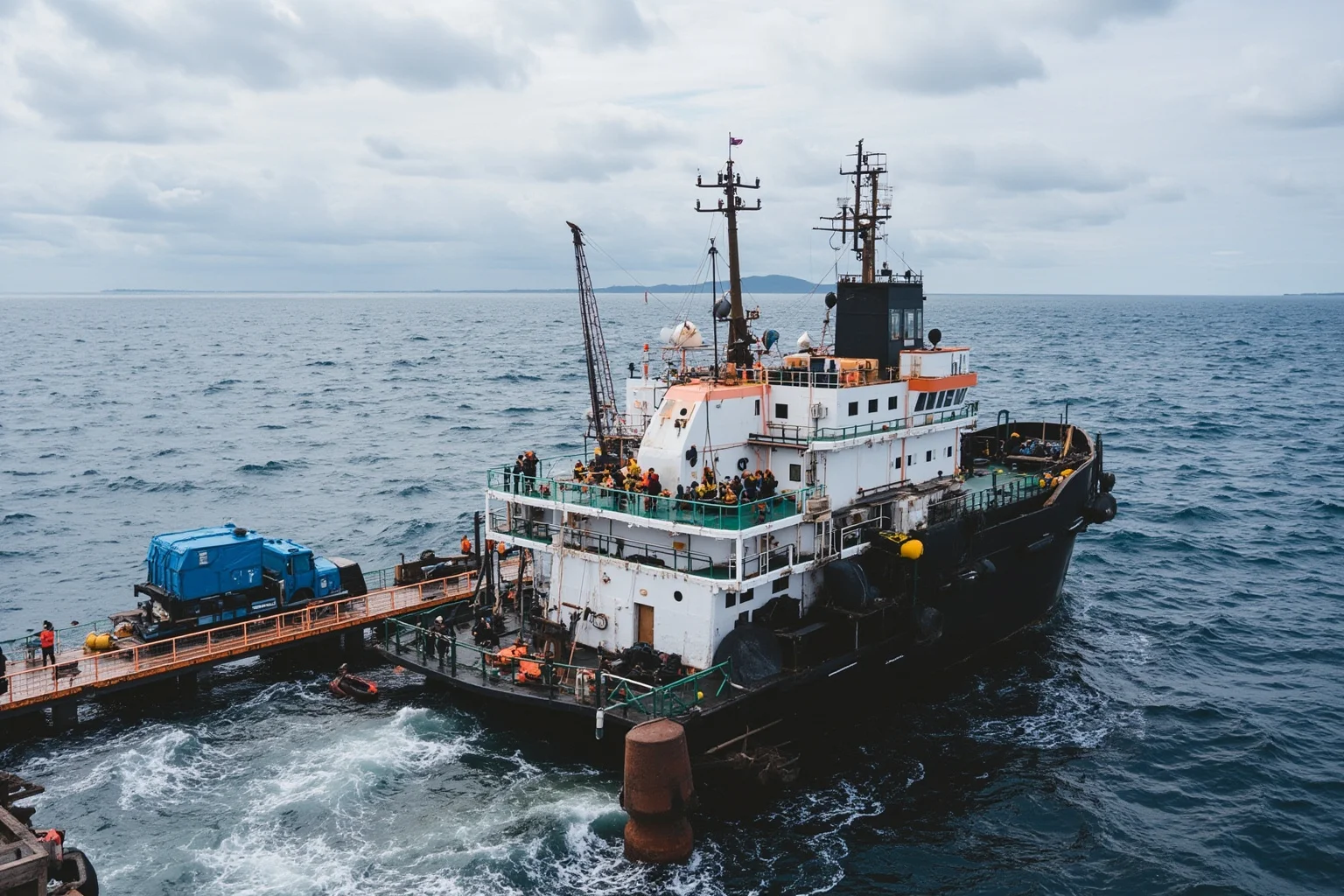
On May 26, 2013, the Jascon-4 was towing an oil tanker off the Nigerian coast near Escravos, in the Gulf of Guinea, on behalf of a Chevron-linked operation — the kind of offshore oil work that, as the Deepwater Horizon disaster later showed the world, can turn catastrophic with little warning. Tugboats like the Jascon-4 are workhorses of offshore oil operations, hauling and stabilizing much larger vessels in open water. That night, the sea turned rough, and the tug was hit by a swell strong enough to flip it.
The boat capsized and sank quickly, trapping the crew inside its hull as it settled upside down on the seabed. Of the twelve men aboard, eleven were killed in the disaster. Harrison Okene was the only crew member who survived, and for nearly three days, nobody on the surface knew he was still alive.
Trapped: 60 Hours in an Air Pocket at the Bottom of the Ocean
At the moment the tug flipped, Okene was inside the ship’s toilet, one of the few enclosed spaces that happened to trap a pocket of breathable air as water flooded the rest of the vessel. As the boat sank and settled upside down on the ocean floor, that small air pocket became his entire world. He was left in total darkness, submerged in cold water up to his waist, roughly 30 meters (about 100 feet) below the surface.
He had no light, no food beyond a small amount he managed to scavenge, and no way to know whether anyone even realized he was missing rather than presumed dead with the rest of the crew. Reports on his ordeal describe him rationing his movements to conserve the shrinking air supply, growing steadily weaker as hours turned into a full day, then two. By most widely reported accounts, he survived on the equivalent of sips of a soft drink and whatever oxygen remained trapped in that small space.
The psychological toll of that isolation is almost impossible to overstate. Okene was alone with the bodies of drowned crewmates nearby, uncertain if rescue would ever come, and forced to manage panic in absolute blackness for the better part of three days. Survival experts who later studied the case pointed to his calm decision-making — staying still, controlling his breathing, and not wasting energy — as the kind of composure under pressure that shows up again and again among the bravest acts done in history.
The Rescue: A Diver’s Hand Reaches Into the Dark
Back on the surface, the company that owned the Jascon-4 hired a marine salvage and diving team, not to search for survivors, but to recover the bodies of the crew and assess the wreck. Nearly 60 hours after the capsize, professional divers descended to the sunken hull to begin that grim task. Nobody expected to find anyone alive.
As a diver worked through the dark, flooded interior of the ship, he felt something unexpected: a human hand reaching back and grabbing his own. That moment — a rescue diver’s gloved hand meeting Harrison Okene’s bare hand in near-total darkness at the bottom of the ocean — is the single image most associated with this story, and it is the reason so many people now search specifically for “Harrison Okene hand” when trying to learn more.
The divers were reportedly as shocked as Okene was relieved. Finding a living, breathing man after 60 hours submerged at that depth defied every expectation of the recovery mission, and it instantly turned a body-retrieval operation into an emergency rescue.
Why the Harrison Okene Hand Photo Still Haunts People Today
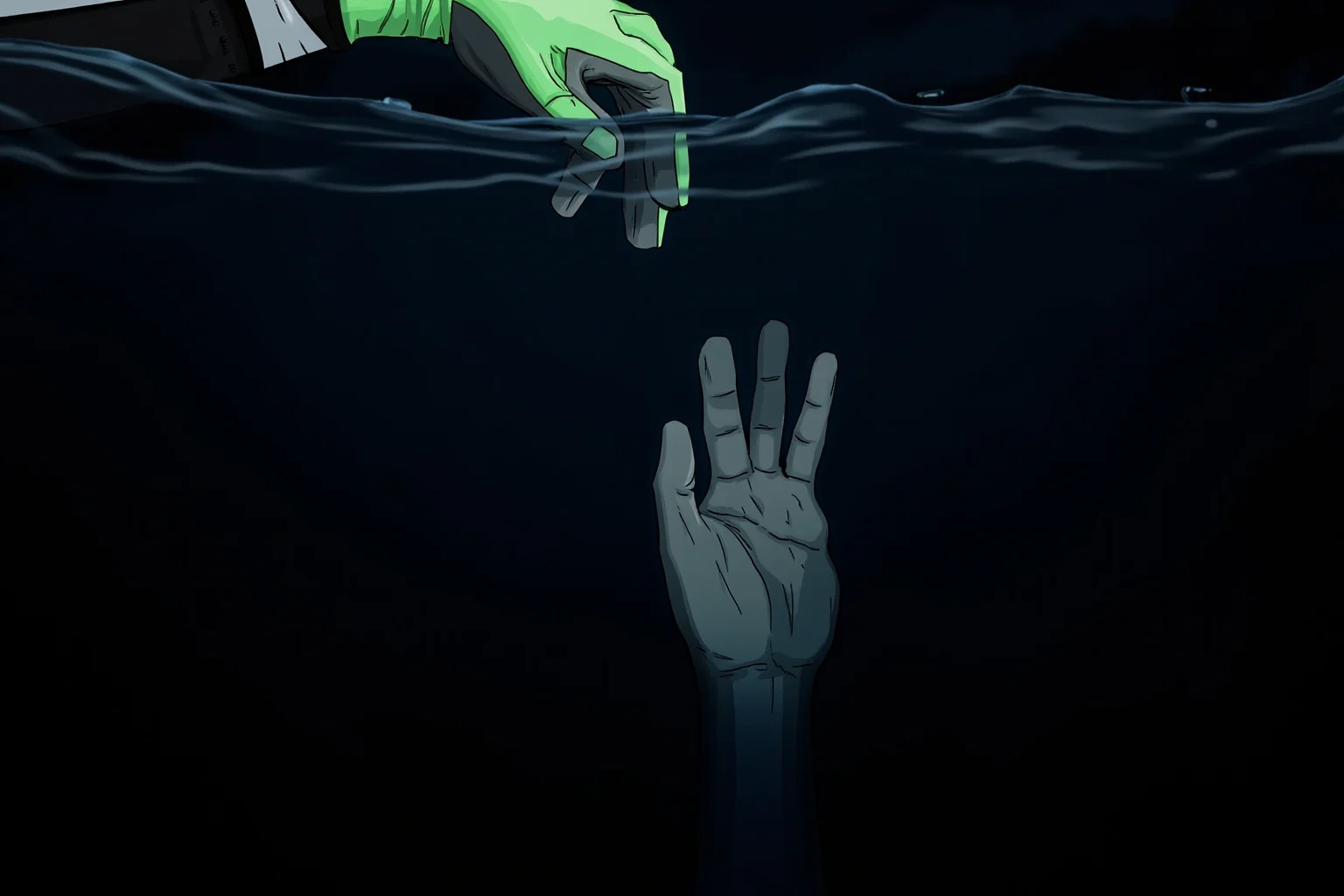
Footage and stills from the rescue divers’ helmet cameras capturing that hand-to-hand contact spread widely once the story broke internationally. It is a striking, almost cinematic image: a bare human hand emerging from pitch-black water to grip a diver’s glove, proof of life where only death was expected. That single frame is arguably what transformed Harrison Okene from a name in a shipping incident report into an internationally recognized survival story.
The visual power of that moment is also why the story has been referenced in documentaries, survival-themed television segments, and even discussions around fictional disaster films. It is a rare, almost unbearably dramatic piece of real footage, and it continues to circulate online years after the actual event.
The Science of Survival: How Did He Live So Long Underwater?
Okene’s survival hinged on a fairly narrow set of circumstances lining up in his favor. The enclosed toilet compartment trapped a pocket of air rather than flooding completely, buying him breathable oxygen even as the rest of the ship filled with seawater. The ambient temperature at that depth, while cold, was not so extreme that hypothermia killed him within hours, and his relative stillness helped conserve both oxygen and body heat.
Just as important was what happened after he was found. Because he had been breathing compressed air trapped at depth for so long, his body had absorbed gases under pressure the same way a scuba diver’s would on a long, deep dive. Bringing him to the surface too quickly could have caused severe decompression sickness, so rescuers placed him in a hyperbaric decompression chamber for an extended period, reportedly around 60 hours, to safely reduce the pressure in his body and prevent life-threatening complications.
The Aftermath: Recovering the Bodies of the Jascon-4 Crew
While Okene’s survival was the headline, the disaster remained a tragedy for ten other families. The divers who found Okene alive continued their original mission afterward, recovering the bodies of several of his deceased crewmates from the wreck. Eleven men in total lost their lives when the Jascon-4 capsized, making Okene’s survival all the more statistically extraordinary.
The incident prompted renewed scrutiny of offshore towing safety procedures in the Nigerian oil and shipping sector, where rough seas and aging support vessels have long been recognized hazards. It remains one of the deadliest tugboat incidents associated with West African offshore operations in recent memory, and it stands alongside other entries on lists of the worst man-made disasters in history as a reminder of how quickly industrial accidents at sea can turn deadly.
Harrison Okene Now: What Happened to Him After Rescue?
A question many people search for today is simply “is Harrison Okene still alive,” or variations like “Harrison Okene now” and “Harrison Okene today.” Based on the most widely available public reporting following his rescue and recovery, Okene survived the ordeal, recovered from his time in the decompression chamber, and returned to life on land in Nigeria.
His story was picked up by international outlets including the BBC and other major news organizations in the months after the rescue, and he gave interviews describing his experience in the years that followed. Detailed, continuously updated public information about his day-to-day life since then is limited, which is typical for private individuals who briefly become the subject of global news coverage and then step back from the spotlight.
What is well documented is that his case became a landmark reference point in discussions of extreme survival, hyperbaric medicine, and maritime rescue operations. He is frequently cited in documentaries and survival-science content precisely because his case was so thoroughly examined by the diving and medical professionals involved in his rescue.
The Story on Screen: Documentaries, Films, and Fiction
Harrison Okene’s ordeal inspired a short documentary titled “Vessel,” directed by Yener Ozturk, which used interviews and dramatized recreations to explore his 60 hours trapped underwater. The short film drew attention on the festival circuit and introduced many viewers outside Nigeria to the details of his survival for the first time.
The story’s dramatic, almost unbelievable structure — a lone survivor in total darkness, found only by chance during a body-recovery dive — has also made it a recurring reference point in articles and video essays about real-life survival stories that feel like fiction. It is easy to see why: few real events combine claustrophobia, deep-sea peril, and a last-second rescue as vividly as this one does.
Not the Same Story: Clearing Up Confusion With Other Survival Tales
Because Harrison Okene’s story involves a capsized vessel and a near-miraculous survival, it sometimes gets tangled up in search results with other, unrelated stories. It is worth being clear-eyed about the differences so the history stays accurate.
“Capsized: Blood in the Water” is a 2019 dramatized film based on a different true story entirely: a 1982 sailing accident in which the yacht Trashman sank in the Atlantic, leaving survivors adrift on a life raft while sharks circled nearby. It has no connection to Harrison Okene, the Jascon-4, or the Nigerian coast, even though both stories involve a sinking vessel and real people fighting to survive at sea.
Similarly, some readers searching for stories of survival against the odds land on questions like “is Prichard Colon still alive.” Prichard Colon is a Puerto Rican boxer who suffered a severe brain injury during a 2015 fight, leaving him with long-term, life-altering disabilities. His story is a serious and separate case entirely unrelated to Okene’s maritime rescue, and the two are only connected by the coincidence of appearing in similar “is this person still alive” search patterns.
Why Harrison Okene’s Story Still Matters
More than a decade later, Harrison Okene’s ordeal is still taught and referenced in diving safety courses, hyperbaric medicine discussions, and maritime rescue training. It stands as a genuine case study in how a combination of a trapped air pocket, mental discipline, and a stroke of extraordinary luck can add up to survival against odds that would have seemed impossible to calculate beforehand.
It is also a reminder that some of the most remarkable stories in modern history are not ancient battles or long-dead historical figures, but ordinary working people who found themselves in extraordinary circumstances. Okene did not set out to become part of survival history; he simply held on, in total darkness, until someone reached back.
Final Thoughts
Harrison Okene’s story endures because it strips survival down to its most basic elements: air, time, and the will to hold still and wait when panic would be the easier response. The image of a diver’s hand meeting his in the dark remains one of the most striking real photographs to come out of any modern maritime disaster.
While many details of his current, private life are not widely published, the core facts of his rescue are well documented and thoroughly verified by the diving professionals, journalists, and medical teams involved at the time. His case remains a genuine, sobering, and ultimately hopeful chapter in the history of maritime survival.
Frequently Asked Questions
Is Harrison Okene still alive?
Yes. Based on widely reported news coverage following his 2013 rescue, Harrison Okene survived the ordeal and recovered after treatment in a hyperbaric decompression chamber. Detailed updates on his private life since then are limited, but there is no credible reporting suggesting he has died.
What happened to Harrison Okene’s hand in the famous rescue footage?
During the rescue, a diver searching the sunken tugboat Jascon-4 for bodies felt a hand grab his own in the darkness. That moment, captured on a diver's helmet camera, showed Harrison Okene reaching out from the air pocket where he had survived for about 60 hours, and it became the most iconic image associated with his story.
How long did Harrison Okene survive underwater?
Harrison Okene survived for approximately 60 hours trapped in an air pocket roughly 30 meters (about 100 feet) below the surface, inside the capsized hull of the tugboat Jascon-4 off the coast of Nigeria in May 2013.
What is Harrison Okene doing now?
Public information about Harrison Okene's day-to-day life today is limited, since he largely returned to private life after giving interviews in the years following his rescue. His case remains widely cited in documentaries and diving safety discussions as one of the most remarkable survival stories in maritime history.
Is Simeon Toko still alive?
No. Simeon Toko was a Congolese religious leader who founded the Church of Christ on Earth (Ntokolism) and died on June 25, 1984. He is unrelated to Harrison Okene, though both names sometimes appear together in "is this person still alive" search patterns.
Is Prichard Colon still alive?
Yes, according to public reporting. Prichard Colon is a Puerto Rican boxer who suffered a severe brain injury during a 2015 fight and has lived with significant long-term disabilities since then. His story is entirely separate from Harrison Okene's maritime rescue.
Is ‘Capsized: Blood in the Water’ based on the same story as Harrison Okene?
No. 'Capsized: Blood in the Water' is a 2019 film dramatizing a 1982 sailing accident involving the yacht Trashman, in which survivors were adrift at sea and threatened by sharks. It is a real but completely different story from Harrison Okene's 2013 tugboat survival off Nigeria.
How is ‘Harrison Okene’ sometimes misspelled online?
Many people search for his story using the misspelling 'Harison Okene' with a single r. The correct spelling of the Nigerian ship's cook who survived the Jascon-4 sinking is Harrison Okene.

Alex Warren
Related Articles





