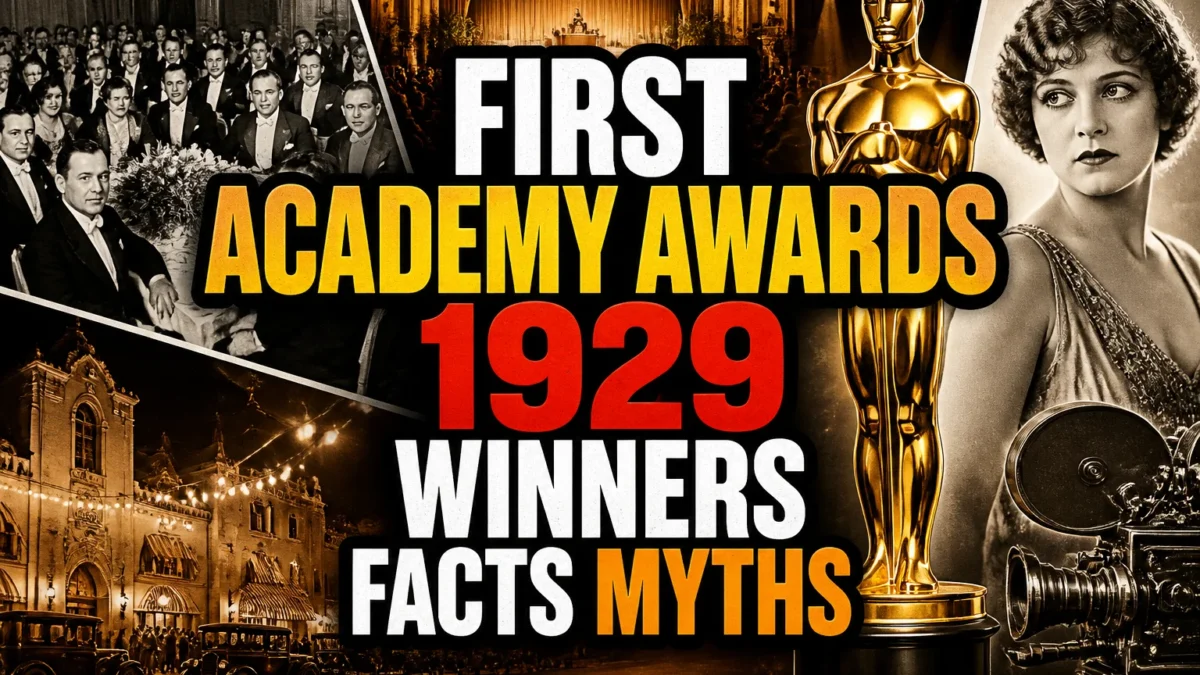
Long before red carpets, livestreams, and envelope mix-ups, the Academy Awards began as a modest dinner for a few hundred people in a Hollywood hotel. The first Academy Awards took place on May 16, 1929, and the presentation itself reportedly wrapped up in around 15 minutes.
Today, plenty of half-remembered "facts" float around about that night. Let's separate what the record supports from the legends, from who really won, to why the winners were no secret, to why people searching for the first Oscars sometimes end up reading about The Green Mile.
TL;DR: The first Academy Awards in 1929 were a brief, low-key hotel dinner that honored films from 1927-28, crowned the WWI aviation epic Wings, and looked almost nothing like today's Oscars.
What Were the First Academy Awards?
The 1st Academy Awards were held on the evening of May 16, 1929, in the Blossom Room of the Hollywood Roosevelt Hotel in Los Angeles. They honored work released between August 1, 1927, and July 31, 1928, which is why the event is often labeled the 1927/28 awards. That odd, non-calendar eligibility window is a reminder that nobody yet knew what a long-running tradition would look like.
The guest list was small by modern standards. Commonly cited figures put attendance at roughly 270 people, with tickets reportedly priced at $5. It was a private banquet for members of the film community and their guests, not a public spectacle.
Douglas Fairbanks, the first president of the Academy, presided over the evening. He is usually credited as the host alongside William C. deMille, a director and the brother of Cecil B. DeMille. Together they handed out the statuettes during a short program that came after dinner.
Why Hollywood Created an Academy in the First Place
The Academy of Motion Picture Arts and Sciences was founded in 1927, with 36 founding members and studio chief Louis B. Mayer playing a leading role in organizing it. The industry was in a period of rapid change. Labor tensions, public image concerns, and the looming arrival of sound all made a unifying organization appealing.
The Academy was set up with branches representing actors, directors, producers, technicians, and writers. Giving awards for excellence was one of several goals, alongside mediation of disputes and general industry promotion. Many historians note that studio leaders also saw the awards as a way to burnish Hollywood's reputation.
It is worth keeping that context in mind. The Oscars did not begin as a glamorous popularity contest. They began as an in-house effort by an industry that wanted to look respectable and organized.
Inside the First Oscar Ceremony: A 15-Minute Dinner
If you picture a first Oscar ceremony with searchlights, gowns, and a broadcast audience, adjust your expectations. The first Academy Award ceremony was a banquet. Guests ate, mingled, and then watched a brisk presentation of awards that took only a small fraction of the evening.
There was no suspense about the results. The winners had been announced to the public about three months earlier, in February 1929, so the dinner functioned more as a celebration than a reveal. The surprise-envelope tradition came much later, after the Academy decided to keep results secret until the night itself.
There was also no mass audience. The ceremony was not televised until 1953, when the 25th Academy Awards reached viewers on NBC. In 1929, the news traveled through newspapers and the industry grapevine.
How the Winners Were Chosen
The voting system of the academy awards first year looked quite different from the modern one. Historians generally describe a process driven by small boards of judges within each branch rather than the broad membership-wide balloting that developed later. Nominees were considered across a set of categories that the Academy would soon streamline.
The structure was also experimental. There were twelve competitive categories, two special awards, and some divisions that would vanish almost immediately. Think of the first year as a prototype, and the Academy treated it as one.
1st Academy Awards Winners: The Full List
Here is a rundown of the 1st Academy Awards winners in the competitive categories, plus the two special honors. Some categories look unfamiliar because they were retired after this single year.
- Outstanding Picture: Wings (Paramount)
- Unique and Artistic Production: Sunrise: A Song of Two Humans (Fox)
- Actor: Emil Jannings, for The Last Command and The Way of All Flesh
- Actress: Janet Gaynor, for 7th Heaven, Street Angel, and Sunrise
- Director (Dramatic Picture): Frank Borzage, 7th Heaven
- Director (Comedy Picture): Lewis Milestone, Two Arabian Knights
- Writing (Adaptation): Benjamin Glazer, 7th Heaven
- Writing (Original Story): Ben Hecht, Underworld
- Title Writing: Joseph Farnham
- Cinematography: Charles Rosher and Karl Struss, Sunrise
- Art Direction: William Cameron Menzies, for The Dove and The Tempest
- Engineering Effects: Roy Pomeroy, Wings
- Special Award: Warner Bros., for producing The Jazz Singer, the pioneering talking picture
- Special Award: Charlie Chaplin, for versatility and genius in acting, writing, directing, and producing The Circus
Two details jump out. Winners could be honored for a body of work across several films rather than a single title, and some awards, such as Title Writing, recognized the intertitle cards that silent films depended on. Both quirks disappeared as the awards matured.
Wings: The War Film That Won the First Best Picture
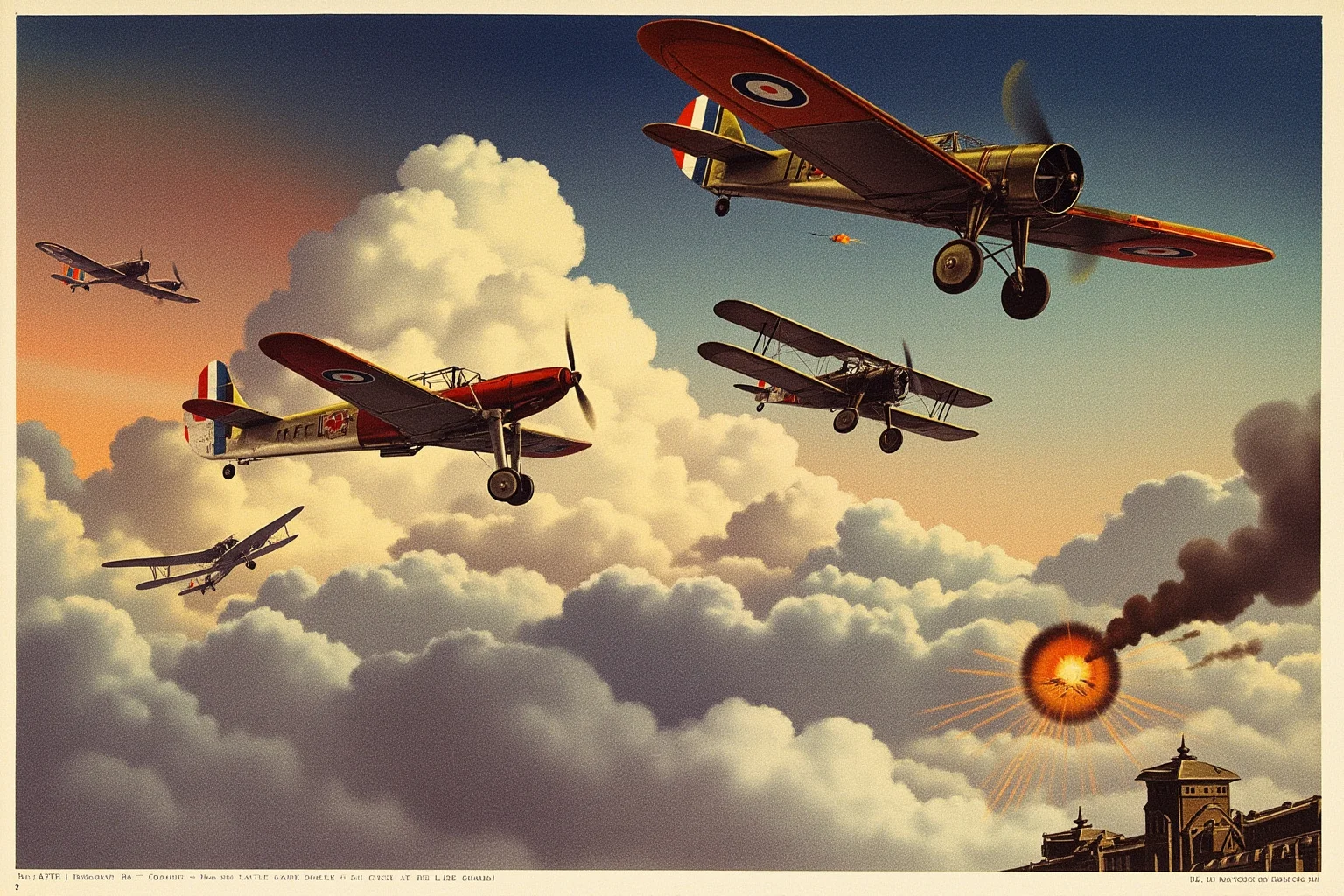
The top prize went to Wings, a World War I aviation drama directed by William Wellman. The story follows two young men who both love the same woman and who become fighter pilots. The cast included Clara Bow, Charles "Buddy" Rogers, and Richard Arlen, with a small early role for Gary Cooper.
What made the film special was its air combat. Wellman had flown in World War I with the Lafayette Flying Corps, and that experience shaped the film's aerial realism. The production drew on the cooperation of the U.S. Army, with filming around San Antonio, Texas, and reportedly involved thousands of soldiers and a very large budget, often cited at around $2 million.
For a history audience, Wings is a neat intersection of two stories. It is a Hollywood landmark and also an early cinematic memorial to the aerial war of 1914-1918, made only about a decade after the conflict ended. Many viewers still consider the dogfight sequences the film's enduring achievement.
Wings is also remembered as the only silent film to win the top prize until The Artist in 2011. That is a fun fact, but keep in mind that talking pictures were just emerging, so silent films were simply the norm in the eligibility period.
Sunrise and the "Other" Best Picture
The Academy's first year had two top-tier picture honors. Wings took Outstanding Picture, which was meant to recognize the most outstanding production in a more conventional sense. Sunrise, directed by German filmmaker F. W. Murnau, won Unique and Artistic Production, an award meant to recognize artistic quality.
The Academy dropped the second category after this ceremony. In later years, the Academy has treated Wings as the official Best Picture winner of the first ceremony, though many film historians argue that Sunrise has aged at least as well, and sometimes better. It also earned Janet Gaynor part of her acting award and gave Rosher and Struss their cinematography trophy.
This split is a useful reminder that the Academy was still figuring out what it was trying to reward. Was it spectacle, craft, or art? The debate has never really gone away.
Special Awards: The Jazz Singer and Charlie Chaplin
Two honors were given outside the competitive categories. Warner Bros. received a special award for The Jazz Singer (1927), widely regarded as a landmark in the arrival of synchronized sound. The Academy reportedly considered the film ineligible for the main picture prize because it would be unfair to compete with silent films.
Charlie Chaplin was originally nominated in several competitive categories for The Circus. The Academy instead removed him from those races and gave him a special award for versatility and genius across acting, writing, directing, and producing. It was an early example of the Academy using honorary awards to recognize people whose achievements didn't fit neatly into its ballot.
So, to be clear, The Jazz Singer did not win Best Picture. It is one of the most commonly repeated misunderstandings about the first Oscars.
A Winner Who Skipped the Party
Emil Jannings, the Best Actor winner, was a major star of German and Hollywood cinema. He was preparing to return to Europe, and the Academy reportedly allowed him to receive his statuette ahead of the ceremony. This is often cited as an example of how informal the first awards were.
The story fits with how the Academy handled early results. Because the winners were already public, there was little reason to insist that every honoree be physically in the room. The practice would later change as the event grew into a major public production.
Jannings's win also has a historical footnote. His career in Hollywood faded with the arrival of sound, in part because of his heavy accent. He later returned to work in Germany.
Myth-Busting the First Oscars
Because the early years are so distant, myths have gathered around them. Here are the ones we see most often.
Myth: The Winners Were a Secret Until the Night
Not in 1929. The results were announced in February, so the ceremony celebrated outcomes that were already known. Sealed-envelope secrecy came later, reportedly after leaks to the press prompted the Academy to change its approach.
Myth: The Statuette Was Always Called "Oscar"
The official name was the Academy Award of Merit. The nickname "Oscar" appeared later, and the origin is disputed. One popular story credits Academy librarian Margaret Herrick with remarking that the statuette resembled her uncle Oscar, while columnist Sidney Skolsky is often associated with popularizing the name in 1934. The Academy formally adopted it in 1939.
Because the origin stories conflict, treat any single tidy explanation with caution. The nickname's popularity is better documented than its birth.
Myth: The Ceremony Was a Hollywood Spectacle
It was a dinner in a hotel ballroom, with about 270 guests. The awards portion was short, and there was no broadcast for the public. The Oscars grew into a global event gradually over the following decades.
Myth: The Jazz Singer Won Best Picture
It received a special award instead, as noted above. The Academy considered it a technological milestone rather than a direct competitor in the picture categories. That is a subtle distinction, but it matters.
Myth: Every Category Became Permanent
Several categories were one-offs, including Title Writing, Unique and Artistic Production, and the separate directing awards for drama and comedy. Others, such as Engineering Effects, evolved into what we now think of as the visual effects awards. The first year was a trial run in more ways than one.
Where The Green Mile Fits In (and Doesn't)
If you arrived here searching for "the green mile academy awards," here is the quick clarification. The Green Mile is a 1999 drama directed by Frank Darabont and based on Stephen King's serialized novel. It has nothing to do with the first Academy Awards, which took place about 70 years earlier.
The film earned four nominations at the 72nd Academy Awards in March 2000: Best Picture, Best Supporting Actor for Michael Clarke Duncan, Best Adapted Screenplay, and Best Sound. It did not win any of them, and American Beauty took Best Picture that year.
The mix-up is understandable, since search engines group Oscar topics together. Still, if your interest is the origins of the awards rather than a specific modern nominee, the story begins in 1929 with Wings, Sunrise, and a Hollywood hotel ballroom.
The Statuette: Design and Early Trophies
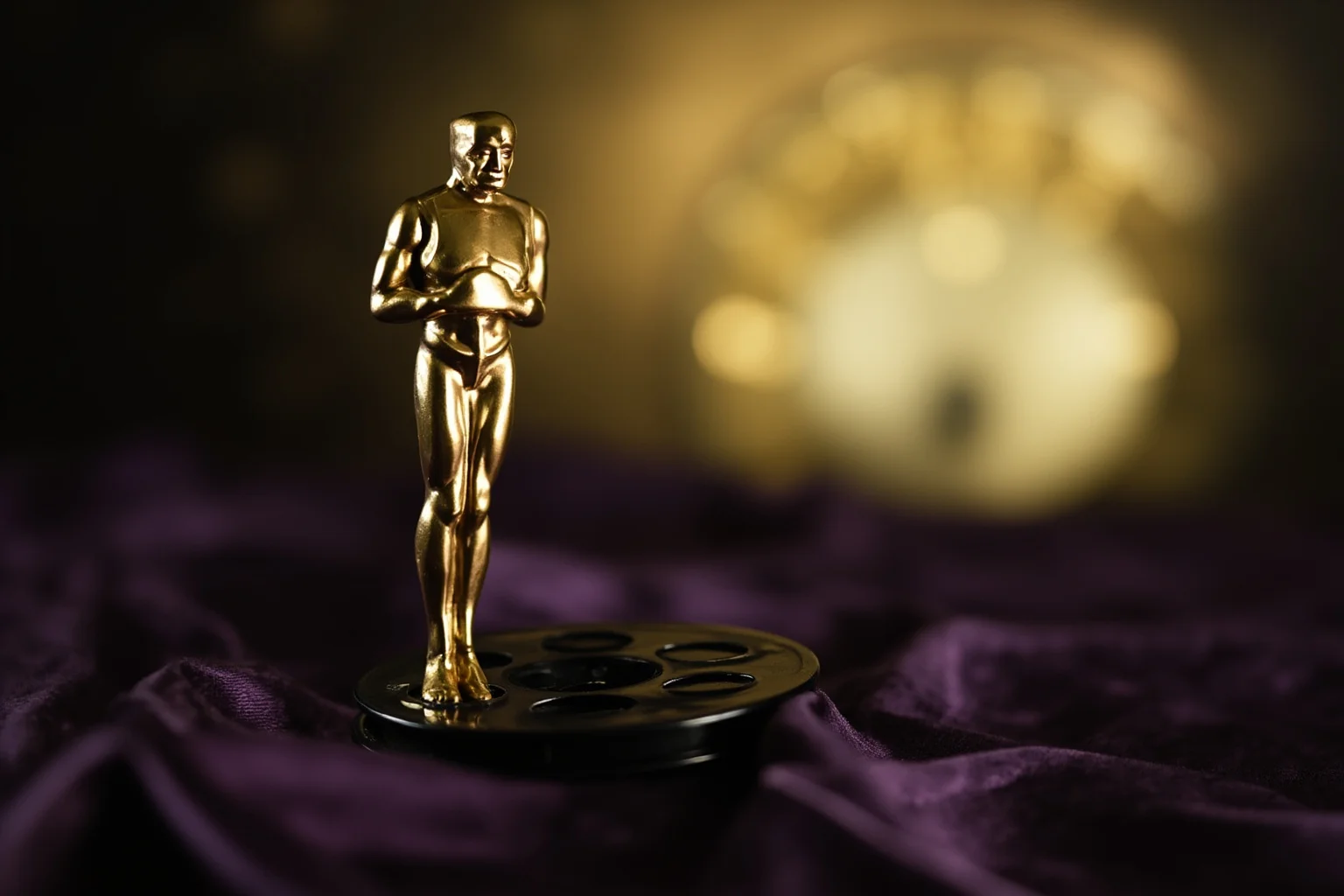
The statuette was designed by Cedric Gibbons, an MGM art director and one of the Academy's founders, and sculpted by George Stanley. It depicts a knight standing on a reel of film, holding a sword. The five spokes of the reel are often said to represent the Academy's original five branches.
A popular story says that the Mexican actor and director Emilio "El Indio" Fernández posed as the model. This is widely repeated, but the details are not something to treat as settled. It is better described as a long-standing and frequently cited account.
The design has remained recognizable for nearly a century, even as materials and manufacturing have changed. It is one of the few elements of that first night that you would instantly recognize today.
Why the First Oscars Still Matter
The first Academy Awards were small, quick, and a little improvised. Yet they established the idea that Hollywood would honor its own work with a yearly ritual, and that idea shaped how film history is told. Decades of film lists, retrospectives, and debates trace back to this one evening.
They also capture a moment of transition. Silent cinema was at its artistic peak, sound was arriving, and a young industry was deciding how to define excellence. The winners reflect that mix of old and new in a way no later ceremony could.
For history fans, Wings offers an especially rich thread. A war film by a veteran pilot, made in the shadow of World War I, became the first picture honored by an institution that would go on to shape global culture. That is a fitting beginning.
Final Thoughts on the 1929 Ceremony
Revisiting the first Oscars is a good reminder that famous institutions often start out modest. A private dinner, a small crowd, a handful of categories, and a few months of advance publicity produced a tradition that has lasted nearly a century.
The next time you watch a modern ceremony, think back to that Blossom Room in May 1929. The speeches are longer now and the stakes are bigger, but the basic idea, an industry pausing to honor its own, hasn't changed.
Frequently Asked Questions
When and where was the first Academy Award ceremony held?
The first Academy Award ceremony took place on May 16, 1929, in the Blossom Room of the Hollywood Roosevelt Hotel in Los Angeles. It was a private dinner of roughly 270 guests, and the awards presentation itself reportedly lasted only about 15 minutes. The ceremony honored films released between August 1, 1927, and July 31, 1928.
Who won Best Picture at the 1st Academy Awards?
The World War I aviation film Wings won Outstanding Picture, the award the Academy now treats as the Best Picture of that first year. A separate award, Unique and Artistic Production, went to Sunrise: A Song of Two Humans. That second category was discontinued after the first ceremony.
Were the winners of the first Oscars a surprise?
No. The winners were announced to the public around February 1929, about three months before the dinner. The ceremony celebrated results that were already known, and the tradition of keeping winners secret until the event came later.
Was the first Academy Awards ceremony televised or broadcast?
No. The 1929 dinner was a private event with no broadcast for the public, and news of it spread through newspapers. The Oscars were first televised in 1953, at the 25th Academy Awards.
Did The Jazz Singer win Best Picture at the first Oscars?
No. Warner Bros. received a special award for producing The Jazz Singer, recognized as a pioneering talking picture. The film was reportedly considered ineligible for the main picture prize because it would have been unfair to compete against silent films.
Did The Green Mile win any Academy Awards?
The Green Mile (1999) received four nominations at the 72nd Academy Awards in 2000: Best Picture, Best Supporting Actor for Michael Clarke Duncan, Best Adapted Screenplay, and Best Sound. It did not win any of them. The film has no connection to the first Academy Awards of 1929.
When did the statuette become known as the Oscar?
The statuette's official name was the Academy Award of Merit, and the nickname Oscar came into use later. Its exact origin is disputed, though columnist Sidney Skolsky is often associated with popularizing it in 1934. The Academy formally adopted the name in 1939.

Alex Warren
Related Articles