On the night of 4 to 5 November 1605, a man calling himself John Johnson was seized in a cellar beneath the House of Lords. Around him lay roughly three dozen barrels of gunpowder, hidden under piles of firewood and iron bars. Within days, the world would know him as Guy Fawkes.
More than four centuries later, the plot is still remembered with bonfires, fireworks and a rhyme most British schoolchildren can recite. But the real story is messier, sadder and far more interesting than the cartoon version. This post separates the documented history from the folklore, from what Guy Fawkes actually did to how the gunpowder plotters met their end.
TL;DR: The Gunpowder Plot of 1605 was a Catholic conspiracy led by Robert Catesby, not Guy Fawkes, to destroy King James I and Parliament, and its failure reshaped English politics, religion and memory.
Gunpowder Treason in Brief: What Happened on 5 November 1605
In its own day, the affair was known as the "Gunpowder Treason", and that is the name you will find in early laws and sermons. Today we call it the Gunpowder Plot, and some people search for it as the "gunpowder rebellion". Strictly speaking, it was a conspiracy with a planned uprising attached, not a rebellion that ever got off the ground.
The idea was simple and shocking. A group of English Catholic conspirators planned to blow up the House of Lords during the State Opening of Parliament, killing King James I and much of the political elite in one blow. They then hoped to seize the king's daughter, Princess Elizabeth, and spark a wider revolt in the Midlands.
The plan failed because the authorities were tipped off. Fawkes was caught guarding the explosives, the other leading plotters were hunted down within days, and by the end of January 1606 the surviving ringleaders had been tried and executed.
Why Did Guy Fawkes Try to Blow Up Parliament?
To understand why Guy Fawkes tried to blow up Parliament, you have to start with religion. England had been officially Protestant since the Reformation, and Catholics faced fines, penalties and suspicion. Priests who ministered in England risked execution as traitors, and ordinary Catholics who refused to attend Church of England services (known as recusants) could be heavily fined.
When Elizabeth I died in March 1603, many Catholics hoped her successor, James VI of Scotland, who became James I of England, would ease the pressure. His wife, Anne of Denmark, was widely rumoured to have Catholic sympathies, and James had shown some early flexibility. Those hopes did not last.
By early 1604 the king had ordered Catholic priests to leave the country, and fines on recusants were enforced again. He also made peace with Spain in 1604, which removed the realistic prospect of a Catholic foreign power coming to the rescue. For a small circle of embittered men, the usual routes to relief seemed closed.
Historians generally see the plot as the desperate act of a few radicalised individuals rather than the plan of English Catholics as a whole. Most Catholics were loyal subjects, and many were horrified when the plot became public. That distinction matters, because the backlash fell on them all the same.
The Story of Guy Fawkes Before the Plot
The story of Guy Fawkes begins in York, where he was baptised on 16 April 1570 at the church of St Michael le Belfrey. He was baptised into the Church of England, so he was not born into a Catholic household in any simple sense. His father, a legal official, died when Guy was still a boy.
His mother later remarried a man with Catholic connections, and Guy attended St Peter's School in York. A number of his schoolfellows would later become involved in the plot, which shows how small and interconnected this world was. At some point he converted to Catholicism, and by his twenties he had left England.
Fawkes became a soldier in the Spanish Habsburg forces fighting in the Netherlands, where he gained a reputation as a capable and disciplined fighter. He sometimes used the Italianised name "Guido", and his military experience, including familiarity with explosives and siege warfare, made him useful to the conspirators. He also travelled to Spain to seek support for English Catholics, but that mission produced nothing.
In 1604 he was approached by Thomas Wintour, one of the plot's organisers, and returned to England. He was not an aristocrat or a politician. He was a trusted soldier with nerve, which is a very different thing from being a mastermind.
The Conspirators: Who Was Really in Charge?
The true leader was Robert Catesby, a charismatic Catholic gentleman from a well-connected family who had already been involved in an earlier rebellion against Elizabeth, the Essex rising of 1601. He is the figure most historians put at the centre of the plot. Fawkes was a key operative, but he was not the architect.
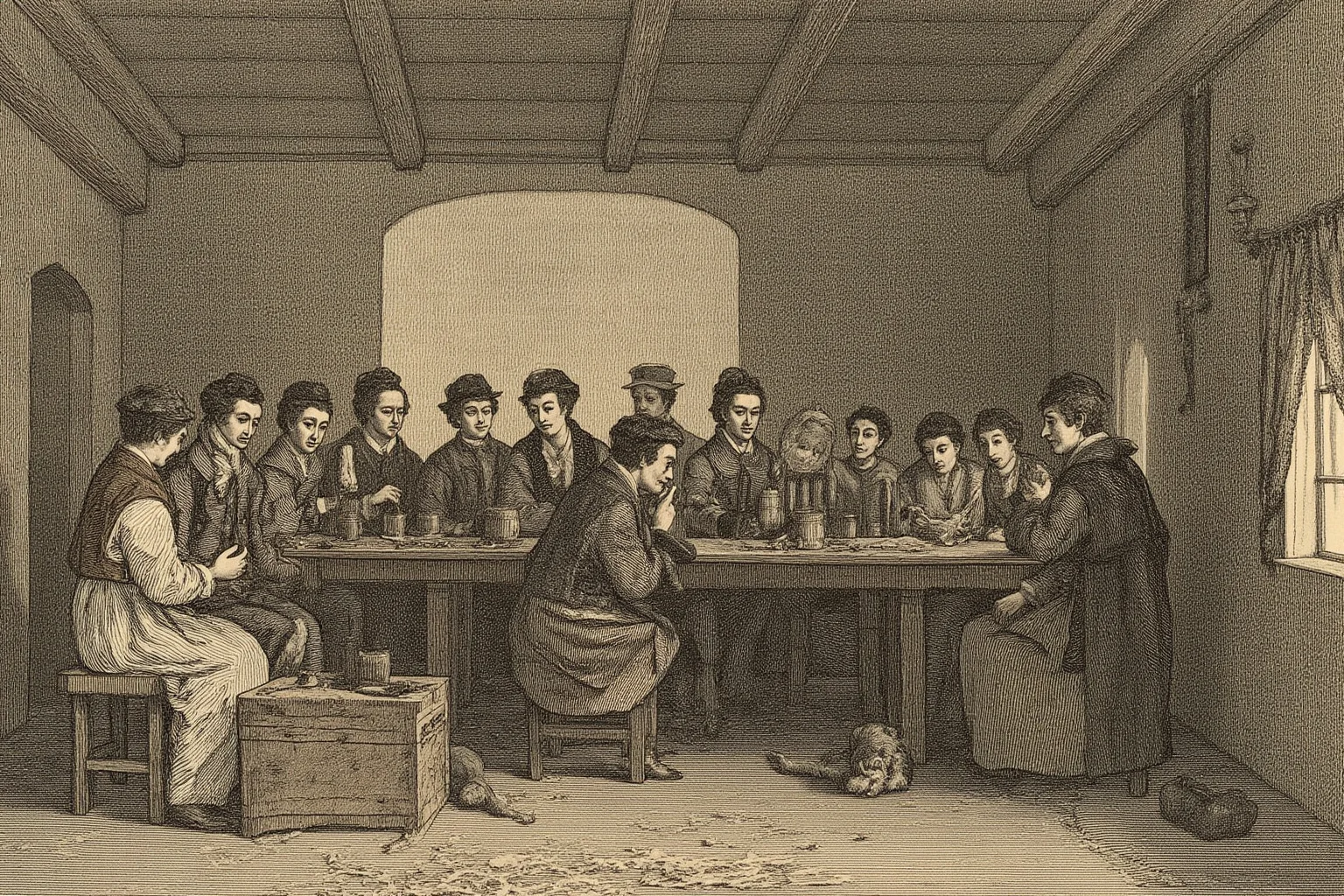
According to the traditional account, the first meeting of the inner circle took place in May 1604. Catesby, Thomas Wintour, John Wright, Thomas Percy and Fawkes are said to have swore an oath of secrecy and received communion. The exact details of that meeting come from later confessions, so some caution is needed.
The group grew over the following year. Other conspirators included Robert Wintour, Christopher Wright, Robert Keyes, Thomas Bates (Catesby's servant), John Grant, Ambrose Rookwood and Sir Everard Digby. Francis Tresham joined late and has long been a figure of suspicion in debates about who leaked the plot.
There were practical reasons for recruiting more people. The plotters needed money, horses, houses and weapons, and the wealthier recruits supplied them. Each additional person, though, was also another chance for the secret to slip out.
How the Plot Was Built: Tunnels, a Cellar and 36 Barrels
The conspirators first rented a house next to the Palace of Westminster through Thomas Percy, who held a position at court. Fawkes lived there under the name John Johnson, posing as Percy's servant. The plan, at first, was to dig a tunnel through to the House of Lords.
Tunnelling proved slow and exhausting, and later confessions describe the work as difficult going through thick foundations. Then a better opportunity appeared. A ground-floor storage cellar directly beneath the House of Lords became available to rent, and Percy took it.
Gunpowder was brought in by river and stored in the cellar in barrels, then covered with firewood and iron bars to disguise it. The commonly cited figure is 36 barrels, a quantity that would have been enormously destructive in a confined space. Exact modern estimates of the weight vary, and the real-world quality of seventeenth-century powder stored for months is itself a matter of debate.
Parliament was repeatedly postponed, partly because of plague, which stretched the timeline and the nerves of everyone involved. It was finally due to open on 5 November 1605. By then the plan had a second half: Catesby and others would raise support in the Midlands and seize the king's daughter, Princess Elizabeth, then living at Coombe Abbey in Warwickshire.
What Guy Fawkes Did, and What He Didn't Do
If you are wondering what Guy Fawkes did, the answer is more specific than the legend suggests. He guarded the gunpowder cellar, helped prepare the explosives and was assigned the job of lighting the fuse on the day. After that, he was supposed to escape across the Thames and travel abroad to explain the plot to Catholic powers.
What he did not do was plan the whole thing, recruit the others or lead the conspiracy. He was also not caught with a burning fuse in his hand, which is a common picture. He was arrested before the day of the opening, with the explosives still in place and a means of lighting them on his person.
This is why the phrase "Guy Fawkes and Gunpowder Plot" is a bit lopsided as shorthand. The man who has given his name to the event was one of several principal figures and arguably the one with the least say in the strategy. His fame comes from being the one who was caught red-handed.
The Monteagle Letter: Who Tipped Off the Government?
On 26 October 1605, about ten days before the opening of Parliament, William Parker, Lord Monteagle, received an anonymous letter. It warned him to find an excuse to stay away from Parliament and hinted that a terrible blow was coming, without revealing who would deliver it. Monteagle passed it to Robert Cecil, Earl of Salisbury, the king's chief minister.
Who wrote it remains unknown. Suspicion has fallen on Francis Tresham, who was Monteagle's brother-in-law, and on others close to the conspirators. Some have wondered whether Monteagle himself had advance knowledge, but there is no conclusive evidence for any of these theories.
The delay between the letter and the discovery is one reason conspiracy theories flourish. Cecil showed the letter to the king after James returned from hunting at the end of October, and the authorities then planned a search. That sequence is documented, but the motives behind it are the sort of thing historians argue over.
The Arrest on the Night of 4 to 5 November
The first search of the area around Parliament took place on 4 November and noticed the large stack of firewood and the man calling himself Johnson. The officials were suspicious enough that a second search was ordered later that night. It was led by Sir Thomas Knyvet, a Westminster magistrate.
Knyvet's men found Fawkes outside the cellar around midnight, wearing boots and spurs. Inside they uncovered the barrels beneath the firewood. Fawkes was arrested and taken to the king's quarters, where he reportedly remained defiant, though some of the dramatic lines attributed to him in popular retellings are hard to verify.
The king's survival was celebrated as nothing short of a divine rescue. Bonfires were lit in London that very night, and the idea that providence had saved the nation became central to the way the plot was remembered.
Guy Fawkes Torture: What the Records Show
Torture was not routine under English law, and it needed special authorisation. Within a day or two of the arrest, King James is recorded as approving its use on Fawkes, with the instruction that gentler methods should come first and harsher ones only by degrees. That wording comes from surviving documents, which makes it one of the better-attested parts of the story.
What exactly happened to Fawkes in the Tower of London is less clear. Many popular accounts say he was stretched on the rack, but the contemporary evidence points more clearly to the use of manacles and other restraints. Historians continue to debate how severe the treatment was, so claims about Guy Fawkes torture should be handled with care.
What we do have is a striking physical clue. Fawkes's signature on his confession of 8 November is faint and shaky, in contrast to the firm hand of his earlier statement. That change suggests a man who had been physically broken.
He gave his real name on 7 November and began naming his fellow conspirators once the authorities already knew many of them. By then, several of the plotters were on the run.
The Manhunt and the Fight at Holbeche House
When news of the arrest reached them, Catesby and the others fled to the Midlands, hoping to raise a rebellion among Catholic gentry. Very few joined them. The plot that was meant to topple a government had turned into a desperate flight.
The core group gathered at Holbeche House in Staffordshire. While drying some damp gunpowder before a fire, a spark caused an explosion that injured several of them. On 8 November the sheriff's forces surrounded the house.
In the fight that followed, Catesby, Thomas Percy and the brothers John and Christopher Wright were killed. Catesby and Percy are reported to have been struck by the same shot. Their bodies were later dug up, and the heads of Catesby and Percy were displayed on spikes near Parliament.
Other plotters, including Thomas Wintour and Ambrose Rookwood, were wounded or captured. Francis Tresham was arrested and died in the Tower on 23 December 1605 of illness, before he could be tried.
The Trial and Execution of the Gunpowder Plotters
Eight surviving conspirators were tried on 27 January 1606 in Westminster Hall: Guy Fawkes, Thomas Wintour, Robert Wintour, Ambrose Rookwood, Robert Keyes, Sir Everard Digby, John Grant and Thomas Bates. The prosecution was led by Attorney General Sir Edward Coke. The outcome was never in doubt, and all were sentenced to be hanged, drawn and quartered.
The execution of the gunpowder plotters took place over two days. On 30 January, Digby, Robert Wintour, Grant and Bates were executed at the west end of St Paul's churchyard. The following day, 31 January, Thomas Wintour, Rookwood, Keyes and Fawkes were executed at Old Palace Yard in Westminster, within sight of the building they had targeted.
How Was Guy Fawkes Executed?
The sentence for treason was brutal. Traditionally, the condemned were dragged to the scaffold, hanged for a short time, cut down while still alive, disembowelled and then beheaded and cut into quarters. It was designed as a public warning as much as a punishment.
Fawkes was the last of the four to be executed on 31 January. Because he was weak, he was helped up the ladder, and most accounts say he either fell or jumped from it, breaking his neck. That means he was probably dead or nearly dead before the rest of the sentence was carried out.
So, to answer the common question, Guy Fawkes was hanged, but he avoided the worst of the agony usually associated with the sentence. The details differ slightly between sources, so it is safest to say that the traditional account describes a broken neck rather than a full, conscious ordeal.
What Happened to the Priests?
The government also pursued Catholic priests. The Jesuit Henry Garnet, the head of the order in England, was tried in March 1606 and executed on 3 May for failing to reveal what he had learned. He had been told of the plot through confession, and his case became a famous dispute over religious secrecy and the doctrine of equivocation.
Nicholas Owen, a lay brother known for building hiding places for priests, died in the Tower in March 1606 after interrogation. These cases show that the plot's consequences reached well beyond the men who had planned it.
Gunpowder Plot Myths, Busted
Because the story is so familiar, it has collected plenty of myths. Here are a few of the most persistent.
Myth: Guy Fawkes Was the Mastermind
He was not. Robert Catesby was the driving force, and Fawkes was an operative with a specific job. His name stuck largely because he was the one caught and because he was the one who endured the interrogation.
Myth: He Was "the Only Man to Enter Parliament with Honest Intentions"
This is a joke, not history, and it is a reminder that the plot would have killed many people. Fawkes was not a harmless idealist. He was prepared to take part in a massacre.
It is also worth remembering that he and the others genuinely believed they were acting against religious persecution. Understanding that is not the same as excusing it.
Myth: The Whole Thing Was a Government Setup
Theories that Robert Cecil engineered or manipulated the plot have been around for centuries. The delay before the search and the unexplained author of the Monteagle letter feed such ideas. Most historians, however, accept that the plot was real and that the evidence for a staged conspiracy is thin.
That said, it is fair to say that the government made the most of the discovery. It used the plot to justify tougher measures against Catholics.
Myth: Every Catholic Supported It
This is the most damaging myth, and it was spread deliberately at the time. In fact, many Catholics condemned the plot immediately, and several of the plotters themselves worried about harming innocent Catholic peers who would be in Parliament. The wider Catholic community paid a heavy price for the actions of a few.
Myth: The Explosion Would Have Flattened Westminster
The claim is often repeated, but the truth is more nuanced. A 2005 television experiment using a replica of the House of Lords and a large quantity of powder suggested that the blast would have been devastating inside the chamber and its immediate surroundings. Even so, questions remain about the condition of the stored powder, and no one can say for certain exactly how far the destruction would have spread.
The Aftermath: New Laws and a New Fear
The discovery of the plot had immediate political consequences. Parliament passed laws in 1606 that tightened restrictions on Catholics, including a new Oath of Allegiance that required them to reject the idea that the pope could depose a monarch. Catholics faced new limits on their public lives and professions.
It would take generations before those restrictions eased, and full Catholic emancipation did not come until 1829. In the meantime, the memory of the plot fed a lasting suspicion that Catholics were politically disloyal.
The event also strengthened a sense of national providence. Many English Protestants saw the king's survival as proof that God favoured their cause, and sermons repeated that message for years.
How Bonfire Night Became a Tradition
Parliament passed a law in early 1606, usually called the Observance of 5th November Act, which required an annual thanksgiving service. It stayed on the books until 1859. That official sanction helped turn a political event into a yearly ritual.
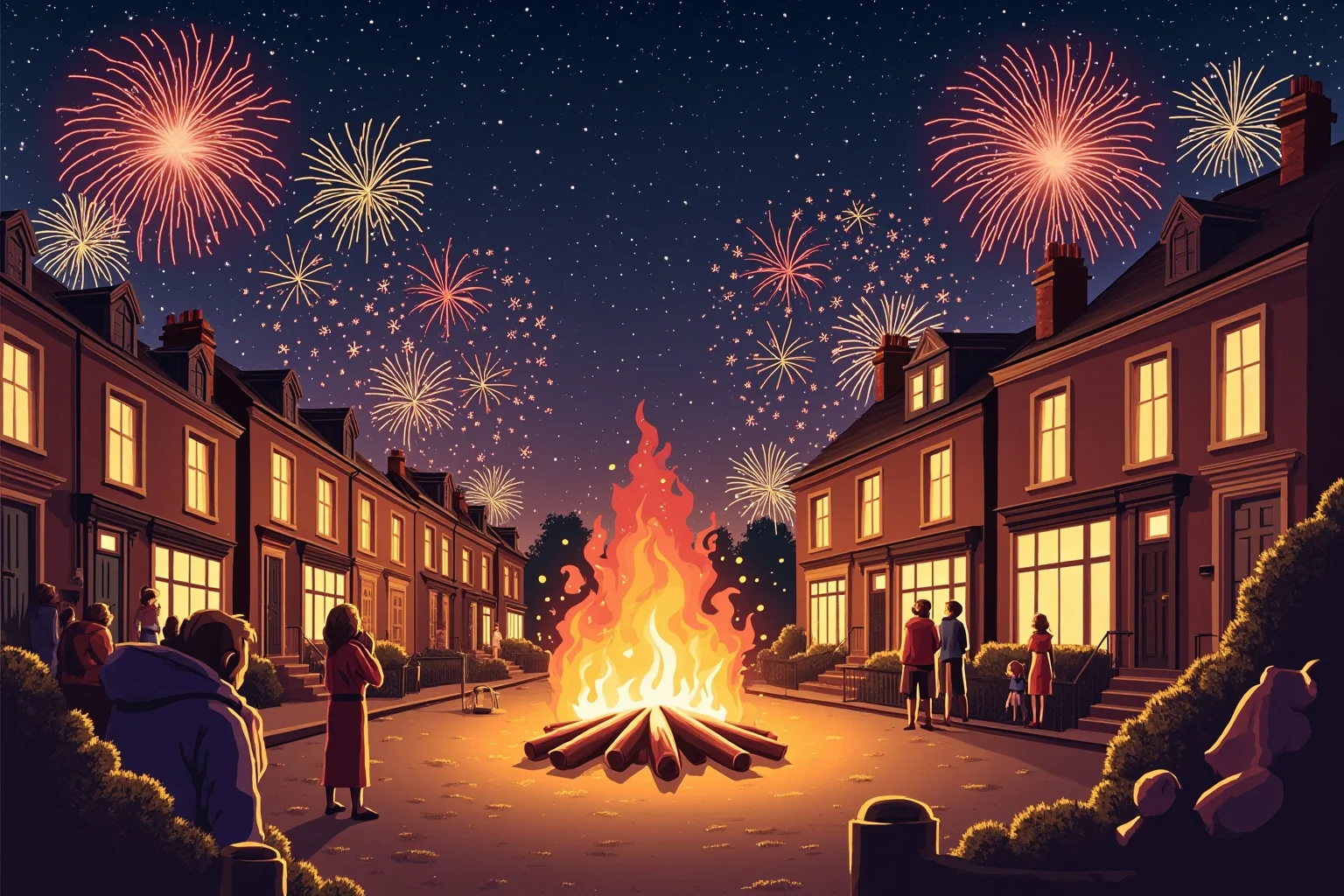
Over time the day became less solemn and more festive. Bonfires, fireworks and the burning of effigies became part of the occasion. In the eighteenth century the effigies often represented the pope, and later the figure of Guy Fawkes took centre stage.
Children began to make their own figures, known as "guys", and ask passers-by for "a penny for the Guy". The everyday word "guy" for a man is commonly traced back to those effigies, though like many word origins it is easier to assert than to prove.
Some communities developed their own traditions. Lewes in Sussex, for example, is famous for its large bonfire societies and torchlit processions. The old rhyme that begins "Remember, remember" is part of that folk memory, though its exact origins are uncertain.
From Cellar to Mask: Fawkes in Modern Culture
The plot's symbolism has changed dramatically. Even now, before each State Opening of Parliament, the Yeomen of the Guard carry out a ceremonial search of the cellars. It is a theatrical custom, but it keeps the story alive in the heart of British government.
In the late twentieth century, the plot found a new audience through the graphic novel V for Vendetta by Alan Moore and David Lloyd. Lloyd's stylised Guy Fawkes mask was later featured in the 2006 film adaptation and became a global symbol of protest, notably adopted by the Anonymous movement. For many people, the mask now signals anti-authority dissent rather than seventeenth-century religious conflict.
That transformation shows how a historical figure can be detached from his real story. The man behind the mask was a soldier who joined a plot to kill many people, and he does not fit neatly into any modern cause.
Why the Gunpowder Plot Still Matters
The Gunpowder Plot is more than a quirky date on the calendar. It is a case study in how political and religious pressure can push a small group towards violence, and in how governments and societies respond afterwards. It also shows how quickly a complicated event can be turned into a simple story.
When we look closely, we find a conspiracy led by Catesby, a soldier named Guy Fawkes who took the fall, an unknown letter-writer who changed the course of events, and a Catholic minority that suffered the consequences. We also find uncertainty, including the identity of the letter's author and the exact nature of Fawkes's torture. Admitting what we do not know is part of telling the story honestly.
So the next time you watch fireworks on 5 November, remember that behind the sparks is a real and troubling episode of English history. It is a story of fear, faith, ambition and failure, and it is still being retold more than 400 years later.
Frequently Asked Questions
What is the connection between Guy Fawkes and the Gunpowder Plot?
Guy Fawkes and the Gunpowder Plot are linked because Fawkes was the conspirator caught guarding the explosives beneath the House of Lords on the night of 4 to 5 November 1605. He was not the leader, though. Robert Catesby was the main organiser, and Fawkes's role was to guard the gunpowder and light the fuse.
Why did Guy Fawkes try to blow up Parliament?
Fawkes and his fellow conspirators were English Catholics who hoped to end the persecution of their faith by killing King James I and much of the political elite. Their hopes of toleration had faded after James enforced anti-Catholic measures in 1604. They planned to follow the explosion with an uprising and to install the king's daughter Elizabeth as a figurehead.
What did Guy Fawkes do in the Gunpowder Plot?
Fawkes helped store and guard 36 barrels of gunpowder in a cellar under the House of Lords, using the alias John Johnson. He was assigned to light the fuse and then escape abroad. He was arrested around midnight before the plan could be carried out.
How was Guy Fawkes executed?
Fawkes was sentenced to be hanged, drawn and quartered and was executed on 31 January 1606 at Old Palace Yard in Westminster. Most accounts say he was so weak that he fell or jumped from the ladder and broke his neck, so he avoided the worst of the sentence. Details vary between sources.
Was Guy Fawkes tortured?
Yes, King James I authorised the use of torture, instructing that gentler methods be used first and harsher ones only by degrees. The exact methods are debated, and the rack is often mentioned but not clearly documented. Fawkes's shaky signature on his confession suggests he was physically broken.
Who were the other gunpowder plotters and what happened to them?
The main conspirators included Robert Catesby, Thomas Percy, Thomas and Robert Wintour, John and Christopher Wright, Robert Keyes, Thomas Bates, John Grant, Ambrose Rookwood, Sir Everard Digby and Francis Tresham. Catesby, Percy and the Wright brothers were killed at Holbeche House, Tresham died in the Tower, and the surviving ringleaders were executed on 30 and 31 January 1606.
Why do we celebrate Bonfire Night on 5 November?
Bonfires were lit on the night of the discovery to celebrate the king's survival, and Parliament later passed an act requiring an annual day of thanksgiving. The custom outlasted that law, which was repealed in 1859, and gradually became the fireworks and bonfire tradition known today.

Alex Warren
Related Articles