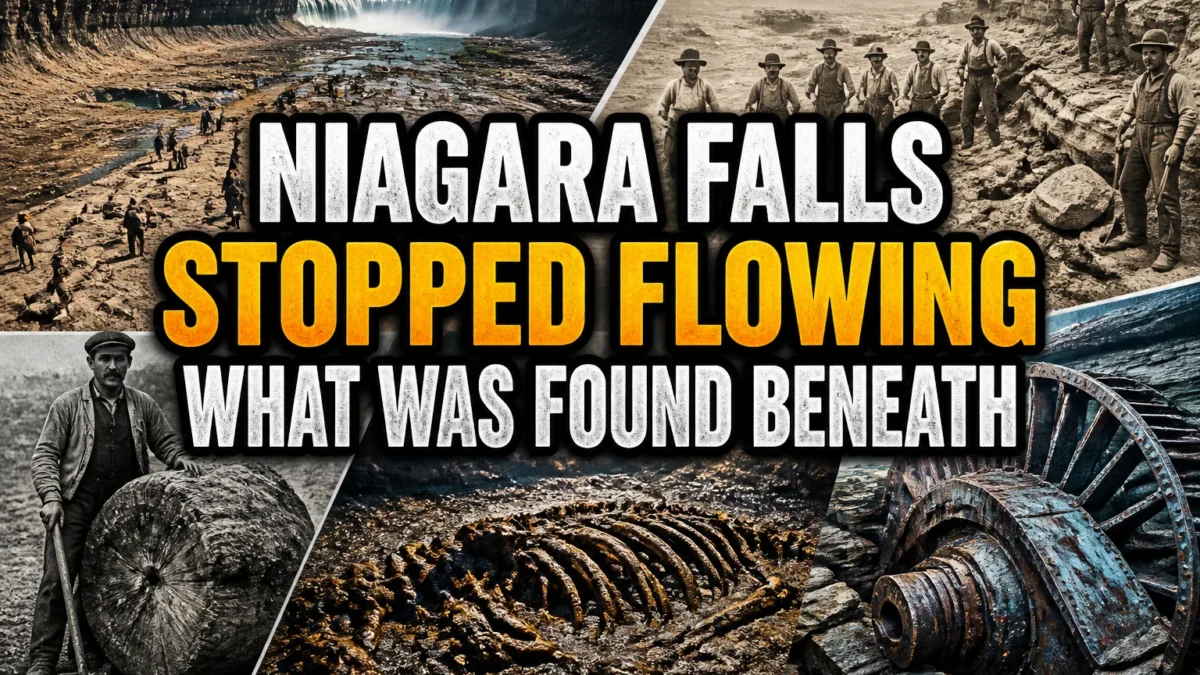
TL;DR: In 1969, the U.S. Army Corps of Engineers dammed the American Falls and briefly turned off Niagara Falls, exposing a rocky, debris-strewn riverbed that yielded coins, a few human remains, and a lot of geological surprises.
Niagara Falls is one of the most photographed natural wonders on Earth. Every minute, millions of gallons of water thunder over its three main cascades: Horseshoe Falls, Bridal Veil Falls, and the American Falls. So it sounds like a tall tale when someone says the falls were turned off, drained, and left standing dry for months.
Yet it really happened. For several months in 1969, the American Falls ran dry while engineers studied whether to remove the rubble at its base. What they found beneath the water was part treasure, part tragedy, and part geology lesson.
Why Would Anyone Turn Off Niagara Falls?
By the 1960s, the American Falls had a problem: too many rocks. Boulders had piled up at the base of the falls, creating a massive talus slope that absorbed the impact of the falling water. That cushion of rock meant the water hit the riverbed with less force, which reduced the spray and changed the look of the falls.
The buildup also raised a practical concern. Engineers worried that without enough force at the base, the falls might slowly erode into a series of rocky rapids rather than a dramatic curtain of water. Some experts believed the American Falls could eventually lose its iconic appearance. Others argued that nature should simply be left alone.
To make an informed decision, the U.S. Army Corps of Engineers needed a closer look at the riverbed. That meant doing something that had never been done at this scale: temporarily stopping the flow over the American Falls.
How Engineers Stopped Niagara Falls
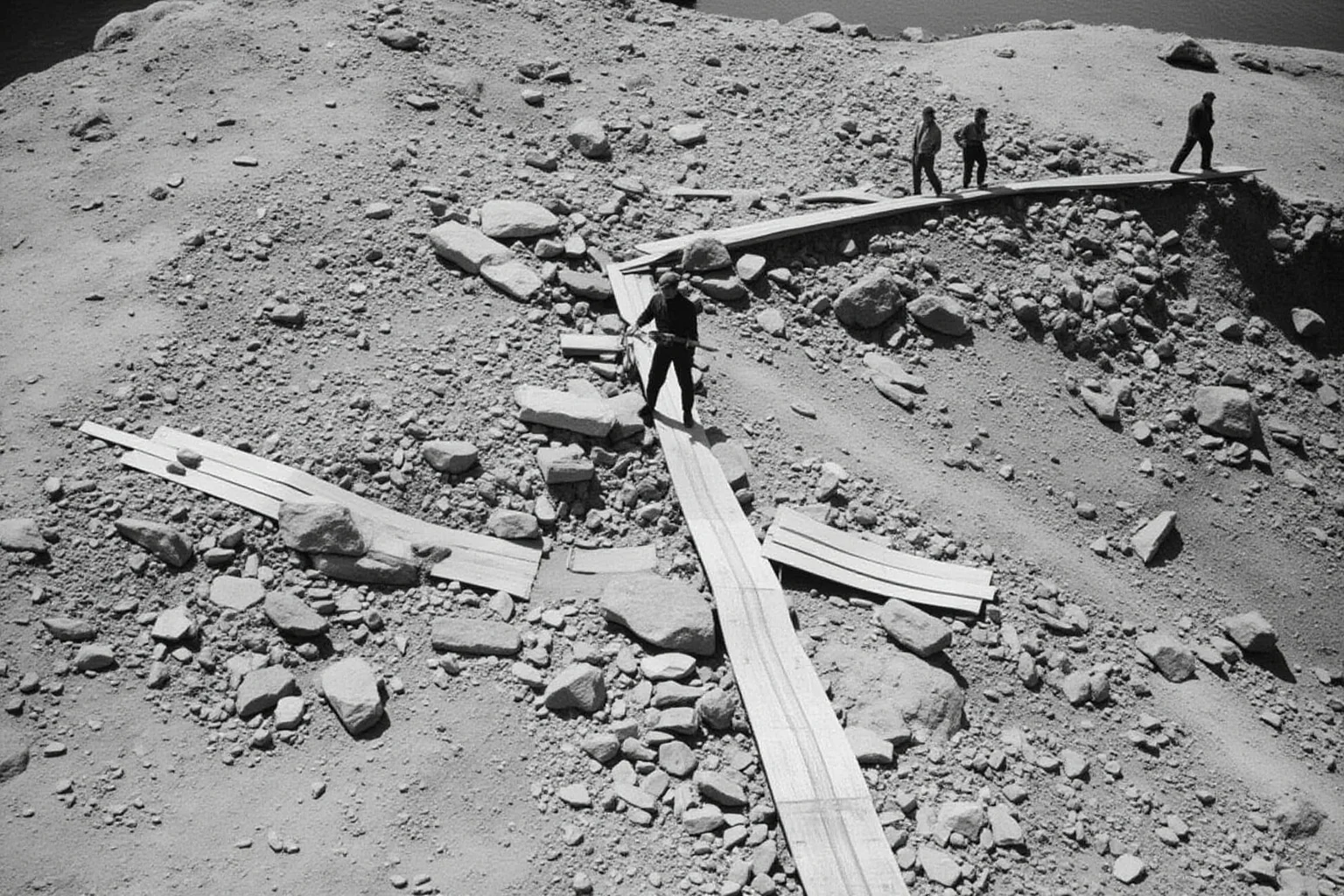
The plan was straightforward in concept and enormous in execution. Engineers built a cofferdam of rock and earth across the Niagara River just upstream of the American Falls. This temporary dam diverted the river's water over Horseshoe Falls on the Canadian side, leaving the American Falls channel dry.
The cofferdam was roughly 600 feet long and contained tens of thousands of tons of rock and fill. Construction began in June 1969 and took only a few days of round-the-clock work. By the end of June, the water over the American Falls had slowed to a trickle and then stopped.
For the first time in an estimated 12,000 years, the American Falls stood silent. The riverbed was exposed from the brink of the falls all the way to the rapids below. What had been a wall of white water became a bare, gray landscape of loose rock.
When Was Niagara Falls Drained?
The famous dewatering happened in 1969, running from roughly June through November. That six-month window is the event most people mean when they search for "niagara falls drained 1969" or "1969 niagara falls." It was never a permanent shutdown, and the water was restored before winter.
However, 1969 was not the only time the falls were altered. In 1950, a smaller cofferdam was built to repair the Canadian Horseshoe Falls. In 2022 and 2023, temporary barriers and low-water conditions again drew headlines, which is why searches for "niagara falls drained 2023" and "niagara falls drained 2022" spiked.
But those later events were different in scale. The 1969 project was the only time the American Falls was fully dried out long enough for a thorough scientific study.
What Was Found at the Bottom of Niagara Falls?
Once the water was gone, engineers, geologists, and curious officials walked out onto what had been the riverbed. They found a surface littered with both natural and human debris. The mix was stranger than anyone expected.
Coins, Coins, and More Coins
The single most common human artifact was money. Visitors had been throwing coins into the falls for decades, and those coins had settled into pockets and crevices in the rock. When the water stopped, those pockets were exposed.
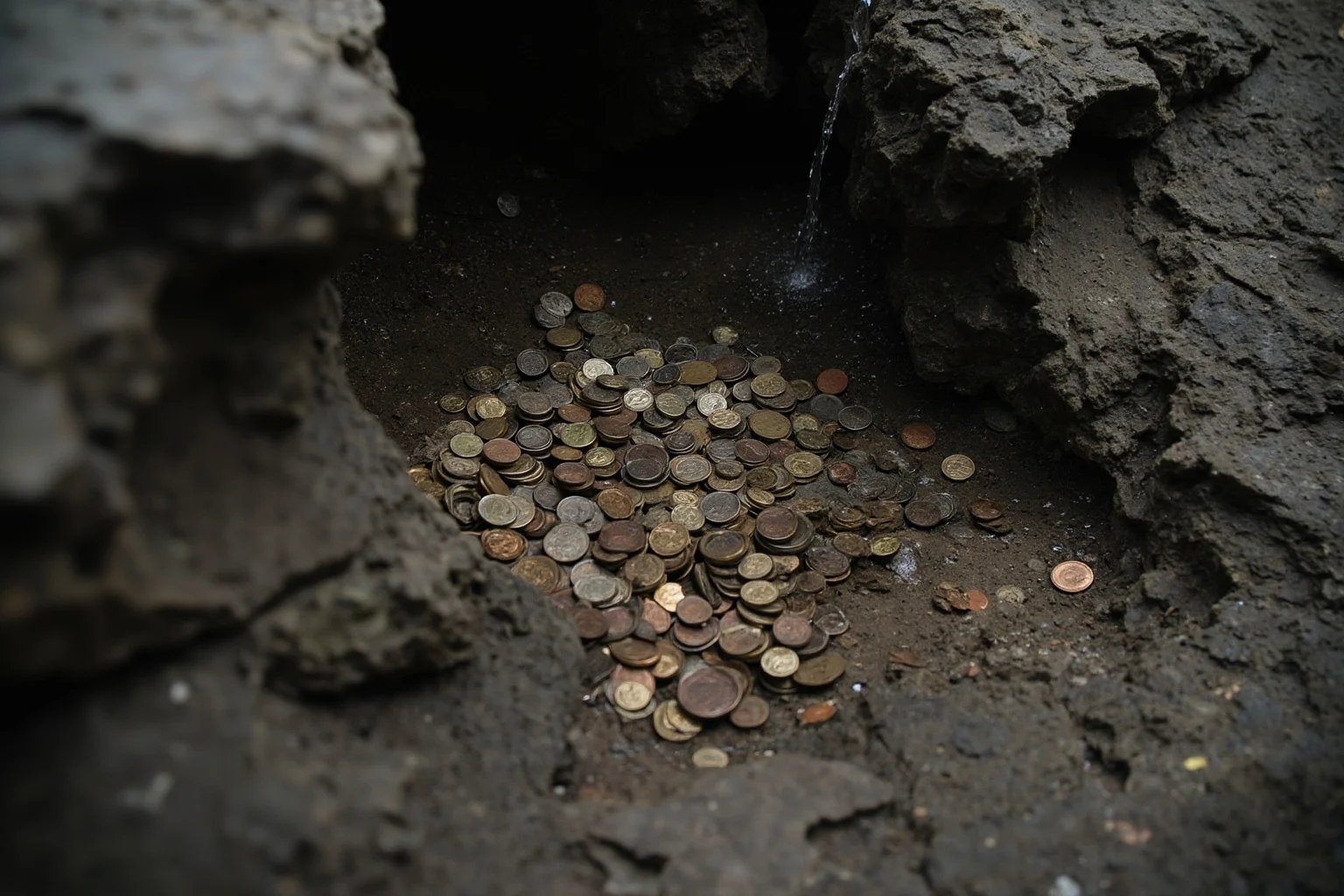
Workers recovered thousands of coins, ranging from pennies to silver dollars. Some dated back to the early 1900s. The total value was modest by modern standards, but the sheer volume told a story about how many people had made wishes at the brink.
Signs, Bottles, and Everyday Debris
Along with the coins, crews found bottles, cans, plastic containers, and fragments of signs. Some of these items had been tossed from observation decks; others had washed downstream from upstream communities. There were also pieces of clothing and at least one mannequin, which reportedly startled workers at first glance.
This debris was not glamorous treasure. It was the accumulated litter of a century of tourism, mixed with whatever the river had carried from farther upstream.
Human Remains
The darker discovery was human remains. Searchers found bones and at least one body in the exposed riverbed. Niagara Falls has long been a site of accidental deaths and suicides, and the river rarely gives back what it takes. The drained riverbed briefly revealed what the water had hidden.
These finds were handled by local authorities, and they serve as a somber reminder that the falls are not just a spectacle. They are also a powerful and dangerous river.
The Stomach-Churning Discovery That Drew Headlines
Among the debris and remains, one find in particular captured public attention: a body that had been lodged in the rocks for years. Reporters at the time described the scene in vivid, unsettling terms, which is why the phrase "stomach churning discovery drained niagara falls" still circulates online.
It is worth being careful here. The story has been retold and embellished many times, and some versions online exaggerate the details. What is well documented is that human remains were recovered, and that the sight was disturbing for the people who found them. That alone was enough to fuel decades of retellings.
How Much Money Was Found When Niagara Falls Was Drained?
This is one of the most persistent questions about the 1969 project, and the honest answer is that no single authoritative total exists. Contemporary reports described thousands of coins being recovered, but records were not kept with the precision of a modern archaeological dig.
Some accounts place the total value in the low thousands of dollars, which in 1969 was more meaningful than it sounds today. The coins were generally treated as salvage, and some were reportedly donated or distributed. If you are looking for an exact, verified figure, be skeptical of any source that claims one.
The real value of the 1969 project was scientific, not financial. The coins were a curiosity; the geology was the point.
The Geology Lesson Beneath the Falls
With the water gone, geologists could finally study the face of the American Falls up close. They measured the rock layers, mapped the talus slope, and examined how the falls had been eroding over time.
One key finding was that the accumulation of rock at the base was substantial. The talus slope was made of boulders that had fallen from the face of the falls over centuries. This pile was effectively protecting the riverbed from further erosion, but it was also changing the character of the falls.
Engineers also studied the rock itself. The upper layers are more resistant dolomite, while the layers beneath are softer shale and sandstone. This contrast is why the falls erode the way they do: the hard caprock holds, then undercuts, then collapses.
The Debate: Should the Rocks Be Removed?
The whole point of draining the falls was to answer a question: should the talus be cleared to restore the falls' height and drama? Two major positions emerged.
One group, including many engineers and tourism interests, argued for removing the rock. A taller, freer-falling waterfall would look more impressive and might erode more naturally. The other group, including many geologists and conservationists, argued against tampering. They pointed out that the rock pile was part of the natural system, and that removing it could cause unpredictable erosion.
In the end, the recommendation was to leave the falls alone. The U.S. Army Corps of Engineers concluded that removing the talus was too risky and too expensive, and that the falls were stable enough as they were. The cofferdam was removed, and the water returned.
Why Did Niagara Falls Turn Red?
One of the stranger search terms attached to this story is "why did niagara falls turn red." The falls have occasionally appeared reddish or brownish, and the reasons are mostly natural and mundane.
Heavy rainfall and runoff can wash clay and sediment into the river, tinting the water brown or reddish. Erosion upstream, especially after storms, sends fine particles downstream that color the water. In some cases, industrial or municipal discharges have also affected water color, though regulations now limit those inputs.
There is no evidence that the falls turned red because of anything supernatural or mysterious. The color changes are a reminder that the Niagara River is a working river, carrying whatever the landscape and communities around it send downstream.
What Happened After the Water Came Back
By late 1969, the cofferdam was removed, and the American Falls returned to its familiar roar. The riverbed that had been walked on by engineers disappeared beneath the water again, likely for good.
One lasting outcome was better data. The 1969 study gave scientists a rare baseline for understanding erosion at Niagara. It also produced a clearer picture of how the falls had changed over time and how they might change in the future.
Another outcome was a decision: leave nature alone where possible. That principle still guides management of the falls today, even as the surrounding parks and infrastructure are heavily engineered.
Was There Ever a "Drained Niagara Falls 2023"?
Searches for "niagara falls drained 2023" often stem from a misunderstanding. In 2022 and 2023, there were temporary low-water conditions and maintenance work, and some viral posts claimed the falls had been drained again. These claims were generally exaggerated or false.
What actually happened in recent years was routine infrastructure work and natural variation in water levels. The American Falls was not drained and studied the way it was in 1969. If you see a dramatic claim about the falls being emptied in 2022 or 2023, check the source carefully.
Who Found Niagara Falls?
A related question that often comes up is "who found niagara falls." The honest answer is that Indigenous peoples lived around the falls for thousands of years before any European arrived. The Haudenosaunee and other nations had deep cultural and spiritual connections to the falls and the Niagara River.
The first recorded European to see the falls is generally cited as Father Louis Hennepin, a French missionary, in 1678. He wrote a widely read account that brought the falls to European attention. So while no single person "found" Niagara Falls, Hennepin is the name most often attached to its introduction to the wider world.
Debunking the Tall Tales
The 1969 draining generated enough real drama that legends were inevitable. Here are a few claims worth treating with caution.
Some stories claim workers found chests of gold or a fortune in jewelry. There is no solid evidence for that. The documented finds were coins, debris, and human remains.
Other stories say the falls were completely shut off, including Horseshoe Falls. That is not accurate. Only the American Falls was dewatered; Horseshoe Falls kept flowing the entire time.
Finally, claims that the 1969 project proved the falls would soon disappear are overstated. The falls are retreating, but the process is measured in geological time, not decades.
How the Falls Are Managed Today
Niagara Falls is not just a natural wonder; it is also a major hydroelectric resource. Under a 1950 treaty between the United States and Canada, a portion of the river's flow is diverted for power generation, especially at night.
During peak tourist hours, more water is allowed over the falls to preserve the spectacle. At night, more is diverted to turbines. This balancing act keeps the lights on while keeping the falls looking like the falls.
That management is why the idea of "turning off" Niagara Falls is not as crazy as it sounds. Humans already control how much water goes over, and the 1969 project showed they could, for a time, stop it entirely on one side.
The Legacy of a Dry Waterfall
The 1969 shutdown remains one of the most remarkable engineering episodes in American history. It was a controlled experiment on one of the world's most famous landmarks, and it produced real answers.
It also produced stories. The coins, the debris, the remains, and the eerie silence of a dry waterfall all became part of Niagara's folklore. Some of those stories are true, some are exaggerated, and some are pure invention. For more examples of how real events can spawn enduring myths, see times the world almost ended.
What is certain is that for a few months in 1969, one of the great waterfalls of North America stopped flowing. People walked where water had fallen for millennia. And for a brief moment, the bottom of Niagara Falls was open to the sky.
Conclusion
Niagara Falls did not stop flowing forever, and it was never fully silenced. But in 1969, the American Falls ran dry, and that brief pause revealed coins, debris, human remains, and a geological puzzle that shaped how the falls are managed today. The event is a reminder that even the most permanent-looking wonders are dynamic, fragile, and sometimes subject to human decisions. If you ever hear someone claim the falls were drained in 2023, you now know the fuller story.
Frequently Asked Questions
Was there really a time with Niagara Falls no water?
Yes. In 1969, the U.S. Army Corps of Engineers built a cofferdam that diverted the Niagara River away from the American Falls, leaving that section of the falls with no water for several months. Horseshoe Falls on the Canadian side kept flowing the entire time.
When was Niagara Falls drained?
The American Falls was dewatered in 1969, from about June through November. A smaller cofferdam was used in 1950 for repairs, and there were temporary low-water conditions in 2022 and 2023, but those were not full drainings.
How much money was found when Niagara Falls was drained?
Reports describe thousands of coins being recovered from crevices in the exposed riverbed, but no single verified total exists. Some accounts place the value in the low thousands of dollars in 1969 terms, and the coins were treated largely as salvage.
What was the stomach-churning discovery at the bottom of Niagara Falls?
Workers found human remains in the exposed riverbed, including at least one body. Because the falls have long been the site of accidents and suicides, these finds were disturbing for the people who made them. Some online retellings exaggerate the details.
Why did Niagara Falls turn red?
The reddish or brownish color is usually caused by sediment, clay, and runoff washed into the river after heavy rain or erosion upstream. There is no evidence of a supernatural cause, and the color changes are temporary.
Who found Niagara Falls?
Indigenous peoples lived around the falls for thousands of years before Europeans arrived. The first recorded European to see the falls is generally cited as Father Louis Hennepin in 1678, though no single person can be said to have 'found' it.
Was Niagara Falls drained in 2023 or 2022?
No, not in the way it was in 1969. There was maintenance work and temporary low-water conditions in those years, and some viral claims overstated what happened. The American Falls was not emptied and studied the way it was in 1969.

Alex Warren
Related Articles