
Every so often, a map goes viral showing today's countries stitched together into one giant landmass, and someone asks whether we're about to get Pangea back. The short answer is no, not anytime soon. But the longer answer is more interesting: Earth has done this before, and it will very probably do it again.
The continents are moving right now, at roughly the speed your fingernails grow. Over hundreds of millions of years, that slow drift has assembled and shattered supercontinents repeatedly, and geologists have some surprisingly specific ideas about what comes next. Let's separate the science from the myths.
TL;DR: Scientists expect a next supercontinent to form roughly 50 to 250 million years from now, but it probably won't be a copy of Pangea, and the exact shape is still hotly debated.
So, When Will the Next Supercontinent Form?
Most published models put the next supercontinent roughly 200 to 250 million years in the future. One proposal, called Amasia, suggests it could arrive in as little as 50 to 200 million years. These are projections built on current plate motions and theories about the mantle, not predictions in the fortune-teller sense.
To get a feel for that timescale, go the same distance backward. Roughly 250 million years ago, the world was recovering from the biggest mass extinction in Earth's history, and the first dinosaurs were just around the corner.
Our own species, by comparison, is only about 300,000 years old. That's roughly a tenth of one percent of the time we're talking about, which is why "when will Pangea form again" is a question about deep geological time rather than anything we'll experience.
What Was Pangea, Exactly?
Pangea (also spelled Pangaea) was a supercontinent that held most of Earth's land in one mass. The name comes from Greek roots meaning "all earth." Both spellings are widely used, with "Pangea" more common in American English.
It assembled gradually during the late Paleozoic, with the main collisions happening roughly 335 to 300 million years ago. It began rifting apart about 200 million years ago, and its fragments eventually became the continents we know. A vast global ocean called Panthalassa surrounded it, and a wedge-shaped sea called the Tethys cut into its eastern side.
The German scientist Alfred Wegener popularized the idea of continental drift in the 1910s. He pointed to the jigsaw fit of the Atlantic coastlines, matching fossils such as the freshwater reptile Mesosaurus and the plant Glossopteris on separated continents, and rock formations that line up across oceans.
Many scientists rejected his idea because he couldn't explain a convincing mechanism for how continents move. Wegener died on an expedition to Greenland in 1930, well before seafloor spreading and plate tectonics vindicated the core of his idea in the 1960s.
Pangea vs Now: How Different Is Today's World?
The contrast between Pangea and now is bigger than most people realize. The table below gives a simplified comparison, though keep in mind that conditions varied a lot across Pangea's long existence.
| Feature | Pangea (around 250 million years ago) | Today |
|---|---|---|
| Land arrangement | One dominant landmass | Seven continents, several separated by wide oceans |
| Atlantic Ocean | Didn't exist yet | Widening basin |
| Ocean circulation | One giant ocean, Panthalassa | Several connected ocean basins |
| Interior climate | Large dry, strongly seasonal regions | Varied, with coastlines close to most land |
| Life | Recovering from the end-Permian extinction | Dominated by mammals, birds, and flowering plants |
A supercontinent changes how the planet works. Huge interior regions sit far from the moderating influence of the sea, so they tend to swing between hot and cold, wet and dry. Today's continents are scattered enough that large parts of land lie relatively close to the coast.
One common misunderstanding is that Pangea was enormous compared with today's total land. The total area of continental crust was broadly similar; it was simply gathered in one place instead of spread around the globe.
A Quick Word on "Pangea Now" Maps
You've probably seen images that overlay modern country borders on Pangea. They're fun and useful for orientation, but treat them as illustrations. Countries didn't exist, coastlines were different, and reconstructions of Pangea's exact shape vary among researchers.
The same caution applies to "new Pangaea" maps of the future. Those are best read as educated sketches of one possible scenario, not photographs of a certain outcome.
Pangea Wasn't the First Supercontinent
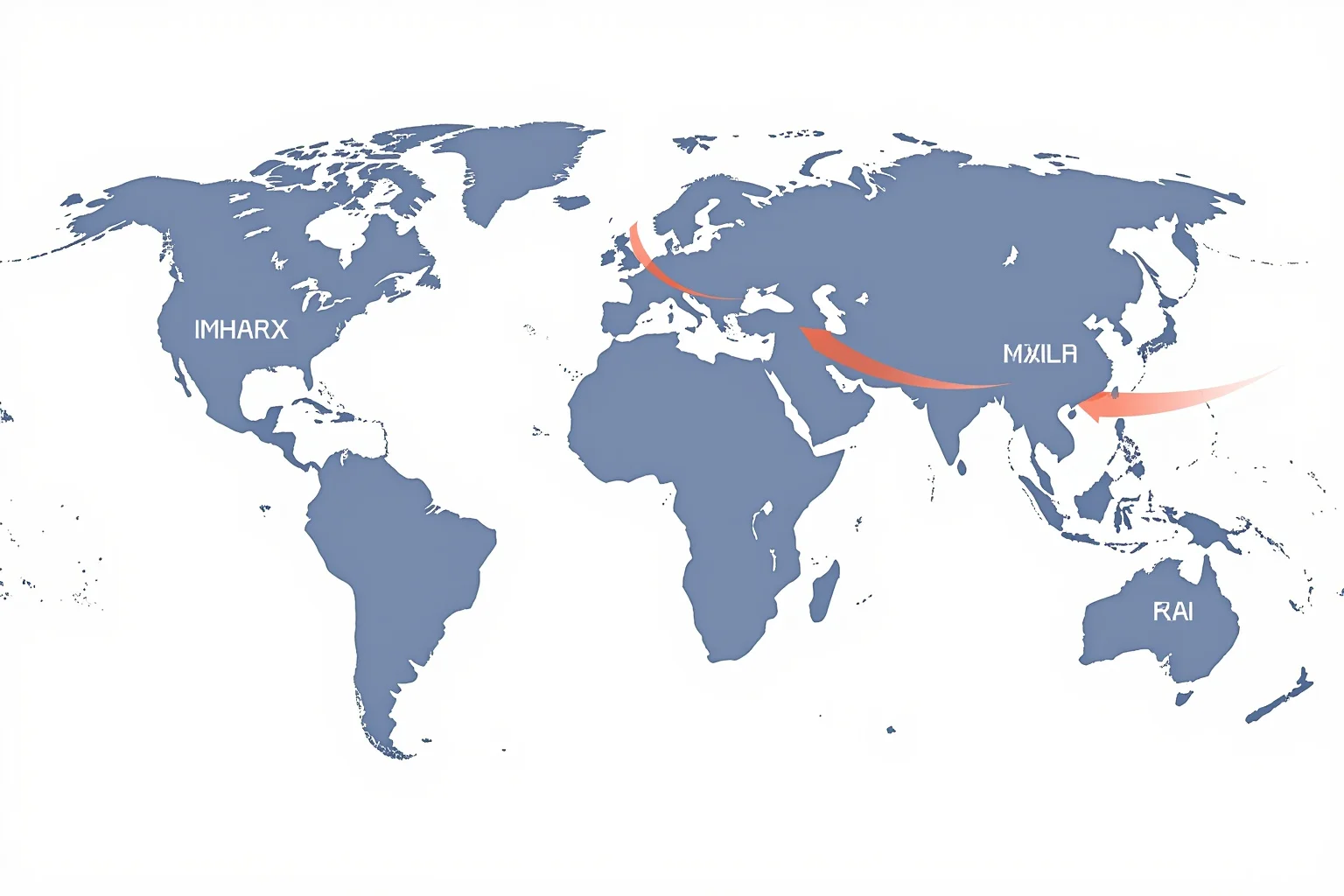
Pangea is the most famous supercontinent only because it's the most recent. Geologists have identified evidence for earlier assemblies, and the idea of a repeating pattern is known as the supercontinent cycle.
Here are the commonly discussed earlier examples:
- Columbia (also called Nuna): proposed to have assembled roughly 1.8 to 1.5 billion years ago.
- Rodinia: assembled around 1.1 billion years ago and broke up beginning around 750 million years ago.
- Pannotia: a more debated, short-lived assembly around 600 million years ago, which some researchers doubt existed as a true supercontinent.
- Earlier candidates: names like Kenorland and Vaalbara appear in the literature, but evidence this far back is thin and interpretations vary.
The opening and closing of ocean basins is sometimes called the Wilson cycle, after the Canadian geophysicist J. Tuzo Wilson. Supercontinents seem to form every few hundred million years, though estimates of the spacing vary, and some scientists question how regular the cycle really is.
That uncertainty matters. Geologists reconstruct ancient continents from scattered rock evidence, such as ancient mineral grains and magnetic signatures, so the older the supercontinent, the shakier the details.
What Makes Continents Come Together?
The engine is the slow churning of Earth's mantle. Heat from the planet's interior drives convection, and the rigid plates at the surface ride along. Where oceanic plates sink back into the mantle at subduction zones, the pull of the sinking slab helps drag other plates along.
This process opens oceans in some places and closes them in others. When an ocean basin closes completely, the continents on either side collide and crumple into mountain ranges, as happened when Africa, Europe, and North America came together to help form Pangea.
Three Ways a Supercontinent Can Assemble
Geologists describe different styles of assembly. In introversion, the interior ocean left behind by the previous supercontinent's breakup closes up. In extroversion, the outer ocean surrounding the old supercontinent closes instead.
A third idea, orthoversion, was proposed by a Yale-led team in a 2012 paper in Nature. It argues the next supercontinent could form about 90 degrees away from the center of the last one, and it's the thinking behind the Amasia scenario below.
There's also a hypothesis that a supercontinent acts like a thermal blanket, letting heat build up in the mantle beneath it and eventually helping to tear it apart. It's an appealing idea, and it remains one of several competing explanations rather than a settled rule.
Four Candidates for the Next Supercontinent
The best-known future supercontinents differ mainly in which oceans close. None is a certainty, and researchers openly treat them as hypotheses to be tested against better models of the mantle.
Pangea Proxima and Pangea Ultima: The Atlantic Closes
In the introversion scenarios, the Atlantic stops widening, reverses, and shrinks as new subduction zones form along its margins. Paleogeographer Christopher Scotese popularized the name Pangea Proxima for a version of this future, and Pangea Ultima is a related scenario that appears in other work.
The Americas would swing back toward Europe and Africa, and the Mediterranean would be squeezed shut as Africa pushes into Europe. Estimates put this about 250 million years out. It's the closest thing to "the continents snapping back together," though even here the final arrangement wouldn't match old Pangea.
Novopangea: The Pacific Closes
In the extroversion scenario, the Atlantic keeps widening while the Pacific shrinks. The Pacific is already ringed by subduction zones, the so-called Ring of Fire, and it is the shrinking ocean today.
The Americas would eventually collide with Asia and Australia on the far side of the shrinking Pacific. This supercontinent is often estimated at 200 to 250 million years away.
Amasia: The Arctic Closes
The Amasia model, from the 2012 Yale-led study, suggests the Americas and Asia could meet near the North Pole. The Arctic Ocean and the Caribbean Sea would close in the process, and Australia would continue its journey north to join in.
This is the earliest of the proposals, with a window of roughly 50 to 200 million years. It's also the one that depends on the orthoversion idea, which not every geologist accepts.
Aurica: A New Ocean Opens
Aurica is a more recent scenario in which both the Atlantic and Pacific close, and a new ocean opens along the East African Rift. It illustrates that the future could include entirely new ocean basins and not just the closing of old ones.
Like the others, it's typically placed about 200 to 250 million years ahead. The takeaway from comparing all four is that scientists agree on the mechanism but not on the outcome.
Signs of Change: What's Happening Now
You can't see these motions with the naked eye, but satellite measurements track them. Here are the key trends that feed into every future supercontinent model:
- The Atlantic is widening: the Mid-Atlantic Ridge spreads at roughly 2 to 5 centimeters per year, depending on location.
- The Pacific is shrinking: subduction around its edges consumes seafloor faster than the Pacific's own spreading ridges create it.
- Africa is pressing into Europe: this squeezing is gradually shrinking the Mediterranean region and continues to build mountains such as the Alps.
- India is still colliding with Asia: the collision that began tens of millions of years ago continues to raise the Himalaya.
- Australia is drifting north: it's moving toward Southeast Asia at several centimeters per year.
- East Africa is rifting: the East African Rift, including the Afar region, shows early stages of continental stretching, though whether it will become a full ocean over millions of years is still uncertain.
These motions are real, but projecting them forward for hundreds of millions of years is the hard part. Plate speeds and directions change as subduction zones start, stall, and shut down.
Will Pangea Happen Again? Busting the Biggest Myths
The honest answer to "will Pangea form again" is probably yes in spirit, with a lot of caveats. Let's tackle the misconceptions that cling to this topic.
Myth: The Continents Will Snap Back Like a Puzzle
Even in the scenarios where the Atlantic closes, the continents don't simply rewind. Plates move along different paths, rotate, and collide at new angles. The future supercontinent would be assembled from the same pieces, but it wouldn't be a replica of Pangea.
Myth: It's Happening on a Human Timescale
Sometimes you'll see claims that continental movement is behind modern earthquakes or the weather you experienced this year. Plate tectonics is a background process, and human-scale events like climate shifts operate on completely different clocks.
The same goes for the popular belief that California will fall into the ocean. The San Andreas Fault is a sideways-slipping boundary, and the commonly cited outcome is that parts of coastal California slowly slide north along it over millions of years.
Myth: A Supercontinent Is a Doomsday Event
Supercontinents are sometimes linked to mass extinctions, partly because the end-Permian extinction around 252 million years ago and the end-Triassic extinction around 201 million years ago bracket Pangea's life. But the causes involved massive volcanic eruptions and are still debated.
The breakup of Pangea was associated with the huge Central Atlantic Magmatic Province eruptions near the Triassic-Jurassic boundary. A link between supercontinent cycles and extinctions is plausible and actively studied, but it isn't a simple cause-and-effect rule.
Myth: Plate Tectonics Will Run Forever
There's no guarantee the cycle will continue indefinitely. As Earth's interior cools over billions of years, plate tectonics may slow or change character, and some models suggest a future when it eventually shuts down.
How long that would take is uncertain, and estimates run to hundreds of millions or even billions of years. So there may be a handful more supercontinents ahead, or perhaps only a few.
What Would Life Be Like on a Future Supercontinent?
A 2023 study in Nature Geoscience, led by Alexander Farnsworth at the University of Bristol, used climate models to examine a Pangea Ultima scenario about 250 million years from now. The results were sobering for mammals like us.
The models combined three factors: a supercontinent's huge dry interior, a Sun that is gradually growing brighter, and higher atmospheric carbon dioxide from increased volcanic activity. Under those assumptions, large regions could see extreme heat, and only a small fraction of the land might remain habitable for mammals.
That's a model of a single scenario with many assumptions, and the authors themselves present it as a projection. It's best read as a thought experiment about how continental arrangement shapes climate, not a forecast of doom.
The same principle explains why Pangea's interior was so dry. When land is far from the sea, rainfall drops and temperature swings grow, which is one reason scientists find supercontinents so influential for the history of life.
Pangea, Pangaea, and Pangrams: Clearing Up the Confusion
Search engines occasionally mix up two similarly spelled words. A pangram is a sentence or word that uses every letter of the alphabet, such as "The quick brown fox jumps over the lazy dog." It has nothing to do with continents.
If you landed here looking for the daily pangram in a word puzzle, you'll need to check that game directly, as the answer changes every day. If you were looking for Pangaea instead, you're in exactly the right place.
The Bottom Line on Pangea in the Future
The continents will almost certainly keep moving, and over deep time they will probably gather again. But "when will the next Pangea happen" really means "which of several possible supercontinents might form, in a window stretching from tens to hundreds of millions of years."
What we know for sure is the mechanism: mantle convection, subduction, and collisions. What we don't know is which oceans will close and which will open.
So the next time you see a viral map of Pangea now or a future supercontinent, enjoy it as a window into deep time. The ground beneath you is slowly rearranging the world, just as it has done for billions of years.
Frequently Asked Questions
When will the next Pangea happen?
Most models place the next supercontinent roughly 200 to 250 million years in the future. One proposal, Amasia, suggests it could form in as little as 50 to 200 million years. These are scientific projections based on current plate motions, not firm predictions.
Will Pangea happen again?
Probably some form of supercontinent will, because Earth has assembled them repeatedly, including Rodinia and Pangea. However, it wouldn't be a copy of the old Pangea, and it isn't guaranteed that plate tectonics will continue forever as the planet cools.
What will Pangea in the future look like?
There's no single answer, since scientists have proposed several scenarios. Pangea Proxima closes the Atlantic, Novopangea closes the Pacific, Amasia joins the Americas and Asia near the North Pole, and Aurica involves a new ocean opening in East Africa. Each is a hypothesis, and which one is correct is still debated.
Is the next supercontinent already forming?
The motions that would build one are happening now: the Atlantic is widening, the Pacific is shrinking, Africa is pushing into Europe, and Australia is moving north. But these are slow trends, and a supercontinent is hundreds of millions of years away from completion.
What is the difference between Pangea and Pangaea?
They're the same thing. Both spellings refer to the supercontinent that existed roughly 335 to 200 million years ago, and the name comes from Greek roots meaning "all earth." Pangea is more common in American English.
How does Pangea compare with the world now?
Pangea held most land in one mass surrounded by the ocean Panthalassa, and the Atlantic didn't exist yet. Today there are seven continents, a widening Atlantic, and a Pacific that is gradually shrinking. Total continental area was broadly similar, but its arrangement was very different.
Is a pangram the same as Pangea?
No. A pangram is a sentence or word that uses every letter of the alphabet, and it's often featured in word puzzles. Pangea is the ancient supercontinent. Check the specific puzzle if you want the daily pangram, as it changes each day.

Alex Warren
Related Articles