Type “did it rain for a million years” into a search bar and you will find a hundred videos, a thousand memes, and a surprising amount of real science buried underneath. The meme version says Earth once endured nonstop rain for a million years — sometimes two million — and then simply moved on. The real story is stranger, messier, and much better documented than the meme.
Somewhere between 234 and 232 million years ago, during the Late Triassic, the climate of the supercontinent Pangaea turned dramatically wet. Geologists call this interval the Carnian Pluvial Episode, and it is the closest thing our planet has to a genuine million year rain. It was not one storm without end, but a long, restless era of monsoons, floods, and shifting coastlines.
TL;DR: Around 234–232 million years ago, Earth's climate shifted into an extraordinarily humid phase lasting roughly one to two million years — the closest thing to a real million year rain, though it was wetter weather worldwide rather than a literal nonstop downpour.
Did It Really Rain for a Million Years?
The short answer is yes, with an important asterisk. A genuine, geologically documented interval of extreme humidity did occur in the Late Triassic, and it lasted on the order of one to two million years. That makes the viral claim broadly true in spirit and misleading in detail.
The word “pluvial” is the key. In geology, a pluvial is a period when a region becomes much wetter than usual, often with expanded lakes, rivers, and wetlands. It describes a climate phase rather than a single meteorological event, so a million year rain means a million years of unusually wet conditions.
Two British geologists, Mike Simms and Alastair Ruffell, first pieced the pattern together in the late 1980s. They noticed that sedimentary rocks across Britain and Europe switched from red desert deposits to grey, clay-rich layers for a stretch of the Carnian. Their name for it — the Carnian Pluvial Event, now more often the Carnian Pluvial Episode — has stuck ever since.
So did it really rain on Earth for a million years? In the loose sense people mean when they ask, yes. This was not a myth invented for clicks; it is a recognised chapter in the planet's climate history, named and studied by working geologists.
When Did It Rain for 2 Million Years?
The event sits inside the Carnian stage of the Late Triassic, a slice of geological time that ran from roughly 237 to 227 million years ago. The wet phase itself is usually bracketed between about 234 and 232 million years ago. That placement comes from radiometric dating of volcanic ash layers, magnetic reversals recorded in sediments, and carbon isotope curves.
Duration estimates wander between roughly one million and two million years, which is exactly why both “rain for a million years” and “rained for 2 million years” circulate online. Neither number is invented. They reflect different studies, different definitions of when the wet phase began and ended, and different rock sequences from different parts of the world.
At that time, all the major continents were welded into Pangaea, a single landmass shaped roughly like a giant C. Most of the world's land sat far from any ocean, which normally produces brutal, dry continental interiors. The Carnian was the great exception.
Why Did It Rain for 2 Million Years?
The leading suspect is a volcanic province called the Wrangellia large igneous province, which erupted across what is now western North America. Those eruptions pumped enormous quantities of carbon dioxide into the atmosphere over a long period, warming the planet and supercharging the water cycle.
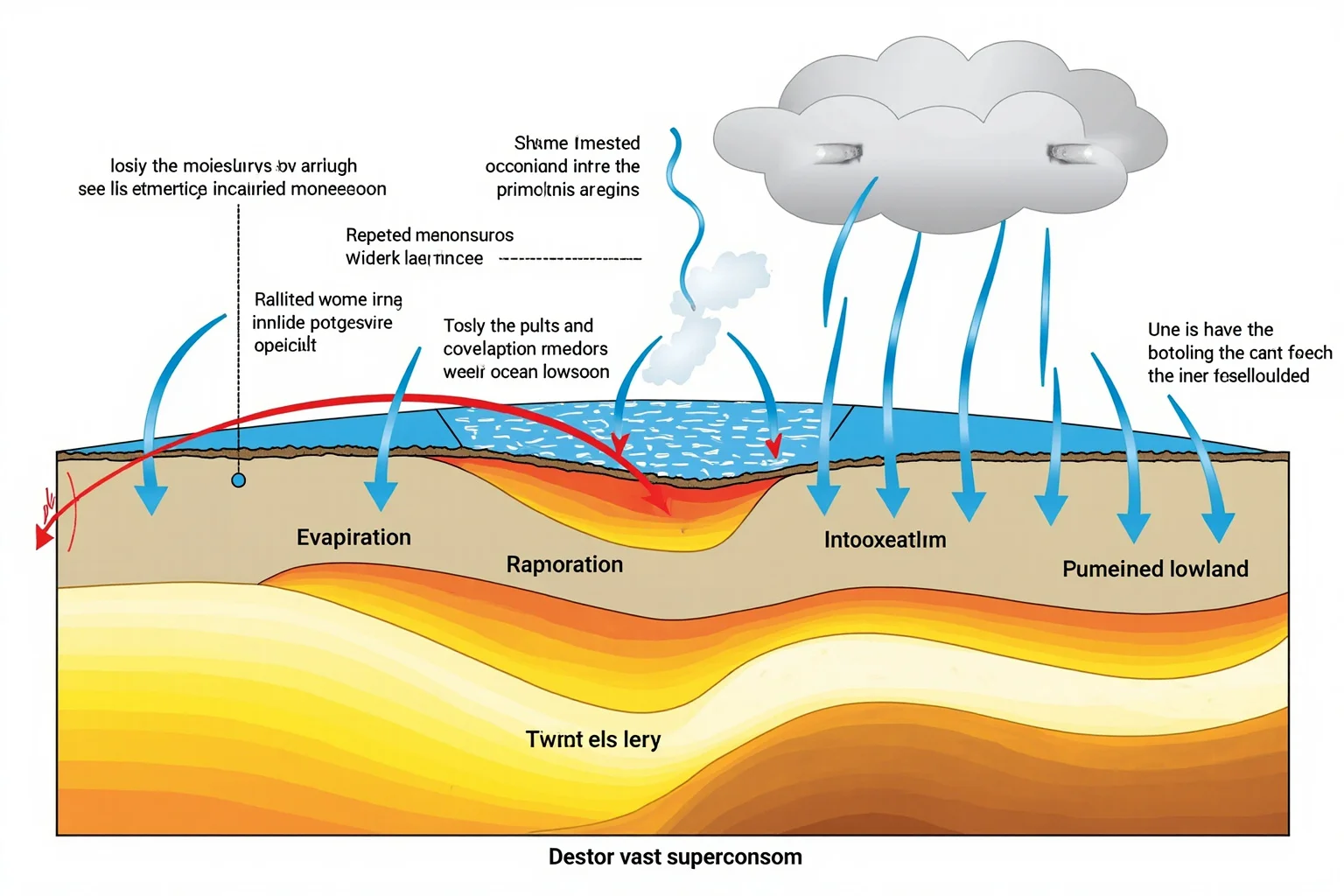
Warmer air holds more moisture, and warmer oceans evaporate more readily. The result was a climate with a vastly intensified monsoon, capable of carrying ocean moisture deep into Pangaea's interior. Instead of a dry continental desert, large regions got seasonal deluges instead.
Geologists also point to a sharp negative carbon isotope excursion in rocks of this age, a chemical fingerprint of massive carbon input into the atmosphere and oceans. Sulfate aerosols and other volcanic gases may have added extra punch, though the exact balance of causes is still debated.
An important caveat is that the volcanic trigger is the leading hypothesis, not a settled verdict. Researchers continue to test whether the eruptions came in pulses that match the wet phases, and how much of the humidity was truly global rather than regional.
How Did It Rain for a Million Years Without Stopping?
This is where the viral phrasing does the science a disservice. Rain almost certainly did not fall continuously, hour after hour, for a million years at any single location. Weather has always been patchy, and even the wettest modern climates have dry days.
What the rocks record instead is a repeated pattern of humid pulses. Several studies have identified multiple wet phases within the Carnian, separated by drier interludes, all packed into a span of one to two million years. The overall climate stayed wet enough for long enough that landscapes, river systems, and ecosystems were permanently reshaped.
So the idea of non stop rain for 2 million years is best read as shorthand for a very long stretch when the world was unusually wet. It is the kind of compression that makes a great headline and a slightly inaccurate geological description. The sky, in other words, never forgot how to stop.
The Evidence: How We Know It Rained
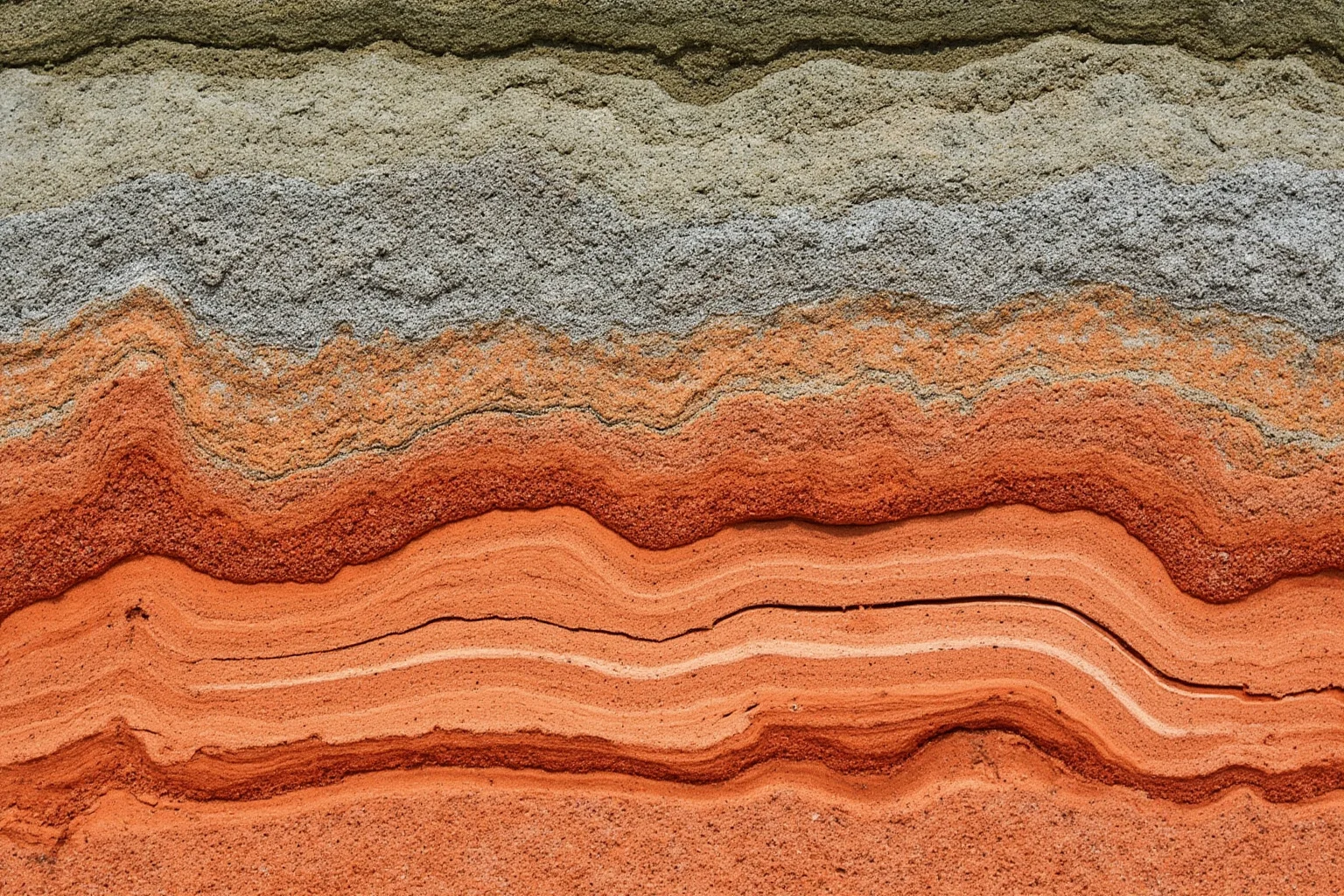
The evidence is written in colour. Across Europe, Triassic rocks are famously red — oxidised desert sediments laid down under dry, oxygen-rich conditions. In Carnian layers, those red beds give way to grey and green shales, sandstones, and clays.
Clay minerals tell a similar story. Kaolinite and other weathering products become abundant in these layers, pointing to intense chemical weathering under heavy rainfall. Coal seams and rich plant fossils appear in places that had previously been arid, hinting at swampy, humid landscapes.
The Dolomites in northern Italy preserve one of the clearest records anywhere. Carbonate platforms that had been building in clear, shallow seas were suddenly smothered by mud and sand washing off the land. That much sediment pouring into the sea means an enormous amount of rain falling on the continents.
Similar signals turn up in Britain, Germany, Austria, China, Argentina, and North America. The event was not a local oddity in one isolated basin; it left traces across much of the world.
Where You Can Still See the Carnian Rocks
You do not need a time machine to touch this story. The cliffs of west Somerset in England, around Watchet and Blue Anchor, expose the grey and red beds that helped Simms and Ruffell build their original argument. The layers are visible from the beach at low tide.
In northern Italy, the Dolomites show the drowning of carbonate platforms in real time, written in limestone and shale. Germany's Keuper beds record the same shift from arid to humid conditions in a different basin. Argentina's Ischigualasto Formation, famous for its early dinosaurs, also spans this critical window.
Seeing these rocks in person makes the scale sink in. A cliff face a few metres thick can represent tens of thousands of years of rain, mud, and slow burial.
What It Did to Life
The Carnian Pluvial Episode was not just a weather story. It coincided with a genuine biological turnover, both on land and in the sea.
In the oceans, reef ecosystems collapsed and carbonate platforms drowned. Several groups of marine invertebrates, including some ammonoids and crinoids, suffered heavy losses. Warm, muddy, nutrient-heavy seas were bad news for the delicate, clear-water organisms that build reefs.
On land, the shift was just as dramatic. Rhynchosaurs, a group of stocky, beak-faced herbivores that had been common across the Triassic world, declined sharply and then vanished. The seed-fern flora that dominated Gondwana, especially Dicroidium, lost ground as conifers and other plants spread.
And then there is the twist that makes this story famous. The wet phase overlaps with the early diversification of dinosaurs. In 2018, a team led by Michael Benton argued that the Carnian climate upheaval cleared ecological space that dinosaurs and their relatives were well placed to fill.
That does not mean the rain created dinosaurs. Early dinosaurs such as Herrerasaurus and Eoraptor were already present in what is now Argentina. What the Carnian seems to have done is give them room to expand, setting the stage for the dominance they achieved later in the Mesozoic.
Did It Rain for 2 Million Years Straight Everywhere?
No. Even at its wettest, the Carnian climate varied enormously from place to place. Some regions turned into humid, river-crossed lowlands, while others probably stayed seasonal or semi-arid.
The evidence is uneven too. Some basins preserve beautifully clear records of the wet phase, while others show only a subtle change or none at all. Geologists have to compare many local stories before they can claim a global pattern.
This is normal for deep time. An event the size of the Carnian Pluvial Episode shows up differently depending on latitude, distance from the sea, and the local geology that happened to preserve a record. Two million years of rain did not look the same in every corner of Pangaea.
How Long Was the Earth Flooded?
This is one of the most common questions attached to the million year rain, and it needs a careful answer. Earth was never completely flooded during the Carnian, and there is no evidence of a global, planet-covering deluge at any point in its history.
Sea levels were high in the Triassic, because there were no large polar ice sheets locking up water. Shallow seas spread across parts of the continents, and coastlines moved constantly as sediment poured off the land. But high sea level is not the same thing as the whole Earth being underwater.
Real megafloods do exist, just not global ones. The Zanclean flood refilled the Mediterranean basin about 5.3 million years ago after it had largely dried out. Glacial outburst floods, such as the Missoula floods of the last ice age, moved staggering volumes of water in a matter of days.
The honest answer to how long was the earth flooded is that it was never flooded all at once. The Carnian was a wet climate phase, not a planetary bathtub.
The Longest Rain Ever: Modern Records vs Deep Time
Modern weather records contain nothing remotely like a million year rain. The wettest inhabited places on Earth, such as Mawsynram and Cherrapunji in northeastern India, receive extraordinary totals each year. They still have dry seasons, dry weeks, and dry days.
Even the most persistent modern wet spells last weeks or months rather than years. Weather systems move, seasons turn, and the atmosphere never locks into a single mode for long over any one place. There is no verified case in the instrument record of rain falling without a break for years on end.
Deep time is different because it measures climate rather than weather. Another notable wet phase was the African Humid Period, roughly 11,700 to 5,000 years ago, when the Sahara held lakes, rivers, and grasslands. That lasted a mere ten thousand years, a blink next to the Carnian.
Even older candidates exist, though they are far harder to study. When the oceans first formed on the early Earth, more than four billion years ago, the cooling planet may have passed through long stretches of steam and torrential condensation. Those remain active research questions rather than settled facts.
The Yearly Flood vs the Million Year Rain
Not every famous flood is a geological mystery. The Nile's annual inundation swelled the river each summer and then receded, leaving dark, fertile mud across the fields. In effect, the yearly flood left this rich substance behind — silt that made Egyptian agriculture possible for thousands of years.
That is a completely different phenomenon from the Carnian Pluvial Episode. The Nile flood was a rhythm measured in months, driven by monsoon rain far upstream in the Ethiopian highlands. The million year rain was a climate regime measured in hundreds of thousands of years.
Keeping those two scales separate matters. Short, predictable floods help build civilisations, while million year shifts build rock layers, redraw ecosystems, and nudge evolution in new directions.
Why Both the “1 Million” and “2 Million” Numbers Circulate
If you are still wondering whether it rained for one million years or two, you are in good company. Working geologists argue about it as well, because the boundaries of the event are genuinely fuzzy.
One problem is definition. Does the Carnian Pluvial Episode begin with the first wet pulse or with the first major carbon shift? Does it end when the climate dries out, or when the last coal seam was deposited? Different answers produce different durations.
The other problem is resolution. Rocks 230 million years old rarely preserve a clock fine enough to separate a one-million-year event from a two-million-year one. Researchers rely on cyclostratigraphy, which counts sedimentary cycles tied to orbital wobbles, alongside radiometric dates from ash beds.
Add in the likelihood of multiple wet pulses separated by dry spells, and both figures become defensible. The fairest summary is that the wet phase lasted somewhere in the region of one to two million years, and that the exact boundary is still being refined.
What This Means for How We Think About Climate
The Carnian Pluvial Episode is a reminder that Earth's climate has flipped between states that would look alien to us today. A world with no polar ice, a mega-monsoon, and forests at high latitudes is not science fiction; it was the Triassic.
It also shows how quickly the planet can reorganise when carbon enters the atmosphere rapidly. The Wrangellia eruptions released carbon over a geologically short window, and the climate, oceans, and ecosystems all responded in turn. The lag between cause and full effect was long by human standards, but brief by geological ones.
And it shows that upheaval creates opportunity. The same event that hurt reefs and rhynchosaurs helped dinosaurs and conifers. Extinction and innovation are usually two sides of the same coin in deep time.
The Forecast for Deep Time
So did it really rain for 2 million years? In the loose, headline sense, yes — Earth went through a very long, very wet stretch in the Late Triassic. In the strict, meteorological sense, no — it rained hard and often for an extraordinarily long time, but the weather still came and went.
The Carnian Pluvial Episode sits at the intersection of geology, climate science, and palaeontology, which is why it keeps resurfacing in popular science. It is a real event with a genuinely strange story, and it does not need exaggeration to be remarkable.
Next time someone tells you it rained for a million years, you can tell them they are mostly right. Then you can explain the difference between weather and climate, and watch their expression change.
Frequently Asked Questions
Did it really rain for 2 million years?
Not in the sense of an unbroken downpour, but something real did happen. Between roughly 234 and 232 million years ago, Earth's climate entered an unusually humid phase known as the Carnian Pluvial Episode, lasting somewhere between one and two million years. Rain fell often and heavily across large regions, but it came in wet pulses rather than falling continuously at every location.
When did it rain for 2 million years?
The wet phase occurred during the Carnian stage of the Late Triassic, roughly 234 to 232 million years ago. At that time all the continents were joined into the supercontinent Pangaea. Dates come from radiometric dating of volcanic ash layers, magnetic reversals in sediments, and carbon isotope records.
Why did it rain for 2 million years?
The leading explanation is massive volcanism in the Wrangellia large igneous province, which released huge amounts of carbon dioxide and warmed the planet. Warmer air and warmer oceans intensified the water cycle and strengthened monsoons, pushing moisture deep into Pangaea's interior. Scientists are still testing the details of this hypothesis.
How long was the Earth flooded?
Earth has never been completely flooded, including during the Carnian Pluvial Episode. Sea levels were high in the Triassic because there were no large polar ice sheets, so shallow seas covered parts of the continents. But that is very different from a global, planet-covering flood, for which there is no geological evidence.
Did it rain for a million years on Earth, or was it 2 million?
Both figures appear in the scientific literature, which is why the question stays confusing. Estimates vary depending on how researchers define the start and end of the event and which rock sequences they study. The most defensible summary is that the humid phase lasted roughly one to two million years.
What is the longest rain ever recorded?
No instrument record comes close to a million years. Even the wettest places on Earth, such as Mawsynram and Cherrapunji in India, have dry seasons and dry days. The longest well-documented wet climate phases, like the African Humid Period about 11,700 to 5,000 years ago, are still thousands of times shorter than the Carnian event.
Did dinosaurs live through the million year rain?
Early dinosaurs were already present when the Carnian Pluvial Episode began, including forms like Herrerasaurus and Eoraptor in what is now Argentina. The climate upheaval appears to have cleared ecological space that dinosaurs and their relatives expanded into. A 2018 study led by Michael Benton argued that this connection helped set the stage for later dinosaur dominance.

Alex Warren
Related Articles