
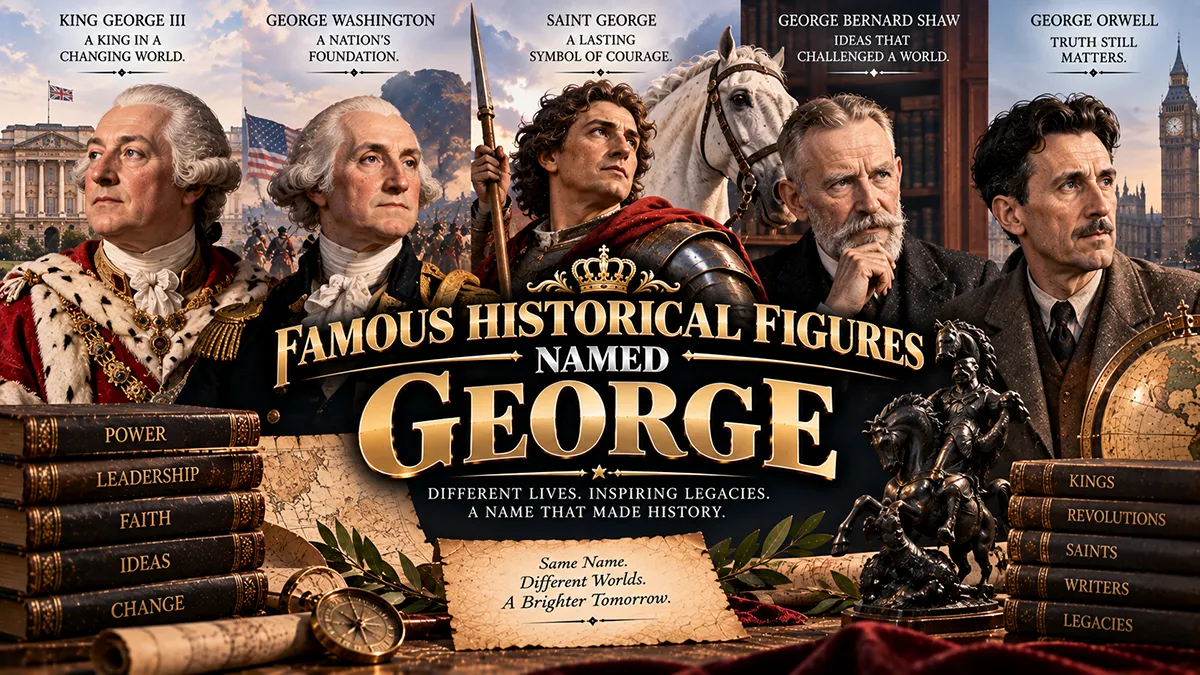
George is one of those names that seems to show up everywhere you look in history books, royal family trees, movie credits, and record stores. Kings have worn it, saints have carried it into legend, and it’s been borrowed as a pen name by writers who wanted to be taken more seriously in their era.
There’s a reason people search for “famous Georges” so often — the name has quietly threaded its way through nearly every century of recorded history.
In this guide, we’re rounding up the most notable people named George, tracing where the name (and the surname) actually comes from, and clearing up a few myths along the way — including the surprisingly real story behind the phrase “ten thousand men named George.”
TL;DR: The name George has crowned kings, canonized saints, powered scientific breakthroughs, and topped movie marquees, making it one of history’s most consistently famous first names — and its surname cousin has its own separate, well-documented story.
Where Does the Name George Come From?
The name George comes from the Greek name Geōrgios, which combines “geo” (earth) and “ergon” (work) — essentially, “earth-worker” or “farmer.” It entered wider European use largely thanks to the veneration of Saint George, a Christian martyr whose cult spread across the Byzantine and later medieval Christian world.
By the Middle Ages, the name had taken root in Britain, though it didn’t become genuinely popular there until the Hanoverian kings named George took the throne starting in 1714.
That royal boost is a big part of why the name George exploded in popularity across the English-speaking world during the 18th and 19th centuries. Once it was a king’s name, it became a common man’s name too, passed down through generations of families who wanted a solid, respectable choice.
It’s also why so many searches for “famous George names” and “famous Georges in history” turn up such a wide mix of monarchs, scientists, and everyday surnames.
The Surname George: Origin and Notable Bearers
It’s worth separating the first name from the last name, since both show up in searches like “george last name” and “george surname.”
The surname George developed independently as a patronymic — essentially meaning “son of George” — and became especially common in Wales, Cornwall, and parts of southwest England during the late medieval period.
Unlike occupational surnames such as Smith or Baker, George as a last name simply preserved a popular given name across generations.
Several notable historical and modern figures carry George as a surname rather than a first name. David Lloyd George served as British Prime Minister from 1916 to 1922, guiding the UK through the final years of the First World War.
Henry George, a 19th-century American economist, wrote the influential book Progress and Poverty and inspired an entire school of economic thought known as Georgism.
More recent examples include NBA All-Star Paul George, novelist Elizabeth George, and actress Melissa George.
So if you’ve ever wondered “what is George’s last name” in a specific context, the honest answer depends entirely on who you mean — because George works just as well as a surname as it does a first name, and the two traditions developed separately.
Famous Historical Figures Named George
Below is a chronological-ish tour through the most famous people who share the first name George, spanning saints, monarchs, scientists, writers, and modern celebrities. This isn’t an exhaustive list of every notable George in history — that would run into the thousands — but it covers the names people are most often searching for.
1. Saint George (Patron Saint and Dragon Legend)
Saint George is believed to have been a Roman soldier martyred around 303 AD during the persecution of Christians under Emperor Diocletian. He became the patron saint of England, Georgia, Catalonia, and several other regions long before the famous dragon-slaying legend attached itself to his story in the medieval period. It’s worth being clear-eyed here: the dragon tale is a popular legend, not a historical event, and most scholars treat it as later folklore layered onto a genuine early Christian martyr.
2. George Washington
George Washington commanded the Continental Army during the American Revolutionary War and became the first President of the United States in 1789. He served two terms and voluntarily stepped down, setting a precedent for peaceful transfers of power that shaped American democracy. His face on currency and monuments has made him arguably the most recognizable George in American history.
3. King George III
George III reigned over Great Britain from 1760 to 1820, a period that included the loss of the American colonies. He’s also remembered for a decline in mental health later in life, long attributed to the blood disorder porphyria, though modern historians note that diagnosis remains debated rather than settled fact. His long reign makes him one of the most consequential Georges in British royal history.
4. King George V
King George V ruled from 1910 to 1936 and steered the British monarchy through the First World War. In 1917, amid strong anti-German sentiment, he changed the royal family’s surname from Saxe-Coburg-Gotha to Windsor, a name still used by the British royal family today. His reign bridged the Edwardian era and the modern 20th century.
5. King George VI
George VI became king in 1936 after his brother Edward VIII abdicated, a role he never expected to hold. He’s widely known today for overcoming a severe stammer, a story dramatized in the film The King’s Speech, and for leading Britain through the Second World War. He was the father of Queen Elizabeth II.
6. George H.W. Bush
George H.W. Bush served as the 41st President of the United States from 1989 to 1993, after earlier serving as Vice President and CIA Director. His presidency included the end of the Cold War and the Gulf War. He remains one of the few American presidents whose son also became president.
7. George W. Bush
George W. Bush, son of George H.W. Bush, served as the 43rd President from 2001 to 2009. His presidency was defined heavily by the September 11 attacks and the wars that followed in Afghanistan and Iraq. Together, father and son make the Bush family one of the most prominent political dynasties to carry the name George.
8. George Washington Carver
George Washington Carver was an American agricultural scientist and inventor born into slavery in Missouri around 1864. He’s best known for his research into peanuts, sweet potatoes, and soil-improving crop rotation methods that helped struggling Southern farmers. Carver’s legacy as both a scientist and educator makes him one of the most celebrated Georges in American history.
9. George Boole
George Boole was a 19th-century English mathematician whose work on logic laid the foundation for what we now call Boolean algebra. That system of logic became essential to the development of digital computer circuits a century later. Without Boole’s theoretical groundwork, modern computing as we know it likely wouldn’t exist.
10. George Stephenson
George Stephenson was an English civil engineer often called the “Father of Railways” for his pioneering locomotive designs in the early 19th century. His locomotive, the Rocket, became a landmark achievement in early railway engineering. Stephenson’s work helped launch the railway age that transformed transportation worldwide.
11. George Orwell
George Orwell was the pen name of Eric Arthur Blair, the British author of 1984 and Animal Farm. He chose the pseudonym partly to distance his journalism and literary work from his family name, and it stuck permanently. Orwell’s writing on totalitarianism and surveillance remains so influential that the term “Orwellian” entered everyday language.
12. George Eliot
George Eliot was the pen name of English novelist Mary Ann Evans, author of Middlemarch and Silas Marner. She adopted a male pseudonym in the 1850s in part to ensure her work was taken seriously and reviewed on its own merits, since female novelists at the time often faced condescension. It’s a fascinating case of a woman choosing the name George specifically to be judged as a serious literary voice.
13. George Bernard Shaw
George Bernard Shaw was an Irish playwright and critic best known for Pygmalion, later adapted into the musical My Fair Lady. He won the Nobel Prize in Literature in 1925 and remains one of the most quoted writers in the English language. Shaw’s sharp wit and social commentary made him a towering literary figure of his era.
14. George Frideric Handel
George Frideric Handel was a German-born Baroque composer who spent much of his career in England, becoming a British citizen in 1727. He’s best remembered for Messiah, a choral work still performed every holiday season around the world. Handel’s influence on Western classical music is difficult to overstate.
15. George Gershwin
George Gershwin was an American composer who blended classical music with jazz influences in works like Rhapsody in Blue and the opera Porgy and Bess. His career, though cut short by his death at 38, produced some of the most enduring American musical compositions of the 20th century. Gershwin remains a defining figure in American music history.
16. George Harrison
George Harrison was the lead guitarist of the Beatles, often called “the quiet Beatle” for his more reserved public persona compared to Lennon and McCartney. He also became a major force in bringing Indian classical music and instruments like the sitar into Western pop music. His solo career, including the album All Things Must Pass, further cemented his legacy beyond the band.
17. George Michael
George Michael rose to fame as part of the duo Wham! before launching an enormously successful solo career with albums like Faith. His smooth vocals and songwriting made him one of the best-selling music artists of the 1980s and beyond. He remains one of the most famous musical Georges of the modern era.
18. Boy George
Boy George is the stage name of George Alan O’Dowd, lead singer of the British band Culture Club, known for hits like “Karma Chameleon.” His distinctive style and voice made him one of the most recognizable pop icons of the early 1980s. Interestingly, his birth name already included George, making the stage name feel almost inevitable.
19. George Clooney
George Clooney built his early career on the TV series ER before becoming one of Hollywood’s most bankable leading men in films like Ocean’s Eleven and Michael Clayton. He’s also known for humanitarian work and political advocacy alongside his acting career. Clooney is frequently among the first names people think of when searching for famous actors named George.
20. George Takei
George Takei is best known for playing Hikaru Sulu in the original Star Trek series, a role that made him a household name among science fiction fans. He later became a prominent activist for LGBTQ+ rights and Japanese American civil rights, drawing on his own family’s experience in WWII internment camps. His career spans both entertainment history and civil rights advocacy.
21. George Lucas
George Lucas created the Star Wars franchise and co-created Indiana Jones, reshaping the American blockbuster film industry in the process. His work at Industrial Light & Magic also pushed forward special effects technology used across the film industry. Few filmmakers have had as broad a cultural footprint as Lucas.
22. George Foreman
George Foreman was a heavyweight boxing champion who won Olympic gold in 1968 and later became famous again for his stunning 1994 title win at age 45. Beyond boxing, he built a hugely successful business career, most notably with the George Foreman Grill. His story of a comeback later in life is one of the more unusual arcs among famous Georges in sports.
23. George Best
George Best was a Northern Irish footballer widely regarded as one of the most talented players of his generation, starring for Manchester United in the 1960s. His flair on the pitch combined with a famously turbulent personal life made him both a sporting legend and a cautionary tale. Best remains a defining name in British football history.
24. Curious George (A Pop-Culture Note, Not a Historical Figure)
It’s worth pausing here for a quick myth-check, since “George wiki” searches often surface this character alongside real historical figures. Curious George is a fictional monkey created by authors H.A. and Margret Rey, first appearing in a 1941 children’s book. He’s not a historical figure at all, but his enduring popularity across generations of readers has made him one of the most searched-for “Georges” in pop culture, fictional or not.
25. Honorable Mentions: Famous “Georges” Around the World
The French spelling “Georges” (pronounced closer to “zhorzh”) has its own roster of notable figures worth a mention. Georges Clemenceau served as French Prime Minister during the final years of World War I and was a key figure at the Treaty of Versailles negotiations. Painter Georges Seurat pioneered the pointillist technique in works like A Sunday on La Grande Jatte, while mixed martial artist Georges St-Pierre became one of the most dominant UFC champions of his era.
The Strange True Story Behind “Ten Thousand Men Named George”
If you’ve come across the phrase “ten thousand men named George” and wondered what it refers to, it comes from a genuine and important piece of American labor history. In the early 20th century, the Pullman Company employed thousands of Black men as sleeping-car porters on American trains, and many passengers took to calling every single porter “George” — after company founder George Pullman — regardless of the man’s actual name.
This practice stripped porters of their individual identities and echoed the dehumanizing naming customs of slavery, and it became a genuine grievance among Pullman employees. The Brotherhood of Sleeping Car Porters, led by labor organizer A. Philip Randolph, fought against this treatment as part of a broader push for fair wages and dignity, eventually winning recognition as the first Black-led labor union to sign a contract with a major American company in 1937. The phrase later inspired the title of the 2002 television film 10,000 Men Named George, which dramatized this civil rights and labor struggle.
Why So Many People Are Named George
Part of what makes George such a recurring name throughout history is simple momentum. A name attached to kings, saints, and celebrated scientists tends to stay in circulation for centuries, passed from grandfather to grandson across generations of families who liked the association. The Hanoverian kings of Britain alone kept the name at the top of English naming trends for the better part of 200 years.
Add in the number of writers who deliberately chose “George” as a pen name — Orwell and Eliot both did it for very different reasons — and you get a name that’s been famous under multiple layers of meaning at once. It’s a first name, a surname, a royal title, and occasionally a disguise, which is part of why searches for famous Georges pull in such a wildly varied cast of characters.
Final Thoughts on History’s Most Famous Georges
Few names carry as much range as George. It’s been worn by martyred saints, revolutionary presidents, Beatles guitarists, and a curious fictional monkey, and it’s been borrowed by authors looking to reinvent themselves entirely. The surname George, meanwhile, has quietly produced its own list of prime ministers, economists, and athletes with no royal or literary connection at all.
Whether you came here chasing down the origin of the George surname, curious about famous actors named George, or trying to track down the real story behind “ten thousand men named George,” the throughline is the same: this is a name that has never really gone out of style. It’s stayed relevant across roughly 1,700 years of recorded history, and given how many notable people are still named George today, it doesn’t look like it’s finished yet.
Frequently Asked Questions
Who are some famous people named George?
Famous people named George span nearly every field of history, including George Washington (U.S. president), Saint George (Christian martyr and patron saint), King George III and King George VI (British monarchs), George Orwell (author), George Harrison (Beatles guitarist), George Clooney (actor), and George Foreman (boxer). The name has been common among royalty, writers, scientists, musicians, and athletes for centuries.
What does the name George mean and where does it come from?
George comes from the Greek name Geōrgios, formed from "geo" (earth) and "ergon" (work), roughly meaning "earth-worker" or "farmer." It spread through Europe largely due to the popularity of Saint George's cult in early Christianity and later became especially common in Britain once the Hanoverian kings named George took the throne starting in 1714.
What is the origin of the surname George?
The surname George developed as a patronymic, essentially meaning "son of George," and became particularly established in Wales, Cornwall, and southwest England during the late medieval period. Unlike occupational surnames, it simply preserved a popular first name across generations of a family.
Is George usually a first name or a last name?
George is most commonly used as a first name, but it's also a well-established surname with its own independent history. Notable examples of George as a surname include former British Prime Minister David Lloyd George, economist Henry George, and NBA player Paul George.
What is George’s last name?
It depends entirely on which George you mean, since the name has been used as both a first name and a standalone stage name. Boy George's real full name is George Alan O'Dowd, while fictional characters like Curious George have no surname at all, since he's a storybook monkey rather than a historical or fully realized human character.
Why is the phrase “ten thousand men named George” significant in history?
It refers to the real historical practice of Pullman Company passengers calling every Black sleeping-car porter "George," after founder George Pullman, regardless of the porter's actual name. Porters organized against this and other injustices through the Brotherhood of Sleeping Car Porters, a struggle later dramatized in the 2002 film 10,000 Men Named George.
Was Saint George a real historical person?
Most historians believe Saint George was a real Roman soldier martyred for his Christian faith around 303 AD under Emperor Diocletian. However, the famous legend of him slaying a dragon is a medieval folk tale added centuries later and isn't treated as historical fact.

Alex Warren
Related Articles