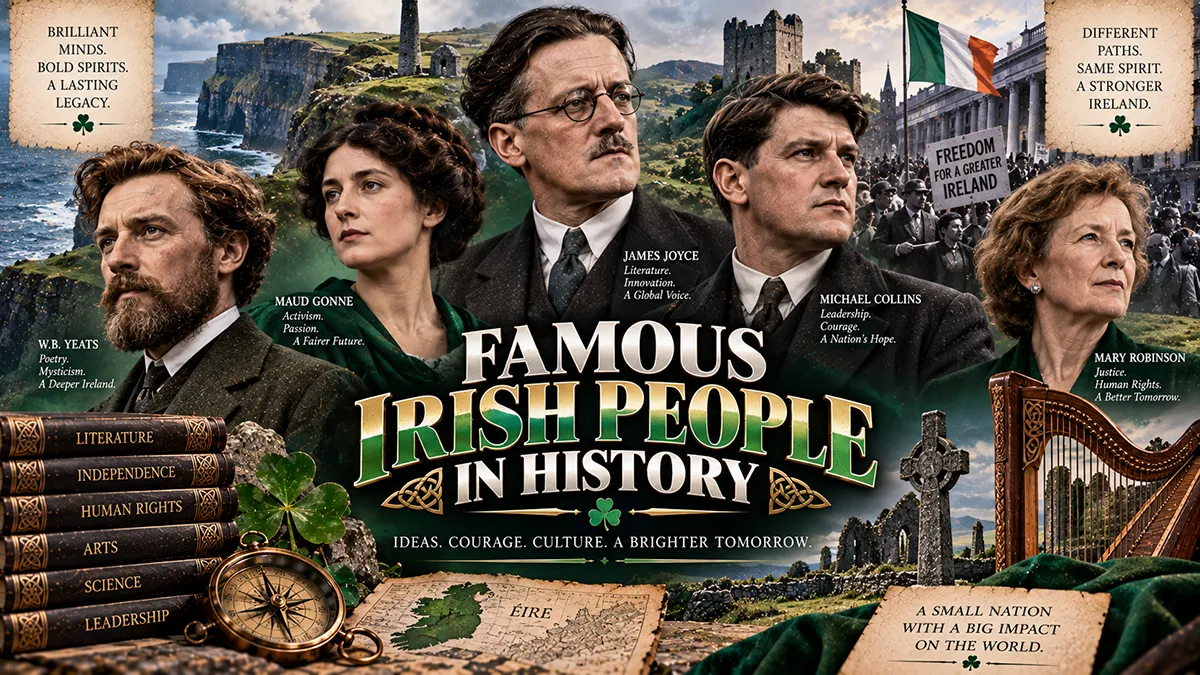
Ireland is a small island that has punched wildly above its weight in world history. From ancient high kings to Nobel-winning writers, from rebel leaders to rock stars, the list of famous Irish people reads like a masterclass in outsized cultural influence.
Ask someone what the Irish are known for and you’ll get answers ranging from literature and music to rebellion and wit. This guide separates the verified history from the folklore and walks through the historical figures of Ireland who actually earned their place in the story — plus a few modern icons who carry that legacy forward.
TL;DR: Ireland’s famous citizens span saints, warrior queens, revolutionaries, and Nobel laureates, and their combined influence on literature, politics, and culture is wildly disproportionate to the island’s size.
What Are the Irish Famous For?
Before diving into individual names, it helps to know the broad categories where Irish figures dominate. Literature is the obvious one — Ireland has produced four Nobel laureates in that field alone, an extraordinary rate for a nation of roughly five million people.
Politics and rebellion are another. Ireland’s long struggle for independence from Britain produced a deep bench of revolutionaries, orators, and statesmen whose tactics and speeches are still studied today.
Music, exploration, and science round things out. Irish emigrants also shaped the destinies of other nations, particularly the United States, meaning “famous Irish people” often means far more than just people who stayed on the island.
1. Saint Patrick
Saint Patrick is Ireland’s patron saint and arguably its most globally recognized name, even though he probably wasn’t born in Ireland at all. Historical accounts, drawn largely from his own writings, suggest he was a Romano-British man captured and enslaved in Ireland before escaping and later returning as a missionary.
Much of the snake-banishing, shamrock-explaining folklore around him developed centuries after his death and isn’t historically verifiable. What is better documented is his role in spreading Christianity across Ireland in the 5th century, a legacy that shaped Irish culture for over a thousand years.
2. Brian Boru
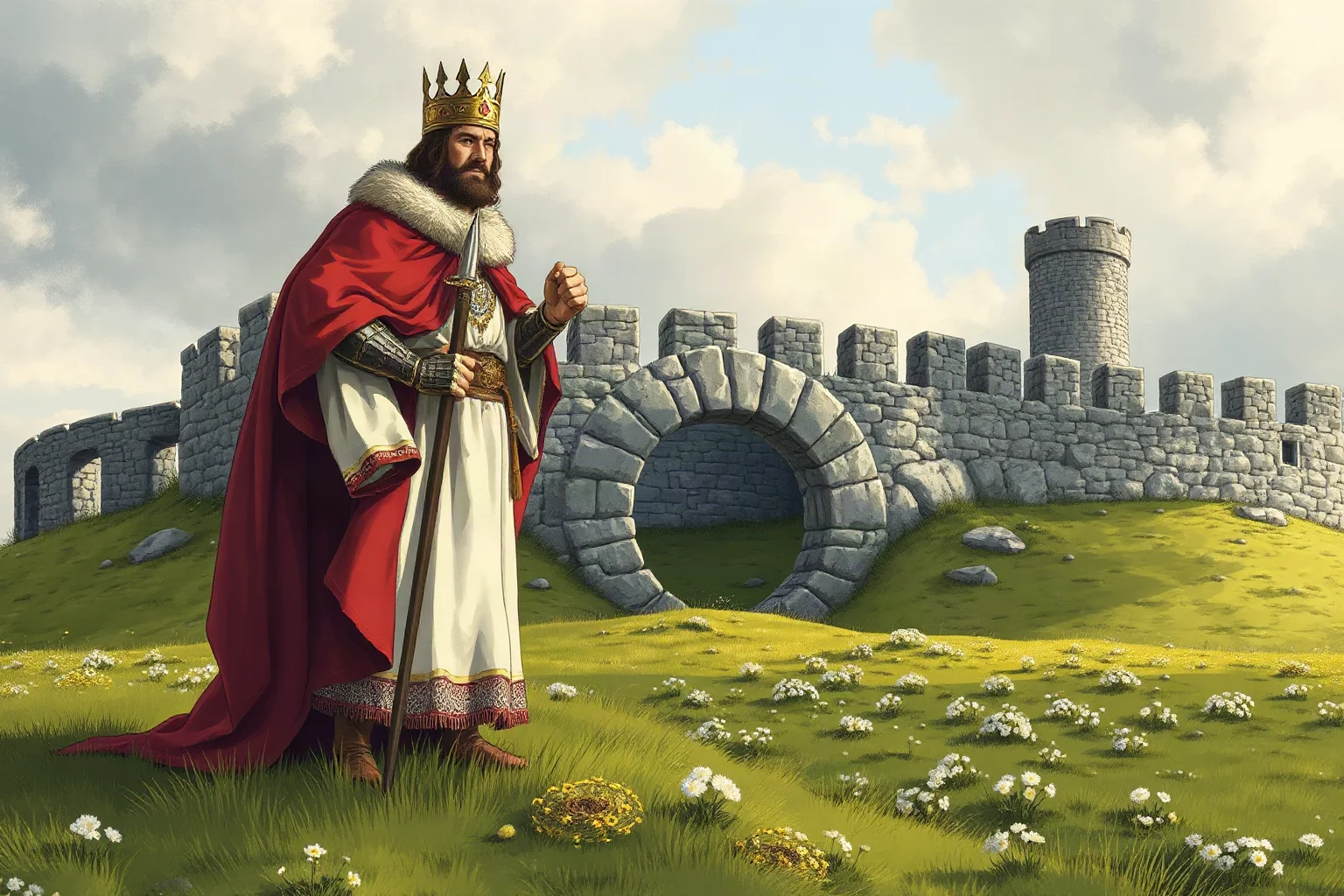
Brian Boru is remembered as the High King who briefly unified much of Ireland under one rule around the turn of the 11th century. He rose from a regional Munster kingship to a position of national dominance through decades of military campaigning.
His death at the Battle of Clontarf in 1014, fighting Viking and rival Irish forces, cemented his legendary status. He remains a touchstone for Irish national identity, even though the “united Ireland” he built didn’t survive long after him.
3. Grace O’Malley (Gráinne Mhaol)
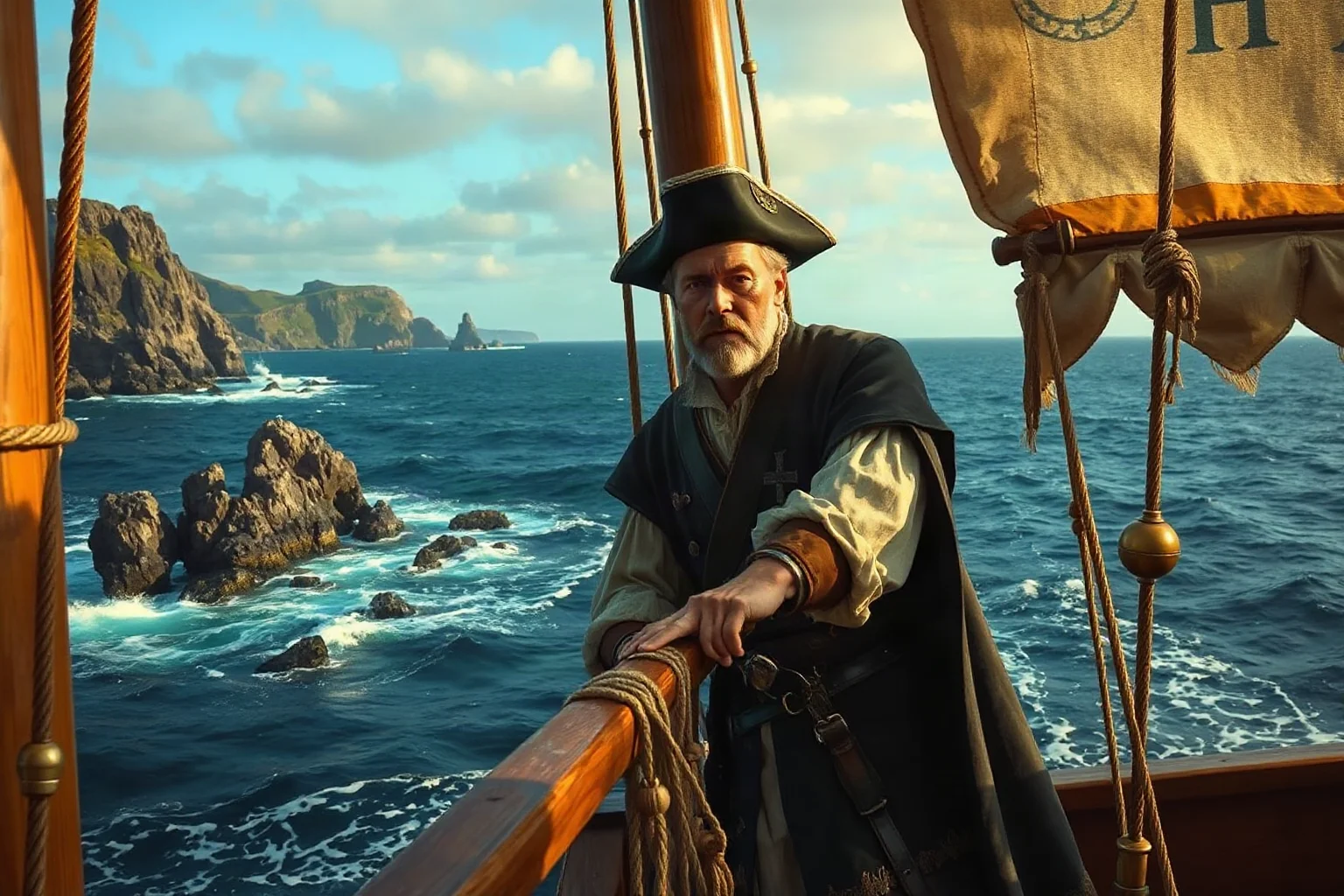
Grace O’Malley was a 16th-century Irish chieftain and seafarer, often nicknamed the “Pirate Queen” of Connacht. She commanded ships, led clan warfare, and negotiated directly with Queen Elizabeth I as something close to an equal power broker.
Contemporary English records confirm her meeting with Elizabeth I in 1593, which is remarkable given how few women of any nationality held that kind of direct political leverage at the time. She remains one of the most famous women in Irish history for good reason.
4. Jonathan Swift
Jonathan Swift, born in Dublin in 1667, became one of the English language’s sharpest satirists. His most famous work, “Gulliver’s Travels,” is often remembered today as a children’s fantasy, but it was originally a biting political satire aimed at the follies of 18th-century society.
Swift also wrote “A Modest Proposal,” a savage satirical essay addressing poverty in Ireland under British rule. He spent much of his career as Dean of St Patrick’s Cathedral in Dublin, cementing his place among Ireland’s literary greats.
5. Edmund Burke
Edmund Burke was an 18th-century Irish statesman and philosopher whose writing helped shape modern conservative political thought. Born in Dublin, he served in the British Parliament and wrote extensively on the French Revolution, liberty, and the limits of government power.
His “Reflections on the Revolution in France” remains a foundational text in political philosophy. Burke’s Irish background influenced his views on colonial policy, including his criticism of British treatment of Ireland, India, and the American colonies.
6. Theobald Wolfe Tone
Wolfe Tone is considered a founding father of Irish republicanism. He helped establish the Society of United Irishmen in 1791, a movement seeking to unite Irish Catholics and Protestants in pursuit of independence from British rule.
Tone’s efforts culminated in the failed Irish Rebellion of 1798, after which he was captured by British forces. He died shortly after, either by suicide or from a self-inflicted wound sustained while awaiting execution, and became a martyr figure for later generations of Irish nationalists.
7. Daniel O’Connell
Known as “The Liberator,” Daniel O’Connell led the campaign for Catholic Emancipation in the early 19th century, successfully pushing Britain to lift many legal restrictions on Irish Catholics in 1829. He achieved this largely through mass peaceful mobilization rather than armed rebellion, a strategy notably ahead of its time.
O’Connell later campaigned to repeal the Act of Union between Britain and Ireland, though that effort ultimately failed. He’s still regarded as one of the most important people in Ireland’s political history for proving that organized, nonviolent mass politics could force real change.
8. Charles Stewart Parnell
Parnell led the Irish Parliamentary Party in the late 19th century and came remarkably close to securing Home Rule for Ireland through parliamentary maneuvering in Westminster. His leadership of the Irish Land League also helped reshape land ownership rights for Irish tenant farmers.
His political career collapsed after a divorce scandal involving Kitty O’Shea split his party and his public support. Even so, historians widely credit him with modernizing Irish nationalist politics before his early death in 1891.
9. Michael Collins
Michael Collins was a central figure in Ireland’s War of Independence, serving as a guerrilla strategist, intelligence chief, and later a negotiator of the Anglo-Irish Treaty in 1921. His intelligence network is often credited with effectively dismantling British operations in Dublin during the conflict.
The treaty he signed created the Irish Free State but also triggered the Irish Civil War, as it fell short of full independence for the entire island. Collins was killed in an ambush during that civil war in 1922, at just 31 years old.
10. Éamon de Valera
Éamon de Valera was one of the dominant figures in 20th-century Irish politics, serving multiple terms as Taoiseach and later as President of Ireland. He opposed the Anglo-Irish Treaty that Collins signed, putting the two men on opposite sides of the Irish Civil War.
De Valera later founded the Fianna Fáil party and helped draft Ireland’s 1937 constitution. His long political career, spanning revolution to statesmanship, makes him one of the most consequential historical figures of Ireland’s independence era.
11. Constance Markievicz
Constance Markievicz was an Irish revolutionary, politician, and suffragette who took part in the 1916 Easter Rising as a leader within the Irish Citizen Army. She was sentenced to death after the rising but had her sentence commuted, reportedly due to her sex, a decision she reportedly found insulting rather than merciful.
In 1918 she became the first woman elected to the British House of Commons, though as an Irish republican she never took her seat. She later served in the first Dáil Éireann, making her one of the earliest female cabinet ministers in the world.
12. James Connolly
James Connolly was a labor organizer and socialist revolutionary who co-led the 1916 Easter Rising alongside Patrick Pearse. He believed Irish independence and workers’ rights were inseparable causes, a view that shaped early 20th-century Irish left-wing politics.
Connolly was executed by British forces after the rising, reportedly while tied to a chair due to injuries sustained during the fighting. His execution, along with those of other rebellion leaders, helped shift Irish public opinion toward supporting full independence.
13. Jonathan Swift’s Literary Descendants: Oscar Wilde
Oscar Wilde, born in Dublin in 1854, became one of the most quoted writers in the English language, celebrated for plays like “The Importance of Being Earnest” and his novel “The Picture of Dorian Gray.” His wit made him a celebrity in Victorian London society.
Wilde’s later life was upended by his 1895 trial and conviction for “gross indecency” due to his relationship with Lord Alfred Douglas, reflecting the harsh anti-gay laws of the era. He died in Paris in 1900, but his reputation as a literary giant has only grown since.
14. William Butler Yeats
W.B. Yeats was a poet and dramatist central to the Irish Literary Revival, and in 1923 he became the first Irish person to win the Nobel Prize in Literature. His poetry blended Irish mythology, mysticism, and the political upheavals of his time.
Yeats also served as a senator in the newly independent Irish Free State, giving him a direct role in shaping the young nation’s cultural policy. Poems like “The Second Coming” and “Easter, 1916” remain widely studied for their engagement with Irish history.
15. James Joyce
James Joyce is often regarded as one of the most influential novelists of the 20th century, thanks largely to “Ulysses,” a book that reimagined the novel form through its stream-of-consciousness style. Set entirely in Dublin on a single day in 1904, it’s one of the most famous literary tributes to any city.
Joyce spent much of his adult life abroad in Trieste, Zurich, and Paris, yet Dublin remained the obsessive subject of nearly everything he wrote. “Dubliners” and “A Portrait of the Artist as a Young Man” further cemented his reputation as a chronicler of Irish life.
16. George Bernard Shaw
George Bernard Shaw was a Dublin-born playwright, critic, and political essayist who won both the Nobel Prize in Literature and an Academy Award, a rare double achievement. His play “Pygmalion” later became the basis for the musical “My Fair Lady.”
Shaw was also a committed socialist and prolific commentator on politics, economics, and social reform. His sharp, often satirical style continued the tradition of Irish wit established by predecessors like Swift and Wilde.
17. Bram Stoker
Bram Stoker, born in Dublin in 1847, created one of the most enduring characters in horror fiction with his 1897 novel “Dracula.” Stoker worked as a theater manager for much of his career and wrote fiction largely on the side.
“Dracula” drew on Eastern European folklore and Victorian anxieties, and it has since inspired countless films, adaptations, and cultural references. Stoker’s contribution shows that Ireland’s literary reach extends well beyond realism and into the roots of modern horror.
18. Robert Boyle
Robert Boyle was a 17th-century natural philosopher born in County Waterford, widely regarded as one of the founders of modern chemistry. He’s best known for Boyle’s Law, which describes the relationship between the pressure and volume of a gas.
Boyle was also a founding member of the Royal Society in London, one of the earliest and most important scientific institutions in history. His experimental approach helped move chemistry away from alchemy and toward the scientific method.
19. Ernest Shackleton
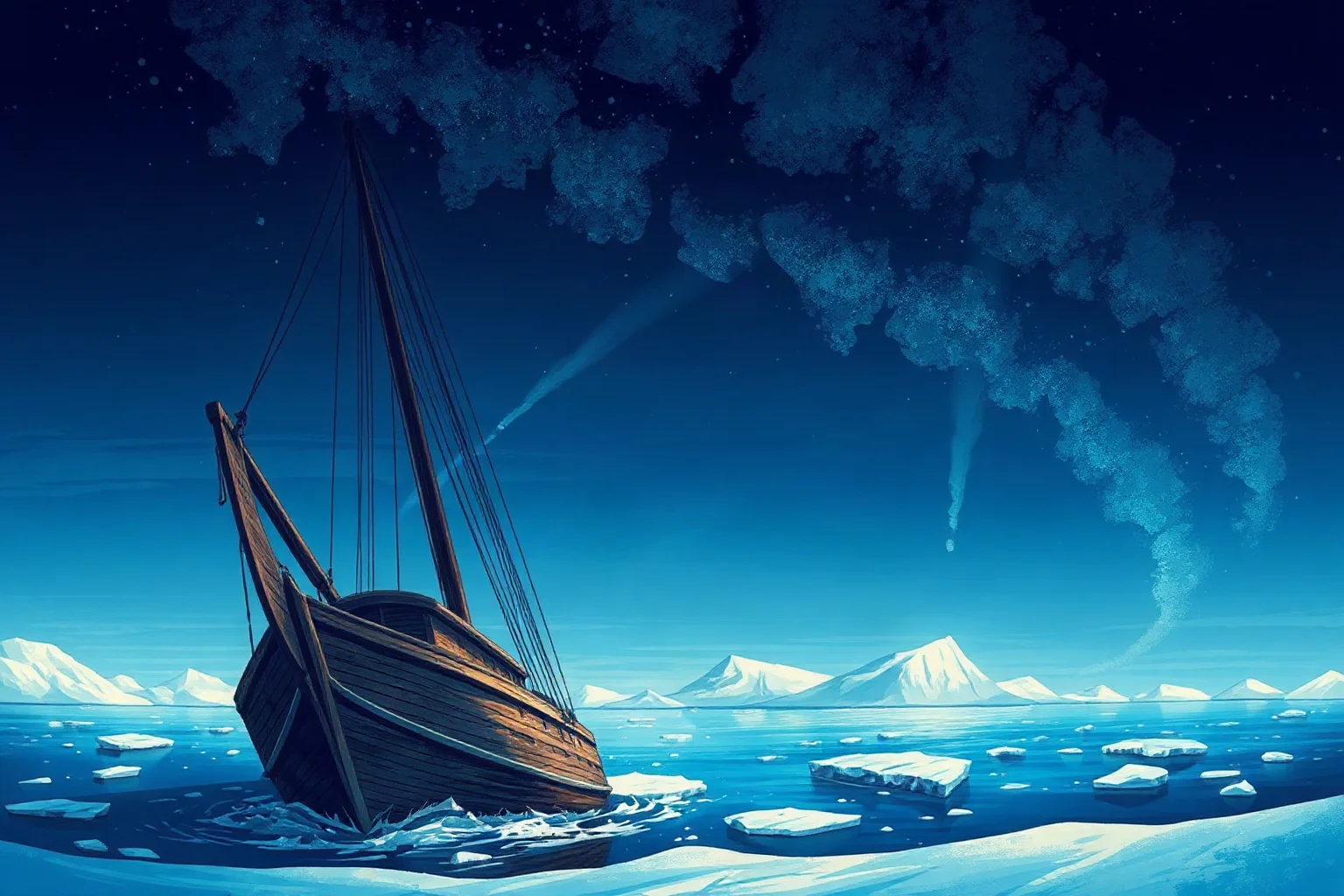
Ernest Shackleton was born in County Kildare in 1874 and became one of the most celebrated Antarctic explorers of the early 20th century. His Endurance expedition of 1914–1917 is legendary less for reaching its goal and more for the extraordinary survival story that followed after the ship became trapped and crushed by ice.
Shackleton managed to bring his entire crew home alive after months of harrowing survival on ice floes and open boats. His leadership under extreme pressure is still studied today in fields well beyond exploration.
20. Mary Robinson
Mary Robinson made history in 1990 as the first woman elected President of Ireland, breaking a significant barrier in Irish politics. She used the largely ceremonial role to champion human rights, reach out to the Irish diaspora, and modernize the presidency’s public profile.
After her presidency, Robinson served as United Nations High Commissioner for Human Rights, extending her influence onto the world stage. She remains one of the most respected historical figures in modern Irish public life.
21. Samuel Beckett
Samuel Beckett, born near Dublin in 1906, became a defining figure of 20th-century avant-garde literature and theater. His play “Waiting for Godot” is considered one of the most important works of the Theatre of the Absurd movement.
Beckett won the Nobel Prize in Literature in 1969, making him one of four Irish-born Nobel laureates in that category. He spent much of his life in France and wrote in both English and French, but his Irish roots remained central to his literary identity.
22. Sinéad O’Connor
Sinéad O’Connor became one of Ireland’s most recognizable and outspoken musical voices from the late 1980s onward, best known internationally for her cover of “Nothing Compares 2 U.” Her career was also marked by fearless, often controversial public stances on the Catholic Church and Irish social issues.
O’Connor’s willingness to challenge institutions made her a polarizing but undeniably influential cultural figure. Her death in 2023 prompted widespread reflection on her impact on Irish music and public discourse.
Famous Irish Emigrants and the Diaspora
No list of important people from Ireland is complete without acknowledging the diaspora, since so much Irish influence happened outside Ireland itself. Waves of emigration, especially following the Great Famine of the 1840s, sent millions of Irish people to the United States, Britain, Australia, and beyond.
Descendants of Irish emigrants shaped entire nations, including U.S. presidents like John F. Kennedy and Ronald Reagan, whose family roots traced back to Irish counties. This diaspora effect is a big reason searches for famous Irish people so often turn up names connected to America, Britain, and Australia rather than Ireland alone.
Why These Historical Figures Still Matter
What connects a 5th-century missionary, a Viking-era king, and a 20th-century punk-rock singer is a consistent thread of resilience, wit, and disproportionate global influence. Ireland’s history of colonization, famine, and emigration could easily have erased its cultural footprint, yet the opposite happened.
These famous Irish citizens, across every era, kept building something recognizable as distinctly Irish: sharp language, fierce independence, and an outsized talent for storytelling. That’s the real answer to what the Irish are famous for, and it’s a legacy that keeps adding new names with every generation.
Frequently Asked Questions
Who are considered the most famous citizens of Ireland?
There's no single official list, but historians and cultural commentators consistently point to figures like Saint Patrick, Michael Collins, W.B. Yeats, James Joyce, Daniel O'Connell, and Mary Robinson as among the most famous citizens of Ireland. These names recur across politics, literature, and social reform, reflecting the range of fields where Irish figures have had global impact.
Who is the most famous Irish person in history?
It depends on the category, since Ireland doesn't have one universally agreed 'most famous' figure. Saint Patrick is the most recognized name internationally due to his namesake holiday, while James Joyce and W.B. Yeats are often cited as the most historically significant in literature, and Michael Collins is frequently named the most consequential political figure.
What are the Irish famous for?
Ireland is best known internationally for its literature (with four Nobel laureates), its history of political rebellion and independence, its music, and its long tradition of storytelling and wit. The Irish diaspora also spread this influence worldwide, particularly across the United States, Britain, and Australia.
Was Saint Patrick actually Irish?
No, historical evidence suggests Saint Patrick was likely born in Roman Britain, not Ireland. He was brought to Ireland as a captive as a young man and later returned voluntarily as a Christian missionary, which is why he's remembered as Ireland's patron saint despite not being a native.
Who was the first woman to become President of Ireland?
Mary Robinson was elected in 1990 as the first female President of Ireland. She later became United Nations High Commissioner for Human Rights, extending her influence in human rights advocacy well beyond her presidency.
What is the difference between Irish historical figures and famous Irish emigrants?
Irish historical figures typically refers to people born and primarily active in Ireland, such as Brian Boru or Michael Collins. Famous Irish emigrants, by contrast, refers to people of Irish birth or heritage who achieved prominence abroad, such as descendants of Irish families who became prominent in American politics and culture.

Alex Warren
Related Articles