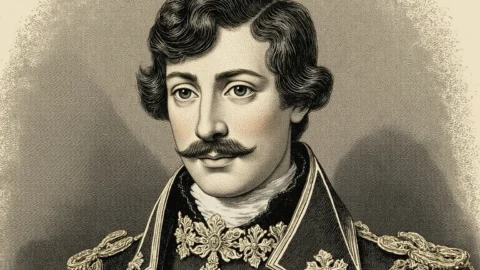

Everyone recognizes “I think, therefore I am” as the ultimate philosophy quote, the kind of line people tattoo on their forearms or scribble in journals at 2 a.m. There’s just one problem: it’s not ancient at all. That phrase belongs to René Descartes, a 17th-century French thinker who lived nearly 2,000 years after the philosophers most people picture when they hear the word “philosophy.”
So let’s set the record straight and go further back, to the thinkers who actually built the foundations Descartes stood on. This list rounds up 20 of the most famous philosophical quotes from the ancient world, from the marketplaces of Athens to the Stoic courts of Rome, with honest context on who really said what, what got lost in translation, and what’s more legend than literal quote.
TL;DR: The 20 quotes below trace 2,500 years of ancient wisdom from Socrates to Marcus Aurelius, and while many are genuine, some famous “ancient” lines are actually later paraphrases or disputed attributions worth knowing about.
Why Ancient Philosophy Still Speaks to Us
Ancient Greek and Roman philosophers didn’t have psychology textbooks, self-help podcasts, or productivity apps. What they had was patience, argument, and a habit of writing things down in a way that still cuts through the noise today.
That’s why philosophy quotes remain some of the most shared, screenshotted, and quoted lines on the internet. They’re short, they’re punchy, and they tend to say something true about being human that hasn’t changed much since 400 BCE.
It’s worth remembering, too, that “ancient” covers a huge span of time and geography. This list focuses mainly on Greek philosophers, with a few Roman Stoics thrown in, since that’s where most of the famous philosophical phrases people search for actually come from.
A Quick Note on Sources and Translations
Before diving into the list, a bit of myth-busting is in order. Many of these thinkers, especially the earliest ones, didn’t leave behind complete original texts. What survives often comes through later writers quoting, summarizing, or translating them centuries after they died.
Socrates, for example, wrote nothing himself. Everything attributed to him comes filtered through students like Plato and Xenophon, which means we’re often getting a student’s memory of a teacher’s argument, not a verbatim transcript.
Similarly, you might have run into a stylized line like “do not quote the ancient texts to me” in a video game or film set in the classical world. Those are fun, but they’re modern writing dressed up in a toga. The real ancient texts, and the genuine quotes from famous philosophers below, are a little messier and a lot more interesting than the fictionalized versions.
1. Socrates — “The Only True Wisdom Is in Knowing You Know Nothing”
This is probably the most quoted line in the history of Western philosophy, and it’s also one of the most paraphrased. In Plato’s Apology, Socrates actually says something closer to: he is wiser only in that he does not think he knows what he does not know.
Over centuries, that idea got compressed into the tidy modern sentence everyone repeats. The spirit is accurate to Socratic thought, even if the exact wording is a later simplification rather than a direct translation.
2. Socrates — “The Unexamined Life Is Not Worth Living”

This one has stronger footing. It comes from Plato’s Apology, where Socrates defends his habit of constantly questioning himself, his neighbors, and Athenian society at large.
He reportedly said this while on trial for his life, arguing that a life without self-reflection isn’t worth preserving. It remains one of the most genuine and well-documented ancient Greek philosophers’ quotes on this whole list.
3. Plato — “Wise Men Speak Because They Have Something to Say; Fools Because They Have to Say Something”
This line shows up constantly in quote collections attributed to Plato, but its exact source inside his dialogues is surprisingly hard to pin down. It’s the kind of aphorism that sounds Platonic and captures his general disdain for empty rhetoric, but readers should treat the precise attribution with some caution.
It’s a good reminder that not every quote circulating under a famous philosopher’s name has a clean paper trail back to their actual writings.
4. Plato — “The Beginning Is the Most Important Part of the Work”

This one is on firmer ground, appearing in Book I of Plato’s Republic. Socrates, as Plato’s mouthpiece, argues that how you start something, whether it’s an education, a habit, or a society, shapes everything that follows.
It’s a favorite among educators and coaches today, but its roots go straight back to a serious argument about how to raise virtuous citizens.
5. Aristotle — “Knowing Yourself Is the Beginning of All Wisdom”

This phrase circulates widely as an Aristotle quote, but it doesn’t appear clearly in his surviving works like the Nicomachean Ethics or Metaphysics. Many scholars consider it apocryphal, a later invention that simply sounds like something Aristotle would say.
It overlaps thematically with the Delphic maxim “know thyself,” which is a different and much older tradition entirely (more on that below).
6. Aristotle — “We Are What We Repeatedly Do”

Here’s a genuinely fascinating case of myth versus history. The full version, “we are what we repeatedly do; excellence, then, is not an act but a habit,” is almost always credited directly to Aristotle.
In reality, it’s a paraphrase written by historian Will Durant in his 1926 book The Story of Philosophy, where he was summarizing ideas from Aristotle’s Nicomachean Ethics. Aristotle absolutely did argue that virtue comes from habit, just not in those exact words.
7. Aristotle — “The Whole Is Greater Than the Sum of Its Parts”

This phrase is a long-standing simplification of ideas in Aristotle’s Metaphysics, where he discusses how a composite thing can have properties its individual pieces lack on their own. Translators and philosophers have condensed this into the popular saying over many centuries.
It’s a decent example of how a genuinely Aristotelian concept can survive accurately in spirit while drifting from his original Greek phrasing.
8. Heraclitus — “No Man Ever Steps in the Same River Twice”
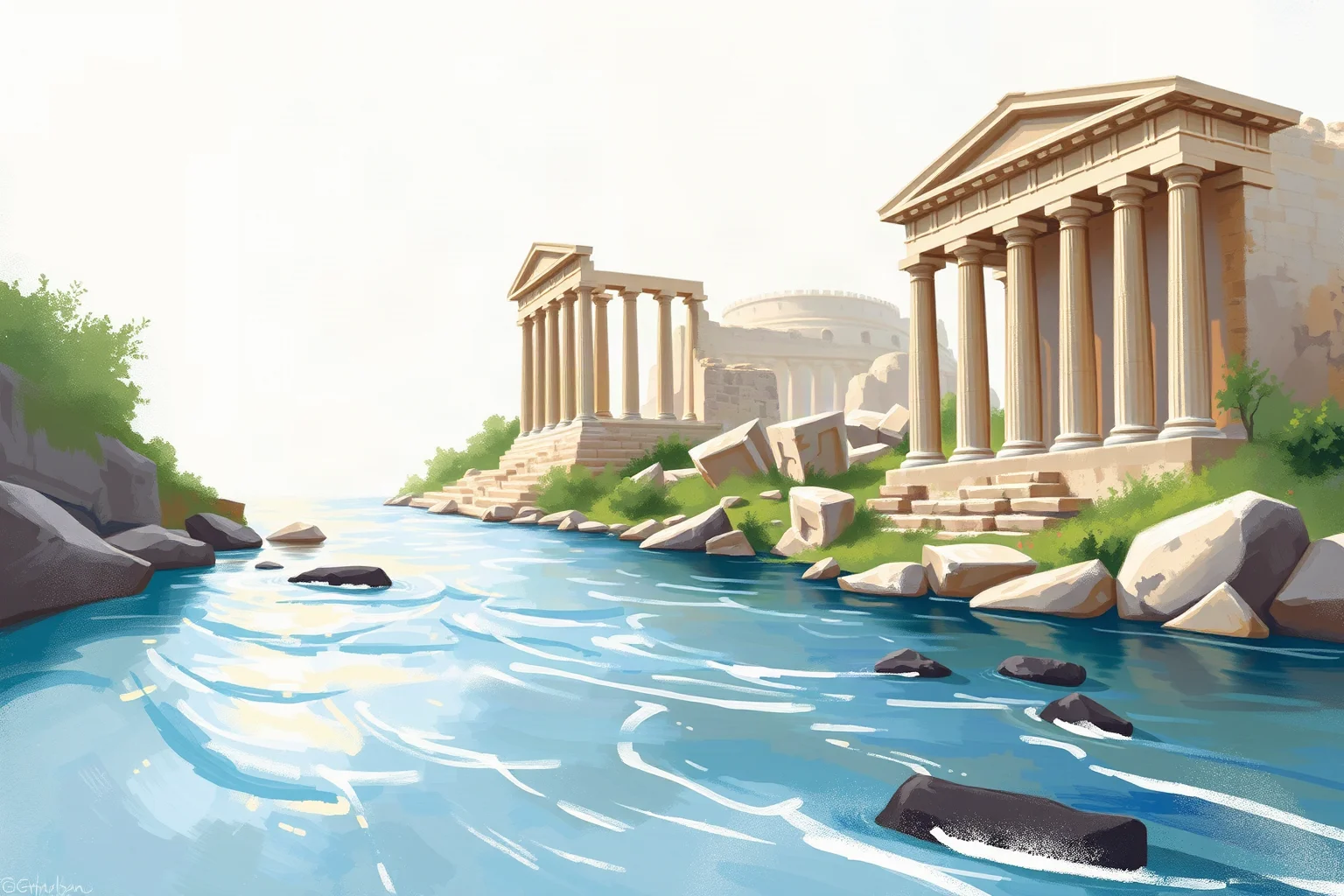
Heraclitus is known almost entirely through fragments quoted by later writers, since none of his original work survives complete. This river image, preserved through sources like Plato’s Cratylus and later commentators, captures his core idea that everything is in constant flux.
The wording varies quite a bit between translations, but the underlying philosophy of impermanence is consistently attributed to him across ancient sources.
9. Heraclitus — “Change Is the Only Constant”

This shorter, punchier version is a modern condensation of the river fragment above rather than a separate ancient quote. It’s become one of the most popular philosophy quotes for a reason: it’s short, memorable, and genuinely reflects Heraclitus’s worldview.
Just know that if you’re looking for the literal ancient Greek wording, this compact phrasing is a modern packaging job, not a direct translation.
10. Pythagoras — “Number Rules the Universe”

Pythagoras is a tricky case because he left no writings of his own, and everything attributed to him comes from followers writing centuries later, like Iamblichus and Porphyry. This particular line reflects the Pythagorean belief that mathematical relationships underlie all of reality.
It’s worth treating Pythagoras quotes generally with a healthy dose of skepticism, since the historical Pythagoras and the legendary teacher described by later admirers aren’t always easy to separate.
11. Democritus — “Nothing Exists Except Atoms and Empty Space; Everything Else Is Opinion”

Democritus developed one of the earliest versions of atomic theory in the ancient world, and this fragment is preserved through later writers like Diogenes Laërtius and Sextus Empiricus. It’s a remarkably modern-sounding idea for someone writing around the 5th century BCE.
While the exact English phrasing depends on which translation you read, the core claim about atoms and void is well attested across multiple ancient sources.
12. Protagoras — “Man Is the Measure of All Things”
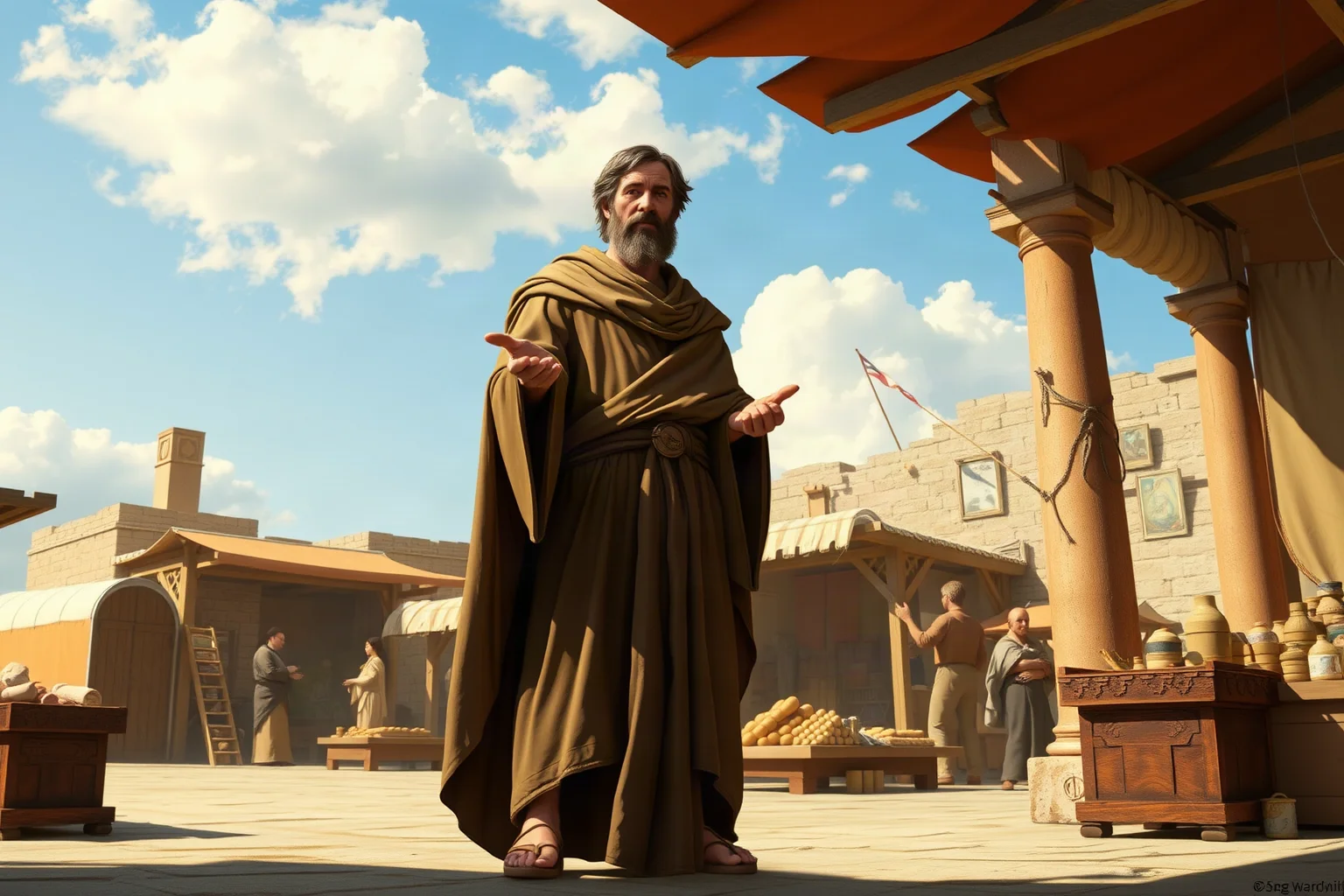
This is the opening line of Protagoras’s lost work On Truth, preserved for us because Plato quotes it directly in his dialogue Theaetetus. It’s one of the more reliably sourced ancient philosophical statements on this list, even though the original full text vanished long ago.
Protagoras used it to argue that truth is relative to individual perception, a genuinely radical idea in classical Athens.
13. Diogenes of Sinope — “I Am a Citizen of the World”
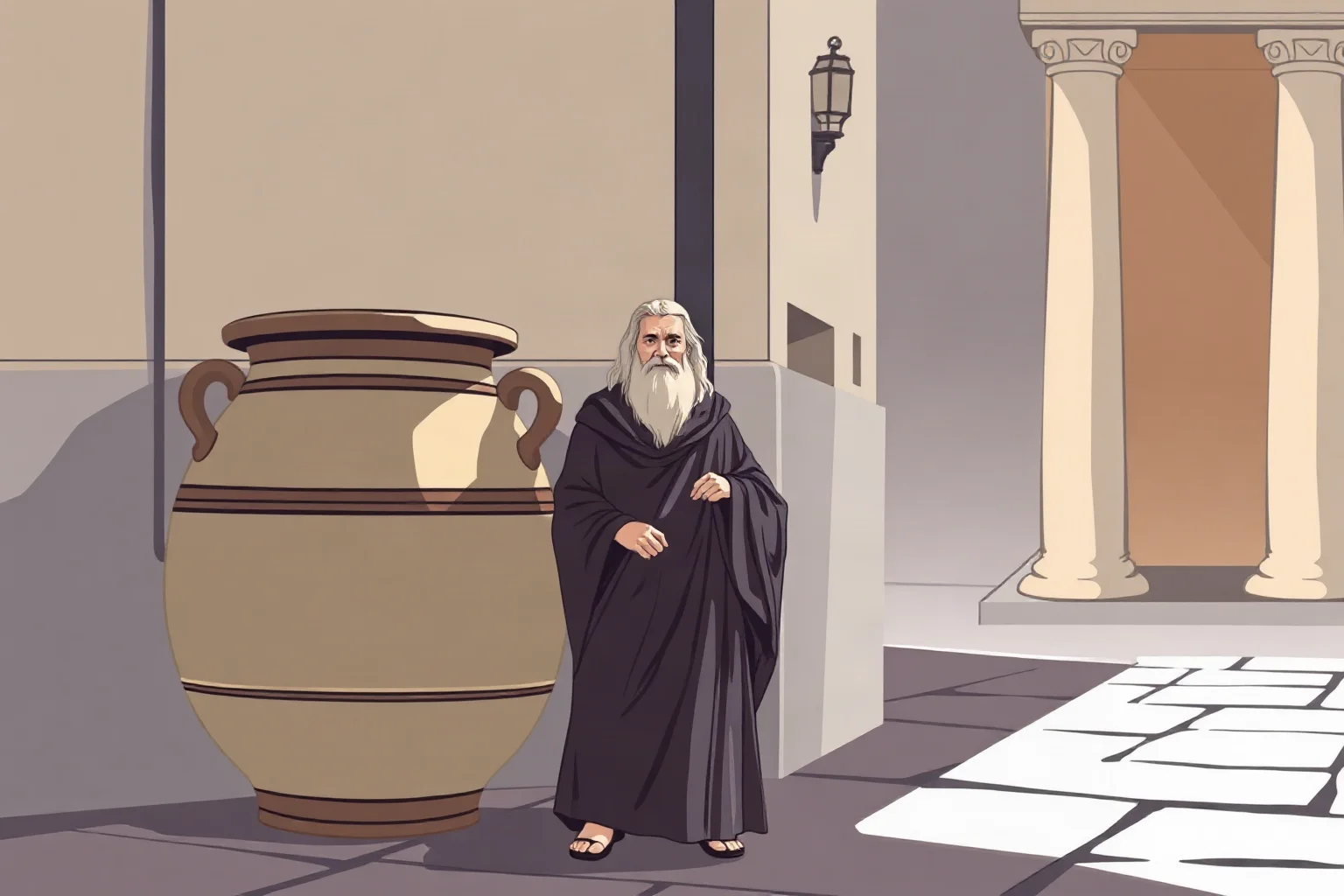
Diogenes the Cynic was famous for rejecting social conventions, allegedly living in a large ceramic jar and mocking Alexander the Great to his face. This quote, describing himself as “kosmopolitês” or citizen of the cosmos, comes to us through Diogenes Laërtius’s Lives of Eminent Philosophers, written roughly 500 years after Diogenes lived.
That gap in time means it should be read as a well-preserved tradition about Diogenes rather than a word-for-word transcript.
14. Epicurus — “Death Is Nothing to Us”

This one comes from Epicurus’s Letter to Menoeceus, one of the few substantial pieces of his writing that survives largely intact, again thanks to Diogenes Laërtius preserving it. Epicurus argued that since death means the absence of sensation, it can’t actually harm us, so fearing it is irrational.
It’s one of the more directly sourced quotes from ancient philosophers on this entire list.
15. Epicurus — “Not What We Have, but What We Enjoy, Constitutes Our Abundance”

This line reflects Epicurus’s broader philosophy of finding contentment in simple pleasures rather than material accumulation, a philosophy often misunderstood today as hedonism. It’s preserved through fragment collections like those compiled by the later anthologist Stobaeus.
Epicurus actually lived quite modestly, favoring friendship and tranquility over luxury, which this quote captures well.
16. Zeno of Citium — “Man Conquers the World by Conquering Himself”

Zeno founded Stoicism around 300 BCE, but like Pythagoras, none of his original writings survive. Everything we know comes secondhand through later biographers, mainly Diogenes Laërtius again.
This quote reflects core Stoic values around self-mastery, ideas that his later followers, especially the Roman Stoics below, developed into much more fully documented philosophy.
17. Marcus Aurelius — “You Have Power Over Your Mind, Not Outside Events”

Unlike many earlier figures on this list, Marcus Aurelius’s writing genuinely survives intact in his personal journal, Meditations. He wasn’t writing for an audience; this was a Roman emperor jotting down Stoic reminders to himself during military campaigns.
That makes this one of the most reliably authentic entries here, even accounting for differences between English translations of his original Greek.
18. Seneca — “It Is Not That We Have a Short Time to Live, but That We Waste a Lot of It”

Seneca the Younger, tutor and advisor to Emperor Nero, wrote extensively on time, mortality, and living well. This line comes from his essay On the Shortness of Life, part of a substantial body of surviving letters and essays.
Seneca’s works are some of the best-preserved philosophical writing from the Roman world, giving historians strong confidence in quotes attributed to him.
19. Epictetus — “It’s Not What Happens to You, but How You React to It That Matters”

Epictetus was born enslaved and later became one of Rome’s most influential Stoic teachers. This popular phrasing summarizes ideas from the opening of his Enchiridion, where he distinguishes between things within our control and things outside it.
The modern wording is a simplified paraphrase rather than a direct quote, but it fairly represents his central teaching.
20. Thales of Miletus — “Know Thyself”
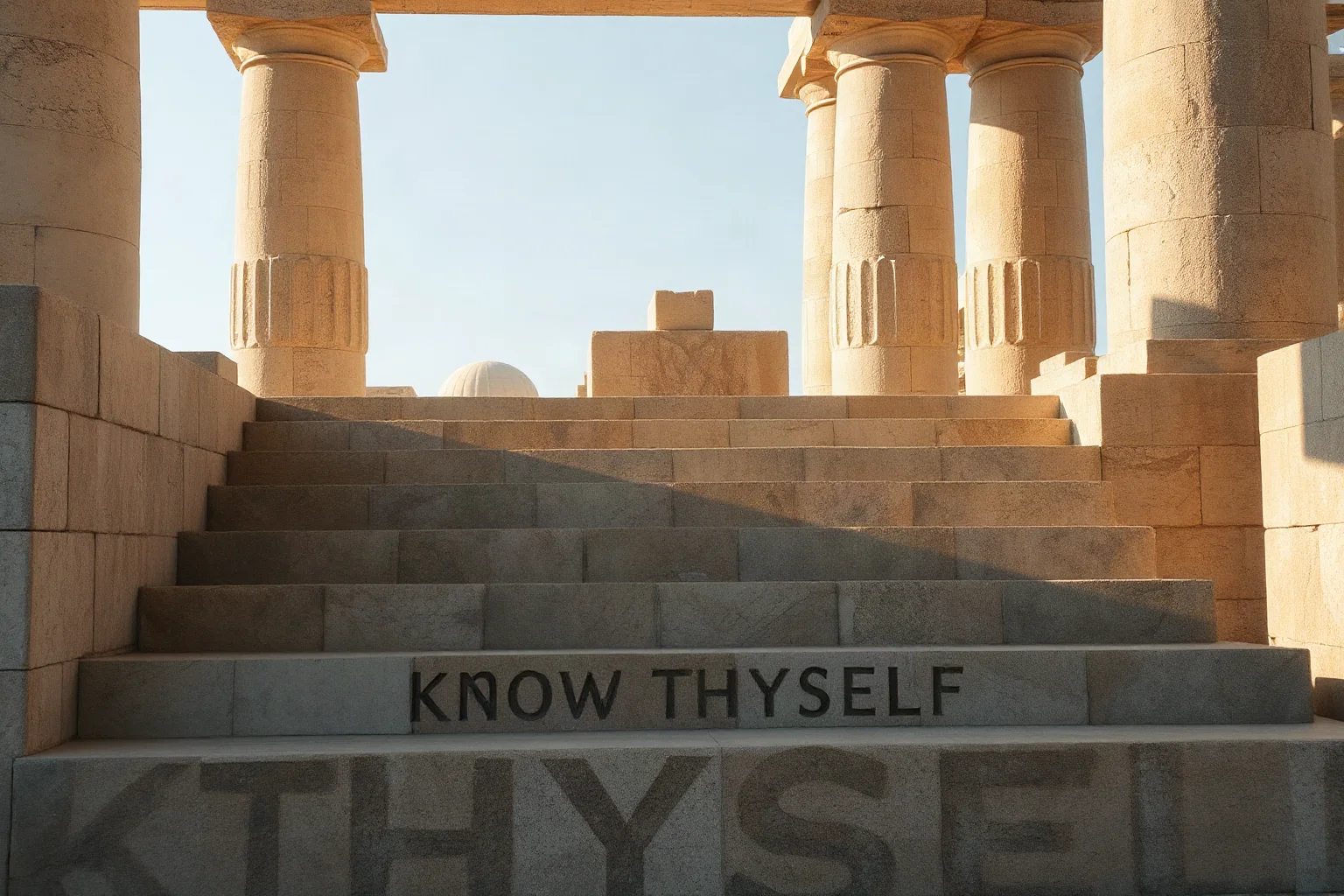
This famous maxim was inscribed at the Temple of Apollo at Delphi, and ancient sources genuinely disagree about who first said it. Diogenes Laërtius lists it among sayings attributed to Thales, but other ancient writers credit it to different members of the legendary Seven Sages, or simply to the Delphic Oracle itself.
Rather than a clean single-author quote, “know thyself” is better understood as a shared piece of ancient Greek wisdom that multiple sources claimed for multiple thinkers.
What Makes a Statement “Philosophical”?
After reading through 20 quotes, it’s fair to ask what actually separates a philosophical statement from just a nice one-liner. Generally, a philosophical statement makes a claim about reality, knowledge, ethics, or existence, and it’s meant to be examined, argued with, or tested against logic.
A good quote can be inspiring without being philosophical, and a genuinely philosophical statement doesn’t have to be short or quotable at all. What lands these ancient lines on posters and coffee mugs is that they manage to be both at once: compact enough to remember, deep enough to argue about for centuries.
How to Use These Philosophical Phrases Today
These quotes work well anywhere you want to add weight or perspective, from a graduation speech to a personal journal entry. You might open a presentation with Marcus Aurelius on focus, or close an essay on ethics with Epicurus on contentment.
If you’re using the word “philosophical” in a sentence yourself, it usually describes a calm, reflective way of facing something, as in: “She took a philosophical view of the setback and focused on what she could still control.” Likewise, you might say, “The philosopher used everyday observations, like a river’s current, to explain profound truths about change.”
Whether you’re building a quote-of-the-day calendar, writing a toast, or just looking for a thinker’s line to sit with for a while, sourcing quotes carefully matters. A quote that’s accurately attributed carries more weight than one that just sounds ancient.
Final Thoughts: Wisdom That Outlasted Empires
What’s striking about this list isn’t just what these philosophers said, but how their words survived at all. Wars, fires, empires, and centuries of copying by hand could easily have erased every one of these lines, yet they made it to us anyway, sometimes intact and sometimes reshaped along the way.
That journey is part of the story. Knowing which quotes are word-for-word ancient, which are educated paraphrases, and which are disputed attributions doesn’t make these thinkers less impressive. If anything, it makes their ideas feel more real, less like decoration on a poster and more like the actual, messy, hard-won record of people trying to figure out how to live well, thousands of years before we were born.
Frequently Asked Questions
What are the best quotes about philosophy?
There's no single definitive list, but widely cited favorites include Socrates' "the unexamined life is not worth living," Marcus Aurelius on controlling your reactions rather than events, and Epicurus on finding abundance in what you enjoy rather than what you own. The best philosophy quotes tend to share two traits: they're short enough to remember and they hold up to genuine scrutiny rather than just sounding wise.
Who actually said ‘I think, therefore I am’?
That line, originally 'Cogito, ergo sum,' belongs to René Descartes, a French philosopher writing in the 1600s, not to any ancient Greek or Roman thinker. It's a common mix-up since the phrase sounds classical, but it postdates figures like Socrates and Aristotle by roughly 2,000 years.
What is the most famous quote from ancient Greek philosophy?
Socrates' line about the unexamined life not being worth living, preserved in Plato's Apology, is probably the single most quoted piece of ancient Greek philosophy. The related idea that true wisdom lies in knowing you don't know everything runs a close second, even though its modern wording is a simplified paraphrase of Socrates' original argument.
Are all famous ancient philosopher quotes historically accurate?
Not entirely, and that's worth knowing. Many quotes attributed to figures like Aristotle or Pythagoras are actually later paraphrases, translations, or outright misattributions, since several ancient philosophers left no surviving writings of their own and are known only through later biographers like Diogenes Laërtius.
What is a philosophical statement?
A philosophical statement is a claim about reality, knowledge, ethics, or existence that's meant to be examined and argued rather than simply accepted. It doesn't need to be quotable or brief; what matters is that it makes a testable or debatable assertion about how the world or human life works.
Which ancient philosopher is generally considered the wisest?
There's no official ranking, but Socrates, Plato, and Aristotle are usually named together as the most influential ancient Greek philosophers, largely because their ideas shaped nearly every branch of Western philosophy that followed. Wisdom in the ancient world was also closely associated with figures like the Seven Sages, whose maxims, including 'know thyself,' were treated as shared cultural wisdom rather than one person's invention.

Alex Warren
Related Articles