
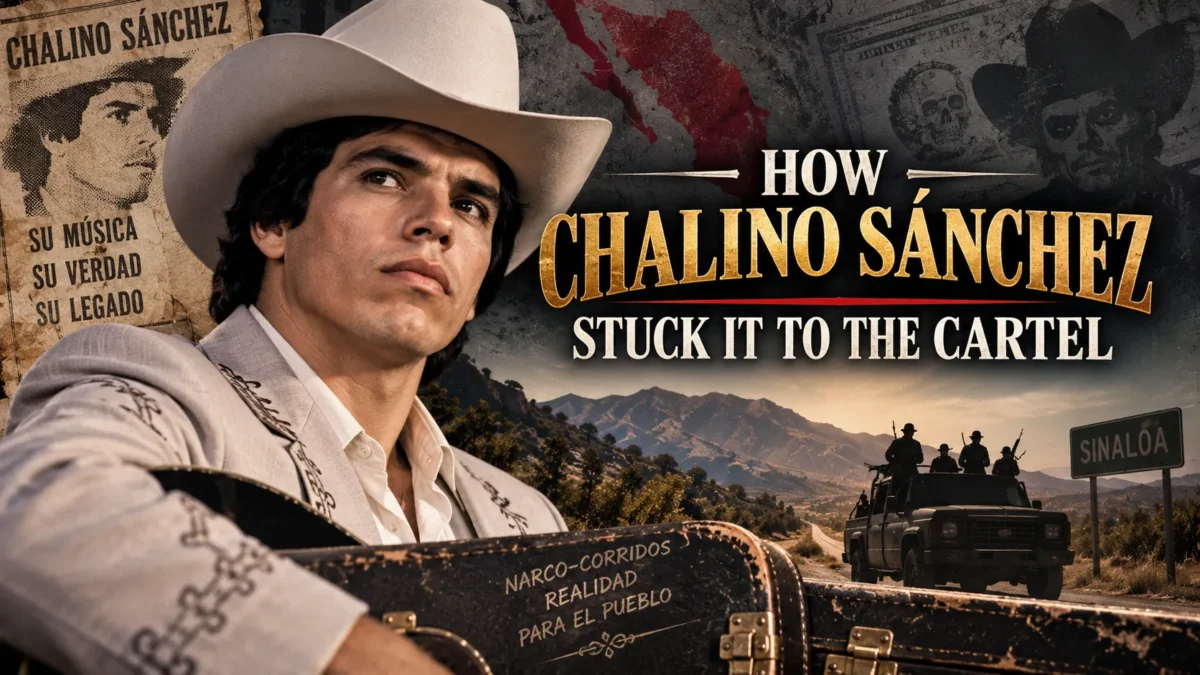
Chalino Sánchez lived the kind of story that sounds too dramatic for real life. A poor kid from rural Sinaloa becomes the godfather of the narcocorrido, gets shot at on stage, keeps singing, and is murdered weeks later under circumstances nobody has ever fully explained.
More than three decades later, people are still typing his name into search bars, trying to untangle fact from legend — the same impulse that keeps drawing people to history’s most recognized historical figures and the stories that grow around them.
This piece walks through what actually happened to Chalino Sánchez, what the autopsy and police records suggest, and which parts of his story are documented history versus corrido-fueled myth. We’re not going to pretend the unsolved parts are solved. But we are going to separate the verified timeline from the legend that’s grown up around it.
TL;DR: Chalino Sánchez, the singer who turned real-life narco stories into corridos, was abducted after a 1992 concert in Culiacán and found shot to death the next morning — a murder that remains officially unsolved to this day.
Who Was Chalino Sánchez?
Rosalino “Chalino” Sánchez Félix was born on August 30, 1960, in the small community of Las Flechas, Sinaloa. He grew up poor, in a region already deeply tied to Mexico’s drug trade, and by his teens he had already lived through more hardship than most people see in a lifetime.
He’s remembered today as the father of the modern narcocorrido — the genre of ballads that tell stories of drug traffickers, betrayal, and revenge with the same matter-of-fact tone other genres reserve for love songs. Chalino didn’t invent the corrido; that tradition goes back over a century in Mexican music. What he did was turn it into something rawer, more personal, and far closer to the streets.
From Sinaloa to South Central: Chalino’s Rise
According to the biography that’s been repeated in countless documentaries and articles, Chalino fled to the United States as a teenager after a violent incident involving his family. The most common version of the story says he shot and killed a man who had assaulted his sister, then crossed into California to avoid the fallout.
It’s worth being upfront that this account comes largely from oral tradition and later interviews rather than court records, so it should be treated as the widely told origin story rather than a courtroom-verified fact — a gap between popular legend and documented history that shows up in the real story of Pocahontas just as much as it does here.
What’s better documented is his life in Los Angeles through the 1980s. Chalino worked odd jobs, moved through immigrant communities in places like Inglewood and Long Beach, and eventually found a niche writing what are called “corridos por encargo” — corridos written to order. People, including real traffickers, would pay him to write a ballad memorializing their exploits, their families, or their fallen friends.
His voice wasn’t polished. Critics at the time might have called it rough, even amateurish. But that rawness is exactly what made his cassette recordings spread like wildfire through swap meets and car trunks in Southern California’s Mexican immigrant neighborhoods.
The Corrido Underground and Why It Mattered

By the early 1990s, Chalino wasn’t just a regional curiosity — he was the center of an entire underground music economy. Independent labels, bootleg tapes, and word-of-mouth concerts turned him into one of the most influential Mexican regional artists of his generation, even though mainstream radio barely touched him.
His songs mattered because they gave a voice, however controversial, to communities living alongside the drug trade rather than reading about it from a distance. That’s also part of why his music made him a target for scrutiny — and, as the legend goes, for danger. Writing about real people and real feuds in a region as volatile as Sinaloa was never going to be risk-free.
The Palm Sunday Shooting That Made Him a Legend
The incident that cemented Chalino’s larger-than-life reputation happened about a month before his death, at a concert in Coachella, California, in the spring of 1992. During the show, gunfire broke out in the crowd. Chalino was grazed, and tragically, another person at the event was killed in the chaos.
What happened next is the part people love to retell: Chalino, according to numerous accounts and footage from the night, calmly had his wound tended to and finished the performance. Some versions of the story claim he pulled his own weapon and returned fire during the confrontation — which is the detail behind the popular idea that he “stuck it to” whoever came after him rather than running scared, the kind of embellishment that turns real people into legends, not unlike the battlefield myths that grew up around Joan of Arc.
It’s important to note that the full details of who started the Coachella shooting, and why, were never conclusively settled in public reporting. What is well documented is that Chalino survived, and that the incident only added to his mystique as a performer who lived the same dangerous world he sang about.
The Final Night: Culiacán, May 15, 1992
Less than a month after Coachella, Chalino was back in his home state for a concert at a hall in Culiacán, Sinaloa, often identified as Salón Bugambilias. It was a homecoming show, packed with fans in the city where his music and his legend both began.
Accounts from people who were there, later repeated by journalists and biographers, describe someone handing Chalino a folded note while he was performing. He reportedly read it, tucked it away, and kept singing as if nothing had happened.
Because this detail comes from secondhand retellings rather than a verified physical record, it should be treated as part of the story’s oral history rather than an established fact — but it’s one of the most consistently repeated details from that night.
After the show, Chalino left with family members, reportedly including a brother-in-law and cousins. Not long after, their vehicle was stopped by armed men. Multiple accounts say the men displayed badges and identified themselves as state judicial police, which is part of why suspicion of official corruption has clung to this case for over thirty years.
How Did Chalino Sánchez Die?

This is the question that brings most people to his story, and the timeline is grim but fairly consistent across sources. Chalino was separated from his relatives that night and driven away by the armed men who stopped their car.
His body was found the next morning, May 16, 1992, on the outskirts of Culiacán near an irrigation canal along a rural road. He had been blindfolded and had his hands bound, and he had suffered gunshot wounds to the head — the hallmarks of what investigators and journalists have described as an execution-style killing rather than a robbery gone wrong.
He was 31 years old. The date of his death, May 16, 1992, came barely weeks after the Coachella shooting that fans still talk about today, which is part of why his story feels almost mythically compressed — two brushes with gunfire in the space of a month, and only one of them survivable.
The Chalino Sánchez Autopsy: What It Revealed
The post-mortem findings that circulated after his death confirmed what the crime scene already suggested: Chalino died from gunshot wounds to the head, consistent with a targeted, close-range killing rather than a chaotic struggle. Reports at the time did not describe extensive additional injuries suggesting a prolonged physical altercation before the shooting.
One detail that has fueled speculation for decades involves his jewelry. Several accounts note that Chalino’s gold chain and other valuables were left on his body, untouched. If true, that detail argues against a simple robbery motive and supports the theory that whoever killed him wanted him dead specifically, not his money or belongings.
It’s worth flagging that, as with much of this case, not every specific claim about the autopsy has been independently verified through a public, accessible official report.
The broader conclusion — that he died from gunshot wounds in what looked like a deliberate execution — is the part that’s held up consistently across journalistic accounts over the years.
Who Killed Chalino Sánchez?
Here’s the honest answer: nobody knows for certain, and no one has ever been charged. The case remains officially unsolved, which is exactly why it still generates fresh debate on true-crime podcasts, documentary specials, and yes, Reddit threads dissecting every detail of that night.
What investigators and journalists have pointed to over the years is the involvement of men posing as, or possibly actually being, state judicial police officers. That detail alone has made corruption within Sinaloa’s law enforcement one of the most persistent threads in every serious retelling of the case.
Beyond that, theories tend to split into a few camps: a personal or family vendetta connected to his earlier life in Sinaloa, a grudge tied to the content of one of his corridos, or a broader entanglement with the power struggles rippling through Sinaloa’s drug trafficking world in the early 1990s. None of these has ever been proven in court.
Why Was Chalino Sánchez Killed?
Since no one was ever convicted, any answer to “why” is necessarily a theory rather than a verdict. That hasn’t stopped decades of speculation, and it’s worth walking through the leading ideas honestly, including their weaknesses.
The most repeated theory ties his death to old blood. If the story about him killing a man in his youth is accurate, some researchers and family members have suggested his murder was long-delayed revenge from that victim’s associates or relatives. It’s a tidy narrative, but it rests on an origin story that itself isn’t fully documented.
Another theory points to the corrido business itself. Because Chalino wrote songs about real people involved in real feuds, it’s plausible that a lyric perceived as disrespectful, or as taking one side of a rivalry, could have angered someone dangerous. This is where the persistent question “what song did Chalino Sánchez get killed for” comes from — but it’s important to say clearly that no specific song has ever been definitively tied to his murder by investigators.
A third, broader theory situates his death within the chaos of Sinaloa’s trafficking world after the 1989 arrest of Miguel Ángel Félix Gallardo, once the region’s dominant boss. With his network fragmenting into rival factions, the early 1990s were an unusually violent, unstable period in the state — the kind of environment where a well-known public figure with underworld connections could become collateral damage in disputes that had nothing to do with his music at all.
Did a Specific Cartel Kill Chalino Sánchez?
This is one of the murkiest parts of the story, and it’s where a lot of retellings quietly slide from documented fact into assumption. No cartel has ever publicly claimed responsibility for Chalino’s death, and no organization has ever been officially named as responsible by Mexican authorities.
Given the timing and location, some accounts loosely connect his murder to the broader Sinaloa trafficking landscape that would eventually give rise to organizations like the Sinaloa Cartel. But connecting his death to a specific, named cartel structure goes beyond what the public record actually supports.
The more consistent and better-supported thread is the alleged involvement of corrupt state police, whether acting on someone’s orders or on their own initiative. That’s a meaningfully different claim than “the cartel did it,” even though the two get blended together constantly in retellings, headlines, and casual conversation.
Separating Chalino From His Son’s Story
One source of genuine confusion online involves Chalino’s son, Adán “Chalino” Sánchez, who followed his father into music and became a star in his own right. Adán died in a car accident in Mexico in 2004, at just 19 years old — a tragedy, but an entirely different event from his father’s 1992 murder.
The two are sometimes mixed up in casual searches, partly because they share the Chalino name. It’s worth being clear that Adán’s death was a road accident, not a killing connected to the cartel world his father’s music often depicted.
Chalino’s Legacy: The King of Corridos Lives On
Whatever the unresolved questions about his death, Chalino Sánchez’s influence on Mexican regional music is not up for debate. He’s widely credited as the artist who set the template for the modern narcocorrido, paving the way for later stars like Los Tucanes de Tijuana and, eventually, the entire movimiento alterado and corridos tumbados scenes decades later.
Songs like “Alma Enamorada” and “Nieves de Enero” became posthumous hits, with “Nieves de Enero” in particular topping charts after his death in a way that only deepened the sense that his music had outlived him in almost eerie fashion. Younger artists still cite him as the reason the genre sounds the way it does.
His death also became a kind of cautionary folk story about the dangers of documenting Mexico’s drug world in song — a risk that later artists in the genre have continued to navigate, sometimes with tragic results of their own.
The Bottom Line on Chalino Sánchez’s Death
Chalino Sánchez was murdered on the night of May 15 into May 16, 1992, after a concert in his home state of Sinaloa, and his body was found the next morning showing gunshot wounds consistent with an execution. He was abducted by armed men who, according to witnesses, presented themselves as police, and no one has ever been charged for his killing.
Beyond that hard timeline, almost everything else — the exact motive, the identity of the killers, and any organizational responsibility — remains speculation dressed up as folklore. That’s not a satisfying answer for a story this dramatic, but it’s the honest one.
What’s not in dispute is the mark he left on Mexican music. Chalino turned his own precarious, dangerous life into a soundtrack for millions of listeners, and more than thirty years after his death, people are still trying to finish the story he never got to tell himself.
Frequently Asked Questions
How did Chalino Sánchez die?
Chalino Sánchez was abducted by armed men after a concert in Culiacán, Sinaloa, on the night of May 15, 1992. His body was found the next morning near an irrigation canal on the outskirts of the city, blindfolded with his hands bound, having suffered gunshot wounds to the head consistent with an execution-style killing.
When did Chalino Sánchez die?
He died on May 16, 1992, when his body was discovered, after being taken from his vehicle late on the night of May 15 following a performance in Culiacán, Sinaloa. He was 31 years old.
Who killed Chalino Sánchez?
No one has ever been officially identified, charged, or convicted for his murder, and the case remains unsolved. Witness accounts say the men who abducted him displayed badges and claimed to be state judicial police, which has fueled long-standing suspicion of law enforcement corruption in the case.
Why was Chalino Sánchez killed?
There is no confirmed motive. Leading theories include a long-delayed revenge tied to an incident from his youth, backlash over the content of one of his corridos, or broader instability tied to Sinaloa's fragmented trafficking underworld in the early 1990s, but none of these has ever been proven.
What song did Chalino Sánchez get killed for?
There is no verified evidence that a specific song caused his death. That idea is a popular piece of folklore surrounding the case, but no investigation has ever officially tied his murder to one particular corrido.
Where was Chalino Sánchez killed?
He was abducted after a concert in Culiacán, the capital of Sinaloa, Mexico, and his body was found the following morning on a rural road near an irrigation canal on the city's outskirts.
What did the Chalino Sánchez autopsy show?
Findings reported after his death indicated he had died from gunshot wounds to the head, consistent with a deliberate, close-range killing rather than a chaotic struggle. Reports at the time also noted his jewelry, including a gold chain, was left untouched, which many took as evidence the killing was not a robbery.
Which cartel killed Chalino Sánchez?
No cartel has ever publicly claimed responsibility, and Mexican authorities have never officially named a specific organization as responsible. The most consistently cited factor in journalistic accounts is the alleged involvement of corrupt state police officers rather than a named cartel.
Is the story about Chalino Sánchez getting shot on stage true?
A shooting did occur during a concert in Coachella, California, in the weeks before his death, where Chalino was grazed by gunfire and another person was killed. Accounts of exactly what happened during the incident, including claims he returned fire, come largely from witness retellings rather than a fully documented police record.
How did Adán Chalino Sánchez die, and is it related to his father’s death?
Adán 'Chalino' Sánchez, Chalino's son and also a singer, died in a car accident in Mexico in 2004 at age 19. It was unrelated to his father's 1992 murder and was a traffic accident, not a killing.

Alex Warren
Related Articles