
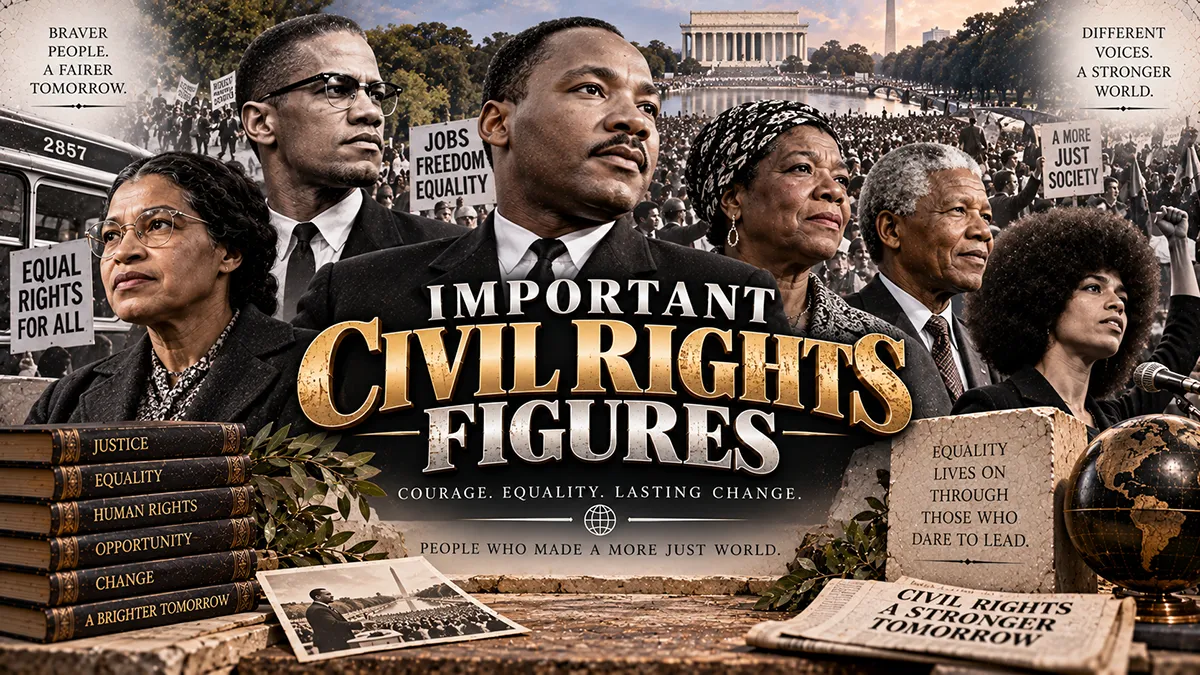
When people picture the civil rights movement, a handful of names usually come to mind first. But the fight for racial justice in America was carried forward by hundreds of organizers, lawyers, students, preachers, and everyday citizens whose names rarely make it into textbooks. Sorting through who did what — and separating verified history from popular myth — is the best way to actually understand how change happened.
This guide walks through the civil rights leaders and activists most historians agree were pivotal, roughly in the order their influence emerged, from the legal groundwork of the 1930s through the legislative victories of the mid-1960s and beyond. It also makes room for the lesser-known organizers whose work made the famous moments possible.
TL;DR: The civil rights movement succeeded because of a wide network of leaders — from Martin Luther King Jr. and Rosa Parks to lesser-known local organizers — who combined legal strategy, mass protest, and grassroots courage over decades, not just a single moment or a single person.
A Quick Note: Civil War vs. Civil Rights
Before diving in, it’s worth clearing up a common mix-up. Searches for “important people during the Civil War” or “influential people in the Civil War” sometimes overlap with searches for civil rights figures, but these are two very different eras of American history.
The Civil War (1861–1865) involved leaders like Abraham Lincoln, Ulysses S. Grant, and Frederick Douglass fighting over slavery and the union itself.
The civil rights movement, by contrast, refers primarily to the mid-20th century struggle — roughly the 1950s and 1960s — to end legal segregation and secure equal rights for Black Americans nearly a century after the Civil War ended.
This article focuses on that later era, though a few figures, like W.E.B. Du Bois, bridge the gap between Reconstruction-era activism and the modern movement.
What Made Someone a Civil Rights Leader?
There was no single job description for a civil rights leader. Some were ministers who built coalitions from the pulpit, while others were lawyers who spent years building court cases, and still others were teenagers who simply refused to move.
What united them was a willingness to challenge Jim Crow laws and entrenched discrimination, often at serious personal risk. Many activists in the civil rights movement worked locally and anonymously, organizing carpools, teaching literacy classes, or hosting strategy meetings in their own living rooms. The famous marches and speeches were the visible tip of a much larger, quieter organizing effort.
The Big Six and Beyond: 25 Key Figures
Historians often refer to “the Big Six” as the leaders of the six major civil rights organizations who coordinated the 1963 March on Washington: Martin Luther King Jr., John Lewis, A. Philip Randolph, Whitney Young, James Farmer, and Roy Wilkins. They’re a useful starting point, but the full list of important people in the civil rights movement is much longer.
1. Martin Luther King Jr.
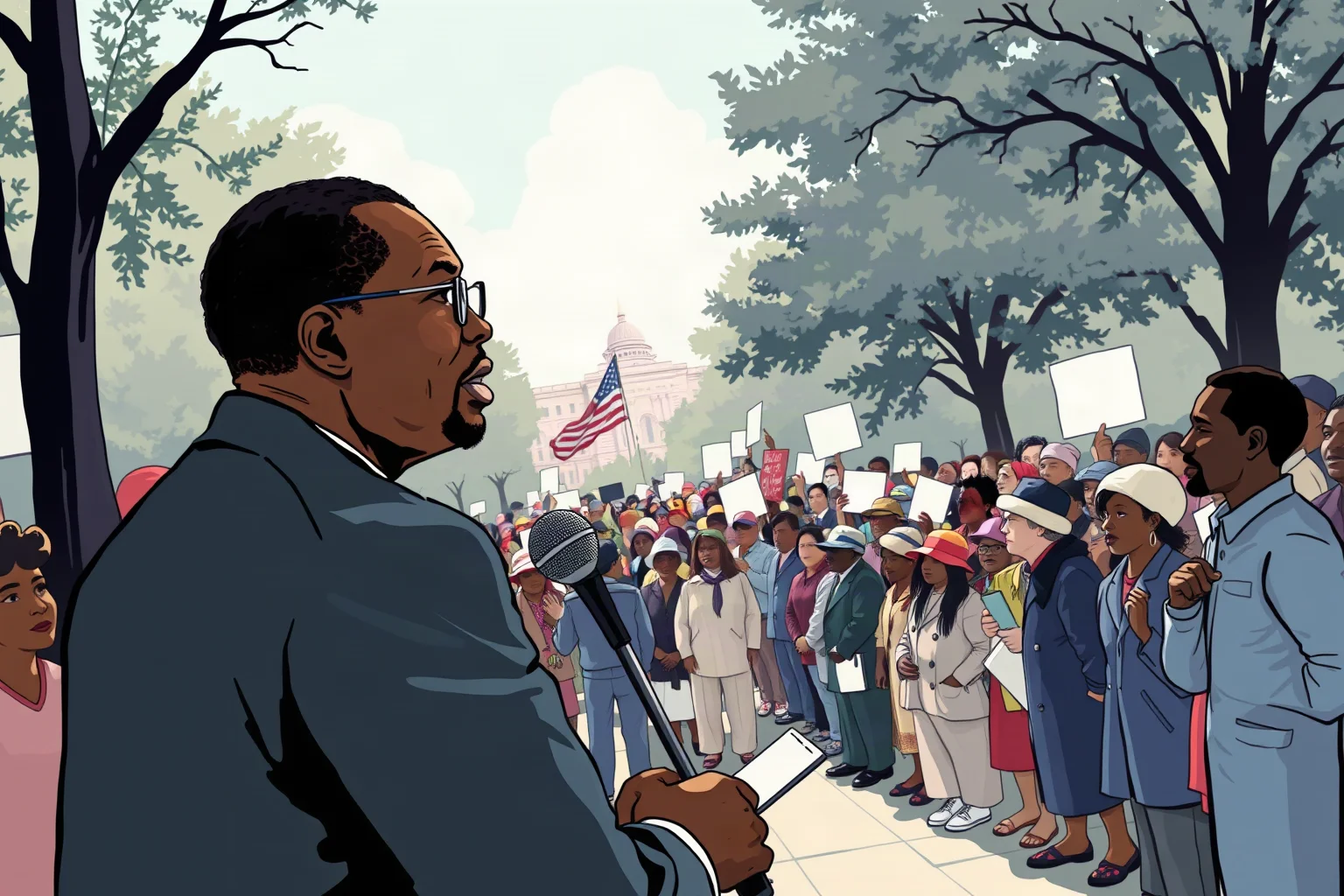
As president of the Southern Christian Leadership Conference, King became the most visible leader of the civil rights movement, known for his commitment to nonviolent resistance. He led the Montgomery Bus Boycott, helped organize the 1963 March on Washington, and delivered his “I Have a Dream” speech that same year. King was assassinated in Memphis in April 1968, but his emphasis on nonviolent civil disobedience remains the movement’s defining strategy in the public imagination.
2. Rosa Parks
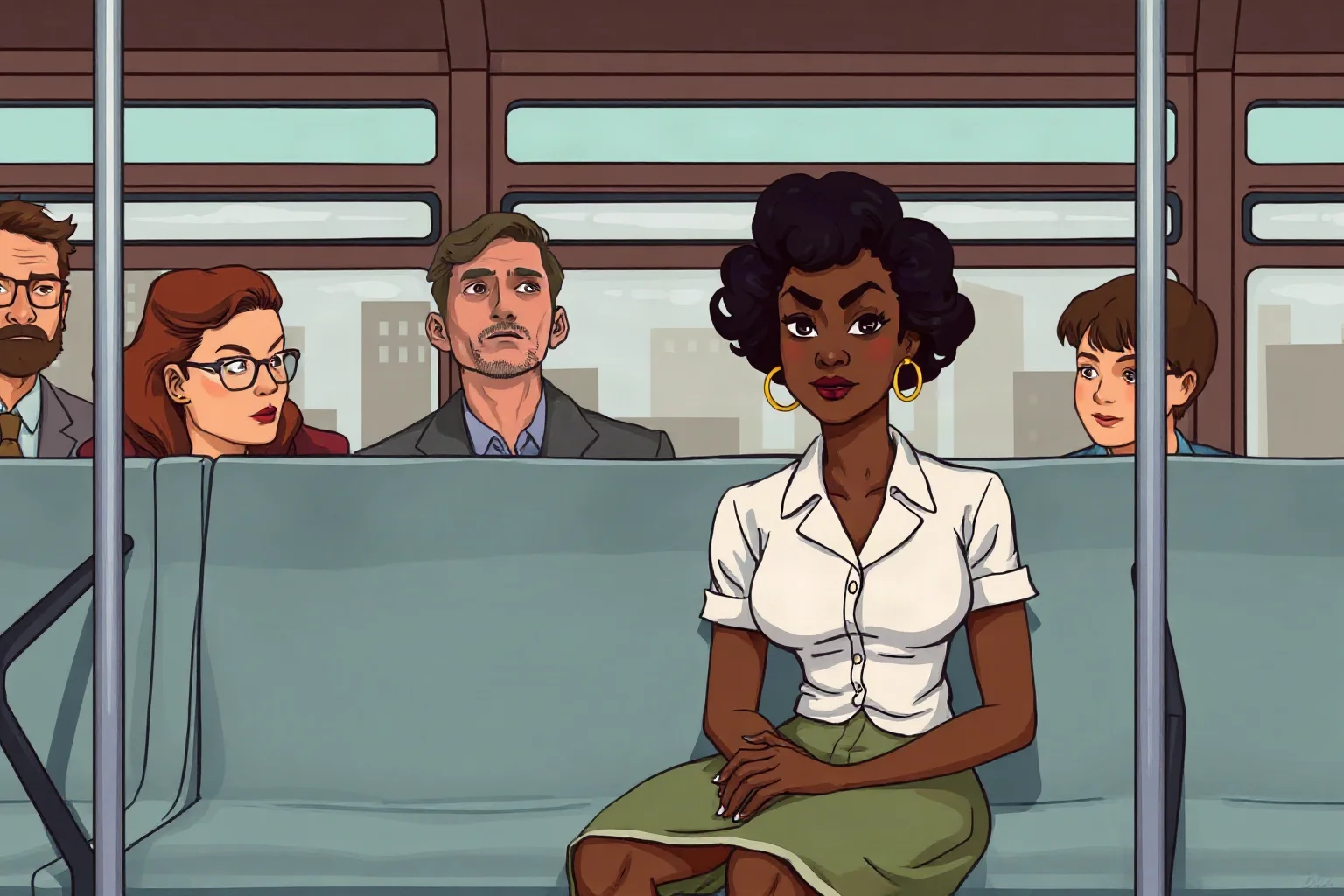
On December 1, 1955, Rosa Parks refused to give up her bus seat in Montgomery, Alabama, an act that sparked the Montgomery Bus Boycott. Parks was already an active NAACP member and secretary of the Montgomery chapter, not simply a tired seamstress acting on impulse, as the popular myth sometimes suggests. Her arrest became a catalyst, but it was part of a broader, deliberate strategy the local NAACP had been preparing for.
3. John Lewis
A founding member and chairman of the Student Nonviolent Coordinating Committee (SNCC), Lewis helped organize the Freedom Rides and spoke at the March on Washington while still in his early twenties. He was severely beaten leading marchers across the Edmund Pettus Bridge in Selma on “Bloody Sunday,” March 7, 1965. Lewis later served nearly 34 years in the U.S. House of Representatives, continuing his civil rights work through legislation.
4. Malcolm X
As a minister for the Nation of Islam and later founder of the Organization of Afro-American Unity, Malcolm X argued for Black self-determination and, at times, self-defense rather than strict nonviolence. His views evolved significantly after his 1964 pilgrimage to Mecca and split from the Nation of Islam. He was assassinated in February 1965, and his ideas continued to influence the Black Power movement that followed.
5. Thurgood Marshall
Before becoming the first Black U.S. Supreme Court Justice in 1967, Marshall served as chief counsel for the NAACP and successfully argued Brown v. Board of Education in 1954, the case that declared school segregation unconstitutional. He argued more cases before the Supreme Court than any other American lawyer in history at the time. Marshall’s legal strategy laid the groundwork many other civil rights victories were built on.
6. A. Philip Randolph
Randolph led the Brotherhood of Sleeping Car Porters and used the threat of a 1941 march on Washington to pressure President Roosevelt into banning discrimination in defense industries. Two decades later, he was a chief organizer of the 1963 March on Washington. Randolph is often called the elder statesman of the movement for his decades of labor and civil rights organizing.
7. Whitney Young
As executive director of the National Urban League, Young focused on economic opportunity, job training, and corporate hiring practices for Black Americans. He served as a bridge between the movement and business and government leaders, pushing institutions to open doors rather than relying solely on protest. His work is a reminder that the movement’s important people included policy negotiators as well as marchers.
8. James Farmer
Farmer co-founded the Congress of Racial Equality (CORE) in 1942 and helped organize the 1961 Freedom Rides, which tested desegregation rulings on interstate buses across the South. Riders faced mob violence in several cities, drawing national attention to Southern resistance to federal law. Farmer’s commitment to direct, nonviolent confrontation made CORE one of the movement’s most active organizations.
9. Roy Wilkins
As longtime executive secretary of the NAACP, Wilkins favored a strategy built on litigation, lobbying, and steady institutional pressure rather than mass protest alone. He worked closely with presidents and Congress to help push through the Civil Rights Act of 1964 and the Voting Rights Act of 1965. Wilkins represents the less flashy but essential legislative side of the fight for equality.
10. Ella Baker
Baker worked with the NAACP and SCLC before helping found the Student Nonviolent Coordinating Committee in 1960, mentoring the young activists who would go on to lead sit-ins and Freedom Rides. She believed strongly in grassroots, decentralized leadership rather than relying on one charismatic figurehead. Many historians consider her one of the most influential organizers of the entire era, even though she rarely sought the spotlight.
11. Fannie Lou Hamer
A sharecropper turned voting rights activist, Hamer co-founded the Mississippi Freedom Democratic Party and testified before the Democratic National Convention in 1964 about the violence she faced trying to register to vote. Her televised testimony exposed the brutal reality of voter suppression in the Deep South. Hamer remained a tireless organizer in Mississippi for the rest of her life.
12. Bayard Rustin
Rustin was the chief organizer behind the 1963 March on Washington, handling the logistics that brought roughly 250,000 people to the National Mall. An openly gay Black man in an era of intense homophobia, he often worked behind the scenes so his identity wouldn’t be used to discredit the movement. His organizing genius is now widely recognized as essential to the march’s success.
13. Medgar Evers
As NAACP field secretary in Mississippi, Evers investigated racial violence, organized boycotts, and worked to register Black voters in one of the most dangerous states for such activism. He was assassinated outside his home in Jackson in June 1963. Evers’s murder became a rallying point that helped build momentum for the Civil Rights Act passed the following year.
14. Diane Nash
Nash was a key strategist in the Nashville sit-in movement and helped coordinate the Freedom Rides after the original riders were attacked in Alabama in 1961. She also played a central role in the Selma voting rights campaign. Nash’s calm, disciplined leadership made her one of SNCC’s most effective organizers.
15. Septima Clark
Often called “the Queen Mother of the Civil Rights Movement,” Clark developed the Citizenship Schools that taught literacy and constitutional rights so Black Southerners could pass discriminatory voter registration tests. Her education programs quietly registered thousands of new voters across the South. Clark’s work shows how education itself was a form of activism.
16. Ralph Abernathy
Abernathy co-founded the Southern Christian Leadership Conference alongside Martin Luther King Jr. and served as his closest colleague throughout the Montgomery boycott and beyond. After King’s assassination, Abernathy took over leadership of the SCLC and led the Poor People’s Campaign in 1968. He remained committed to nonviolent protest as a strategy for economic and racial justice.
17. Stokely Carmichael
As SNCC chairman, Carmichael popularized the phrase “Black Power” during a 1966 march in Mississippi, signaling a shift toward a more assertive, self-reliant approach among younger activists. He later joined the Black Panther Party and became a prominent voice for Black nationalism. His trajectory illustrates the movement’s internal debates over strategy and tone.
18. James Meredith
In 1962, Meredith became the first Black student to enroll at the University of Mississippi, an event that triggered riots requiring federal troops to restore order. His enrollment tested the enforcement of Brown v. Board’s promise nearly a decade after the ruling. Meredith later organized the 1966 “March Against Fear,” during which he was shot and wounded but survived.
19. Daisy Bates
As president of the Arkansas NAACP, Bates mentored and protected the Little Rock Nine, the students who integrated Central High School in 1957 amid violent resistance. She coordinated their daily safety and dealt directly with the media and government officials during the crisis. Bates’s role shows how local NAACP leaders often did the hardest, most dangerous groundwork.
20. Bob Moses
Moses led SNCC’s voter registration efforts in Mississippi and was a chief architect of Freedom Summer in 1964, which brought volunteers from across the country to register Black voters. The project faced fierce, sometimes deadly resistance, including the murders of three Freedom Summer volunteers. Moses later moved into education reform, applying his organizing philosophy to math literacy programs.
21. Claudette Colvin
Nine months before Rosa Parks’s famous refusal, fifteen-year-old Claudette Colvin refused to give up her bus seat in Montgomery and was arrested. Because she was a teenager and became pregnant shortly after, NAACP leaders felt her case wasn’t the ideal public test of the segregation law, and her story was largely overlooked for decades. Colvin later served as a plaintiff in Browder v. Gayle, the federal case that ultimately struck down Montgomery’s bus segregation.
22. Charles Hamilton Houston
As dean of Howard University’s law school, Houston trained a generation of civil rights lawyers, including Thurgood Marshall, and pioneered the legal strategy of dismantling segregation case by case. He’s sometimes called “the man who killed Jim Crow” for laying the legal foundation Brown v. Board would later stand on. Houston died in 1950, before seeing his strategy’s full success, but his influence on civil rights law is hard to overstate.
23. W.E.B. Du Bois
A scholar, writer, and co-founder of the NAACP in 1909, Du Bois spent decades documenting racial injustice and advocating for full civil and political equality long before the mid-century movement began. His research and writing, including “The Souls of Black Folk,” shaped how generations of activists understood systemic racism. Du Bois represents the deep roots the civil rights movement drew on going back to the early 1900s.
24. Ruby Bridges
In 1960, six-year-old Ruby Bridges became the first Black child to integrate William Frantz Elementary School in New Orleans, walking past screaming crowds with federal marshals as escorts. Her courage as a small child became one of the era’s most enduring images of quiet resistance. Bridges later founded a foundation promoting racial tolerance through education.
25. Unsung and Local Organizers
Alongside these well-known figures were countless local activists whose names rarely appear in history books. Jo Ann Robinson led the Women’s Political Council in Montgomery and drafted the leaflets that launched the bus boycott before Rosa Parks was even arrested. Barbara Johns, a sixteen-year-old student, organized a 1951 walkout at her segregated Virginia high school that became part of the case bundled into Brown v. Board.
Amelia Boynton Robinson spent decades organizing voter registration in Selma and was beaten on the Edmund Pettus Bridge in 1965. These lesser-known civil rights activists remind us that the movement’s success depended on thousands of ordinary people, not just the handful whose names became famous.
How These Leaders Made the Movement Successful
The civil rights movement succeeded through a combination of strategies rather than a single approach. Legal challenges from lawyers like Marshall and Houston chipped away at segregation’s legal foundation, while mass protests, boycotts, and sit-ins organized by figures like King, Nash, and Farmer put direct pressure on public opinion and businesses. Voter registration drives led by Hamer, Moses, and Clark aimed to shift power through the ballot box.
This layered approach meant setbacks in one area, like a failed protest or a stalled court case, didn’t stop momentum elsewhere. It also meant the movement could survive the loss of major leaders, including the assassinations of Evers, Malcolm X, and King, because leadership was distributed across so many organizations and communities. That resilience is a big part of why the movement achieved landmark victories like the Civil Rights Act of 1964 and the Voting Rights Act of 1965.
Why These Stories Still Matter
Learning about civil rights icons isn’t just an exercise in memorizing names and dates. These figures show how legal strategy, grassroots organizing, and personal courage can combine to change a country’s laws and culture within a single generation.
The movement also wasn’t a neat, unified story with one leader and one method; it included real disagreements over tactics, from nonviolence to Black Power, and real people who took enormous personal risks. Understanding that complexity honors their legacy more accurately than flattening them into a single simplified narrative ever could.
Final Thoughts
From courtroom strategists to teenage protesters to organizers working quietly in church basements, the people of the civil rights movement came from every walk of life. Their combined efforts, not any single dramatic moment, are what actually dismantled legal segregation in the United States.
The next time you hear a famous name like Martin Luther King Jr. or Rosa Parks, it’s worth remembering the wider network of civil rights heroes working alongside them. Their courage, strategy, and persistence remain one of the most important chapters in American history.
Frequently Asked Questions
Who were the activists in the civil rights movement?
The activists in the civil rights movement included nationally known figures like Martin Luther King Jr., Rosa Parks, John Lewis, and Malcolm X, as well as thousands of local organizers such as Ella Baker, Diane Nash, Fannie Lou Hamer, and Jo Ann Robinson. Together they used strategies ranging from legal challenges and voter registration drives to boycotts, sit-ins, and mass marches.
Who is considered the main leader of the civil rights movement?
Martin Luther King Jr. is most commonly identified as the movement's central leader because of his role with the Southern Christian Leadership Conference and his prominence at events like the March on Washington. That said, the movement had many co-equal leaders across different organizations, including the NAACP, SNCC, and CORE, rather than a single command structure.
Who were the ‘Big Six’ leaders of the civil rights movement?
The Big Six were Martin Luther King Jr. (SCLC), John Lewis (SNCC), A. Philip Randolph (Negro American Labor Council), Whitney Young (National Urban League), James Farmer (CORE), and Roy Wilkins (NAACP). They coordinated efforts among their organizations, most notably in planning the 1963 March on Washington.
How did the civil rights movement achieve success?
The movement succeeded through a combination of legal action, such as Brown v. Board of Education, grassroots organizing and voter registration, and highly visible nonviolent protest like boycotts, sit-ins, and marches. This multi-pronged approach kept pressure on lawmakers and public opinion, ultimately leading to the Civil Rights Act of 1964 and the Voting Rights Act of 1965.
What does ‘I Am a Man’ refer to in civil rights history?
"I Am a Man" was the slogan carried by striking Black sanitation workers in Memphis, Tennessee, in 1968, protesting unsafe working conditions and unequal treatment. Martin Luther King Jr. traveled to Memphis to support the strike and was assassinated there, making the slogan a lasting symbol of the fight for dignity and economic justice within the broader movement.
Are there important civil rights activists most people don’t know about?
Yes, many crucial organizers remain far less famous than leaders like King or Parks. Figures such as Claudette Colvin, Barbara Johns, Jo Ann Robinson, and Amelia Boynton Robinson did essential organizing and protest work but are often left out of popular retellings of the movement.

Alex Warren
Related Articles