

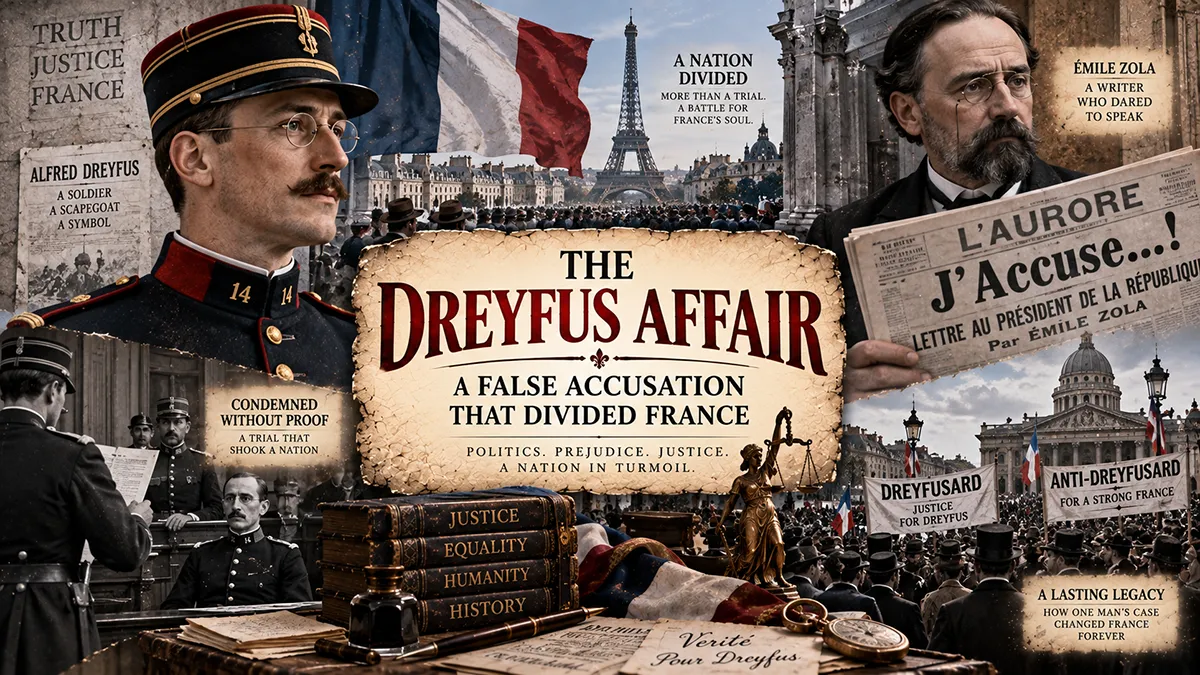
In the closing years of the 19th century, a single forged document and a wrongly convicted army officer managed to do what no foreign enemy had done in decades: split French society down the middle. Families stopped speaking to each other over dinner tables.
Newspapers traded accusations of treason and conspiracy. The event became known simply as l’affaire Dreyfus, and more than a century later, historians still use it as a case study in how prejudice, institutional pride, and a free press can collide.
This is the story of Captain Alfred Dreyfus, the real spy who got away with it for years, the novelist who risked everything to speak out, and the scandal that reshaped modern France—a nation whose history already included legendary figures like Joan of Arc.
TL;DR: The Dreyfus Affair was a real espionage scandal in which a French Jewish army officer was falsely convicted of treason in 1894, sparking a decade-long national crisis over antisemitism, military cover-ups, and press power before he was fully exonerated in 1906.
What Was the Dreyfus Affair? A Quick Overview
So what was the Dreyfus Affair, in plain terms? It began in 1894 when French military intelligence discovered that someone was leaking secrets to the German embassy in Paris.
Suspicion fell on Captain Alfred Dreyfus, a French artillery officer of Jewish-Alsatian background, largely because his handwriting was said to resemble a note found in a wastepaper basket.
Dreyfus was court-martialed, convicted of treason, and shipped off to a brutal island prison off the coast of French Guiana. The catch is that he was innocent, and the real culprit, a French army major named Ferdinand Walsin Esterhazy, kept spying for years while officers who knew the truth chose silence over scandal.
What followed was roughly twelve years of trials, forged evidence, a famous newspaper editorial by novelist Émile Zola, and a national argument that touched nearly every institution in France, from the army to the Catholic Church to the press.
The Arrest: A Junior Officer Under Suspicion (1894)
The Dreyfus case in France started with a torn-up note, known as the “bordereau,” recovered from a wastebasket at the German embassy by a cleaning woman working for French intelligence.
The note listed French military documents being offered to the Germans. Investigators wanted a suspect quickly, and Alfred Dreyfus, one of the few Jewish officers on the army’s General Staff, fit their preexisting biases.
Handwriting experts were consulted, and their opinions were mixed at best. Despite this, and despite Dreyfus having no clear motive, financial trouble, or contact with German officials, he was arrested in October 1894 on charges of treason. The evidence was thin, but the assumptions surrounding a Jewish officer’s loyalty in that era were not.
The First Trial and Conviction
The Dreyfus trial took place behind closed doors in December 1894, a decision the army justified on national security grounds. What the public did not know was that the military judges were shown a secret dossier of documents that Dreyfus and his lawyers never saw, a serious violation of legal procedure even by the standards of the time.
Dreyfus was found guilty and sentenced to life imprisonment and public military degradation. At a humiliating ceremony in the courtyard of the École Militaire, his epaulettes and buttons were torn off and his sword broken in front of a jeering crowd. Witnesses recalled him shouting that he was innocent and that he still loved France, but the damage to his name was already done.
Devil’s Island: Life in Exile
Dreyfus was sent to Devil’s Island, a small, isolated rock off French Guiana used for the harshest political prisoners. He spent nearly five years there in near-total isolation, guarded around the clock and cut off from most news of the outside world. His health deteriorated steadily under the tropical conditions and psychological strain.
While Dreyfus languished in exile, his wife Lucie and brother Mathieu worked tirelessly in Paris to reopen the case. They petitioned officials, hired investigators, and slowly built alliances with journalists and politicians willing to question the official story. It was a slow, difficult campaign that would eventually gain unexpected help from within the military itself.
Enter Ferdinand Walsin Esterhazy: The Real Traitor
The real break in the case came from Lieutenant Colonel Georges Picquart, the army’s new head of counter-intelligence, who noticed that a French officer named Ferdinand Walsin Esterhazy had handwriting strikingly similar to the bordereau. Esterhazy, it turned out, was deeply in debt and had a documented history of financial desperation, both of which made him a far more plausible spy than Dreyfus ever was.
Picquart quietly investigated and became convinced that Esterhazy, not Dreyfus, was the true author of the note. Rather than being praised, Picquart was sidelined and eventually transferred out of Paris, because senior officers had no appetite for admitting the army had convicted an innocent man. Esterhazy was investigated only reluctantly, and in January 1898 a military tribunal acquitted him after a trial that lasted barely a few minutes of actual deliberation.
The Cover-Up: Why the Army Refused to Admit the Truth
Once doubts about Dreyfus’s guilt surfaced, senior military officials faced a choice between admitting an embarrassing error and doubling down. They chose the latter. Colonel Hubert-Joseph Henry, an intelligence officer, forged additional documents to strengthen the case against Dreyfus, a fabrication that would only come to light later.
The army’s motives were a mix of institutional pride, fear of scandal, and, for some officers, plain antisemitism. Admitting the mistake meant admitting that the military justice system had failed publicly and that a Jewish officer had been railroaded on shaky evidence. That admission threatened the reputation of the army at a moment when French national pride was still bruised from its defeat in the Franco-Prussian War of 1870.
Émile Zola’s “J’Accuse…!” and the Power of the Press
The turning point in the Dreyfus Affair in France came on January 13, 1898, when novelist Émile Zola published an open letter titled “J’Accuse…!” on the front page of the newspaper L’Aurore. Zola and Dreyfus had never met, but Zola had grown convinced of a miscarriage of justice and used his literary fame to demand a new trial. The piece directly accused named generals and officials of knowingly covering up forged evidence.
The essay caused an immediate sensation, selling roughly 300,000 copies of the paper in a single day, an extraordinary number for the era. Zola was put on trial for libel and convicted, forcing him to flee temporarily to England to avoid imprisonment. Still, the connection between Zola and Dreyfus had permanently changed the case from a quiet military matter into a national political crisis that ordinary citizens argued about in cafés and on street corners.
Dreyfusards vs. Anti-Dreyfusards: A Nation at War With Itself
By 1898, France had effectively split into two camps. Dreyfusards, meaning those who believed Dreyfus was innocent and demanded a retrial, included figures like Zola, Georges Clemenceau, and future prime minister figures who saw the case as a test of republican justice and civil liberties. A dreyfusard wasn’t just someone with an opinion on one man’s guilt; the label came to represent a broader stance on secularism, individual rights, and skepticism toward unchecked military and church authority.
Anti-Dreyfusards, on the other hand, tended to prioritize the honor of the army and, in many cases, openly embraced antisemitic rhetoric, arguing that questioning a military tribunal’s verdict was itself an act of disloyalty to France. Nationalist leagues organized rallies, and antisemitic riots broke out in several French cities during the height of the controversy. The divide cut across class lines, touched nearly every newspaper in the country, and even affected friendships and family relationships, making the affair as much a referendum on the identity of the French Republic as it was about one officer’s guilt.
Why Is It Called an “Affair”? Clearing Up a Common Mix-Up
It’s worth pausing on the name itself, because it trips people up more often than you’d expect. In French, “l’affaire Dreyfus” simply means “the Dreyfus case” or “the Dreyfus matter,” using “affaire” the way English speakers might say “the Watergate affair.” It has nothing to do with romance or infidelity, even though English readers occasionally hear “affair” and assume otherwise, which is likely where the joking phrase about mishearing “my French ears heard your affair” comes from online.
So whether you see it written as the Dreyfus affair, dreyfus affaire, or l’affaire Dreyfus, it always refers to this same sprawling legal and political scandal, not a personal relationship. It’s a small linguistic quirk, but it’s a fun one to clear up, since the actual story is dramatic enough without any romantic subplot.
The Second Trial, the Pardon, and Continued Doubt (1899)
Public pressure and mounting evidence of forgery eventually forced France’s highest court of appeals to order a new trial. Dreyfus was brought back from Devil’s Island in 1899, a journey that alone took weeks, to face a second military court-martial in the town of Rennes. Remarkably, despite overwhelming evidence pointing to Esterhazy and clear proof that key documents had been forged, the tribunal still found Dreyfus guilty, though this time with “extenuating circumstances” and a reduced ten-year sentence.
The verdict stunned observers both in France and abroad, many of whom saw it as proof the military simply could not admit fault. Facing international criticism and exhausted by years of imprisonment, Dreyfus accepted a presidential pardon shortly afterward, which freed him but did not legally clear his name. For years, the closest most people came to certainty was that Dreyfus was free but technically still a convicted traitor on paper.
Full Exoneration: Justice at Last (1906)
The stain on Dreyfus’s record wasn’t fully erased until 1906, when France’s Court of Cassation formally overturned his conviction, ruling that the original charges had no valid basis. Dreyfus was reinstated into the army with the rank of major and awarded the Legion of Honor, France’s highest civilian and military distinction. He went on to serve during World War I, retiring as a lieutenant colonel.
Georges Picquart, the officer who had first uncovered Esterhazy’s guilt at real cost to his own career, was also promoted and later served briefly as France’s minister of war. Esterhazy, for his part, had already fled to England years earlier and eventually confessed his guilt in interviews, though he was never seriously punished. It took twelve years from arrest to full legal exoneration, a timeline that says a great deal about how hard institutions can dig in once they’ve committed to being wrong.
The Legacy of the Dreyfus Affair
The Dreyfus scandal left marks on France that outlasted the individual case by decades. It hardened the political divide between secular republicans and conservative nationalists, contributing directly to France’s 1905 law formally separating church and state. The affair also exposed how deeply antisemitic conspiracy theories could take root even in a modern democracy, a lesson that resonated well beyond France’s borders.
One of the most significant ripple effects came through journalist Theodor Herzl, who covered Dreyfus’s public degradation in 1894 and was reportedly influenced by the antisemitic mob reaction he witnessed in Paris. Herzl went on to become a founding figure of modern political Zionism, and many historians point to his experience covering the Dreyfus case as one of several formative influences on his thinking about Jewish statehood. The affair is also remembered as an early, dramatic example of investigative journalism and public opinion forcing a government to reconsider a legal injustice, a template that later reform movements would study closely.
Setting the Record Straight: A Few Persistent Myths
Because the Dreyfus Affair has been retold so many times in books, films, and classrooms, a few details often get exaggerated or oversimplified along the way. Dreyfus was not personally friends with Zola before the scandal, for instance; Zola took up the cause because he believed in the principle of justice, not out of personal loyalty. Similarly, Esterhazy was never seriously prosecuted for espionage despite later confessing, which frustrates many readers looking for a tidier ending.
It’s also worth remembering that Dreyfus himself was famously reserved and largely avoided political grandstanding even after his release, unlike many of the activists who had campaigned on his behalf. He wanted rehabilitation and to return to military service, not to become a symbol, even though history made him one regardless. Keeping these nuances in mind helps separate the real, well-documented history from the simplified version that sometimes circulates.
Why the Dreyfus Affair Still Matters Today
More than a century later, the Dreyfus Affair in France remains a touchstone for discussions about wrongful conviction, institutional accountability, and the dangers of scapegoating minorities during moments of national anxiety. It’s frequently cited in law schools, journalism programs, and political science courses as a case study in how evidence, prejudice, and public pressure interact. The phrase “j’accuse” itself has entered common usage well beyond France, invoked whenever someone publicly confronts a powerful institution over a cover-up.
The case also serves as a reminder that a free press and independent judiciary, however imperfect, can eventually correct even deeply entrenched official errors. It took Zola’s essay, Picquart’s conscience, and years of public agitation to get there, but the truth did eventually surface. That slow, hard-won correction is arguably the most important legacy the Dreyfus case left behind.
Final Thoughts
The story of Alfred Dreyfus is ultimately about how quickly institutions can close ranks around a convenient lie, and how much effort it can take to undo one. It’s also a story about individual courage, from Lucie and Mathieu Dreyfus’s relentless advocacy to Picquart’s career-ending honesty to Zola’s willingness to face prison rather than stay silent. France and the Dreyfus Affair are now inseparable in the historical record, and despite his own reluctance to embrace the spotlight, Dreyfus’s name endures among the most recognized historical figures tied to modern France—a permanent reminder of both the country’s capacity for injustice and its eventual, if delayed, commitment to correcting it.
Whether you first encountered this story through a history class, a novel, or a documentary, the core facts remain as sobering today as they were in the 1890s. A man was falsely accused because of who he was, not what he did, and it took a national reckoning to set things right. That’s a history worth remembering carefully, and telling accurately.
Frequently Asked Questions
What was the Dreyfus Affair?
The Dreyfus Affair was a political and legal scandal in France that began in 1894, when army Captain Alfred Dreyfus was wrongly convicted of passing military secrets to Germany. It later emerged that the real spy was Major Ferdinand Walsin Esterhazy, and the case exposed antisemitism, forged evidence, and a military cover-up, dividing French society for over a decade.
When was the Dreyfus Affair?
The affair began with Dreyfus's arrest in October 1894 and his first conviction that December. It continued through Émile Zola's 1898 'J'Accuse…!' letter, a second trial and pardon in 1899, and concluded with Dreyfus's full legal exoneration in 1906.
How did France and the Dreyfus Affair change the country’s politics?
France and the Dreyfus Affair became closely linked because the case split the nation into pro-Dreyfus republicans and anti-Dreyfus nationalists, deepening tensions between secular and conservative forces. It helped push France toward the 1905 law separating church and state and left a lasting mark on debates about antisemitism and civil rights.
What does ‘Dreyfusard’ mean?
A Dreyfusard was someone who believed Alfred Dreyfus was innocent and campaigned for his exoneration, including figures like Émile Zola and Georges Clemenceau. The term became shorthand for supporters of republican justice, secularism, and opposition to unchecked military authority during the affair.
Who was Ferdinand Walsin Esterhazy?
Ferdinand Walsin Esterhazy was the French army major who was actually responsible for spying for Germany, the crime for which Dreyfus was wrongly convicted. Despite mounting evidence against him, a military tribunal acquitted Esterhazy in 1898, and he later fled to England, where he eventually confessed to the espionage.
What role did Émile Zola play in the Dreyfus case?
Novelist Émile Zola published the open letter 'J'Accuse…!' in January 1898, publicly accusing military officials of covering up evidence to keep Dreyfus wrongly imprisoned. The essay turned the Dreyfus case into a national scandal and led to Zola's own conviction for libel, though it also galvanized public support for a retrial.
Was Alfred Dreyfus ever fully cleared of the charges?
Yes. After a pardon in 1899 that freed him without clearing his name, France's Court of Cassation formally overturned Dreyfus's conviction in 1906. He was reinstated into the army as a major and awarded the Legion of Honor.
Does ‘l’affaire Dreyfus’ mean a romantic affair?
No, this is a common mix-up. In French, 'affaire' simply means 'case' or 'matter,' similar to how English speakers refer to 'the Watergate affair.' The Dreyfus Affair was a legal and political scandal involving espionage and injustice, not a romantic relationship.

Alex Warren
Related Articles





