
Ask ten people how the Library of Alexandria met its end and you'll probably get ten confident answers. Julius Caesar torched it, or religious zealots burned it, or a caliph used its scrolls to heat bathhouses. Each story has a grain of something behind it, and each is messier than the legend.
The truth is less cinematic but far more interesting. The lost Library of Alexandria wasn't killed by one fire on one terrible night. It faded over centuries through war, politics, shrinking budgets, and the plain fact that papyrus doesn't last. Let's walk through what the ancient sources actually say, what they don't, and where historians are still guessing.
TL;DR: The Library of Alexandria was not destroyed in a single blaze but declined over several centuries, and while Caesar's fire in 48 BCE hurt it, neglect, politics, and lost funding did the deeper damage.
What Was the Library of Alexandria, Exactly?
The library was founded in the early third century BCE by the Ptolemies, the Greek-speaking dynasty that ruled Egypt after Alexander the Great's death. Ancient tradition credits Ptolemy I Soter and his son Ptolemy II Philadelphus with building it. It was part of the Mouseion, a "shrine of the Muses" that worked something like a state-funded research institute, with scholars supported by the crown.
It wasn't a public library in the modern sense. It was a royal collection, in the tradition of older royal libraries of the ancient Near East, meant to gather the written knowledge of the known world, and it was tied to a community of working scholars. Those scholars edited texts, wrote commentaries, and compiled catalogs.
The names attached to Alexandria's scholarly world are impressive. Callimachus produced the Pinakes, a huge catalog of Greek literature that is now lost. Eratosthenes estimated the circumference of the Earth, and Aristarchus of Samothrace edited Homer in ways that still shape our texts. Euclid is traditionally placed in Alexandria under Ptolemy I, though we know very little about his life.
How Many Scrolls Did It Hold?
Ancient authors give wildly different figures. Seneca mentions 40,000 books burned, while Aulus Gellius and Ammianus Marcellinus cite 700,000 volumes. Both wrote long after the Ptolemies, and none of these numbers can be verified.
Modern historians urge caution. A single ancient work could fill many scrolls, so the number of distinct titles would be much smaller than the number of rolls. Scholars such as Roger Bagnall have argued that the largest ancient figures are probably inflated, though nobody can say what the real total was.
How Did the Library Collect Its Books?
The Ptolemies were famously aggressive collectors. The physician Galen, writing in the second century CE, reports that books found on ships entering Alexandria's harbor were seized and copied, with the owners sometimes receiving the copies instead of the originals. He also tells a story about Ptolemy III borrowing official Athenian copies of the great tragedians, then keeping them and forfeiting a hefty deposit.
These stories come from a source writing centuries later, so treat the details with care. But they capture the spirit of an institution that really did try to acquire everything it could.
What Happened to the Library at Alexandria? The Short Version
There is no single date for the destruction of the Library of Alexandria, because there was no single destruction. Instead, a series of events chipped away at the institution and its collections. Here are the main candidates, in order:
- Around 145 BCE: Ptolemy VIII purges intellectuals from Alexandria, scattering scholars.
- 48 BCE: Fire spreads during Julius Caesar's war in the city, burning some quantity of books.
- 215 CE: The emperor Caracalla reportedly punishes the city and curtails privileges for scholars.
- Around 270s CE: Aurelian's campaign devastates the Brucheion, the palace district that probably housed the Mouseion.
- 391 CE: The Serapeum, the temple that held a "daughter library," is destroyed in the Christian-pagan conflicts of the era.
- 642 CE: The legend of the caliph Omar ordering the books burned, which most historians regard as a later invention.
So who destroyed the Library of Alexandria? The honest answer is "nobody, and everybody." Several rulers and armies damaged it, but the larger story is of an institution that lost support and a collection that was never adequately recopied.
How Did the Library of Alexandria Burn? Caesar's Fire in 48 BCE
The most famous fire happened during the Alexandrian War. In 48 BCE, Julius Caesar arrived in Egypt chasing his rival Pompey, who was killed on arrival. Caesar then found himself tangled in a power struggle between Cleopatra VII and her brother Ptolemy XIII, and was besieged in the royal quarter.
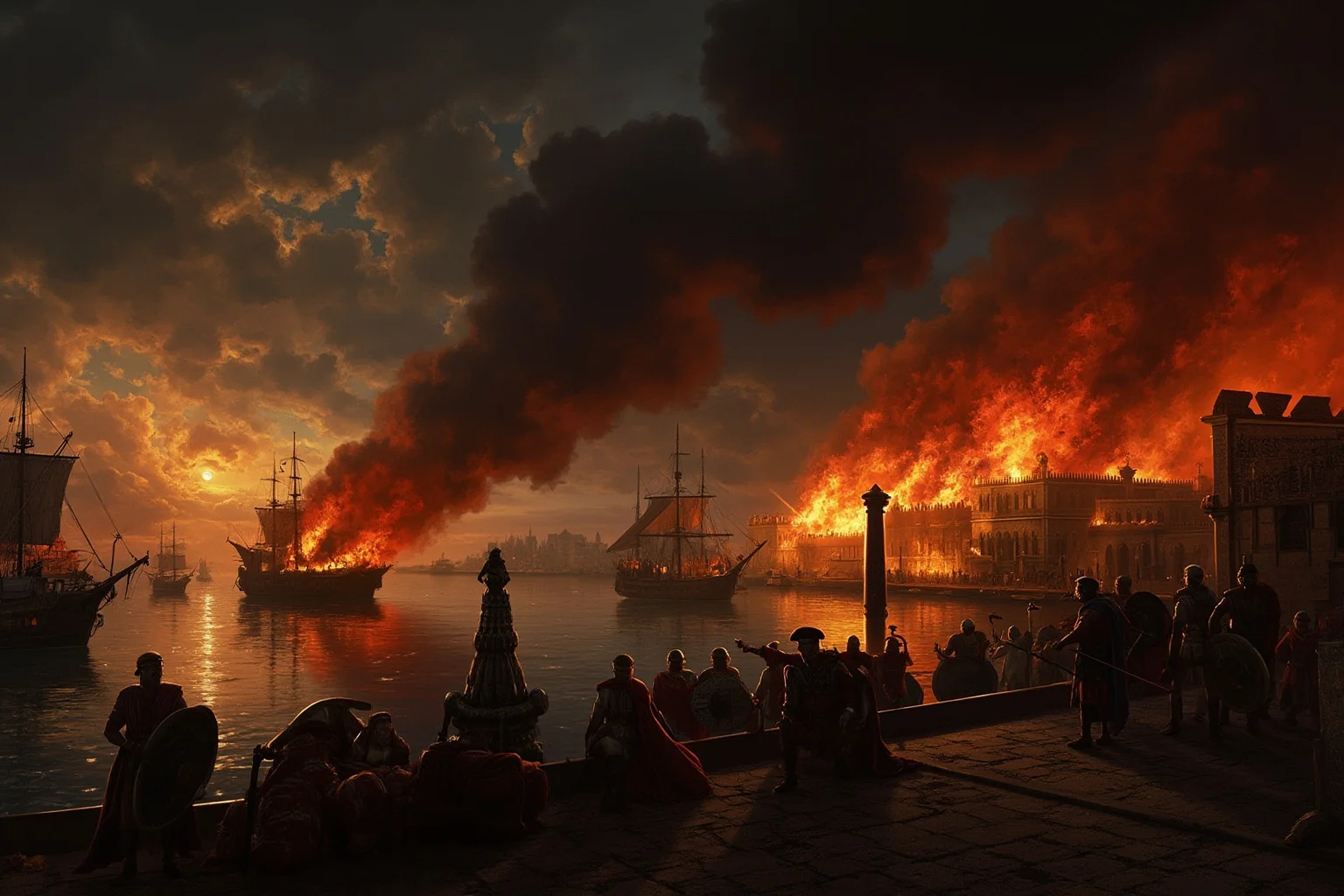
To avoid losing control of the harbor, Caesar's forces set fire to Egyptian ships. The flames spread to buildings along the waterfront. That much is well supported, and Caesar's own account describes burning ships and the fire reaching nearby structures.
What Do the Ancient Sources Say?
The later sources disagree about what burned. Plutarch, writing about a century and a half afterward, says the fire destroyed the great library. Seneca refers to 40,000 books lost, and Aulus Gellius gives the figure of 700,000.
Cassius Dio, writing in the third century CE, is more specific. He says that storehouses holding grain and books near the docks burned, and that these books were numerous and fine. That detail matters, because it suggests the fire may have consumed scrolls kept in warehouses rather than the main library building.
Caesar's own writings don't mention the library at all. That silence isn't proof of anything, since he had reasons to downplay damage. But it's one reason historians remain divided.
Did the Library Survive Caesar?
There are good reasons to think Alexandria's scholarly life continued after 48 BCE. The geographer Strabo visited around 20 BCE and described the Mouseion as a functioning institution within the palace quarter. He doesn't tell us a library lay in ruins. The Alexandrian scholar Didymus, active in the late first century BCE, is said to have written an enormous number of works drawing on earlier texts, which implies he had resources to work with.
Later, the emperor Claudius is reported to have added a new wing to the Mouseion, according to Suetonius. Institutions in ashes don't usually get extensions. The likeliest reading is that Caesar's fire destroyed a meaningful quantity of books but did not end the library.
What About Antony and Cleopatra's 200,000 Scrolls?
Plutarch passes along a claim that Mark Antony gave Cleopatra 200,000 scrolls from the library of Pergamon to make up for Alexandria's losses. He presents it as an accusation from Antony's enemies, and modern historians treat it cautiously. If it were true, it would be a neat explanation for how the collection recovered, but we can't rely on it.
Why Was the Library of Alexandria Burned?
In the Caesar episode, the answer appears to be "by accident of war." Nobody in the ancient sources suggests Caesar set out to destroy a library. The fire was a tactical move aimed at ships, and the damage to books, whatever its scale, was collateral.
That distinction matters for the myth-busting. The popular image of a cultural vandal deliberately burning knowledge doesn't match the evidence for 48 BCE. If anything, the sources portray the loss as a tragic side effect.
Later episodes had different motives. The Ptolemaic purge was political, and the destruction of the Serapeum was religious. Each deserves its own explanation rather than being lumped into one story of burning.
The Slow Decline: Politics, Budgets, and Neglect
Historians increasingly see the library's fate as a slow decline rather than a sudden death. A grand institution that depends on royal patronage is only as strong as its patron.
The Expulsion of Scholars
Around 145 BCE, Ptolemy VIII seized power after a bloody succession struggle and expelled many intellectuals from Alexandria. Aristarchus of Samothrace, the Homer editor, is among those said to have left. The purge didn't destroy books, but it damaged the community that used and cared for them.
Ancient writers like Athenaeus describe scholars scattering across the Mediterranean. In a way, this helped spread Alexandrian learning, but it weakened the institution itself.
Roman Rule and Shifting Support
Under Roman emperors, the Mouseion continued for a time, but its position changed. Funding and favor depended on the whims of distant rulers. In 215 CE, after unrest in the city, Caracalla is reported to have punished Alexandria and cut privileges for its scholars.
The real blow came in the later third century. During Aurelian's campaign against the Palmyrene rule in Egypt, the Brucheion district was devastated. Ammianus Marcellinus says that quarter, once splendid, was laid waste in the wars of that era. References to the Mouseion as a working institution fade out after this period.
The Problem With Papyrus
There's a quieter explanation too. Papyrus scrolls are fragile, and in a humid coastal city like Alexandria they could need recopying within a few generations. If a text wasn't copied, it eventually crumbled or rotted.
This is how most ancient literature was lost. Only seven plays of Sophocles survive out of well over a hundred he is said to have written. Much of that loss happened not through dramatic fires but through lack of readers and copyists willing to pay for new copies.
The Serapeum and the Year 391
Alexandria also had a second library, often called the "daughter library," housed in the Serapeum, the great temple of the god Serapis. Later writers say it was founded under Ptolemy III, though the details come from sources much later than the event. Its holdings were presumably smaller than the main library's.
In 391 CE, the Roman emperor Theodosius I issued measures against pagan worship. In Alexandria, tension between Christians and pagans erupted into violence centered on the Serapeum, and the bishop Theophilus oversaw its destruction. Christian historians like Rufinus, Socrates Scholasticus, and Sozomen describe the temple's fall in detail.
Were There Books in the Serapeum in 391?
Here's the surprising part: those accounts focus on the cult statue and the temple, not on any library. Eunapius, a pagan writer who disliked what happened, laments the looting of the temple without mentioning a book collection. Ammianus Marcellinus, writing in the late fourth century, mentions the Serapeum's great libraries in wording that can be read as referring to the past.
The Christian writer Orosius, around 416 CE, claims he saw empty book cabinets in temples in Alexandria, emptied in his own time. He is a hostile and imprecise source, so his comment is hard to interpret. Still, it hints that whatever collection the Serapeum once held may have been gone, or sharply diminished, before the building fell.
So the Serapeum's destruction was real and significant as a religious and cultural event. Whether it was also a major loss of books is much less certain.
The Caliph Omar Legend
The story many people know best is that the Arab conqueror Amr ibn al-As consulted Caliph Omar about the library after taking Alexandria in 641 or 642 CE. Omar supposedly replied that if the books agreed with the Quran they were unnecessary, and if they disagreed they were heretical. The scrolls were then said to have fueled the city's bathhouses for six months.
The problem is the timing of the sources. The story first appears in writers like Abd al-Latif al-Baghdadi and Ibn al-Qifti, about six centuries after the conquest. No contemporary account of the conquest mentions it, and most modern historians consider it a legend.
By the seventh century, there was probably no great library left to burn. The tale seems to say more about later attitudes and politics than about what happened in 642.
Hypatia and Other Popular Myths
Some retellings link the philosopher Hypatia to the library's end. She was murdered by a Christian mob in 415 CE, which was a real and shocking event. But there's no evidence she worked in the library, and the Mouseion was probably long gone by her day.
Another common claim is that the library held ancient technological marvels that were lost forever, from steam engines to flight. Alexandrian scholars like Hero did write about devices, and some of those texts survive. The more dramatic claims about lost super-science are speculation, not evidence.
Finally, there's the idea that one person is solely to blame. Whether you choose Caesar, Theophilus, or Omar, the evidence points the other way. The decline involved many hands and many decades.
What Year Did the Library of Alexandria Burn?
If you want a single year for the fire most often tied to the library, it's 48 BCE, during Caesar's war in Alexandria. That's the date most reference works give when they ask when the Alexandria library was burned. But it comes with the caveat that what burned is uncertain and the library seems to have continued afterward.
Other dates are attached to other losses, such as the 270s CE for the Brucheion and 391 CE for the Serapeum. The legend of 642 CE shouldn't be treated as a real date for the library's end. No year works as a clean answer, which is itself the answer.
How Much of the Library of Alexandria Survived?
Nobody can give a percentage, because we don't know the size of the original collection. What we can say is that essentially no physical scrolls from the library are known to survive today. There's no confirmed example of a papyrus roll that we can point to and say it came from the Great Library.
What survived is texts, passed down through copies. Euclid's Elements, Homer's poems in the form edited by Alexandrian scholars, and Ptolemy's Almagest all reached us through chains of copying in the Byzantine and Islamic worlds. In that sense, a lot of what Alexandria's scholars studied or produced lives on, even though the building and its scrolls don't.
What About Scrolls From Alexandria?
People often ask about scrolls from Alexandria turning up in the sand. The dry sands of Egypt have preserved huge numbers of papyri, but the famous finds, such as those at Oxyrhynchus, come from provincial towns in Middle Egypt. Alexandria's damp, coastal climate and long habitation are bad for papyrus survival.
So the surviving papyri give us a picture of ancient reading habits, but not of the library's own shelves. That absence is one reason the lost Library of Alexandria remains so mysterious.
What Was Lost for Good?
Many Hellenistic works survive only in fragments or as quotations in later authors. Callimachus's Pinakes is gone, and Manetho's history of Egypt survives only through later summaries and quotations. These are real, specific losses we can name.
But it's worth remembering that many such texts disappeared through centuries of neglect, not just one catastrophe. The Library of Alexandria is a symbol for all of that loss, but it wasn't the only cause.
Did the Library of Alexandria Set Us Back?
You may have seen the claim that the library's destruction set science back by a thousand years or more. It makes a dramatic story, but there's no solid evidence for it. Knowledge in the ancient world was spread across many places, including Pergamon, Athens, Antioch, Rome, and private collections.
Alexandrian science also didn't end when the library declined. Ptolemy's astronomy and Galen's medicine were written centuries after Caesar, and Late Antique mathematicians like Pappus and Diophantus worked in Alexandria too. Later, scholars in Constantinople, Baghdad, and elsewhere preserved and expanded much of that inheritance.
That doesn't mean nothing was lost. Every lost work is a real loss, and we can't know what we'd have if more had survived. But "set us back" is a counterfactual that history can't prove, and it tends to overstate the role of one institution.
Library of Alexandria Remains: What Can You See Today?
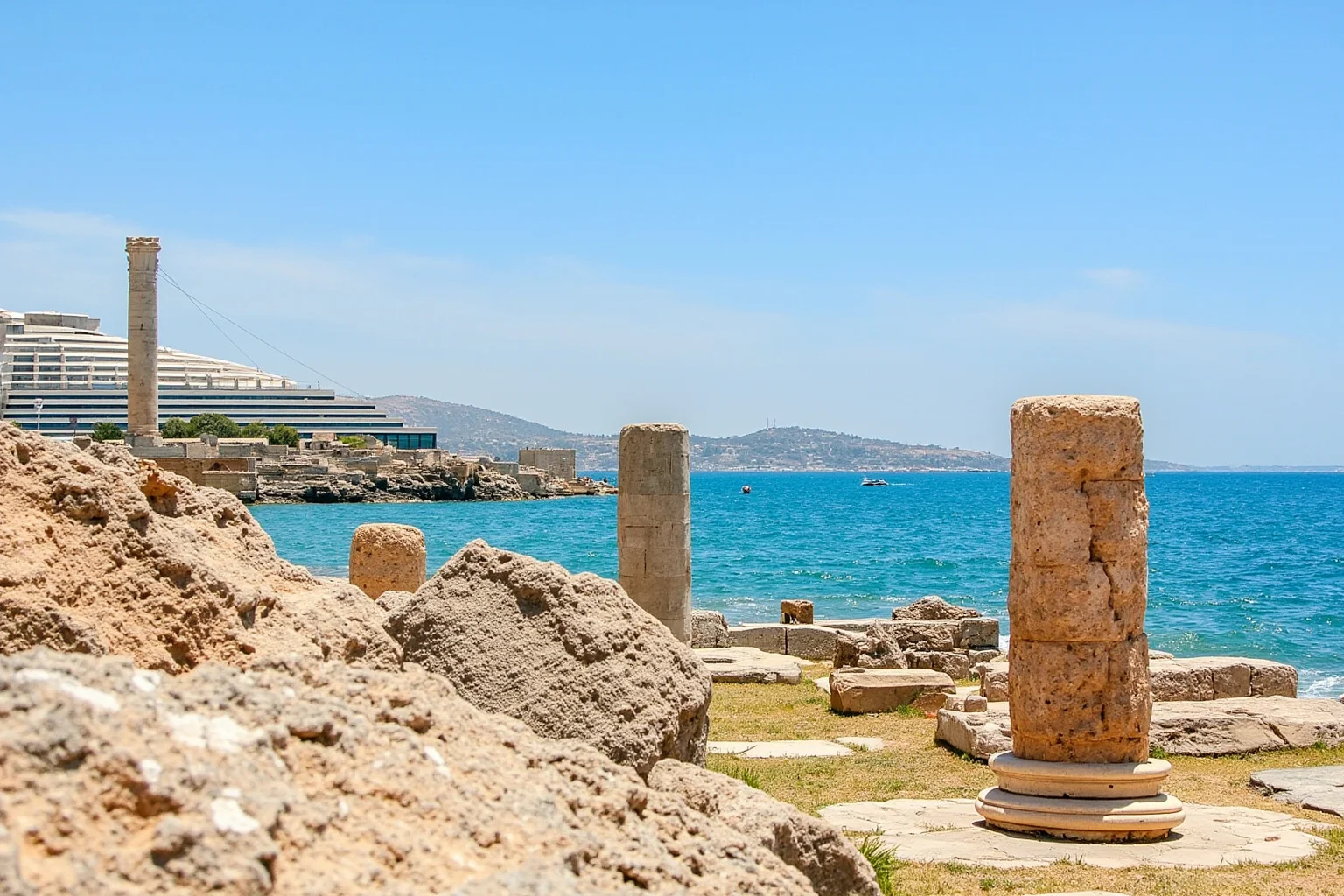
You can't visit the Great Library, because its exact location and remains haven't been definitively identified. The most likely area is the old royal quarter, the Brucheion, but much of it lies under the modern city or beneath the waters of the harbor. Earthquakes, tidal waves, and sinking land have swallowed part of ancient Alexandria, and underwater archaeologists have found remnants of palaces and harbor structures there.
Headlines occasionally announce that the library has been found. For example, excavations at Kom el-Dikka uncovered a set of lecture halls, sometimes described as part of the ancient library's world. Those auditoria, however, date to the late Roman and early Byzantine era, centuries after the library's heyday, so they're better seen as evidence of a later teaching tradition.
The Serapeum Site and Pompey's Pillar
The Serapeum area is easier to visit. A tall granite column known as Pompey's Pillar still stands there, though it was actually erected for the emperor Diocletian around 297 CE and has nothing to do with Pompey. Visitors can also see underground galleries cut into rock, which some have suggested were used for storing books, but that's an unproven idea.
Does the Library of Alexandria Still Exist?
The ancient library doesn't, but a modern one does. The Bibliotheca Alexandrina opened in 2002 near the old royal quarter as a tribute to the original, with space for millions of books and several museums and research centers. It doesn't contain the ancient collection, but it keeps the spirit of Alexandria's ambition alive.
So, What Actually Happened?
Putting it all together, the lost Library of Alexandria suffered a long series of blows. Caesar's war fire probably destroyed some books, the Ptolemaic purge and Roman-era turmoil weakened the scholarly community, and third-century wars devastated the quarter where it stood. By the time the Serapeum fell in 391, the great collection may already have been a shadow of what it once was.
The legends of one villain and one blaze are appealing, but the real story is more human. Libraries survive because people fund, copy, and use their books, and when those things stop, even the greatest collections fade. Alexandria's real lesson isn't about a single fire but about how fragile knowledge is when nobody is tending it.
Frequently Asked Questions
How did the Library of Alexandria burn?
The best-known fire happened in 48 BCE during Julius Caesar's war in Alexandria, when his forces set fire to Egyptian ships in the harbor and the flames spread to nearby buildings. Later writers such as Plutarch, Seneca, and Cassius Dio say books were lost, though Dio specifically mentions warehouses near the docks, so it's unclear whether the main library building burned. The library also seems to have kept functioning afterward, so this fire was probably a serious loss but not the final end.
Who destroyed the Library of Alexandria?
No single person or group destroyed it. Julius Caesar's war fire, Ptolemy VIII's purge of scholars, Aurelian's destruction of the Brucheion district, and the 391 CE destruction of the Serapeum have all been blamed. Historians generally see the library's end as a gradual decline caused by war, loss of funding, and neglect.
Why was the Library of Alexandria burned?
In the case of Caesar's fire in 48 BCE, the ancient sources suggest it was an accident of war rather than a deliberate attack on the library. The fire was set to ships in the harbor and spread. The popular idea that someone intentionally burned the library to suppress knowledge isn't well supported by the evidence.
What year did the Library of Alexandria burn?
The date most often cited is 48 BCE, the year of Caesar's fire in Alexandria. However, the library did not end in that year, and other damaging events occurred around 145 BCE, the 270s CE, and 391 CE. The story of the caliph Omar burning the books in 642 CE is considered a later legend.
How much of the Library of Alexandria survived?
Nobody knows exactly, because the original size of the collection is uncertain and no known physical scrolls from the library survive. What did survive are texts that were copied and passed down through later centuries, including works by Euclid, Homer, and Ptolemy. Many other Hellenistic works survive only in fragments or quotations.
Did the Library of Alexandria set science back?
There's no good evidence that its loss set science back by centuries. Knowledge was spread across many libraries and scholars in the ancient world, and Alexandrian science continued long after Caesar's time. Specific works were certainly lost, but the idea of a thousand-year setback is speculation.
Does the Library of Alexandria still exist, and can you see its ruins?
The ancient library no longer exists, and its exact remains have not been confirmed. Parts of the royal quarter lie under the modern city or beneath the harbor, and visitors can see the Serapeum site with Pompey's Pillar and the late Roman lecture halls at Kom el-Dikka. The modern Bibliotheca Alexandrina, opened in 2002, honors the original.

Alex Warren
Related Articles