
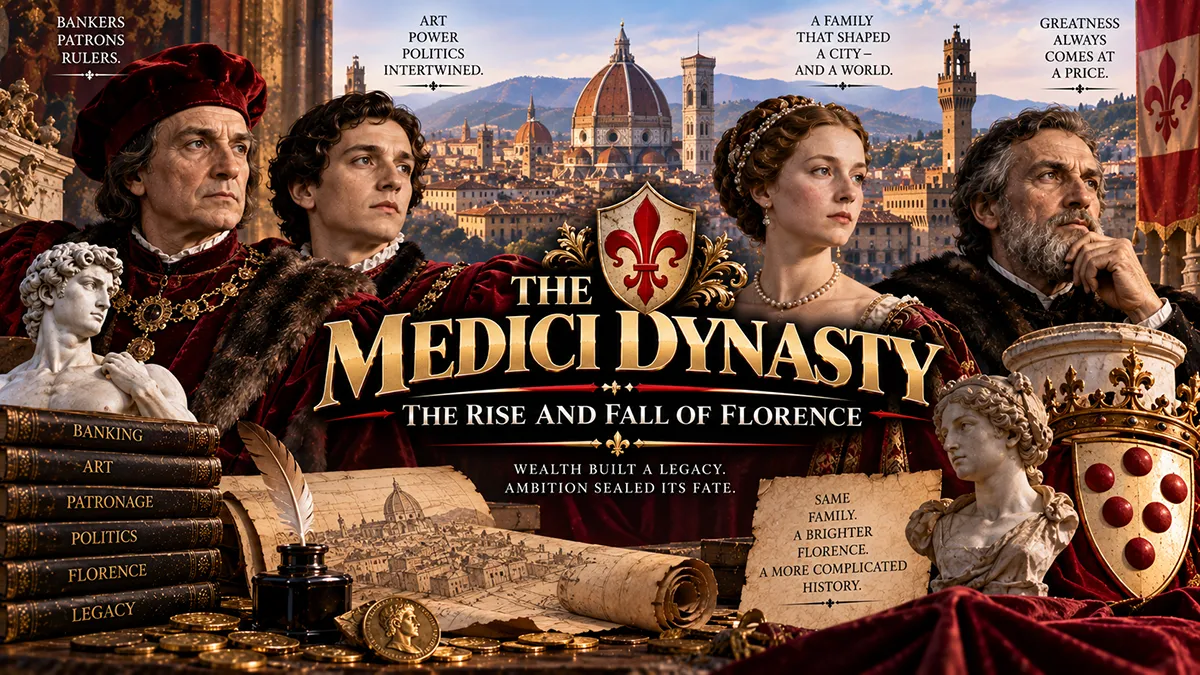
If you’ve ever admired Michelangelo’s David, marveled at the dome of Florence Cathedral, or wondered how one Italian city produced so much genius in such a short span of time, you’ve already brushed up against the Medici. This wasn’t a royal bloodline in the traditional European sense.
It was a family of merchants and bankers who turned money into power, power into art, and art into a legacy that still shapes how we imagine the Renaissance today.
The Medici story is really two stories in one: a rags-to-riches tale of financial genius, and a cautionary tale about how even the mightiest dynasties eventually run out of heirs, money, or luck.
Let’s walk through who the Medici actually were, how they built Florence into a cultural capital, and what happened when the family finally faded from history.
TL;DR: The Medici were a Florentine banking family who used their fortune to seize political control of the city, bankroll the Renaissance’s greatest artists, and place two popes and two queens on European thrones, before the family line quietly died out in the 18th century.
Who Was the Medici Family?
So, who was the Medici family, exactly? In simple terms, the Medici family definition boils down to this: they were a powerful Italian dynasty from Florence who rose from wool trading and banking to become the de facto rulers of the city for roughly three centuries, on and off, between the 1400s and 1700s.
They weren’t born into aristocracy. There was no ancient noble title waiting for them, no inherited crown. The Medici of Florence earned their influence the hard way, through trade, finance, and some very shrewd political maneuvering.
It’s a common misconception that the Medici were kings or that Florence was always a monarchy under them. For much of their early rise, Florence was technically a republic, and the Medici ruled from behind the scenes as its most influential citizens rather than official monarchs. Only later did they formally become dukes and grand dukes with hereditary titles.
Where Did the Medici Come From?
The Medici family originally hailed from the Mugello region, a rural area of hills and farmland just north of Florence in Tuscany. Historical records suggest the family had modest origins as farmers or minor merchants before migrating into the city itself sometime in the 12th or 13th century.
Once settled in Florence, various Medici family members worked as merchants, moneylenders, and guild members, slowly building connections within the city’s tightly-knit commercial class. Florence at the time was a thriving hub of trade and textile production, which gave an ambitious family plenty of room to climb.
It would take a few generations of careful business dealings before the Medici family in Italy became a name anyone outside Florence would recognize.
How Did the Medici Become Wealthy?
The real turning point came with banking. In 1397, Giovanni di Bicci de’ Medici founded the Medici Bank, and it grew into one of the most successful financial institutions in Europe.
The bank didn’t just serve local merchants. It handled finances for the Papacy in Rome, which was an enormously lucrative and prestigious client, along with a network of branches stretching to Venice, Rome, Geneva, London, and Bruges.
The Medici also innovated in how banking itself worked, refining techniques like double-entry bookkeeping and letters of credit that made large-scale international trade far less risky. This is really the answer to how did the Medici family make their fortune: they became the essential middlemen of European finance at a moment when trade across the continent was exploding.
Wool and textile trading added another steady income stream, but banking was what turned a comfortable merchant family into one of the richest in Europe.
When Did the Medici Family Take Power in Florence?
Money bought influence, and influence eventually bought political control. Giovanni di Bicci’s son, Cosimo de’ Medici, is generally credited as the man who transformed the family’s wealth into outright political dominance.
Cosimo returned from a brief exile in 1434 and effectively became the unofficial ruler of Florence, even though the city retained its republican institutions on paper. He achieved this not through a coup or violence, but by controlling the purse strings, placing allies in key positions, and quietly managing Florence’s councils and committees.
This is the moment historians usually point to when discussing when the Medici family took power in Florence, and it kicked off roughly sixty years of relatively stable, prosperous rule under Cosimo and his descendants. It’s worth noting the Medici didn’t hold a single unbroken reign after this. Their grip on the city loosened and tightened multiple times over the following three centuries, as we’ll see.
The Golden Age Under Lorenzo the Magnificent
No discussion of the Medici family and the Renaissance is complete without Lorenzo de’ Medici, known to history as Lorenzo the Magnificent. He led Florence from 1469 until his death in 1492, and this period is widely regarded as the high point of Medici rule.
Lorenzo was a skilled diplomat who kept Florence stable during a volatile era in Italian politics, and he was also a genuine patron of the arts and learning. Poets, philosophers, and painters gathered around his court, and he personally supported figures like Sandro Botticelli and a young Michelangelo Buonarroti.
His rule wasn’t without violence, though. In 1478, a rival family, the Pazzi, orchestrated an assassination attempt known as the Pazzi Conspiracy during Mass at Florence Cathedral. Lorenzo survived with injuries, but his brother Giuliano was killed, a stark reminder that Medici power was never entirely secure.
The Medici Family and the Renaissance
The connection between the Medici and the Renaissance is one of the most important reasons this family is still studied today. Their patronage didn’t just fund pretty paintings; it helped fuel an entire cultural movement that reshaped European art, science, and philosophy.
The Medici commissioned or supported an extraordinary roster of talent, including Donatello, Fra Angelico, Botticelli, and later Michelangelo. They also funded humanist scholars who translated and studied classical Greek and Roman texts, helping spark the intellectual curiosity that defines the Renaissance.
It’s worth being careful here, though, because popular culture sometimes overstates their role. The Medici were major patrons, but they were not the sole engine of the Renaissance. Other wealthy families, guilds, and even the Church across Italy also funded artists and thinkers during this same period.
How Did the Medici Influence Architecture?
When people ask how did the Medici influence architecture, the honest answer involves a mix of genuine patronage and a myth or two worth clearing up. The Medici funded major building projects, including the Basilica of San Lorenzo, which became something of a family church, and the sprawling Palazzo Medici on Via Larga.
One persistent myth is that the Medici commissioned the famous dome of Florence Cathedral. In reality, that project was overseen by the city’s wool merchants’ guild, the Arte della Lana, and it was largely complete before the Medici rose to real political power. The Medici’s architectural legacy lies more in family chapels, palaces, villas, and later civic buildings like the Uffizi.
What Was Brunelleschi’s Relationship with the Medici Family?
Filippo Brunelleschi, the architect behind that cathedral dome, did have a documented relationship with the Medici, just a more specific one than many assume. Cosimo de’ Medici commissioned Brunelleschi to design the Basilica of San Lorenzo, intending it as the Medici family’s own parish church and eventual burial site.
Interestingly, Brunelleschi is also believed to have submitted a design for the Medici family’s new palace, but Cosimo reportedly rejected it as too extravagant and likely to draw unwanted political attention. The commission went instead to Michelozzo, whose more restrained design became the Palazzo Medici Riccardi that still stands in Florence today.
Medici Popes and the Family’s Reach Beyond Florence
The Medici family history and influence on Europe extended well past Tuscany’s borders, largely through the Church and strategic marriages. Two Medici family members became pope: Leo X, who reigned from 1513 to 1521, and Clement VII, who reigned from 1523 to 1534.
These papacies gave the family enormous religious and political leverage across Catholic Europe, though Clement VII’s tenure was also marked by turmoil, including the 1527 Sack of Rome. A later pope, Pius IV, was born Giovanni Angelo Medici, but he came from an unrelated Milanese family that simply shared the same surname, a detail historians are careful to distinguish.
Medici Queens of France
Two Medici women became queens of France through marriage, further cementing the family’s international reach. Catherine de’ Medici married King Henry II of France in 1533 and later ruled as regent, wielding considerable influence during a turbulent period of religious wars.
Marie de’ Medici followed decades later, marrying King Henry IV of France in 1600 and later serving as regent for her son, Louis XIII. Both women brought Florentine tastes in art, cuisine, and court culture with them, leaving a lasting mark on French royal life.
The Medici Take the Duchy: From Bankers to Dukes
The family’s status shifted permanently in 1531 when Alessandro de’ Medici was named Duke of Florence, formally ending the city’s republican pretenses. This marked a real turning point, converting the Medici from powerful private citizens into hereditary rulers with an official title.
Alessandro was assassinated in 1537, and the title passed to Cosimo I de’ Medici, a distant cousin who proved to be a formidable and ambitious ruler. In 1569, Cosimo I was elevated further, becoming the first Grand Duke of Tuscany, a title his descendants would hold for nearly two more centuries.
Cultural Patronage in the Later Medici Era
Even as their political fortunes shifted, later Medici rulers kept up the family’s tradition of arts and science patronage. Grand Duke Cosimo II famously supported the astronomer Galileo Galilei, and the Medici court became an important hub for early modern scientific inquiry, not just painting and sculpture.
The Uffizi Gallery, originally built as government offices under Cosimo I, was gradually transformed into one of the world’s great art museums thanks to Medici collecting habits. This collection forms the backbone of what visitors still admire in Florence today.
The Slow Decline of Medici Power
No dynasty rules forever, and the Medici’s decline was gradual rather than sudden. The Medici Bank itself had already collapsed in 1494, decades before the family became formal dukes, due to bad loans and mismanagement following Lorenzo the Magnificent’s death.
Politically, the family was actually expelled from Florence entirely between 1494 and 1512, following the rise of the reformist friar Girolamo Savonarola, before managing to claw their way back to power. Even after securing the grand ducal title in the 1500s, later generations produced fewer capable heirs and struggled with debt, weakening the family’s grip over time.
The End of the Line
The Medici dynasty’s rule over Tuscany came to a definitive close in 1737 with the death of Gian Gastone de’ Medici, who left no heirs to continue the family’s ducal line. His sister, Anna Maria Luisa de’ Medici, was the last Medici to hold real historical significance, and she made one final, generous contribution to Florence.
Before her death in 1743, she negotiated an agreement known as the Patto di Famiglia, ensuring that the vast Medici art collection would remain in Florence permanently, rather than being scattered or sold off to foreign buyers. Following Gian Gastone’s death, the Grand Duchy of Tuscany passed to the House of Habsburg-Lorraine, closing the book on centuries of Medici rule.
Does the Medici Family Still Exist Today?
This is one of the most common questions people ask, and it deserves an honest, myth-busting answer. The main ruling line of the Medici, the branch descended from Cosimo I and the Grand Dukes of Tuscany, did indeed die out with Gian Gastone and Anna Maria Luisa in the 18th century.
However, genealogists have identified other, more distant branches of the extended Medici family tree that some believe continued into later centuries, though these connections are often difficult to verify with certainty and are sometimes wrapped in local legend rather than solid documentation. So if you’re wondering whether the Medici family still exists today in any direct, verifiable royal sense, the honest answer is no, that specific ruling dynasty is extinct.
What does live on is the name itself, along with an enormous cultural footprint. Modern references to a “modern day Medici family” usually describe wealthy art patrons or business dynasties being compared to the Medici, rather than actual descendants.
The Medici Family Today: Legacy Over Lineage
When people search for the Medici family today, they’re usually less interested in bloodlines and more interested in the family’s lasting cultural footprint. Florence itself is essentially a living museum shaped by Medici money, taste, and ambition.
The Uffizi Gallery, the Boboli Gardens, the Palazzo Pitti, and countless churches and chapels across the city all trace back to Medici patronage in one form or another. Their name has also become a kind of shorthand in popular culture for old money, political intrigue, and lavish arts patronage, showing up in television series, novels, and museum branding worldwide.
What Was the Medici Family Famous For?
Pulling it all together, the Medici family’s fame rests on a few key pillars. They’re famous for building one of Europe’s most successful banking empires, for governing Florence for generations through both formal and informal power, and for bankrolling an extraordinary concentration of Renaissance art and scholarship.
They’re also remembered for producing two popes, two French queens, and a line of grand dukes, giving a single Florentine family influence that stretched across the religious and political map of Europe. Few merchant families in history managed to convert commercial success into cultural and dynastic power quite so thoroughly.
Final Thoughts on the House of Medici
The story of the Medici is ultimately a story about how wealth, when paired with ambition and genuine cultural curiosity, can reshape a city and ripple outward across a continent. They weren’t perfect rulers, and their history includes plenty of ruthlessness, financial collapse, and political scheming alongside the artistic triumphs.
But walk through Florence today, past the Duomo, into the Uffizi, or along the Ponte Vecchio, and you’re walking through the world the Medici helped build. That’s a legacy few families in history, royal or otherwise, can claim.
Frequently Asked Questions
Who was the Medici family?
The Medici family was a powerful Italian dynasty from Florence that rose from banking and trade to become the city's dominant political power for roughly three centuries. They were not born into nobility; instead, they built their influence through the enormously successful Medici Bank and used that wealth to control Florence's politics, later becoming official dukes and grand dukes of Tuscany, along with producing two popes and two queens of France.
What was the Medici family famous for?
The Medici are best known for founding one of Europe's most influential banking houses, ruling Florence for generations, and funding an extraordinary range of Renaissance art and architecture. Their patronage supported artists like Botticelli, Donatello, and Michelangelo, and their political reach extended to the papacy and the French crown.
Does the Medici family still exist today?
The main ruling branch of the Medici, descended from the Grand Dukes of Tuscany, died out in the 18th century with the deaths of Gian Gastone de' Medici and his sister Anna Maria Luisa de' Medici. Some more distant and harder-to-verify branches of the extended family tree have been claimed over the years, but no confirmed direct royal line survives today.
When did the Medici family rule Florence?
The Medici began exercising real, unofficial political control over Florence around 1434 under Cosimo de' Medici, though the city remained officially a republic for decades afterward. Their rule became formal in 1531 when Alessandro de' Medici was named Duke of Florence, and the family continued ruling as Grand Dukes of Tuscany until 1737.
How did the Medici family make their fortune?
The Medici built their wealth primarily through banking, after Giovanni di Bicci de' Medici founded the Medici Bank in 1397. The bank served clients across Europe, including the Papacy, and the family also profited from wool trading and textile commerce common to Florence's merchant economy.
What role did the Medici family play in the Renaissance?
The Medici were major patrons of Renaissance art, architecture, and humanist scholarship, funding artists such as Botticelli, Donatello, and Michelangelo, along with scholars who revived interest in classical Greek and Roman texts. They were significant contributors to the movement, though not its sole cause, since other patrons across Italy also funded Renaissance culture.
Are there any Medicis left, or is the family completely extinct?
The historically significant ruling line of the Medici is extinct, ending with Gian Gastone de' Medici's death in 1737. Claims of surviving distant relatives exist in some genealogical research, but they are generally considered unverified or uncertain rather than confirmed continuations of the ruling dynasty.

Alex Warren
Related Articles