

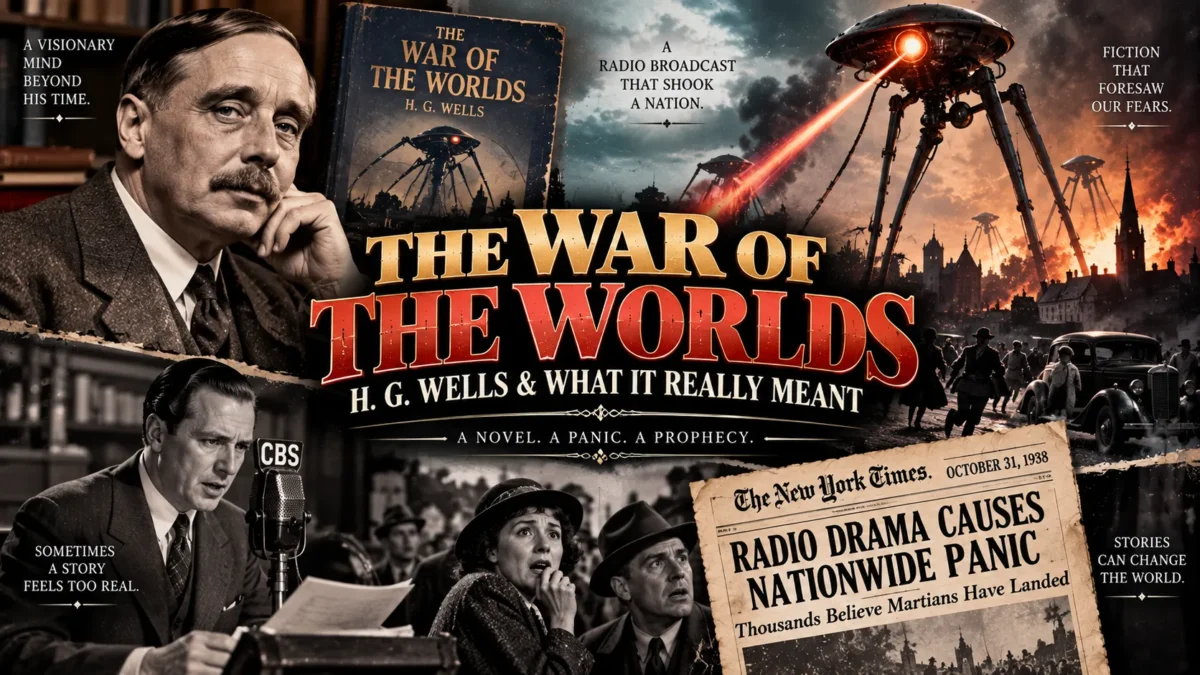
When people hear “The War of the Worlds,” most picture flying saucers, death rays, and Tom Cruise running from a tripod. But H.G. Wells’ original 1898 novel was never really about aliens. It was about Britain, empire, and the uncomfortable question of what happens when the conquerors become the conquered.
Understanding the real story behind this book means going back to the anxious, rapidly changing world Wells was writing in, and reading his Martians not as monsters from Mars, but as a mirror held up to Victorian society itself.
TL;DR: H.G. Wells’ War of the Worlds is less a story about alien invasion and more a Victorian critique of British imperialism, scientific hubris, and humanity’s fragile place in nature.
When Was War of the Worlds Written?
H.G. Wells wrote The War of the Worlds between 1895 and 1897, and it was first serialized in Pearson’s Magazine in the UK and Cosmopolitan in the US throughout 1897.
It was published as a complete novel in 1898. This places it firmly in the late Victorian era, a period buzzing with new scientific ideas, imperial confidence, and a fair amount of underlying dread.
This timing matters enormously. Charles Darwin, often ranked among the smartest people in history, had spent decades reshaping how people thought about nature and survival, and the idea of a “struggle for existence” between species was very much in the cultural bloodstream.
Wells, who had trained in biology under Thomas Henry Huxley, one of Darwin’s most prominent defenders, was steeped in this scientific worldview.
At the same time, the British Empire was near its territorial peak, controlling roughly a quarter of the globe. Wells wrote the novel during a period when Britain’s colonial conquests, including the ongoing scramble for Africa, were front-page news. That context is essential to understanding what he was actually trying to say.
What Is War of the Worlds, Really?
So what is the War of the Worlds at its core? On the surface, it is science fiction’s first great alien invasion story, though it’s far from the oldest novel in the world overall—that title is still generally reserved for works like The Tale of Genji, written in Japan nearly a thousand years earlier.
Wells’ book instead follows an unnamed narrator as Martians land in the English countryside and begin a devastating campaign against humanity. But Wells structured the book as a piece of speculative social commentary disguised as adventure fiction.
Wells himself was explicit in later writing that he intended readers to feel what it might be like to be on the receiving end of colonial conquest, the way indigenous peoples had experienced European expansion.
The novel’s early chapters even draw a direct comparison, noting that humans should remember how European settlers treated the native Tasmanians before condemning the Martians too quickly. That single passage is one of the clearest windows into what Wells really meant.
It is also a book obsessed with scientific plausibility for its time. Wells wanted his invaders to feel biologically and technologically logical rather than fantastical, which is part of why the novel still reads as startlingly modern more than a century later.
War of the Worlds Summary: Book One
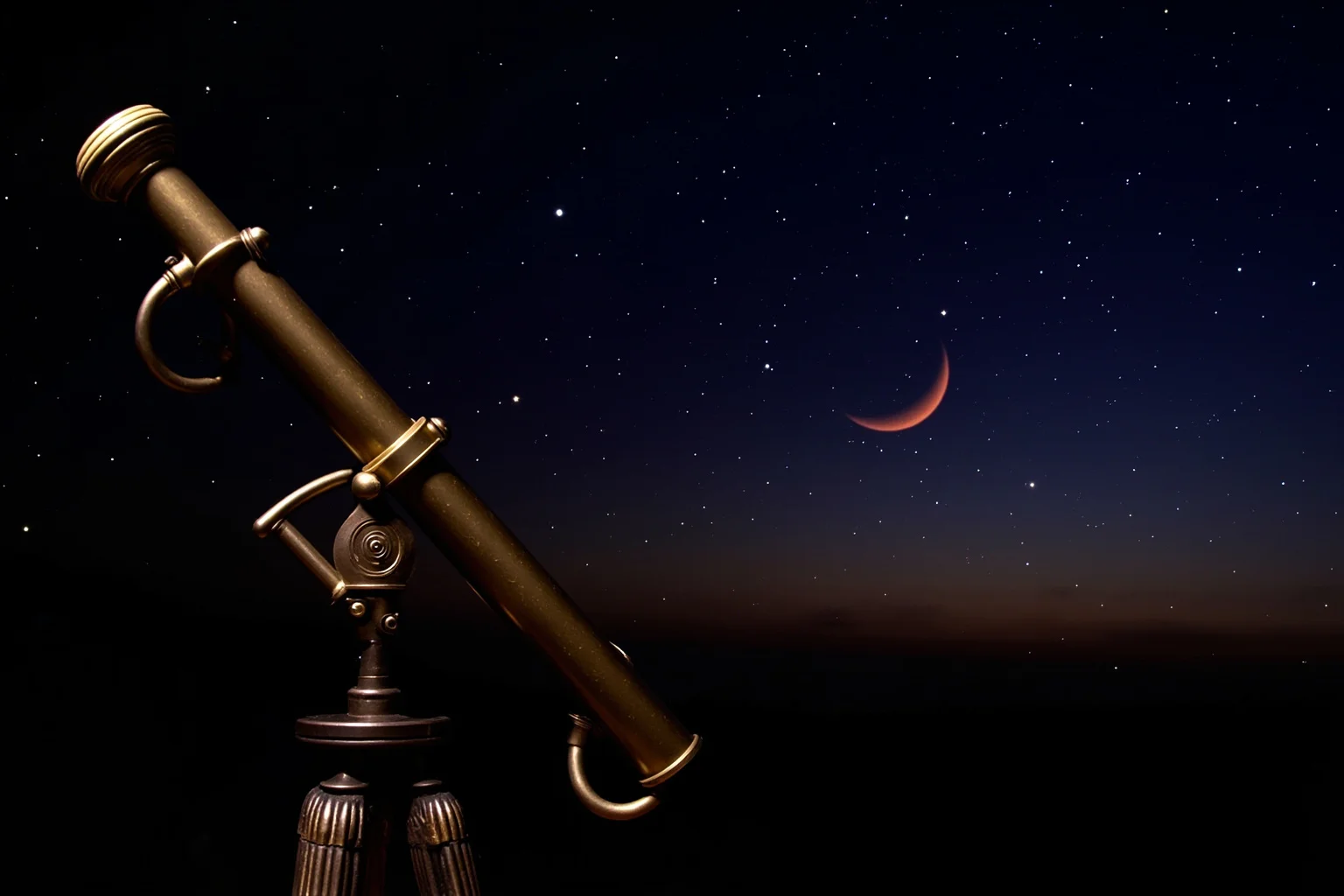
The novel opens with an unnamed narrator, a philosophically minded writer living in Woking, Surrey, observing strange gas eruptions on Mars through a telescope alongside an astronomer named Ogilvy.
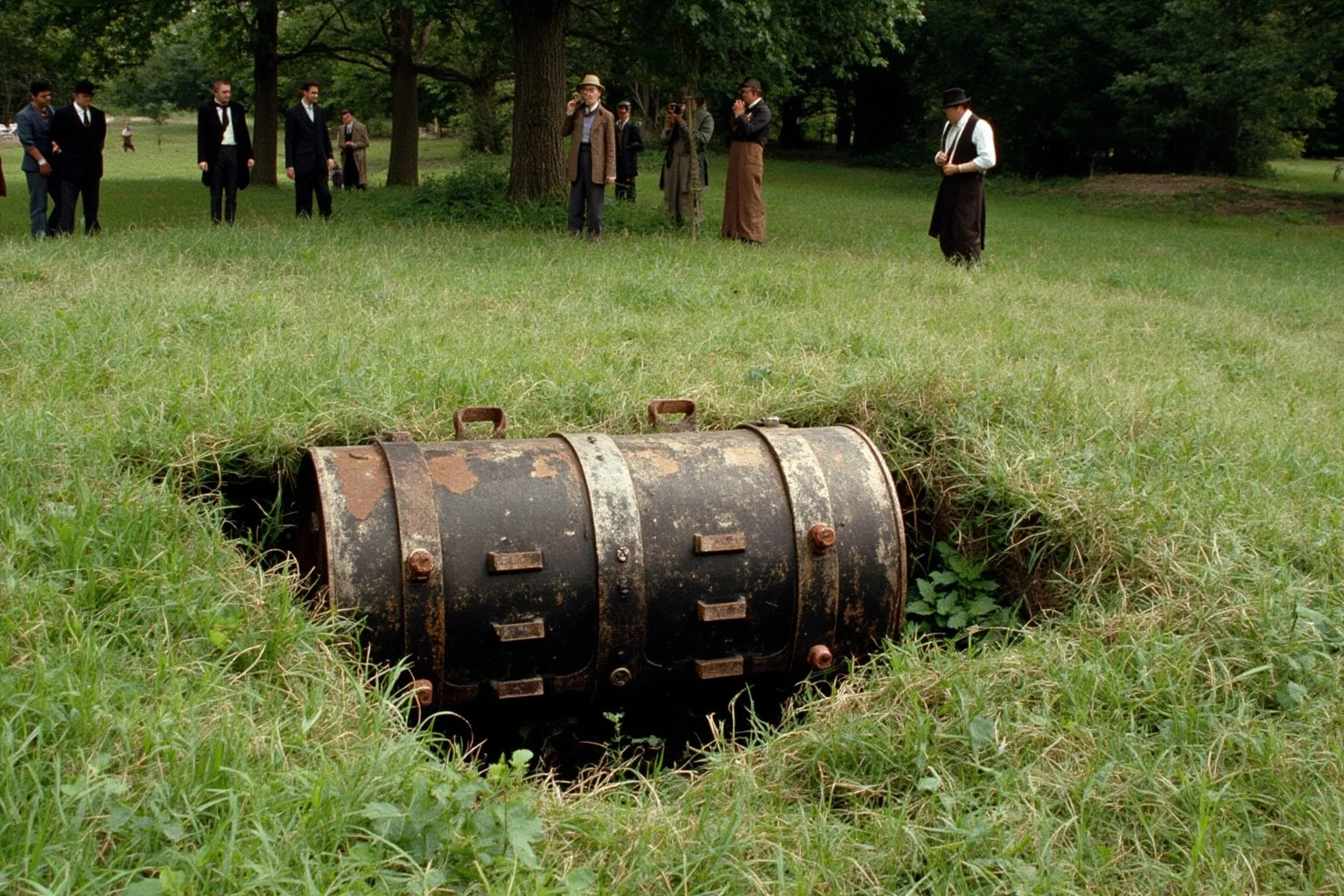
Soon after, a mysterious cylinder crash-lands on Horsell Common near the narrator’s home. Curious crowds gather, assuming it might be a meteorite.
The cylinder unscrews itself, revealing tentacled, large-eyed Martians who struggle to move in Earth’s gravity. A human delegation approaches waving a white flag, and the Martians respond by incinerating them with a mysterious Heat-Ray. This is the moment the story shifts from curiosity to catastrophe.
More cylinders land across the region, and the Martians assemble towering three-legged fighting machines. The narrator flees with his wife to safety, but circumstances separate him from her, and much of Book One follows his desperate attempts to survive amid collapsing social order.
Along the way he encounters an artilleryman who offers grim, sometimes self-serving philosophy about humanity’s chances, and a curate whose religious certainty crumbles under the strain.
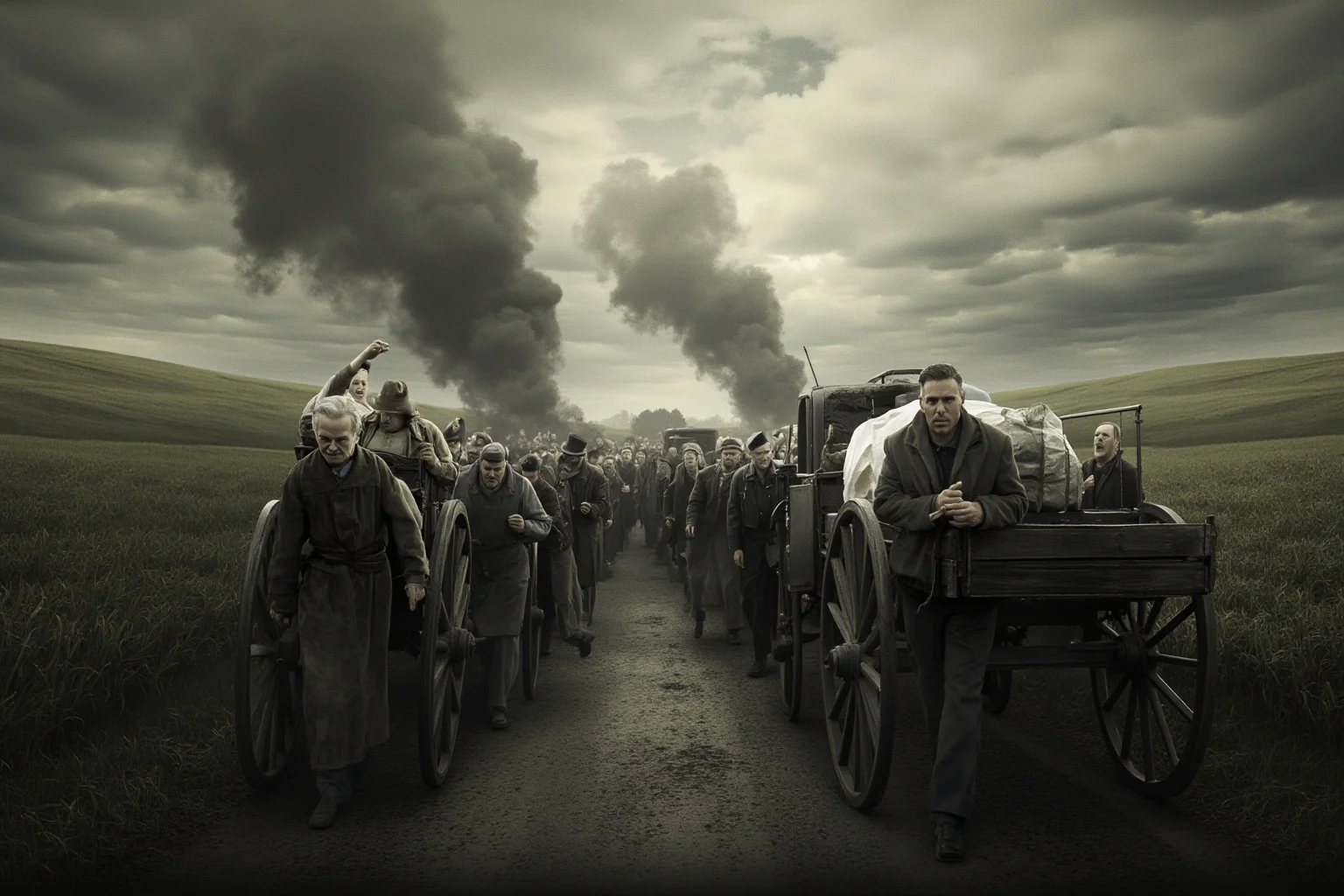
The British military attempts to fight back, but Victorian weaponry proves useless against Martian technology. Whole towns are destroyed, refugees clog every road out of London, and the narrator witnesses the complete unraveling of the social fabric he once took for granted.
War of the Worlds Summary: Book Two
Book Two narrows the focus, following the narrator as he shelters with the increasingly unstable curate in a half-ruined house near a Martian encampment. Their confinement becomes a psychological pressure cooker, and the sequence is often read as Wells examining how civilization’s thin veneer cracks under genuine existential threat.
Meanwhile, the narrator’s brother, introduced in a separate thread, joins the mass exodus from London and witnesses the panic of ordinary citizens overwhelmed by the invasion. This section broadens the scope of the war of the worlds synopsis beyond one man’s survival story into a portrait of an entire capital city collapsing.
The Martians, having crushed human resistance and begun harvesting people for their nutritional needs, seem unstoppable. Then, in one of literature’s most famous endings, the invaders begin dying suddenly and mysteriously. The narrator discovers they have been killed not by human weapons but by ordinary earthly bacteria, to which they had no evolved immunity.
The novel closes on a subdued note rather than a triumphant one. The narrator is reunited with his wife, but he remains permanently changed, haunted by what he witnessed and uncertain whether humanity has learned anything from its brush with annihilation.
Setting of the War of the Worlds
The setting of the War of the Worlds is deliberately mundane, which is part of what made it so unsettling to its original readers. Wells set the invasion in real, recognizable towns across Surrey and London, including Woking, Chertsey, Leatherhead, and the streets of the capital itself. Readers in 1897 could trace the Martian advance on an actual map of their own commute.a
This grounded, hyper-local setting was a deliberate technique. By invading the comfortable, orderly suburbs of southern England rather than some distant fictional land, Wells forced his British audience to imagine themselves as the powerless victims of an unstoppable foreign force, a reversal of the colonial role they were used to occupying.
The timeframe is similarly close to home, set in what was essentially the present day of its first readers, the late 1890s. There is no far-future setting or exotic backdrop, just ordinary Victorian life interrupted by the unimaginable.
Themes in War of the Worlds
Imperialism and Colonial Anxiety
The most widely discussed of the themes in War of the Worlds is its critique of empire. By making the technologically superior, morally indifferent Martians the aggressors, Wells invited British readers to see their own empire’s behavior reflected back at them.
The novel’s narrator explicitly draws parallels between the Martians’ treatment of humans and European colonizers’ treatment of colonized peoples. This was a pointed and, for many contemporary readers, uncomfortable comparison to make in 1897 Britain.
Darwinism and Survival of the Fittest
Wells frames the entire conflict through an evolutionary lens rather than a moral one. The Martians are not portrayed as evil in a fairy-tale sense; they are simply better adapted, more advanced organisms exploiting a weaker species, much as humans had exploited other species and other humans.
The eventual downfall of the Martians via bacteria reinforces this theme sharply. Humanity survives not through courage, cleverness, or military might, but through blind biological chance, a distinctly Darwinian and rather humbling twist.
The Fragility of Civilization
Throughout the novel, social order collapses astonishingly fast once the Martians prove unbeatable. Institutions that Victorian readers trusted implicitly, the army, the church, the government, all fail to protect ordinary people.
This theme is reinforced through characters like the curate, whose faith cannot withstand the crisis, and the artilleryman, whose grand survival schemes turn out to be mostly self-serving fantasy. Wells seems to argue that civilization is a fragile agreement, not a fixed guarantee.
Human Arrogance and Scientific Hubris
The novel opens with humanity confidently assuming its dominance over the natural world is permanent and unchallengeable. The Martian invasion punctures that assumption almost immediately, exposing how little control people actually have over their fate.
Wells, trained in the sciences himself, used this theme to warn against complacency, suggesting that technological and social progress can create a dangerous illusion of permanent safety.
The True Story Behind The War of the Worlds
When people search for “the war of the worlds the true story,” they are usually looking for one of two things: the real history that inspired the novel, or the famous 1938 radio broadcast that some believed was real. Both are worth untangling carefully, since a lot of popular retellings blur fact and legend, much the way the real story of Pocahontas has been flattened into something closer to fairy tale over time.
On the inspiration side, there is no verified single event that directly caused Wells to write the book. Instead, historians point to a mix of influences: contemporary astronomical speculation about canals on Mars popularized by Percival Lowell, ongoing British anxiety about invasion from European rivals, and Wells’ own scientific training under Huxley. His brother Frank Wells is often cited in biographical accounts as having sparked early conversations about what an alien invasion of England might look like, though details of that exchange come mostly from later reminiscence rather than contemporaneous documentation.
As for the famous panic myth, it centers on Orson Welles’ 1938 radio adaptation, presented as a series of fake news bulletins. It is often repeated that this broadcast caused nationwide mass hysteria. Contemporary media historians have found that the scale of panic was significantly exaggerated by newspapers at the time, partly out of rivalry between print and the newer medium of radio. Some listeners were genuinely alarmed, but the idea of a nation gripped in terror is largely a media-driven myth rather than a documented mass event, not unlike the exaggerated legends that grew up around Nostradamus’s predictions long after the fact.
Key Characters Worth Knowing
The unnamed narrator serves as Wells’ philosophical stand-in, a rational, observant man whose scientific curiosity gradually gives way to raw survival instinct. His lack of a name is a deliberate choice, making him an everyman figure readers could project themselves onto.
The artilleryman represents a certain kind of confident, self-mythologizing survivalist. His grand plans for rebuilding civilization underground sound inspiring until the narrator later finds him drinking and gambling rather than digging, exposing the gap between big talk and real action.
The curate embodies institutional religion’s failure to cope with genuine existential catastrophe. His descent into despair and instability is one of the novel’s darker character arcs, and it unsettled some religious Victorian readers precisely because it was so unflattering.
Why This Novel Still Matters
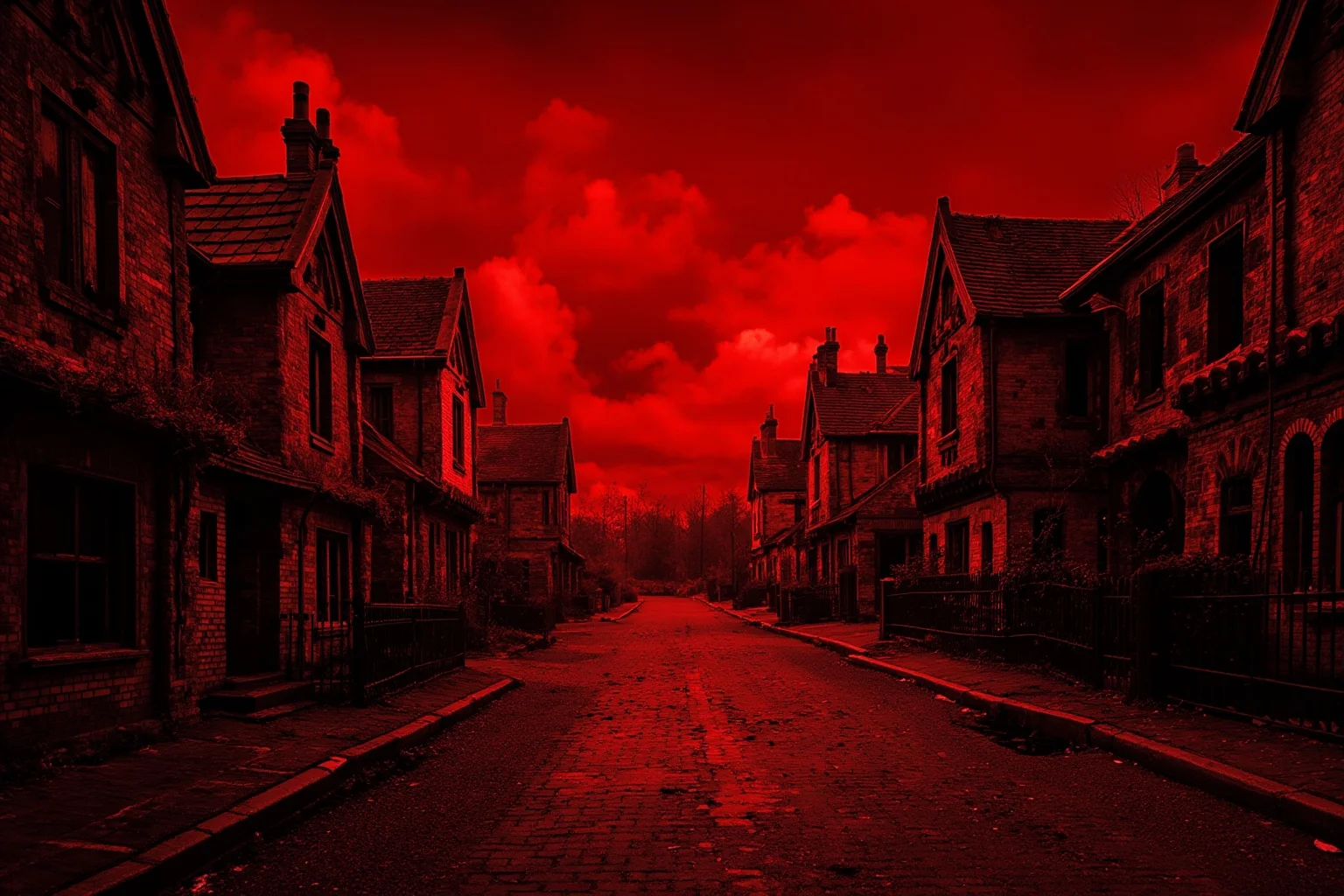
Students searching for a summary of The War of the Worlds or a quick sparknotes-style rundown are often approaching it as a classic assignment. But the novel’s lasting relevance goes well beyond the classroom, since it essentially invented the alien invasion genre that later shaped everything from science fiction films to modern disaster narratives.
It also remains a strikingly early example of an author using speculative fiction to critique real-world power structures rather than simply entertain. Wells used Martians to make Victorian Britain look at its own reflection, a technique later science fiction writers would borrow again and again.
The novel’s ending, with humanity saved by disease rather than heroism, still resonates as a humbling reminder about the limits of human control. It is a theme that has only grown more resonant in the century since, through real pandemics, real wars, and real reckonings with empire.
Final Thoughts
H.G. Wells’ The War of the Worlds endures not because it predicted little green men, but because it used an imagined invasion to interrogate very real, very human problems: arrogance, empire, and the fragile assumptions civilizations make about their own permanence. Reading it purely as a monster story misses most of what Wells was actually doing on the page.
When you go back to the source material rather than the countless adaptations, the political and scientific commentary is impossible to miss. That is really what separates H.G. Wells’ War of the Worlds from the pulpier invasion tales it inspired, and why it still gets assigned, adapted, and argued over more than 125 years later.
Frequently Asked Questions
What is H.G. Wells’ War of the Worlds actually about?
On the surface, HG Wells' War of the Worlds is about a Martian invasion of Victorian England, told through an unnamed narrator's survival. Underneath that, Wells used the story to critique British imperialism, Darwinian struggle, and the fragility of human civilization when faced with a technologically superior, morally indifferent power.
When was War of the Worlds written and published?
H.G. Wells wrote the novel between roughly 1895 and 1897. It was first serialized in magazines in 1897 before being published as a complete novel in 1898.
What is the basic summary of The War of the Worlds?
An unnamed narrator in Surrey witnesses Martians land in cylinders and unleash devastating fighting machines against humanity. Society collapses as the invasion spreads toward London, and the Martians appear unstoppable until they are ultimately killed by ordinary Earth bacteria, to which they have no immunity.
What is the setting of The War of the Worlds?
The novel is set in real towns in Surrey, England, including Woking and Leatherhead, and in London, during roughly the same period it was written, the late 1890s. This grounded, real-world setting made the invasion feel unnervingly plausible to contemporary readers.
What are the main themes in War of the Worlds?
Key themes include the critique of imperialism and colonialism, Darwinian survival of the fittest, the fragility of civilization under crisis, and human arrogance about our dominance over nature. The Martians' downfall by disease reinforces the theme that humanity survives more by chance than by strength.
Is the 1938 War of the Worlds radio panic a true story?
The Orson Welles 1938 radio adaptation did alarm some listeners, but historians have found that widespread nationwide panic was significantly exaggerated by newspapers at the time. It is more accurate to describe it as a media-amplified myth than a fully documented mass hysteria event.
Why is War of the Worlds considered an important science fiction novel?
It helped establish the alien invasion genre and demonstrated how speculative fiction could be used to comment on real political and scientific issues, like empire and evolution. Its influence can be traced through countless later films, radio dramas, and novels about extraterrestrial conflict.

Alex Warren
Related Articles





