
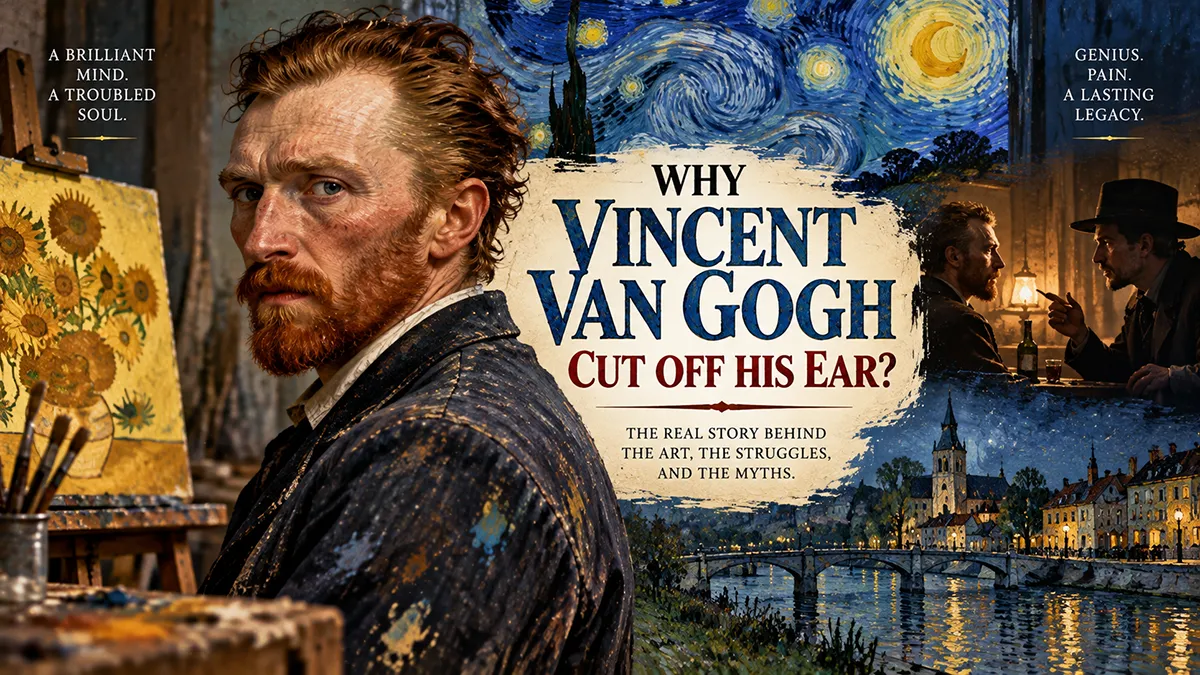
Vincent van Gogh is one of the most beloved painters in history, famous for swirling stars, sunlit wheat fields, and a face we all recognize from his self-portraits — bandage and all. That bandage points to one of the strangest, saddest, and most misunderstood moments in art history: the night Van Gogh mutilated his own ear.
It’s a story that’s been repeated so often it’s picked up myths along the way, from exaggerated love triangles to conspiracy theories about who really wielded the blade. So let’s separate the documented facts from the folklore, and look honestly at what happened, why it likely happened, and what we still don’t know for certain.
TL;DR: On the night of December 23, 1888, a severely distressed Vincent van Gogh cut off part of his left ear during a mental health crisis worsened by a tense falling-out with fellow artist Paul Gauguin, exhaustion, and probable underlying illness — not, as legend often claims, simply over a woman or an argument alone.
What Really Happened on December 23, 1888
Vincent van Gogh was living in Arles, in the south of France, sharing a rented house he called the “Yellow House” with fellow painter Paul Gauguin.
The two had been working together for about two months, and their relationship had grown increasingly strained. Van Gogh was overworked, drinking heavily, eating poorly, and showing signs of severe psychological distress.
On the evening of December 23, 1888, something inside Van Gogh broke. In the aftermath, he used a razor to cut off a portion of his own left ear.
He then wrapped the wound and, according to the most widely accepted account, walked to a nearby brothel and handed the piece of ear to a woman who worked there before returning home.
Gauguin later said he found Van Gogh unconscious the next morning, covered in blood. Van Gogh was rushed to the Hôtel-Dieu hospital in Arles, where doctors treated the wound and worked to stabilize him.
This is the incident people are asking about when they search for how did Van Gogh lose his ear, and it is confirmed by contemporary police reports, hospital records, and letters — not just legend.
The Story Behind the Story: Van Gogh and Gauguin in Arles
To understand why this happened, you have to understand the pressure Van Gogh was under that autumn. He had invited Gauguin to Arles hoping to build an artists’ colony, a shared studio he called the “Studio of the South.” It was meant to be a creative partnership and a source of much-needed companionship.
Instead, the two artists clashed constantly. They disagreed about technique, philosophy, and how to spend their time, and Van Gogh’s letters from this period show growing anxiety and instability. Gauguin, for his part, found living with Van Gogh exhausting and later wrote about tension building in the days before the incident.
On December 23, the two reportedly argued, and Gauguin left the house, later saying he decided to stay elsewhere that night. Some accounts describe Van Gogh confronting Gauguin with a razor earlier that evening, though Gauguin’s own retelling of events — written years later — is not considered fully reliable by historians. What’s clear is that the argument was the spark, not the whole explanation.
So Why Did Van Gogh Cut Off His Ear? The Leading Theories
There isn’t one single, universally agreed-upon reason why Van Gogh chopped his ear off, and that’s exactly why the question keeps getting asked. Most historians and medical researchers point to a combination of factors rather than one clean motive.
A Severe Mental Health Crisis
Van Gogh had been showing signs of serious psychological strain for weeks before the incident, including erratic behavior, extreme mood swings, and paranoia. Many researchers now believe he experienced some kind of acute psychotic or dissociative episode that night, which is why the phrase “psychotic episode” comes up so often in discussions of the Van Gogh ear incident.
His own letters, written to his brother Theo in the days after, describe confusion about what happened and a sense that he had lost control. He wasn’t performing an act of calm decision-making; he appears to have been in genuine crisis.
Underlying Illness
Over the decades, doctors and historians have proposed dozens of possible diagnoses for Van Gogh, including bipolar disorder, temporal lobe epilepsy, borderline personality disorder, and even lead poisoning from his paints. Some researchers have also pointed to acute intermittent porphyria, a rare metabolic disorder that can cause psychiatric symptoms.
None of these diagnoses can be confirmed with certainty today, since they rely on secondhand descriptions from over a century ago rather than direct medical examination. What’s fairly well agreed is that Van Gogh suffered from some kind of recurring psychiatric condition that worsened under stress.
Alcohol, Exhaustion, and Poor Health
Van Gogh was known to drink absinthe heavily during his time in Arles, and he often neglected sleep and food while consumed by his work. This kind of physical depletion can worsen almost any underlying psychiatric vulnerability, and many historians see it as a contributing factor rather than the root cause.
Combined with the emotional blow of his falling-out with Gauguin, and possibly the looming departure of a friend he badly needed, the conditions were set for a breakdown. It’s this pileup of stressors — not a single dramatic betrayal — that most likely triggered the event.
Grief, Guilt, and Isolation
Van Gogh struggled throughout his life with loneliness and a fear of being a burden to his brother Theo, who supported him financially. Some historians believe the prospect of Gauguin leaving Arles, effectively ending the artist colony Van Gogh had hoped for, intensified his sense of failure and abandonment.
It’s worth noting that Van Gogh himself later described the act with regret and confusion rather than defiance. This lines up with a mental health crisis rather than a considered statement or gesture.
Which Ear Did Van Gogh Cut Off?
Historical and medical records indicate Van Gogh cut off part of his left ear, not the right. This detail matters because of a famous visual mix-up: in his self-portraits painted afterward, the bandage appears on the right side of his face.
That’s not a historical inconsistency — it’s simply how mirrors work. Van Gogh painted himself by looking in a mirror, which reverses the image, so the bandaged ear appears on the opposite side in the finished painting. If you’ve ever looked at one of the famous “Self-Portrait with Bandaged Ear” paintings and wondered which side was real, now you know why it looks flipped.
What Did Van Gogh Do With the Severed Ear?
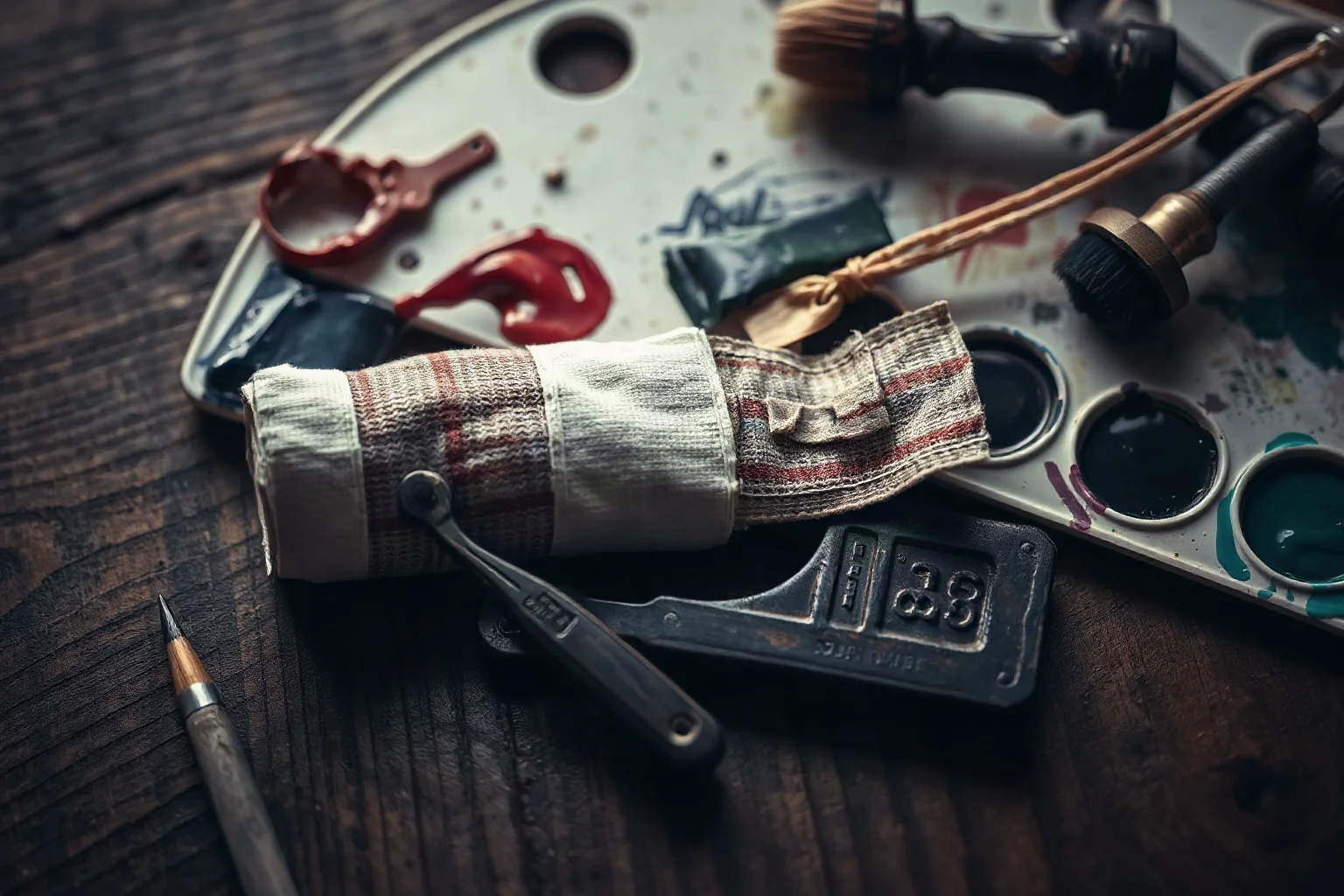
According to police and hospital accounts from the time, Van Gogh wrapped the piece of his ear and carried it to a brothel he was known to frequent in Arles. He reportedly asked for a woman named Rachel and handed her the ear, apparently asking her to keep it.
This detail can sound almost absurd out of context, but it fits the picture of a man in acute crisis rather than someone acting with clear reasoning. Local newspapers reported on the strange incident within days, and it quickly became local, then international, gossip.
Did Gauguin Actually Cut Off Van Gogh’s Ear?
One persistent and controversial theory deserves mention because it circulates widely online. In 2009, two German art historians, Hans Kaufmann and Rita Wildegans, published a book arguing that Gauguin — an experienced fencer — may have accidentally sliced off Van Gogh’s ear during a heated confrontation involving swords, and that the two men then agreed to cover it up.
This theory is intriguing but remains speculative and is not accepted by most mainstream Van Gogh scholars, including experts at the Van Gogh Museum in Amsterdam. The bulk of contemporary evidence, including Van Gogh’s own letters and hospital reports from the time, points to self-inflicted injury during a psychological crisis, not an accident caused by someone else. It’s a fascinating footnote in the historiography of the case, but it shouldn’t be mistaken for a settled alternative explanation.
The Aftermath: Hospitals, Asylums, and a Return to Painting
After the incident, Van Gogh was hospitalized in Arles, where he was initially in critical condition. Theo van Gogh rushed to be with his brother, and Gauguin quickly left Arles for good, ending their brief experiment in shared living and work.
Local residents, unnerved by the incident and Van Gogh’s erratic behavior in the weeks that followed, petitioned to have him committed. In May 1889, Van Gogh voluntarily admitted himself to the Saint-Paul-de-Mausole asylum in Saint-Rémy-de-Provence, seeking stability and treatment.
Remarkably, this period of hospitalization became one of his most productive as an artist. It was at Saint-Rémy that he painted “The Starry Night,” along with dozens of other now-iconic works, suggesting that even amid serious illness, his creative drive never fully left him.
Was the Ear Incident a Single “Psychotic Episode,” or Part of a Pattern?
Medical historians generally view the December 1888 incident as part of a larger pattern of psychiatric crises rather than an isolated event. Van Gogh experienced several further breakdowns during his time at Saint-Rémy, some severe enough that he was temporarily unable to paint.
This pattern is one reason modern doctors lean toward diagnoses involving recurring mood or psychotic episodes, rather than a single one-time trigger. Whatever the precise clinical label, the evidence suggests Van Gogh lived with a serious, fluctuating mental illness for the final years of his life, and the ear incident was one especially dramatic flashpoint within it.
Did Van Gogh Live the Rest of His Life With One Ear?

Yes. Van Gogh did not fully lose his hearing, but he did permanently lose part of his outer left ear, and photographs and accounts from his final years confirm he lived visibly altered by the injury. He generally covered it with hats or bandages and largely avoided discussing the incident directly in his later letters.
He died less than two years later, in July 1890, from a gunshot wound widely believed to be self-inflicted, following further struggles with his mental health. The ear incident is often remembered as an early, visible sign of the deeper crisis that would eventually take his life.
The Myth of the “Tortured Genius”
Van Gogh’s story has fed a persistent cultural myth: the idea that genius and madness are inseparable, and that suffering somehow fuels great art. It’s a compelling narrative, but most art historians and mental health experts caution against romanticizing it.
Van Gogh’s most celebrated paintings were often produced despite his illness, during calmer stretches, not because of active crises. Treating the ear incident as some kind of artistic statement misunderstands what was, by every contemporary account, a medical and psychological emergency.
Untangling Van Gogh From Picasso: Clearing Up a Common Mix-Up
Because the phrase “artist who cut off his ear” is so tied to Van Gogh, some people searching online end up wondering whether Pablo Picasso did something similar. He didn’t. There is no credible historical record of Picasso cutting off his own ear or anyone else’s.
The confusion likely comes from Picasso’s fame as another towering, sometimes turbulent modern artist, plus the general blending of famous art-world anecdotes in popular memory. When people ask “who was the artist that cut his ear off,” the answer, based on verified historical record, is Vincent van Gogh alone.
Why This Story Still Fascinates Us
More than 130 years later, people are still searching to understand why Van Gogh cut off his ear, and that curiosity says a lot about how we relate to artists and mental illness. The incident is shocking, but it’s also deeply human: a portrait of a man in real pain, not a gothic legend.
Understanding the full context — the failed artist colony, the fraught friendship with Gauguin, the probable underlying illness, the exhaustion and drinking — gives us a much more accurate, and more compassionate, picture than the shorthand version of the story. Van Gogh wasn’t a tortured myth performing for history; he was a real person living through a real crisis, one that happened to unfold in front of an audience that never forgot it.
When we look at his bandaged self-portraits today, we’re not just looking at an odd historical curiosity. We’re looking at an artist who kept painting through some of the darkest moments of his life, leaving behind both extraordinary art and an honest, if painful, record of what he endured.
Frequently Asked Questions
Did Van Gogh really cut off his own ear?
Yes. Historical records, including police reports and hospital documents from Arles, confirm that Vincent van Gogh cut off part of his left ear on the night of December 23, 1888, during a severe mental health crisis.
Vincent van Gogh, why did he cut his ear off?
Most historians point to a combination of factors: a tense falling-out with fellow artist Paul Gauguin, exhaustion, heavy drinking, and an underlying psychiatric condition that caused an acute breakdown. There was no single simple motive, and it wasn't a calm, deliberate decision.
Which ear did Van Gogh cut off?
Van Gogh cut off part of his left ear. In his self-portraits, the bandage appears on the right side because he painted from a mirror reflection, which reverses the image.
What did Van Gogh do with his severed ear?
According to contemporary accounts, Van Gogh wrapped the piece of his ear and carried it to a brothel in Arles, where he gave it to a woman he knew there. He then returned home, where Gauguin reportedly found him unconscious the next morning.
When did Van Gogh cut off his ear?
The incident took place on the night of December 23, 1888, while Van Gogh was living in Arles, France, sharing a house with painter Paul Gauguin.
Did Van Gogh have one ear for the rest of his life?
Van Gogh survived with a permanently altered left ear after losing part of it in the 1888 incident, though he did not lose his hearing entirely. He lived with the visible injury until his death in 1890.
Was Van Gogh’s ear actually cut off by Gauguin, not himself?
A 2009 theory by two German researchers suggested Gauguin may have accidentally injured Van Gogh's ear during a sword-related altercation, but this idea is speculative and not accepted by most mainstream Van Gogh scholars. The dominant, better-supported account remains that Van Gogh injured himself during a psychological crisis.
Why did Picasso cut his ear?
Picasso did not cut off his ear. That story belongs entirely to Vincent van Gogh; the two artists are sometimes confused simply because both are iconic, famously eccentric painters.
How did Van Gogh cut his ear?
According to historical accounts, Van Gogh used a razor to cut off part of his own left ear during an episode of acute psychological distress in Arles.
Was the Van Gogh ear incident a psychotic episode?
Many medical historians believe Van Gogh experienced some form of acute psychotic or dissociative episode that night, though exact diagnoses like epilepsy, bipolar disorder, or porphyria remain debated. It appears to have been part of a broader pattern of psychiatric crises he experienced in his final years.

Alex Warren
Related Articles