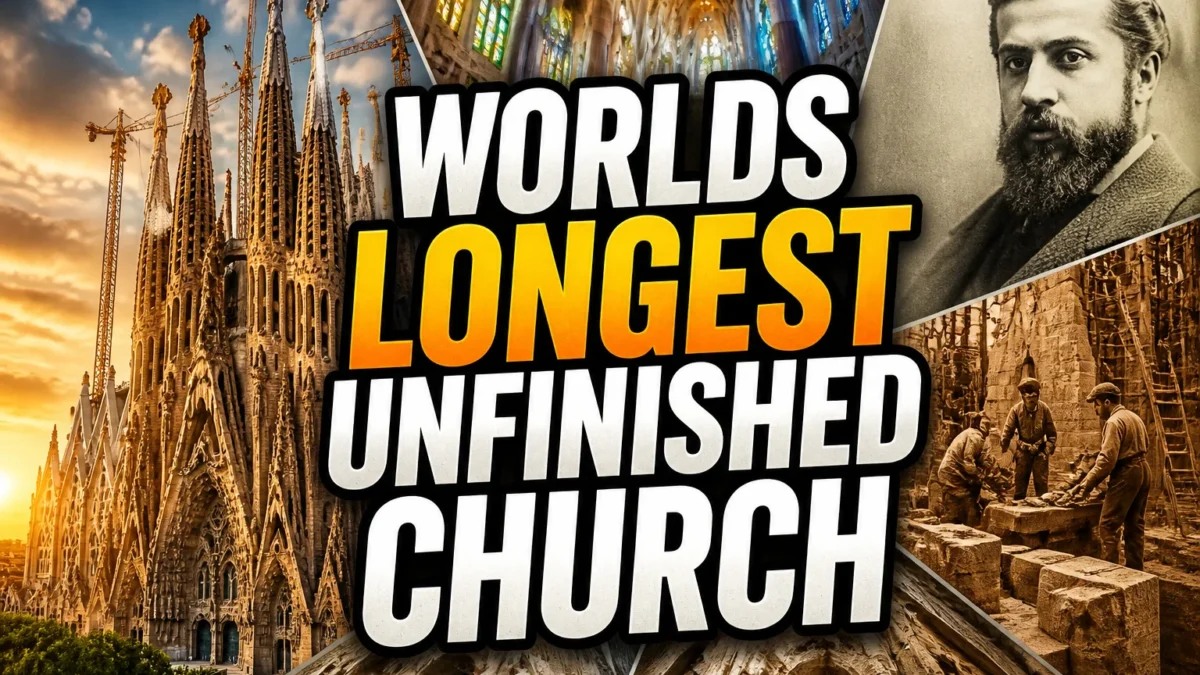
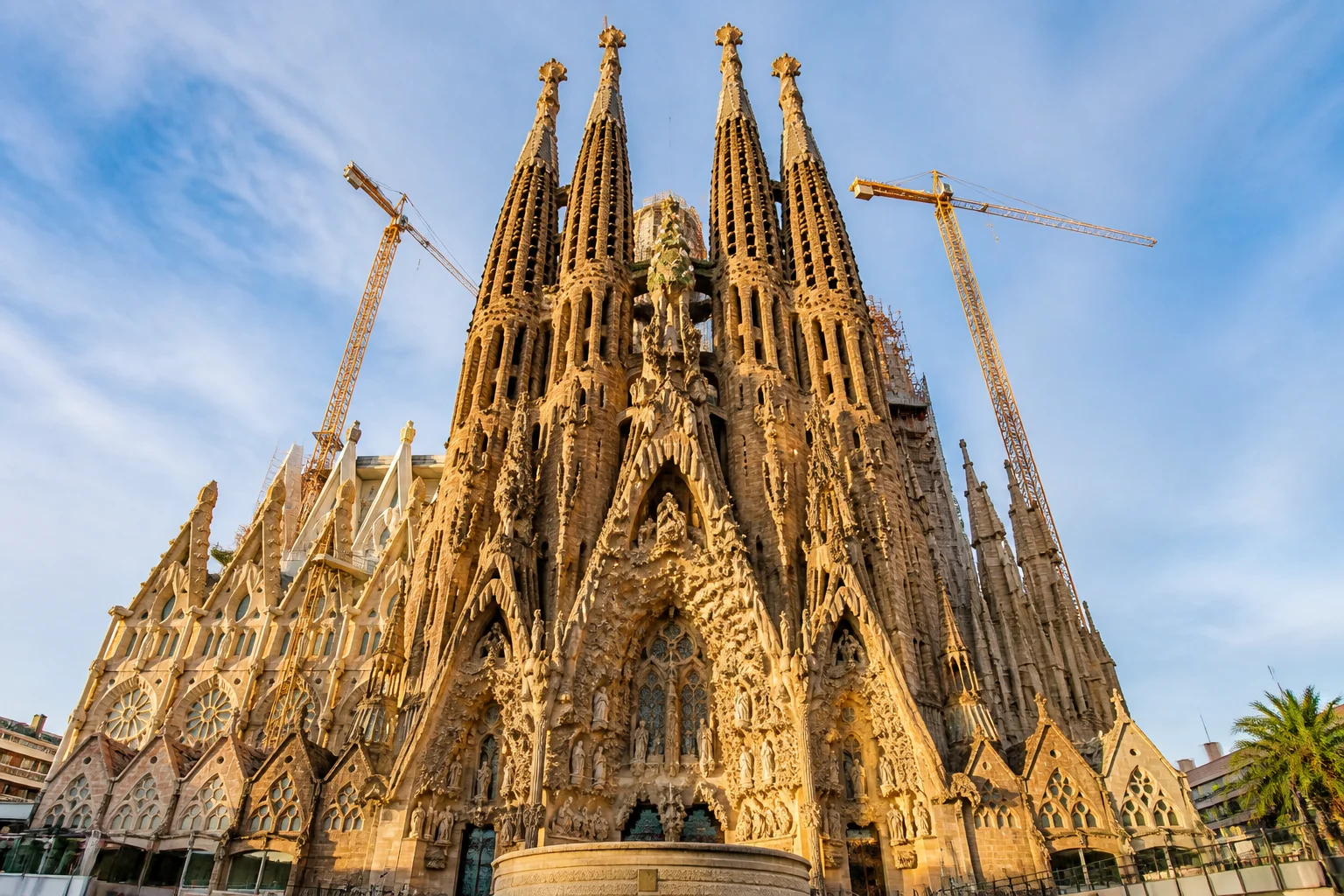
Barcelona’s skyline is crowded with Gothic towers, modern art museums, and one enormous construction crane. For more than 140 years, that crane has belonged to the Basílica de la Sagrada Família, the city’s famous unfinished church and a masterpiece still in the making. Visitors do not come to see a finished monument; they come to watch history being built in real time.
The building is often called the world’s longest unfinished building, and the label is difficult to dismiss. Construction began in 1882, and work has never stopped for good since. Yet the story behind that slow rise is not a simple tale of administrative delays or poor planning.
TL;DR: The Sagrada Família has been under construction since 1882, surviving war, funding gaps, and the death of its architect to become a leading contender for the world’s longest unfinished building.
A Bookseller’s Dream Starts the Unfinished Church
The Sagrada Família began with a bookseller named Josep Maria Bocabella. In 1866 he founded a spiritual association devoted to Saint Joseph and the Holy Family. The group wanted an expiatory temple, a church built to honor and make amends through private donations.
Bocabella bought a plot in Barcelona’s then-new Eixample district. The first architect, Francisco de Paula del Villar, designed a conventional neo-Gothic church. The foundation stone was laid on March 19, 1882, but the project soon faltered over technical and cost disagreements.
By 1883 del Villar had resigned. Antoni Gaudí, a 31-year-old architect with a growing reputation, accepted the commission. He eventually discarded much of the original Gothic scheme and replaced it with something radically personal.
Gaudí’s All-Consuming Vision for the Unfinished Church
Gaudí spent 43 years connected to the Sagrada Família. He worked on it alongside other famous projects for decades, but in his final twelve years he devoted himself to it almost exclusively. He moved into a workshop on the site and became as much a resident as an architect.
He knew he would not live to finish the church. When asked about timescales, he is often credited with saying that his client was not in a hurry. That remark captures the project’s early philosophy: the church would be finished when enough money and skill allowed it to be finished.
Gaudí produced drawings, plaster models, and precise geometric studies for his successors. Many of those records were later destroyed, but their influence still shapes every stone placed today.
Why It Is Called the World’s Longest Unfinished Building
The label ‘world’s longest unfinished building’ is popular shorthand rather than an official record. Other great churches, such as Cologne Cathedral, took centuries from start to completion, though Cologne stood unfinished or dormant for long stretches. The Sagrada Família’s distinction is its 140-plus years of nearly continuous construction activity.
A medieval cathedral often grew in fits and starts across many generations. The Sagrada Família has also experienced interruptions, but it has remained a live construction site into the 21st century. That makes it a natural candidate for the world’s longest unfinished building.
Still, comparisons are tricky. Some ancient and modern projects have longer timelines if you include periods of total abandonment or multi-phase rebuilding. When people use the phrase today, they usually mean a famous unfinished church that is still actively rising after more than a century.
The Pay-as-You-Go Model Behind the Unfinished Church
One of the biggest reasons the Sagrada Família remains an unfinished church is money. It is not funded by the Vatican, the Spanish state, or the city of Barcelona in the way many assume. Instead, it has historically relied on private donations, alms, and, in recent decades, ticket sales.
The church was conceived as an expiatory temple. That meant its construction would be supported by the faithful rather than by a royal treasury or a bishop’s budget. When funds ran low, work simply slowed.
Today, millions of visitors buy tickets each year, and those funds keep the work moving. This pay-as-you-go model gives the project unusual independence, but it also makes completion dates dependent on tourism and the wider economy.
A Timeline of Slow Progress and Hard Stops
Construction progressed steadily between 1882 and 1926. During those decades, Gaudí completed the crypt, the apse, and much of the Nativity facade. By his death in 1926, however, less than a quarter of the full design had been built.
The worst setback came in 1936, during the Spanish Civil War. Rioters set fire to the crypt and smashed Gaudí’s plaster models, drawings, and photographs. The attack destroyed a huge part of the project’s physical memory.
Reconstruction of the surviving fragments took years. A team of architects and craftspeople puzzled over broken models to recover Gaudí’s intent. Work continued through the late twentieth century with new tools and computer-aided stone cutting.
Major milestones eventually stacked up. The nave was covered and opened for worship, and in 2010 Pope Benedict XVI consecrated the building as a minor basilica. Even so, the towers and the main Glory facade remained unfinished.
The Spanish Civil War: How an Unfinished Church Almost Lost Its Blueprint
The 1936 attack is one of the most painful chapters in the church’s history. Anarchist and anti-clerical violence during the civil war targeted many religious buildings in Barcelona. The Sagrada Família’s crypt was burned, and the workshop that held Gaudí’s models was ransacked.
The loss was not just symbolic. Gaudí had relied heavily on three-dimensional plaster models rather than conventional blueprints. When those models were smashed, later architects had to reconstruct complex geometry from scattered fragments.
Experts still debate which modern details reflect Gaudí accurately and which are sensitive reconstructions. That uncertainty is one reason the unfinished church contains so much interpretation alongside preservation.
Geometry That Slows the Work Down
Gaudí avoided the simple flat walls and uniform arches of earlier Gothic designs. He used ruled surfaces, hyperboloids, helicoids, and other complex geometries that require each stone to be cut differently. That visual richness comes at a practical cost.
Before modern computer modeling, each block had to be shaped by hand using templates and trial. Even today, many pieces are individually produced, and the schedule must account for quality control. The result is an unfinished church with no repetitive assembly line.
The design also relies on inclined columns that branch to match structural forces. Gaudí tested these ideas with hanging weighted strings to find optimal shapes. The same forms that make the interior feel alive are the reason progress cannot be rushed.
The Architect’s Death: A Turning Point for the Unfinished Church
Antoni Gaudí died on June 10, 1926, three days after being struck by a tram. He was dressed plainly, and witnesses initially mistook him for a beggar. He was taken to a hospital, where he was identified too late for his injuries to be treated as they might have been.
His death transformed the project from a living personal vision into a collective inheritance. Architects after him had to interpret what he wanted, often disagreeing about details. Every new generation of builders has had to answer the same question: what would Gaudí do?
Today Gaudí is buried in the crypt of the Sagrada Família. His tomb lies in the very building he worked on for more than four decades, making the unfinished church both his legacy and his resting place.
Reading the Three Facades of the Unfinished Church
Every finished and unfinished part of the Sagrada Família is packed with narrative. The church is designed with three grand facades: the Nativity on the east, the Passion on the west, and the Glory on the south. Each facade tells a different part of the Christian story.
The Nativity facade is the only major facade completed in Gaudí’s lifetime. It is exuberant, organic, and crowded with plant and animal forms. The Passion facade, built later from Gaudí’s drawings, is stark and angular, reflecting suffering.
The Glory facade is still under construction and will eventually serve as the main entrance. It is planned to depict the road to God, the afterlife, and the Final Judgment. Until it is complete, the church’s story remains literally unfinished.
The Eighteen Towers Still Reaching for the Sky
Gaudí’s full design calls for eighteen towers. Twelve represent the apostles, four represent the evangelists, one represents the Virgin Mary, and the tallest represents Jesus Christ. The tower program gives the building its unmistakable rising profile.
Progress on the towers has accelerated in recent years. The Tower of the Virgin Mary was crowned with a twelve-pointed star in late 2021. The four evangelists’ towers have since been completed in stages, visibly changing the skyline.
The central Tower of Jesus Christ is designed to reach 172.5 meters, which would make it the tallest church tower in the world. That height would surpass Ulm Minster’s 161.5-meter steeple, though the Sagrada Família’s final form is still being built.
One often-repeated detail is that Gaudí wanted the tallest tower to stay below the summit of Montjuïc hill. Guides commonly link this to his belief that human work should not exceed God’s creation, though the point is as symbolic as it is structural.
Inside the Unfinished Church: What Visitors See Today
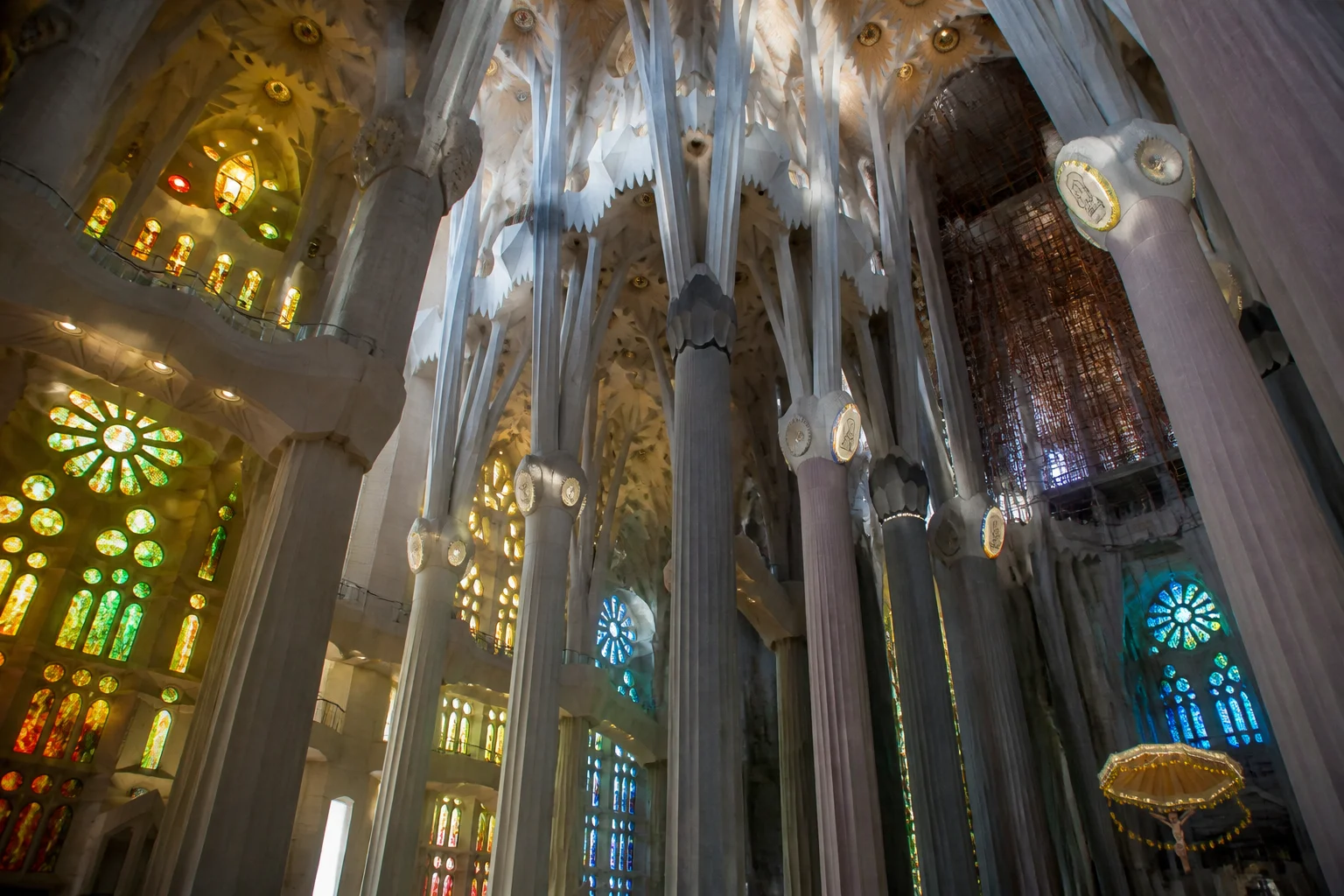
Walking into the Sagrada Família today is unlike visiting a static old cathedral. The nave, consecrated in 2010, rises like a stone forest, with columns branching into tree-like capitals. Stained glass floods the space with shifting blue, green, orange, and red light.
Construction does not hide in the background. Visitors may hear saws, see scaffolding behind glass, and notice carved blocks waiting to be lifted into place. The building is a working site, a museum, and a basilica at the same time.
Because the church is an active place of worship, visitors are asked to dress respectfully and keep quiet during Mass. That mix of tourism and liturgy can feel unusual, but it reflects the building’s double life as an unfinished church and a functioning sacred space.
Is It Still an Unfinished Church if It Is Already a Basilica?
Some visitors assume an unfinished church cannot be used for worship. The Sagrada Família proves otherwise. In 2010, Pope Benedict XVI consecrated the building as a minor basilica, authorizing it for formal Catholic liturgy.
Consecration is not the same as completion. A church can be consecrated when its primary worship space is ready, even if towers, facades, and decorative work remain. That is exactly what happened in Barcelona.
The Sagrada Família has actually hosted worship for much longer in its crypt. The 2010 ceremony simply confirmed its elevated status while the larger building continued to rise around it.
Not a Cathedral: A Simple Myth Worth Busting
One of the most common errors visitors make is calling the Sagrada Família a cathedral. It is a basilica, not a cathedral, because it is not the seat of a bishop. Barcelona’s actual cathedral is the Cathedral of the Holy Cross and Saint Eulalia in the Gothic Quarter.
The distinction matters in history writing and local culture. Barcelonians often gently correct tourists who confuse the two buildings. Understanding the difference helps explain why this famous unfinished church has a unique legal and religious identity.
UNESCO Recognition: Only Part of the Unfinished Church Is Listed
The Sagrada Família’s relationship with UNESCO is more selective than many travelers realize. Its Nativity facade and crypt are part of the Works of Antoni Gaudí World Heritage designation. The listing was extended in 2005 to include those elements.
The entire modern construction is not a UNESCO World Heritage Site, because later work was built after Gaudí’s death. That partial listing surprises people who assume the whole building enjoys blanket protection. It also highlights the tension between preserving Gaudí’s hand and completing his vision.
Comparing the Sagrada Família to Other Unfinished Churches
The Sagrada Família is not the only great church to spend centuries unfinished. Cologne Cathedral began in 1248, stopped in the sixteenth century, and was not completed until 1880. St. John the Divine in New York has also been under construction for more than a century.
What makes Barcelona’s unfinished church unusual is its continuity and its tourist economy. Cologne sat dormant for centuries, while the Sagrada Família has been actively building in most decades since 1882. Each case shows that delay is the norm for ambitious sacred architecture.
Historians often note that medieval cathedrals were also funded by donations and shaped by changing tastes. The Sagrada Família belongs to that older tradition even though it uses modern cranes, software, and laser cutting.
The Role of Technology in a Handmade Unfinished Church
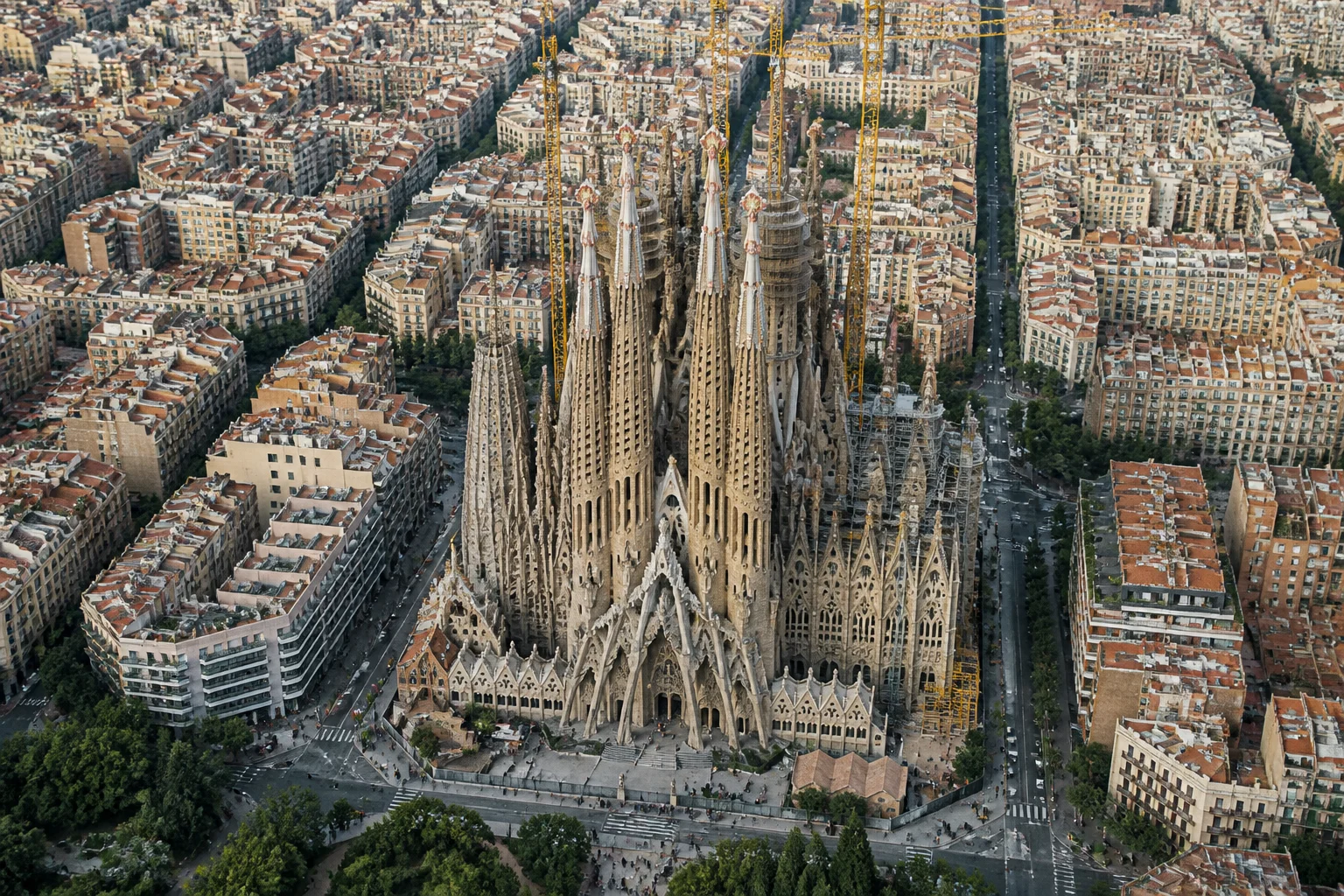
For much of its life, the Sagrada Família was built with hand tools, wooden molds, and patient craftsmanship. In the late twentieth century, computer-aided design and robotic stone cutting began to accelerate the work. These tools allow complicated blocks to be shaped more quickly and precisely.
Technology has not erased the human element. Artisans still assemble, finish, and place many pieces by hand. The project blends 19th-century devotion with 21st-century technique, which makes it a strange and fascinating construction site.
This mix also raises preservation questions. Some historians worry that machine precision changes the texture Gaudí intended. Others argue it is the only practical way to complete the church within a lifetime.
Why the World Still Visits an Unfinished Church
The Sagrada Família drew roughly 4.5 million visitors in its busiest pre-pandemic years. Many come precisely because it is unfinished. They want to see a masterpiece in progress rather than a sealed museum piece.
There is also a pilgrimage quality to the building. People return years apart to see new towers, new facades, or new stained glass. An unfinished church offers something a completed monument cannot: visible change.
Guides often point out that watching the Sagrada Família rise is like watching a medieval cathedral being built in real time. The experience turns visitors into witnesses of an ongoing historical event.
The 2026 Target and the Reality of Completion Dates
For years, the project used 2026 as a symbolic completion date, marking the centenary of Gaudí’s death. That goal has slipped more than once, especially after the COVID-19 pandemic interrupted construction and dried up visitor income.
Current official communications focus on finishing the central Tower of Jesus Christ around 2026, not on finishing every detail of the church. Other work, including the Glory facade and some decorative programs, could continue into the 2030s.
It is wise to read any announced completion date with patience. The Sagrada Família has never behaved like a normal construction project, and its deadlines have always been aspirational rather than contractual.
What Finishing an Unfinished Church Actually Means
Even when the last tower is topped out, the Sagrada Família may not look finished in the way visitors expect. Some surfaces will remain plain, some sculptures may be added over time, and the building will still require maintenance. Completion is a spectrum, not a switch.
The church’s trustees and architects have also discussed balancing Gaudí’s original intent with modern safety and accessibility needs. That debate means some elements may be adapted or left open for future generations. In that sense, the unfinished church may never be entirely closed.
What the Unfinished Church Symbolizes in Barcelona
For many Barcelonians, the Sagrada Família is a civic symbol as much as a religious one. It appears on skyline photos, souvenirs, and city marketing, even though it is a working church. Its unfinished state has become part of the city’s identity.
Some locals have mixed feelings about the crowds, ticket prices, and constant construction. Others view the slow work as a refreshing counterpoint to fast, disposable modern building. The debate is part of what makes the unfinished church so interesting.
The building has also survived political upheaval, economic crises, and changing architectural fashion. Its continued rise suggests that cities can commit to multi-generational projects, not just short-term wins.
Closing: Why the Unfinished Church Matters
The Sagrada Família is not famous despite being unfinished; it is famous in part because it is unfinished. Its slow construction connects modern Barcelona to the long, uncertain building campaigns of the medieval past. It reminds us that great architecture often outlasts the people who dream it.
Next time you see a photo of its cranes and spires, you will know the story behind them. The world’s longest unfinished building is not a failed project; it is a living one, and it still has chapters left to build.
Frequently Asked Questions
Why is the Sagrada Família called the world’s longest unfinished building?
It has been under construction since 1882, and its slow pace, interruptions from war, and pay-as-you-go funding have made it a famous unfinished church. Unlike many older cathedrals that stopped for centuries, it has remained an active building site for most of its life.
When will the Sagrada Família be finished?
The project once aimed for 2026, the centenary of Gaudí’s death, but that target has slipped. The central Tower of Jesus Christ may be complete around 2026, while other work, including the Glory facade, could continue into the 2030s.
Is the Sagrada Família a cathedral?
No, it is a minor basilica, not the seat of a bishop. Barcelona’s cathedral is the Cathedral of the Holy Cross and Saint Eulalia in the Gothic Quarter.
Can you go inside the Sagrada Família while it is unfinished?
Yes, it has been an active basilica since its consecration in 2010 and welcomes millions of visitors each year. You can see completed worship spaces alongside active construction work.
Was Antoni Gaudí buried in the unfinished church?
Yes, Gaudí is buried in the crypt of the Sagrada Família, in the chapel dedicated to Our Lady of Mount Carmel. His tomb lies in the building he worked on for more than four decades.

Alex Warren
Related Articles