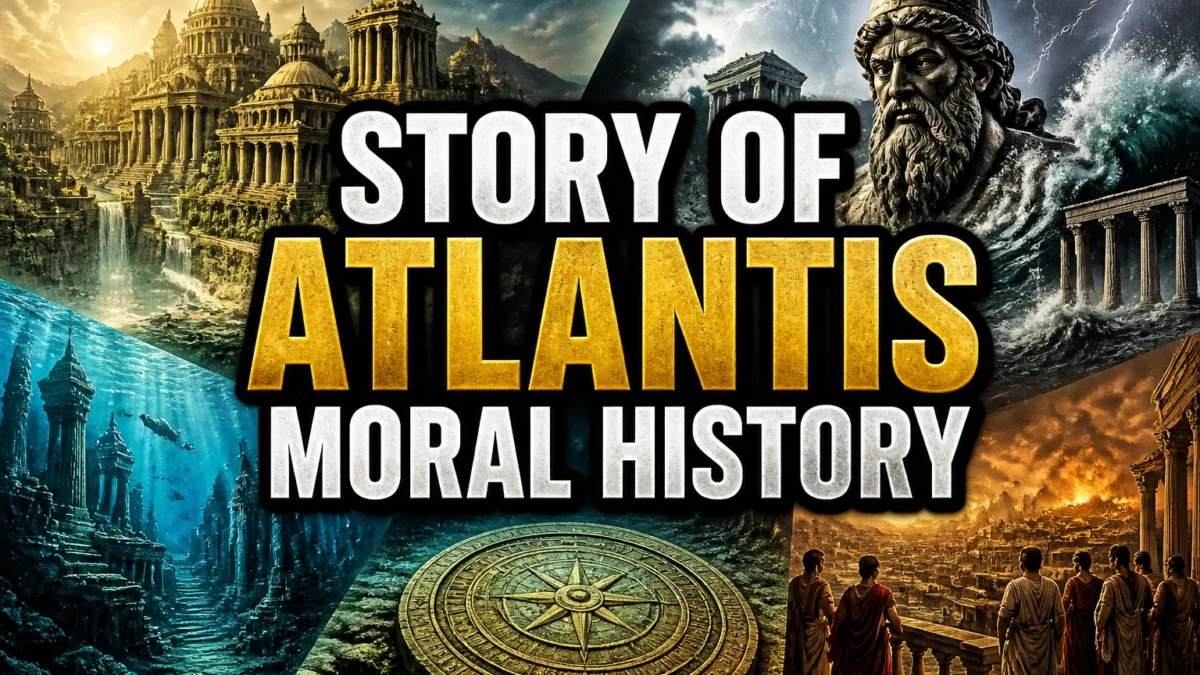
Few ancient tales fuse geography, philosophy, and catastrophe as completely as the Atlantis story. It begins with a philosopher, not an archaeologist, and it was written for a moral purpose as much as a historical one. For most readers, Atlantis the story opens not with maps but with a question about power.
The legend of Atlantis is often treated as a missing page from real history, but the evidence points in a different direction. Plato created or adapted the tale in the fourth century BCE to explore justice, virtue, and the rise and fall of civilization. Understanding the legend of the Atlantis means reading it as a deliberate thought experiment, not a settled historical record.
TL;DR: The Atlantis story is Plato's philosophical allegory about a powerful island civilization destroyed by its own hubris, not an archaeologically verified lost continent.
Where Did the Story of Atlantis Come From?
To answer where did the story of Atlantis come from, you have to start with one ancient Greek writer. Plato introduced the island in two dialogues, Timaeus and Critias, composed around 360 BCE. These works are philosophical conversations, not travelogues or chronicles.
The story is presented as something the Athenian lawmaker Solon supposedly heard from Egyptian priests at Sais. According to the dialogues, Solon passed the tale down through Critias's family, and Critias retells it during a conversation with Socrates. That chain of transmission is part of Plato's framing device, and scholars treat it with caution.
So where does the story of Atlantis come from in a literary sense? It sits within a conversation about the ideal state, justice, and whether philosophy can explain real political success. Plato uses Athens as a noble counterpoint to Atlantis, which makes the tale feel more like a moral contrast than a documentary record.
Plato places the story about 9,000 years before Solon's time. That enormous gap removes it from any verifiable Greek or Egyptian historical record. The distance also gives Plato room to invent a society that can carry his philosophical argument.
Plato's decision to place the source in Egypt was not random. Egypt carried an ancient and wise reputation in the Greek imagination, which gave the tale an air of authority. By setting the story outside Greek memory, Plato could claim a deeper past than Athens could document.
Ancient writers after Plato did not agree on how to read the story. Some treated it as an instructive fiction, while others searched for a real location. That debate began early and has never really ended.
What Is the Story of Atlantis?
At its core, what is the story of Atlantis? In Plato's account, Atlantis was a vast island empire located beyond the Pillars of Heracles, the ancient Greek name for the Strait of Gibraltar. It was said to be larger than Libya and Asia combined, though ancient geographic labels do not map neatly onto modern continents.
The island was ruled by descendants of Poseidon, the sea god, and its first king was Atlas. Atlantis commanded a wealthy and technologically impressive civilization, with a powerful navy and influence over the Mediterranean. The kings initially ruled justly, but over time they grew arrogant and expansionist.
Plato describes the Atlantean empire as extending far beyond the main island. In the story, Atlantis controlled parts of North Africa and Europe up to the borders of Egypt and Tyrrhenia. That detail makes the war feel like a true clash of civilizations rather than a local dispute.
According to the tale, the Atlanteans launched a war against the peoples of the Mediterranean, including prehistoric Athens. Against the odds, the smaller and more virtuous Athenians defeated the invaders. Soon afterward, violent earthquakes and floods destroyed Atlantis, and the island sank beneath the sea in a single day and night.
Prehistoric Athens in the story is not the Athens of stone temples and city walls. It is a smaller, more austere society that Plato praises for its shared purpose and military discipline. The contrast with Atlantis is the core of the moral lesson.
That sequence of war and destruction is the emotional center of the Atlantis story. It gives the island a rise, a climax, and a fall in just a few pages. The fall is not framed as random bad luck but as a consequence of moral decay.
The story cuts off in Critias before the final judgment is described. Plato leaves the narrative unfinished, which only adds to the mystery. Readers never see the full divine punishment that Zeus appears ready to deliver.
Description of Atlantis: Plato's Blueprint
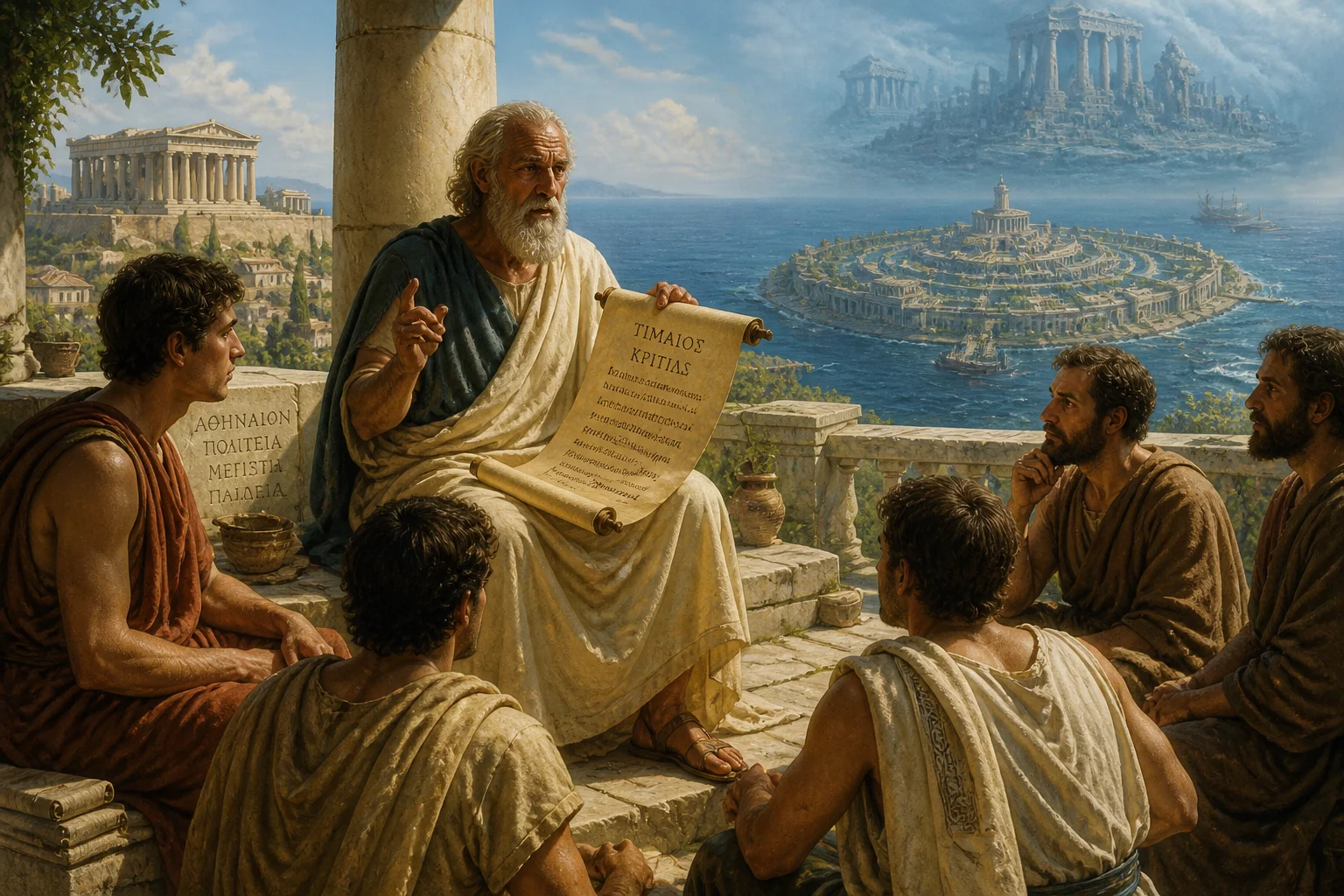
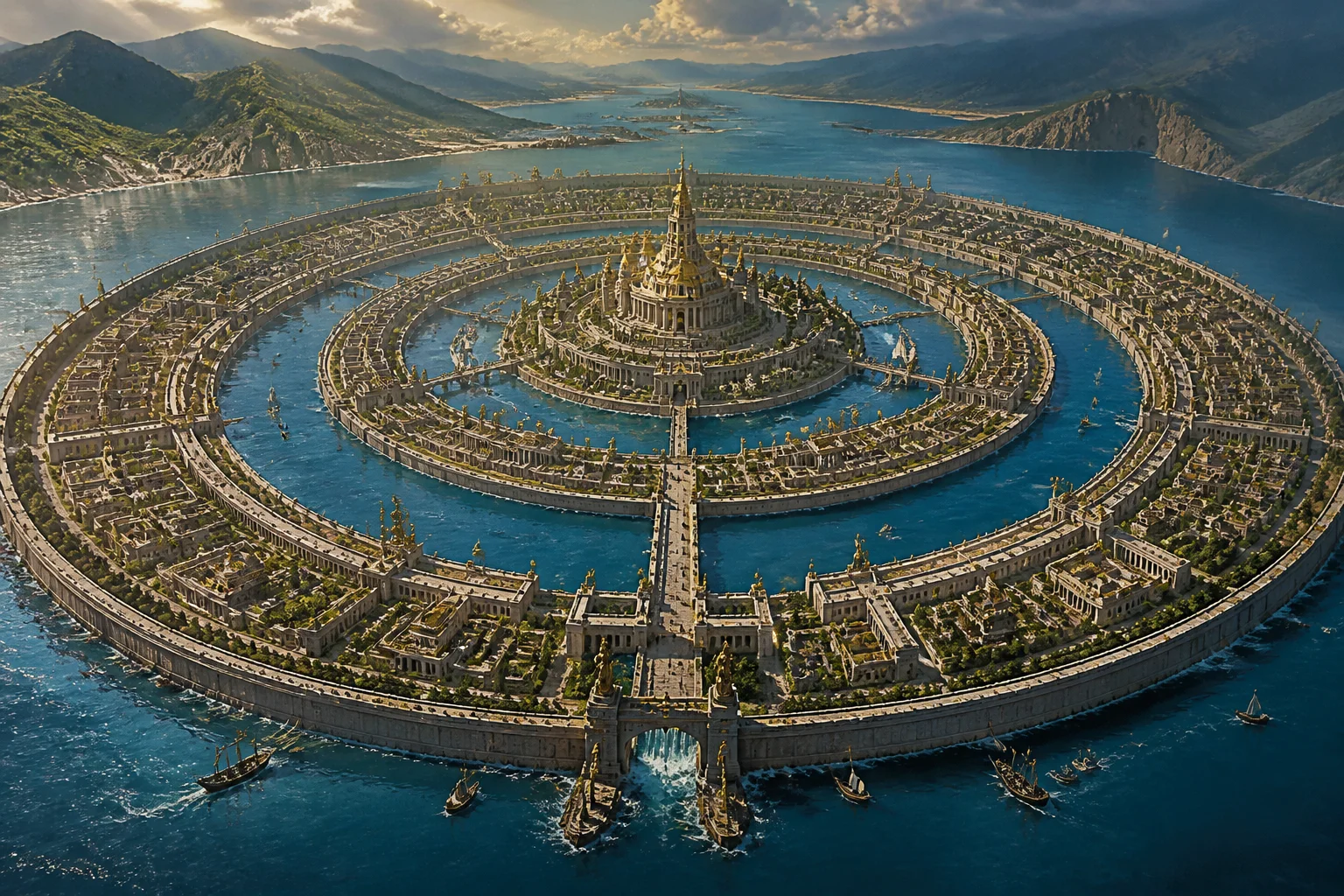
Plato offers a surprisingly detailed description of Atlantis, which is one reason the tale feels so vivid. The city was built on a central island and surrounded by concentric rings of water and land. These rings were connected by bridges and encircled by a harbor, creating a striking geometric layout.
According to the myth, Poseidon carved the island into rings to protect Cleito and their children. He then divided the kingdom among ten sons, with Atlas as the eldest and most powerful. This divine origin gives the city a claim to legitimacy and an early reason for its pride.
At the center stood a temple sacred to Poseidon and Cleito, his mortal partner. The temple was decorated with gold, silver, and a mysterious metal called orichalcum, which ancient readers could not always identify. The walls of the rings were coated with brass, tin, and orichalcum, giving the capital a gleaming, otherworldly appearance.
Beyond the capital, Plato describes a large rectangular plain irrigated by canals. The island supposedly produced abundant crops, timber, minerals, and even elephants. Hot and cold springs supplied water, and the city had separate zones for docks, walls, and residential areas.
Plato also describes a legal inscription on a pillar of orichalcum, where the kings of Atlantis recorded their laws. The rulers met at intervals to sacrifice a bull and renew their oath to govern justly. That ritual detail serves the moral structure of the story, not just its visual texture.
These details are part of the story's power, but they do not prove that Atlantis existed. Plato often used vivid imagery to make philosophical arguments more compelling. The description of Atlantis works best as an imaginative blueprint for an ideal, wealthy, and ultimately corrupted society.
What Is the History of Atlantis After Plato?
What we call the history of Atlantis is really the history of how people have used the story. For centuries after Plato, the tale circulated among Greek and Roman writers. Some accepted it as a real lost land, while others, like the geographer Strabo, treated it with open skepticism.
The philosopher Crantor was later reported to have believed the Egyptian account, but that report comes from a much later source and offers no direct proof. Most classical references to Atlantis are brief and repeat Plato rather than add independent evidence. No Egyptian text has ever been found that clearly mentions a drowned island empire called Atlantis.
During the Middle Ages, the legend of Atlantis remained mostly in the background of European thought. It returned with force in the Renaissance, when classical texts were rediscovered and utopian writers borrowed the name. Francis Bacon's New Atlantis, published in 1627, turned the lost island into a model for scientific and social progress.
In the modern era, the story shifted from philosophy to pseudoarchaeology. Ignatius Donnelly's 1882 book Atlantis: The Antediluvian World argued that Atlantis was a real continent and the source of all ancient civilizations. His claims were popular but not supported by archaeology, geology, or any historical source.
Theosophists and later occult writers added mystical layers to the legend of the Atlantis. Some modern extremist groups tried to claim Atlantis as a prehistoric Aryan homeland, but that is a distortion of both history and Plato's text. Mainstream historians regard these readings as pseudoarchaeology, not serious scholarship.
That does not mean the story lacks historical context. Scholars have proposed several real events that may have inspired details in Plato's narrative. The Minoan eruption of Thera, the collapse of Minoan Crete, and the destruction of the Greek city of Helike have all been suggested as possible echoes, but none matches Plato's timeline or geography exactly.
Modern searches for Atlantis have scanned the Mediterranean, the Atlantic, and even Antarctica. Some expeditions claim to find walls or roads, but those claims fall apart under independent review. The search is often driven more by media appeal than by testable archaeology.
Geology also weighs against a lost continent. Continents do not sink beneath the ocean on human timescales, and plate tectonics explains the positions of landmasses without requiring a vanished island. A regional disaster could erase a city, but not an entire continent.
Today, the question what is the history of Atlantis is best answered in two ways. There is the literal search for a sunken city, which has no confirmed result, and the intellectual history of a symbol that keeps changing shape. The second history is real, well documented, and far more interesting.
The Moral Behind the Legend of Atlantis
Plato did not write the legend of Atlantis as a neutral record. The moral behind the legend of Atlantis is central to his purpose. Atlantis starts as a blessed civilization and falls because its power outgrows its virtue.
In the dialogues, the ancient Athenians are good because they are disciplined, unified, and aligned with reason. Atlantis becomes dangerous because its wealth, navy, and empire encourage greed and ambition. The story is a warning about what happens when a state abandons justice in favor of expansion.
That warning mattered to Plato's original audience in Athens. The city had built a naval empire and had recently suffered defeat in the Peloponnesian War. The tale of a sea power destroyed by disaster would have felt urgent, even if the setting was fictional.
Another moral lesson is about memory and humility. In the story, the Egyptian priests tell Solon that the Greeks are young in soul and have forgotten their own past. Atlantis becomes a reminder that cultures can lose their history, especially after catastrophe.
Plato's larger philosophical project helps explain the tale. In Republic, he explores what makes a just city, and Atlantis often reads as a grand scale test of those ideas. The island represents a society that has every advantage but loses its soul.
The story also warns against mistaking size and wealth for virtue. Atlantis is rich, beautiful, and powerful, yet it is the smaller Athens that wins the moral and military victory. For Plato, that inversion is the point.
The unfinished ending of Critias may itself be deliberate. Zeus calls the gods together but the text breaks off, leaving the judgment forever approaching. That open ending keeps the moral suspension alive and makes the reader complete the lesson.
The legend of the Atlantis is ultimately a philosophical mirror. It asks what a society should preserve, what it should resist, and whether power can be held without corruption. Those questions remain urgent long after the search for a literal island has stalled.
Myth-Busting the Atlantis Story
Because the Atlantis story is so famous, it attracts many modern claims. One common claim is that Atlantis was a real continent in the Atlantic Ocean. No accepted archaeological or geological evidence supports that idea, and no ancient civilization has been found beneath the Atlantic.
Another claim is that Atlantis was destroyed exactly as Plato described. Plato's timeline of about 9,000 years before Solon is inconsistent with the civilizations he mentions in the same story. The details are best read as symbolic or dramatic, not as a precise chronicle.
Some people argue that Atlantis was the Minoan civilization on Crete. The volcanic eruption at Thera did cause massive damage to Minoan sites, and it may have contributed to the civilization's decline. However, the chronology, location, and cultural details do not match Plato's Atlantis closely enough to prove a direct connection.
Others propose that Atlantis was located in the Caribbean, Antarctica, Bolivia, or the Sahara. These claims often rely on visual similarities, like the Richat Structure in Mauritania, rather than archaeological evidence. A circular landform may look like Plato's rings, but resemblance is not proof.
A more credible historical inspiration is Helike, a Greek city destroyed by an earthquake and tsunami in 373 BCE. Plato was alive at the time, and some scholars think such a disaster may have shaped the vivid sinking sequence. That is a plausible influence, but it remains an interpretation, not a confirmed source.
Flood myths exist in many cultures, from Mesopotamia to Mesoamerica. The Atlantis story belongs to that broader human tradition of lost lands and drowned cities. That does not mean all flood myths record the same event; it means flood stories are a common way for cultures to process real environmental danger.
Archaeology has made genuine underwater discoveries, such as Thonis-Heracleion in Egypt and parts of ancient Alexandria. These are real submerged cities, but they do not correspond to Plato's Atlantis. The difference between verified sunken sites and Atlantis is important for anyone interested in real history.
Some pseudoarchaeological claims survive because they are visually striking and emotionally satisfying. A sunken continent is more exciting than a philosophical dialogue. Critical thinking, however, requires following the evidence rather than the excitement.
Scholars do not say that every detail of Atlantis is invented from nothing. Plato may well have borrowed from real places, real disasters, and real sea peoples. The honest position is that no identified real event accounts for the whole story.
Why the Legend of Atlantis Still Captivates Us
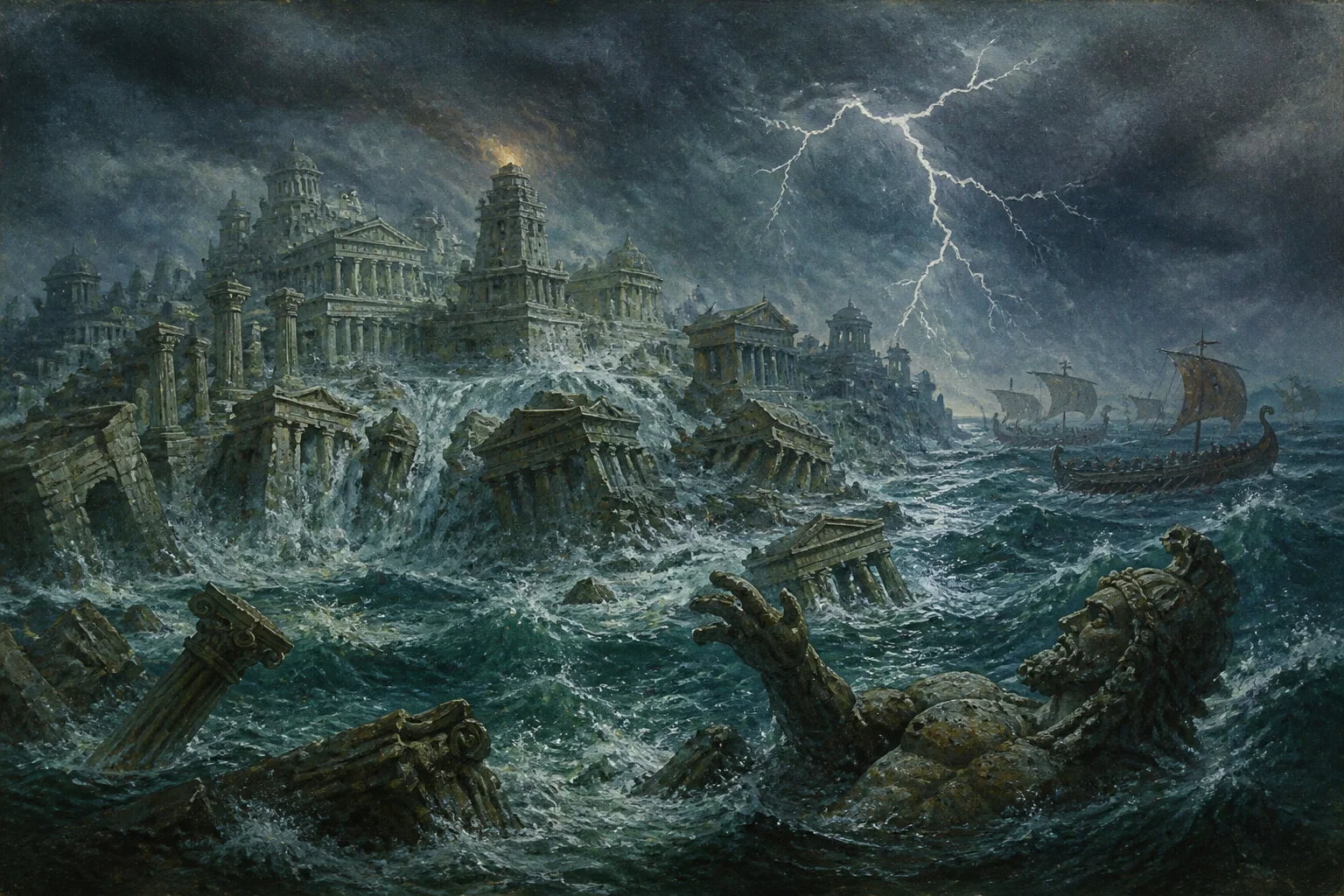
Atlantis survives because it blends several powerful ideas. It offers a lost golden age, a catastrophic fall, and the possibility that ancient people knew more than we assume. That mixture is irresistible to storytellers and explorers.
The story also taps into a modern desire for hidden knowledge. Documentaries, novels, and games often treat Atlantis as a real place waiting to be found. Many of these works borrow Plato's basic setup but ignore his philosophical point.
Part of the appeal is visual. The description of Atlantis with its concentric canals and shining temple is easy to imagine and easy to dramatize. That visual clarity has made the lost city a favorite subject for fantasy art, film, and theme park attractions.
Another reason Atlantis endures is that it lets us talk about our own societies. When people call a city or empire Atlantean, they usually mean it is overconfident, wealthy, and headed for disaster. The story works as a cultural shorthand for hubris.
At the same time, the legend of Atlantis encourages real scientific curiosity. Marine archaeology and geology have grown partly because people want to find lost places. Even when the target is myth, the tools and questions can lead to genuine discoveries.
The rise of the internet has amplified both good and bad Atlantis content. Scholarly sources are easier to reach, but so are endless speculative videos. Readers have to weigh evidence carefully and check whether a claim traces back to Plato or to modern fantasy.
The City That Lives in the Mind
The Atlantis story is best understood as one of history's most successful thought experiments. Plato used a fictional island to ask real questions about power, morality, and the limits of civilization. The story's value does not depend on proving that the island existed.
What is the story of Atlantis? It is the legend of a great power that lost its ethical foundations and collapsed into the sea. Where did the story of Atlantis come from? It came from a philosopher's imagination, shaped by the anxieties of Athens and the enduring human fear of sudden catastrophe.
The next time you encounter a claim about Atlantis, ask whether it treats the story as myth or as measurable fact. The most honest answer is usually both: a real story with enormous cultural impact, but no verified sunken island beneath the Atlantic. That dual answer is harder to sell than a simple sunken city, but it is also more accurate.
Atlantis remains a place we can visit through philosophy and story. It is not on any map, but it is firmly lodged in the way we imagine the rise and fall of nations.
Frequently Asked Questions
What is the legend of the Atlantis?
The legend of the Atlantis is the story Plato tells in Timaeus and Critias, in which a powerful naval empire beyond the Pillars of Heracles becomes corrupt and is destroyed by divine punishment and a catastrophic flood. It is best understood as a philosophical fable about hubris rather than a literal historical account.
Where did the story of Atlantis come from?
The story comes from Plato's dialogues Timaeus and Critias, written around 360 BCE. Plato presents it as an ancient Egyptian tradition passed to Solon, but no Egyptian source has been found, and most scholars regard it as Plato's own literary creation.
What is the story of Atlantis in brief?
Atlantis is a wealthy island empire founded by Poseidon and ruled by Atlas. It grows powerful but corrupt, attacks Athens, and is then destroyed by earthquakes and floods, sinking into the sea in a single day and night.
Is there any real historical evidence for Atlantis?
No accepted archaeological or geological evidence confirms that Atlantis existed. Real disasters and sunken cities exist, including Thera and Thonis-Heracleion, but none matches Plato's timelines, location, or description exactly.
What is the moral behind the story of Atlantis?
The central moral is that wealth and military power can corrupt a society and lead to its downfall. Plato contrasts Atlantis with a virtuous Athens to show that justice and discipline matter more than riches, ambition, or empire.
What is the history of Atlantis after Plato?
After Plato, Atlantis remained a minor classical topic until the Renaissance revived it as a utopian symbol. In the modern era, writers such as Ignatius Donnelly popularized it as a real lost continent, but historians now treat that as pseudoarchaeology.

Alex Warren
Related Articles