

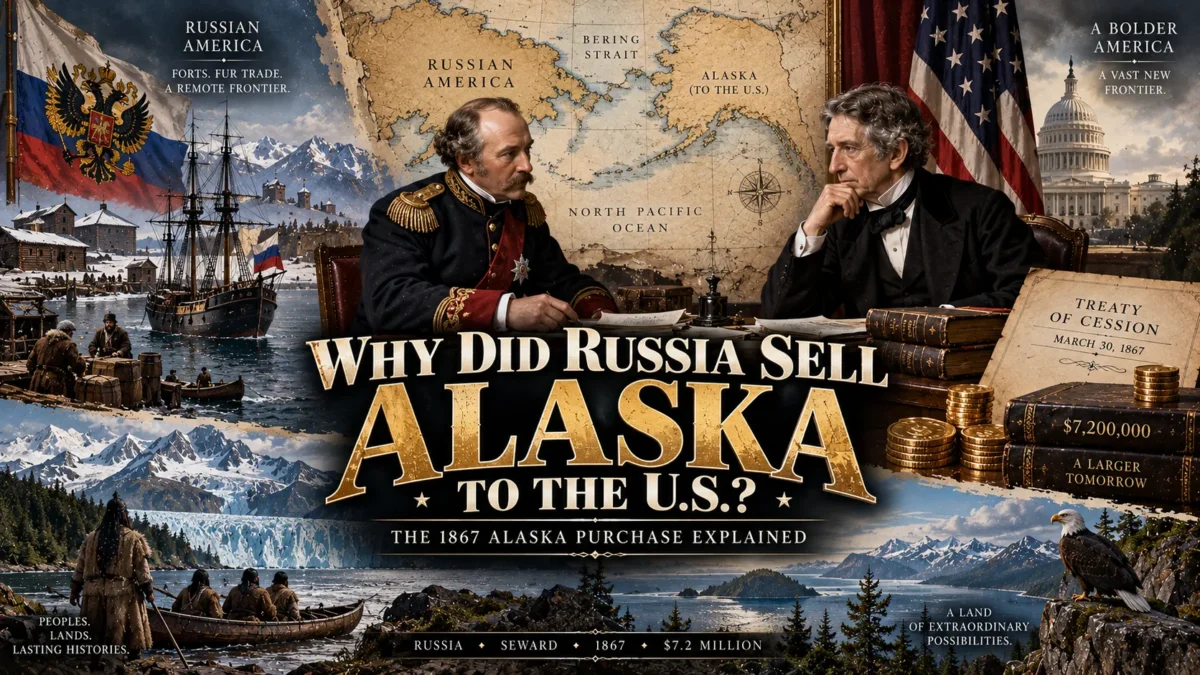
Alaska feels so thoroughly American today — glaciers, oil pipelines, bush planes, and Sarah Palin jokes — that it’s easy to forget it was once a Russian colony. For over a century before the Stars and Stripes ever flew there, Alaska belonged to the Russian Empire, hunted for furs and governed from a tiny outpost thousands of miles from Moscow.
So why would a global empire hand over nearly 600,000 square miles of territory to a rival power? The popular story is that Russia sold Alaska because it was a frozen, worthless wasteland nobody wanted. The real story is far more interesting, and it says a lot more about 19th-century geopolitics than it does about the weather.
TL;DR: Russia sold Alaska to the US in 1867 not because the land was worthless, but because it was expensive to defend, its fur trade had collapsed, and Russian leaders feared Britain would simply seize it for free in the next war.
Quick Answer: Why Russia Sold Alaska
In short, Russia sold Alaska to the United States because the colony had become a financial and military liability. The fur trade that once justified Russian settlement there had been hunted nearly to extinction, and the territory was ruinously expensive to supply and protect.
Russian officials also worried that Britain, whose Hudson’s Bay Company already operated next door in Canada, could seize Alaska in a future war without paying a cent for it. Selling to the United States, a friendly power that Russia hoped would counterbalance British influence, seemed like the smarter long-term move.
The deal was finalized on March 30, 1867, when Russian minister Eduard de Stoeckl and US Secretary of State William H. Seward signed a treaty transferring Alaska to the United States for $7.2 million.
That works out to roughly two cents per acre, a price that looks absurdly cheap now but reflected how little immediate value either side placed on the land at the time.
Alaska Under the Russian Empire: A Costly Colony
Russia’s claim to Alaska dated back to the 1700s, when explorers like Vitus Bering charted the region and fur traders began pushing across the Bering Strait. In 1799, the Russian-American Company was chartered as a state-backed monopoly to manage the territory, much like the British East India Company operated in Asia.
But Russian Alaska was never densely populated by settlers from the homeland. At its peak, only a few hundred to around 800 ethnic Russians lived there, managing a colony spread across a landmass roughly one-fifth the size of the contiguous United States.
Supplying that colony was a logistical nightmare. Ships had to sail enormous distances from European Russia, and the colony perpetually struggled to feed and support itself, relying heavily on trade with American and British merchants just to stay afloat.
Reason 1: Alaska Was Bleeding Money
By the 1860s, the Russian-American Company was in serious financial trouble. The company’s charter needed renewal, and government officials increasingly questioned whether propping up a money-losing colony on the far side of the world made any sense.
Maintaining forts, paying company employees, and shipping in supplies cost far more than the colony generated in revenue. For an empire already strained by other financial pressures, Alaska looked less like a prized possession and more like a hole in the treasury.
Reason 2: The Crimean War Was a Wake-Up Call
The Crimean War (1853–1856) exposed just how vulnerable Russia’s overseas territories really were. British and French naval forces operated aggressively in the Pacific during the conflict, and Russian officials realized they had no way to defend Alaska if a major European power decided to attack it.
At one point during the war, Russian and British colonial administrators in the Pacific even negotiated a local truce to avoid fighting over Alaska, since neither side had the resources to properly wage war there. That uneasy arrangement made it painfully clear that Russia’s grip on the territory was more symbolic than real.
Reason 3: Russia Feared Losing Alaska for Free
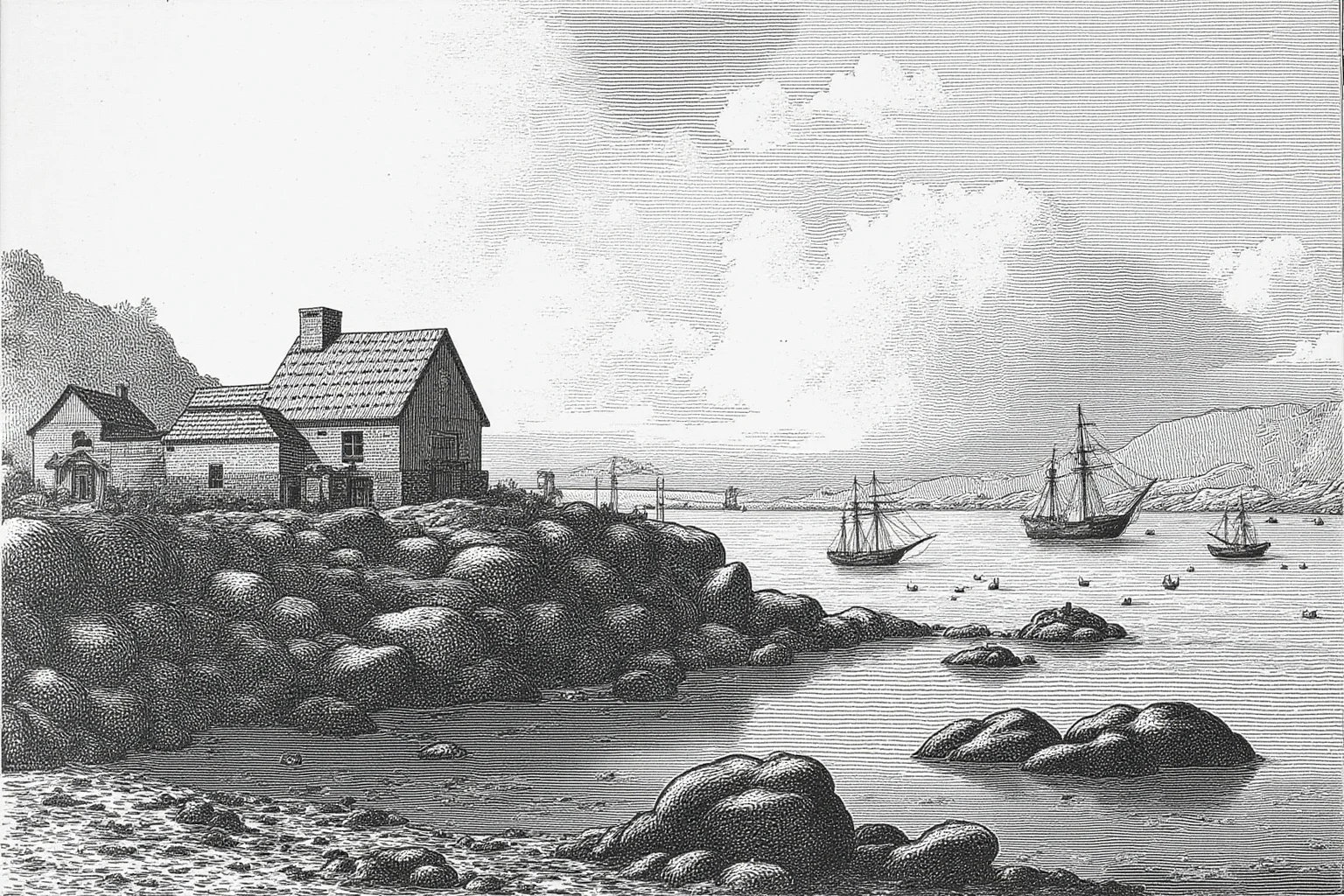
This is arguably the most important reason of all, and it’s the one most often left out of the simplified version of the story. Russian strategists, including Tsar Alexander II’s brother Grand Duke Konstantin Nikolayevich, worried that in any future war with Britain, Alaska would simply be conquered by British forces in Canada without Russia receiving any compensation.
Given that grim possibility, selling the territory to a neutral or friendly power while it still had cash value seemed like the wiser move. Better to get $7.2 million from the Americans now than to lose Alaska to the British for nothing later.
Reason 4: The Fur Trade Had Collapsed
Alaska’s original appeal to Russia was almost entirely about fur, particularly sea otter pelts, which fetched high prices in Chinese markets. By the mid-1800s, decades of intensive hunting had devastated sea otter and fur seal populations across the region.
Without a thriving fur trade, the Russian-American Company lost its core reason for existing. The economic engine that had justified the colony’s founding had essentially run out of fuel.
Reason 5: Russia’s Real Priorities Were in Asia
While Alaska struggled, Russia was actively expanding elsewhere in Asia. The Treaty of Aigun in 1858 and the Treaty of Peking in 1860 handed Russia huge new territories along the Amur River and Pacific coast, including the site of what would become Vladivostok.
These newly acquired Siberian and Far Eastern territories were closer to home, easier to defend, and seen as far more strategically valuable. Alaska increasingly looked like a distraction from Russia’s more pressing ambitions in continental Asia.
Reason 6: A Strategic Gift to a Friendly Power
Russia and the United States had a relatively warm relationship in the mid-1800s, partly because both saw Britain as a shared rival. Russian officials hoped that selling Alaska to the Americans would strengthen this friendship and boost US influence on the Pacific coast at Britain’s expense.
This wasn’t pure altruism, of course. It was calculated diplomacy dressed up as a real estate deal, designed to serve Russian interests long after the transaction closed.
How the Deal Actually Went Down
Russian minister Eduard de Stoeckl spent years quietly working American contacts to gauge interest in a sale. Secretary of State William Seward, a committed expansionist who wanted to extend American influence across the Pacific, jumped at the opportunity.
The two men negotiated through the night of March 29, 1867, and signed the treaty in the early hours of March 30. The US Senate ratified it on April 9, 1867, and the formal transfer ceremony took place in Sitka that October.
The United States paid $7.2 million in gold, equivalent to roughly two cents an acre. Adjusted for inflation, that sum is worth well over $100 million in today’s money, still a remarkably small price for a territory more than twice the size of Texas.
“Seward’s Folly”: Why Americans Mocked the Purchase
Far from celebrating the deal, much of the American press and public mocked it. Newspapers dubbed the purchase “Seward’s Folly” and “Seward’s Icebox,” portraying Alaska as a frozen, useless wasteland that Seward had foolishly overpaid for.
Critics argued that the US already had plenty of unsettled land and didn’t need a distant, icy territory with no obvious economic value. It took decades, and the discovery of gold and later oil, for public opinion to shift and for the purchase to be seen as the bargain it actually was.
The Klondike Gold Rush of the late 1890s was the turning point, drawing tens of thousands of prospectors north and finally proving Alaska’s economic worth. Oil discoveries in the 20th century, especially the massive Prudhoe Bay field, sealed Alaska’s reputation as anything but a folly.
Busting the Biggest Alaska Purchase Myths
One persistent myth claims Russia never actually sold Alaska outright, but merely leased it to the United States for 99 years, implying it should have reverted to Russia sometime in the mid-20th century. This claim circulates widely online, but it isn’t supported by the historical treaty documents, which clearly describe a permanent cession of territory, not a lease.
Another popular legend holds that the gold used to pay Russia for Alaska was lost when the ship carrying it sank en route, meaning Russia never actually got paid. Various versions of this story exist, but there isn’t solid documented evidence confirming that a payment shipment was lost at sea; the transaction was primarily handled through financial credits and drafts rather than a single dramatic gold shipment.
A third myth suggests Russia had no idea Alaska held valuable resources and sold it purely out of ignorance. In reality, Russian officials knew the fur trade had collapsed and understood the territory’s defense costs; they made a calculated economic and strategic decision rather than an ignorant one, even if they couldn’t have predicted future gold and oil discoveries.
Did Russia Regret It Later? Separating Fact from Legend
Once gold turned up in the Klondike and later in Nome, and especially once enormous oil reserves were discovered at Prudhoe Bay in 1968, it’s easy to imagine Russian officials kicking themselves. This idea shows up constantly in online discussions and pop culture jokes about Russia wanting Alaska back.
Historians generally caution against reading too much modern hindsight into a 19th-century decision. Given what Russian leaders knew and faced in the 1860s, namely a depleted fur trade, crushing distance from the capital, and real fear of losing the territory for free in a war with Britain, selling was a reasonable and defensible choice at the time.
That said, occasional Russian political figures and commentators have floated symbolic or half-joking remarks about wanting Alaska back over the years, and Russian state media has periodically stoked the narrative for public attention. None of this reflects an actual Russian government policy or legal claim on the territory, which was permanently and legally transferred in 1867.
The Legacy of the Alaska Purchase
The Alaska Purchase quietly reshaped the map of North America and gave the United States a foothold in the Arctic and the North Pacific decades before those regions became strategically vital. It also removed a major European colonial power from mainland North America, aside from British Canada.
Today, Alaska is a cornerstone of US energy production, military positioning near Russia and the Arctic, and even space launch capabilities. What critics once dismissed as a frozen folly turned out to be one of the most consequential land deals in American history.
It’s also a useful reminder that big historical decisions rarely come down to one single cause. Russia didn’t sell Alaska because of any one dramatic reason, but because of overlapping financial, military, and diplomatic pressures that all pointed toward the same conclusion.
Final Thoughts
The story of why Russia sold Alaska to the United States isn’t really about Russia giving up on a useless icebox. It’s about an empire making a pragmatic, if imperfect, calculation under real strategic pressure, choosing a modest cash payout over the risk of losing everything for free.
Nearly 160 years later, the deal still gets debated, joked about, and occasionally distorted into online myths. But the historical record is clear enough: this was a calculated sale, not a careless giveaway, and it changed the shape of North America forever.
Frequently Asked Questions
Does Russia regret selling Alaska?
There's no official Russian government position claiming regret, and the 1867 sale was a legally final transfer of territory. Occasional Russian commentators and state media have floated symbolic or joking remarks about wanting Alaska back, especially after gold and oil were discovered there, but these are not formal claims and carry no legal weight.
Why did Russia sell Alaska to the US?
Russia sold Alaska because the colony was expensive to maintain, its fur trade had collapsed, and officials feared Britain could seize the territory for free in a future war. Selling to the United States, seen as a friendly counterweight to Britain, offered cash and a strategic upside instead.
How much did the United States pay for Alaska?
The US paid Russia $7.2 million in gold, or roughly two cents per acre. Adjusted for inflation, that amount is worth well over $100 million in today's money.
Did Russia actually sell Alaska, or just lease it?
Russia sold Alaska outright. The 1867 treaty describes a permanent cession of territory, and there is no credible historical evidence supporting the popular myth that it was only a 99-year lease.
Why did the US buy Alaska if the public thought it was worthless?
Secretary of State William Seward believed Alaska had long-term strategic and economic value, including access to Pacific trade routes and resources. Much of the public and press mocked the deal as 'Seward's Folly' at the time, but opinion shifted once gold and later oil were discovered.
Why didn’t Britain buy Alaska instead of the United States?
Russia specifically wanted to avoid strengthening Britain, its main imperial rival, and feared Britain might simply take Alaska by force in a future war rather than pay for it. Selling to the United States was partly a deliberate move to keep the territory out of British hands.

Alex Warren
Related Articles





