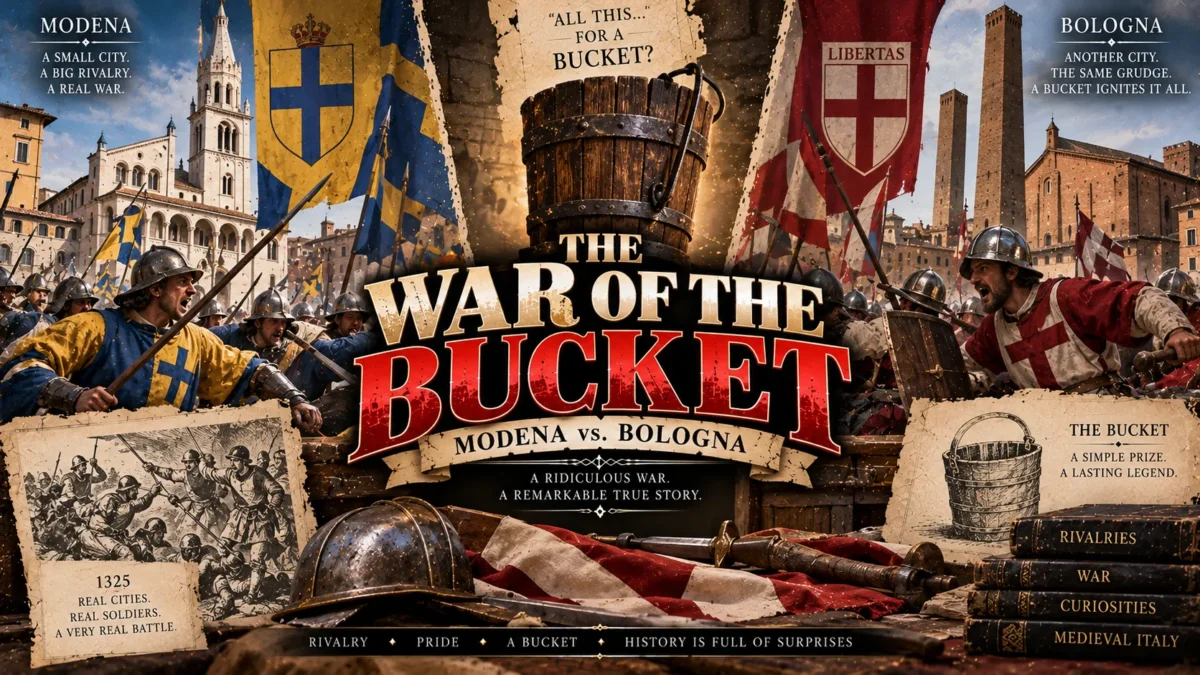
Picture two proud Italian cities going to war, thousands of soldiers marching into battle, and blood spilled on a muddy field — all supposedly because someone stole a wooden bucket. It sounds like the setup to a joke, but the story is rooted in a real 14th-century conflict between Bologna and Modena. Over the centuries, it’s been exaggerated, romanticized, and turned into satire, until the “bucket” became more famous than the war itself.
This is the tale of the War of the Bucket, sometimes called the War of the Oaken Bucket, and the strange wooden trophy that still sits in a tower in Modena, Italy today. We’re going to separate the legend from the documented history, and show you why this odd little story has survived for nearly 700 years.
TL;DR: The War of the Bucket was a real 1325 battle between Bologna and Modena rooted in deep political rivalry, but the popular idea that it was fought purely over a stolen wooden bucket is a satirical legend that grew out of a 17th-century mock-heroic poem.
Setting the Scene: Medieval Italy’s City-State Rivalries
To understand the war over a bucket, you first need to understand medieval Italy. In the 13th and 14th centuries, the Italian peninsula wasn’t a unified country at all. It was a patchwork of fiercely independent city-states, each with its own army, alliances, and grudges.
Many of these cities aligned with one of two larger political factions: the Guelphs, who supported the Pope, and the Ghibellines, who backed the Holy Roman Emperor. This wasn’t just a religious squabble. It shaped trade routes, land disputes, and family feuds for generations.
Bologna was solidly Guelph. Modena, along with its powerful neighbor Ferrara, tended to lean Ghibelline. These two cities sat less than 40 kilometers apart, close enough that minor border skirmishes were practically routine.
By the early 1300s, this same period that saw the poet Dante Alighieri exiled from Florence over similar factional politics, the Guelph-Ghibelline rivalry had already caused decades of intermittent warfare across the region. Bologna and Modena were simply one more flashpoint in a much larger and much older fight.
Bologna vs. Modena: A Feud Centuries in the Making
Bologna was, at the time, one of the largest and wealthiest cities in Europe, home to a university founded in 1088 that still operates today. It had a large population, a sizable citizen militia, and no shortage of ambition when it came to controlling the surrounding countryside.
Modena was smaller, but it had powerful friends. It had strong ties to the House of Este, the ruling family of nearby Ferrara, who could provide troops and support when needed.
Throughout the late 1200s and early 1300s, Bologna and Modena had clashed repeatedly over border territory, castles, and political influence. These weren’t isolated incidents; they were part of an ongoing contest for regional dominance in the Emilia-Romagna area.
By 1325, tensions had reached a boiling point. Bologna had been steadily pushing into territory that Modena considered its own, and Modena, backed by Ferrara and other Ghibelline allies, was looking for a reason to push back hard.
The Legend of the Stolen Bucket
Here’s where the story gets its famous nickname. According to popular legend, a raiding party of Modenese soldiers slipped into Bologna and, as a mocking prank, stole a simple wooden bucket from a well in the city center.
The bucket itself was nothing special. It was a plain oaken well-bucket, the kind used daily by ordinary Bolognese citizens to draw water. That’s precisely what made stealing it such an insult; it wasn’t a treasure, it was a taunt.
According to the legend, an enraged Bologna demanded the bucket’s return. Modena refused, and this refusal became the spark that lit a full-scale war. It’s a great story, and it’s the reason people still search for “the bucket war” or “war over a bucket” today.
But as we’ll see, most historians treat the bucket theft as, at best, a minor and symbolic incident rather than the actual cause of the war. The real reasons Bologna and Modena went to war ran much deeper than a missing pail.
The Battle of Zappolino, 1325
The war’s decisive moment came on November 15, 1325, at a place called Zappolino, a small rural spot in the countryside near Bologna. This clash is formally known to historians as the Battle of Zappolino, and it’s the real historical event behind the legend.
Bologna assembled a large citizen army, and while exact numbers vary between chronicles, most accounts describe a Bolognese force considerably larger than Modena’s, possibly numbering in the tens of thousands when allied troops are counted. Modena’s force was smaller, reinforced by cavalry and infantry from Ferrara and other Ghibelline allies.
Despite being outnumbered, the Modenese and their allies won a decisive victory. Bologna’s army was routed, and estimates of the dead, again varying by source, run into the thousands, with the heaviest losses falling on Bologna’s side.
It was a humiliating defeat for Bologna, one of Italy’s largest and proudest cities, at the hands of a much smaller rival. That humiliation is arguably the real reason the story stuck around for centuries: losing a war is embarrassing, but losing one that started (allegedly) over a bucket was even worse.
Myth vs. Reality: Did a Bucket Really Start a War?
This is the part where a little myth-busting is due. The Battle of Zappolino was absolutely real, and the rivalry between Bologna and Modena was absolutely real. What’s far less certain is whether a stolen bucket was the actual trigger.
Most modern historical accounts treat the bucket theft as folklore layered on top of a genuine political and military conflict. The war’s true causes were the same causes behind dozens of other Guelph-Ghibelline clashes: territorial ambition, competing alliances, and a desire to settle old scores.
It’s entirely possible that Modenese soldiers really did make off with a bucket during a raid on Bolognese territory at some point, since petty raiding and looting were common in medieval border warfare. But treating that as the singular cause of a war involving thousands of troops stretches the evidence well past what the sources can actually support.
What we can say with confidence is that the bucket became a powerful symbol after the fact. It represented Bologna’s humiliation and Modena’s triumph in a way that a formal treaty or land grant never could. Symbols like that tend to outlive the political disputes that created them.
Alessandro Tassoni’s “La Secchia Rapita” and the Birth of a Legend
The story of the war of the bucket owes much of its lasting fame to one man: the Italian poet Alessandro Tassoni. Nearly three centuries after the Battle of Zappolino, in 1622, Tassoni published a mock-heroic poem titled “La Secchia Rapita,” which translates to “The Stolen Bucket.”
Tassoni’s poem wasn’t meant to be a sober history lesson. It was satire, deliberately mimicking the grand, elevated style of classical epics like the Iliad, but applying that style to a comically trivial subject: a bucket. This mismatch between serious poetic form and absurd subject matter was the entire joke.
The poem was hugely popular and is still regarded as an important early work of mock-heroic literature, influencing later satirical epics across Europe. But its popularity also had a side effect: it cemented the bucket-theft story in the public imagination as the accepted version of events, even though it was written generations after the actual battle and was never intended as a factual record.
In other words, much of what people “know” about the war of the oaken bucket comes not from 14th-century chronicles, but from a 17th-century poet having fun at both cities’ expense. That’s an important distinction for anyone treating this as settled historical fact rather than a colorful legend built around a real war.
What Happened to the Bucket? The Modena Bucket Today

So what became of the actual Modena bucket, the object at the center of all this? According to long-standing local tradition, the Modenese kept the captured bucket as a war trophy after their victory at Zappolino, a common practice in medieval warfare where seized banners, bells, or relics symbolized triumph over a rival.
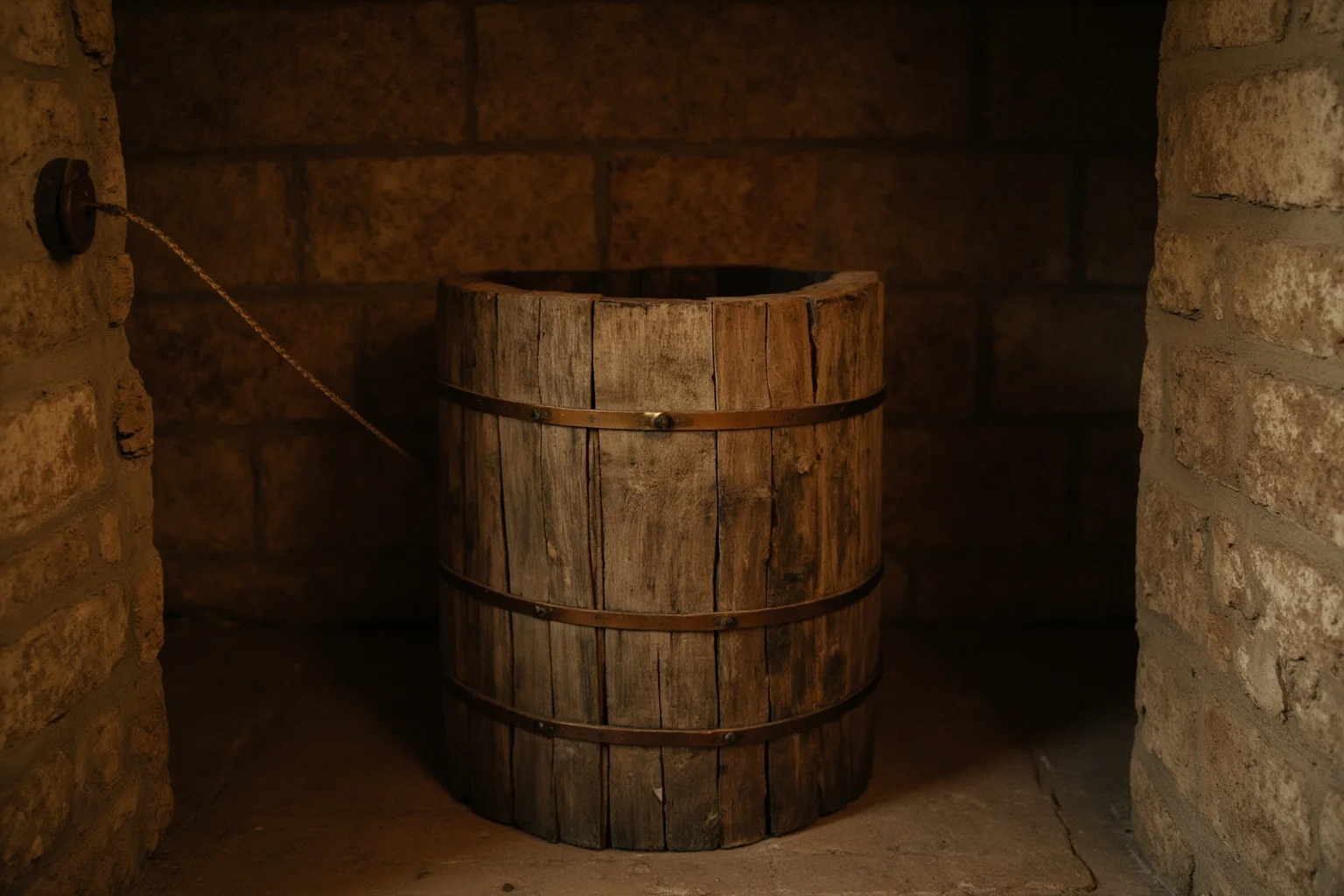
The bucket was reportedly placed in the Torre della Ghirlandina, Modena’s landmark bell tower, which still stands today as part of Modena’s cathedral complex, a UNESCO World Heritage Site. It has remained a point of civic pride in Modena for centuries, referenced in local tradition and folklore well before Tassoni ever wrote his poem.
Visitors to Modena today can typically see a bucket displayed inside the Ghirlandina tower, though various local accounts suggest a replica is what’s shown publicly, with the older, more fragile original kept more carefully protected. Given the centuries involved and the way local legends tend to evolve, it’s worth treating exact details about which bucket is which with a bit of healthy skepticism rather than certainty.
Either way, the tradition endures, and the tower remains one of the few places in the world where a centuries-old grudge is literally still on display.
Aftermath and Legacy of the War of the Oaken Bucket
The Battle of Zappolino didn’t end the broader Guelph-Ghibelline conflict, and it certainly didn’t end tensions between Bologna and Modena overnight. Border disputes and skirmishes between Italian city-states continued for decades afterward, as they did across much of the peninsula.
What Zappolino did accomplish was cementing Modena’s reputation as a city that could stand up to a much larger rival and win. For a smaller city allied with Ferrara’s House of Este, that kind of victory carried real political weight in the constantly shifting alliances of medieval Italy.
For Bologna, the defeat was a lasting embarrassment, made worse by the fact that it eventually became the punchline of one of Italy’s most famous satirical poems. It’s a strange kind of legacy: losing a war badly enough that it becomes a comedy.
Centuries later, the phrase “war of the bucket” (and its close cousin “war of the oaken bucket”) became a shorthand for wars that seem to spring from trivial causes—not unlike the wars historically blamed on women rather than the deeper politics behind them—even when the underlying reality was far more complicated. Historians still point to it as a useful reminder that popular memory often simplifies messy political conflicts into a single, memorable image.
Why We Still Talk About the War Fought Over a Bucket
There’s something irresistible about the idea of grown adults, armies, and city-states going to war over a bucket. It’s absurd, it’s funny, and it makes for a great story to tell at dinner parties or trivia nights.
But the real value of the story isn’t the bucket itself. It’s what the legend reveals about how history gets remembered. The Battle of Zappolino was a genuine, bloody clash rooted in decades of political rivalry between Guelphs and Ghibellines, yet centuries later, it’s the small wooden object that people remember, not the complex web of alliances that actually caused the fighting.
That’s true of a lot of history. Big, complicated conflicts often get boiled down to one vivid symbol: a shot heard round the world, a piece of tea dumped in a harbor, a single decoded telegram that pushed a nation into world war, or in this case, a bucket pulled from a well. The symbol makes the story memorable, even if it oversimplifies the causes.
So the next time someone mentions the War of the Bucket, you can share the fun version, the one about the stolen pail that supposedly started it all. Just make sure to mention that the real story, involving Guelphs, Ghibellines, and a genuinely fierce medieval battle at Zappolino, is even more interesting than the legend.
Frequently Asked Questions
What is the War of the Bucket?
The War of the Bucket refers to the 1325 conflict between the Italian city-states of Bologna and Modena, which culminated in the Battle of Zappolino. According to popular legend, the war was triggered when Modenese soldiers stole a wooden bucket from a well in Bologna, though historians generally view this as a colorful legend layered on top of a much deeper political rivalry.
Is the War of the Oaken Bucket the same event as the War of the Bucket?
Yes. "War of the Oaken Bucket" is simply an alternate English name for the same 1325 conflict between Bologna and Modena, emphasizing that the disputed bucket was made of oak. Both names describe the Battle of Zappolino and the legend surrounding it.
Did a war really start because of a stolen bucket?
Almost certainly not entirely. While a bucket theft may have occurred during border raiding between Bologna and Modena, the war's real causes were rooted in decades of Guelph-Ghibelline political rivalry and territorial disputes. The bucket-centric version of the story was popularized much later by Alessandro Tassoni's 1622 satirical poem 'La Secchia Rapita.'
Where is the Modena bucket kept today?
Local tradition holds that the captured bucket was placed in the Torre della Ghirlandina, Modena's famous bell tower, where a bucket is still displayed as a civic trophy. Some local accounts suggest the object shown to visitors is a replica, with the older original kept separately, though details vary between sources.
Who won the Battle of Zappolino?
Modena and its allies, including forces from Ferrara's House of Este, won a decisive victory over the much larger army of Bologna on November 15, 1325. The unexpected defeat of the larger Bolognese force is part of what made the battle so memorable in local history.
Why is the War of the Bucket still famous today?
The war remains famous largely because of Alessandro Tassoni's mock-heroic poem 'La Secchia Rapita,' written nearly 300 years after the battle, which turned a real medieval conflict into a satirical legend about a stolen bucket. The story endures because it's a memorable example of how history can be simplified into a single vivid symbol.

Alex Warren
Related Articles