
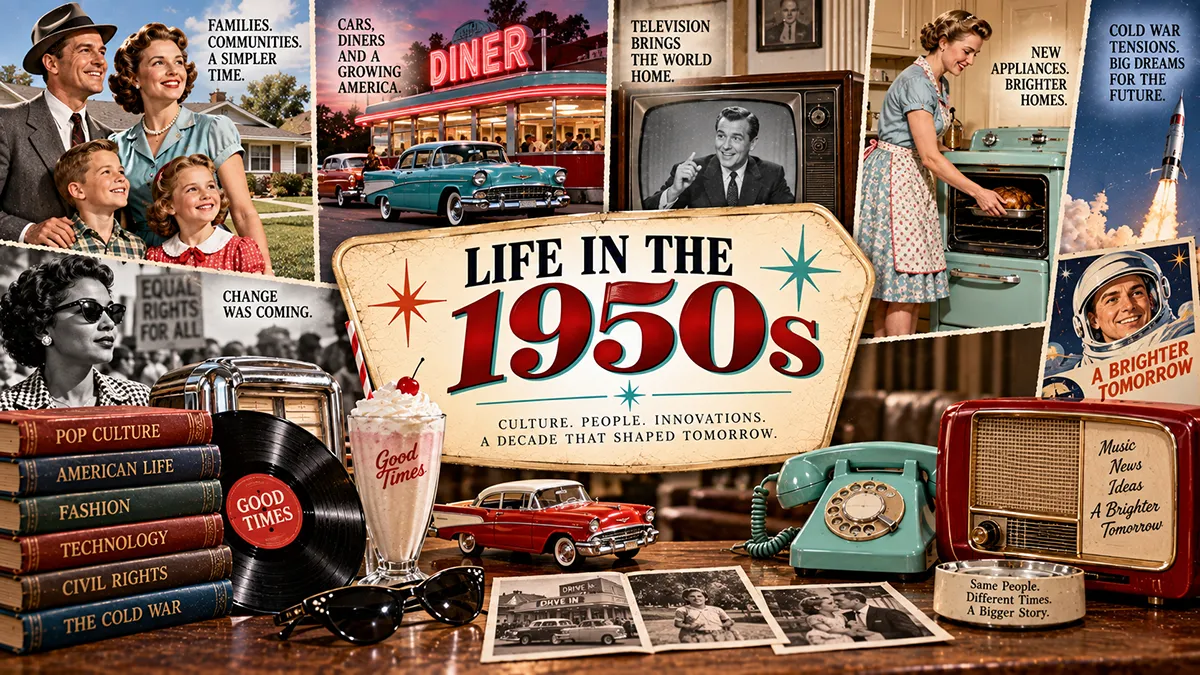
When people picture the 1950s, they usually imagine chrome-finned cars, backyard barbecues, and families gathered around a brand-new television set. That image isn’t entirely wrong, but it’s only part of the story. Life in the 1950s in America was shaped just as much by anxiety, inequality, and rapid change as it was by prosperity and picket fences, a reminder that, like many other historical time periods and eras, the popular image rarely tells the whole story.
TL;DR: The 1950s in America were defined by suburban growth, consumer prosperity, and a powerful ideal of conformity—alongside Cold War fear, racial segregation, and social pressures that the decade’s nostalgic image often leaves out.
This was a decade of contrasts. The U.S. economy boomed, birth rates soared, and new technology transformed the American household almost overnight. At the very same time, the nation lived under the shadow of nuclear anxiety, racial segregation, and rigid expectations about how men, women, and children were supposed to behave. Understanding 1950s culture means holding both realities at once. Below are 20 things that defined what it was actually like to live in the United States during the 1950s, from the everyday household to the headlines that shaped the era.
1. The Postwar Economic Boom Set the Stage for Everything
America emerged from World War II as the world’s dominant economic power, and that advantage carried straight into the 1950s. Factories that had built tanks and planes shifted to producing cars, appliances, and housing materials for a public eager to spend after years of wartime rationing.
Wages rose steadily for much of the decade, and unemployment stayed relatively low by historical standards. This economic confidence is the backdrop for nearly everything else on this list, from suburban expansion to the rise of consumer culture, and it’s a big reason the 1950s are often remembered as a golden age of American life.
2. The Nuclear Family Became the Cultural Ideal
Popular magazines, advertisements, and early television shows promoted a very specific image of family life in the 1950s: a working father, a homemaker mother, and two or three children in a single-family home. This vision of the American family became the standard against which real households were measured, even though it didn’t reflect everyone’s experience.
Many families, including working-class households, single parents, and communities of color, didn’t fit this mold at all. Still, the idealized nuclear family shaped social expectations, marketing, and public policy throughout the decade in ways that echo into how people talk about 1950s family life today.
3. Suburbia Exploded Almost Overnight
Between cheap land, GI Bill home loans, and mass-production building techniques pioneered by developers like Levitt & Sons, suburban housing developments sprang up around American cities at a stunning pace. Places like Levittown, New York, became symbols of this new suburban lifestyle.
Millions of families left crowded cities for these new communities, chasing space, safety, and a yard of their own. This shift didn’t just change where Americans lived; it reshaped shopping, schooling, and transportation for generations afterward.
4. Television Took Over the Living Room
In 1950, roughly 9% of American households owned a television. By the end of the decade, that number had climbed to nearly 90%, making TV the fastest-adopted home technology in American history up to that point.
Shows like I Love Lucy, The Ed Sullivan Show, and Leave It to Beaver became shared cultural touchstones. Television didn’t just entertain 1950s families; it also helped standardize ideas about how Americans should look, speak, and live.
5. The Automobile Became a Way of Life
Car ownership surged alongside suburban growth, and the automobile became a central symbol of 1950s American culture. Detroit automakers rolled out increasingly flashy designs, complete with tailfins, chrome trim, and two-tone paint jobs that celebrated speed and status.
The 1956 Federal-Aid Highway Act, which funded the Interstate Highway System, only accelerated this car-centered lifestyle. Drive-in restaurants, drive-in movie theaters, and roadside motels all boomed because Americans were now driving everywhere.
6. Rock and Roll Gave Young People Their Own Sound
Rock and roll emerged in the early-to-mid 1950s, blending rhythm and blues, country, and gospel influences into something entirely new. Artists like Chuck Berry, Little Richard, and Elvis Presley turned the genre into a nationwide phenomenon by mid-decade.
This music alarmed plenty of parents and commentators, who saw it as rebellious or even dangerous. For teenagers, though, rock and roll became a soundtrack that felt like it belonged to their generation alone, setting the stage for youth culture in the decades that followed.
7. “Teenager” Became Its Own Cultural Category
The word “teenager” existed before the 1950s, but the decade turned it into a distinct identity with its own music, fashion, slang, and spending power. Advertisers quickly noticed that teens had money to spend and began marketing directly to them.
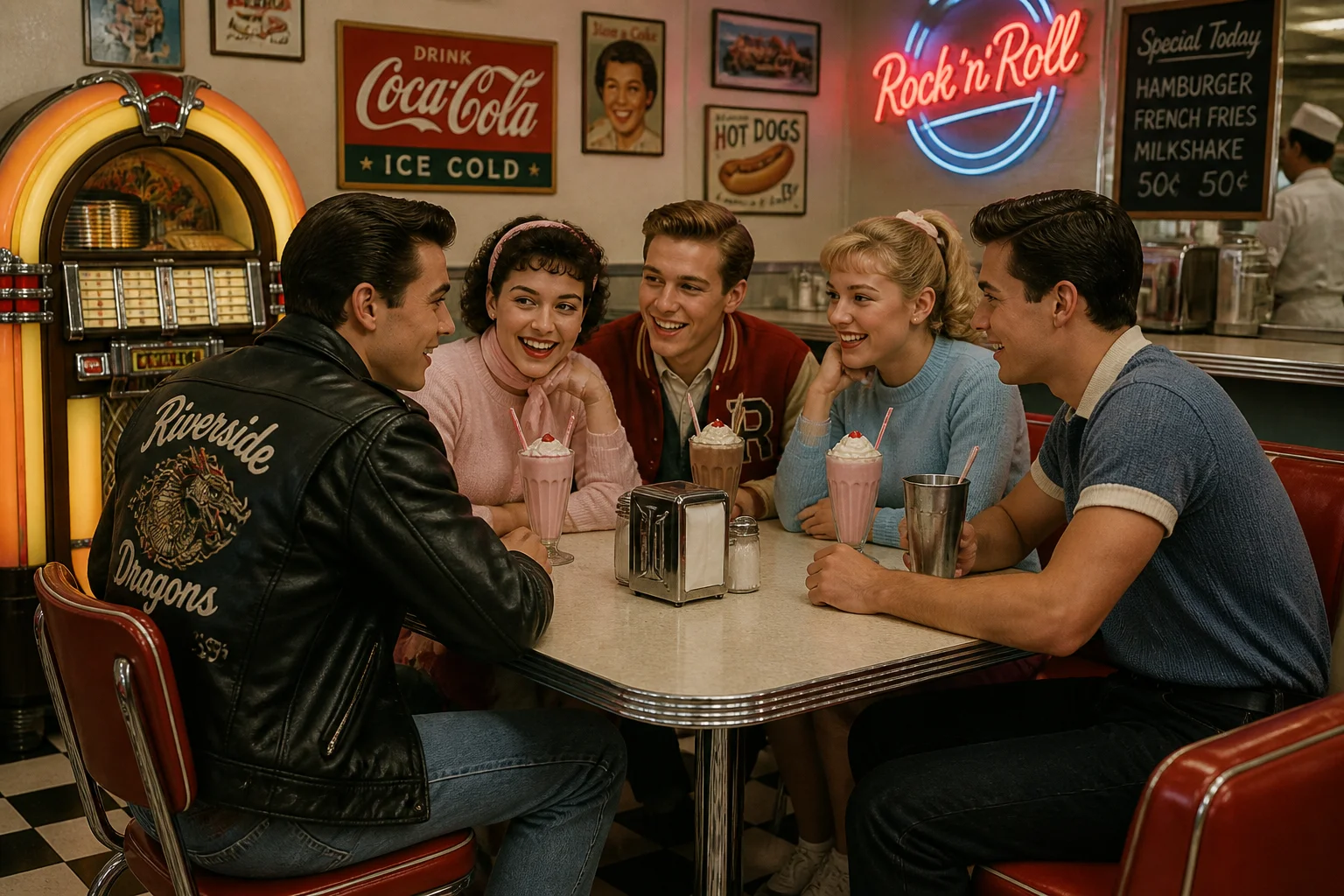
Drive-ins, soda fountains, sock hops, and going steady all became part of a recognizable teenage life in the 1950s. This new youth culture wasn’t universal, but it was influential enough to worry plenty of adults about where it might lead.
8. Conformity Was the Unwritten Rule
Conformity in the 1950s wasn’t just a personal choice; it was often treated as a social expectation. Sociologist David Riesman’s 1950 book The Lonely Crowd and William Whyte’s The Organization Man both explored how postwar Americans, especially in new suburbs and corporate jobs, felt pressure to fit in rather than stand out.
Dressing similarly, buying similar homes, and holding similar opinions were seen as signs of stability after years of depression and war. This pressure toward sameness is one of the most talked-about characteristics of the 1950s, and it helped fuel countercultural pushback later in the century.
9. Women Faced Pressure to Return to the Home
During World War II, women had taken on factory and industrial jobs in large numbers. After the war, many were encouraged, and sometimes outright pressured, to leave the workforce and focus on homemaking instead.
Media and advertising reinforced this shift, portraying the ideal woman as a devoted wife and mother rather than a career professional. That said, plenty of women continued working outside the home throughout the decade, especially in lower-income households, even as public messaging suggested otherwise. Life for women in the 1950s was more varied than the stereotype often implies.
10. The Household Got a Technological Makeover
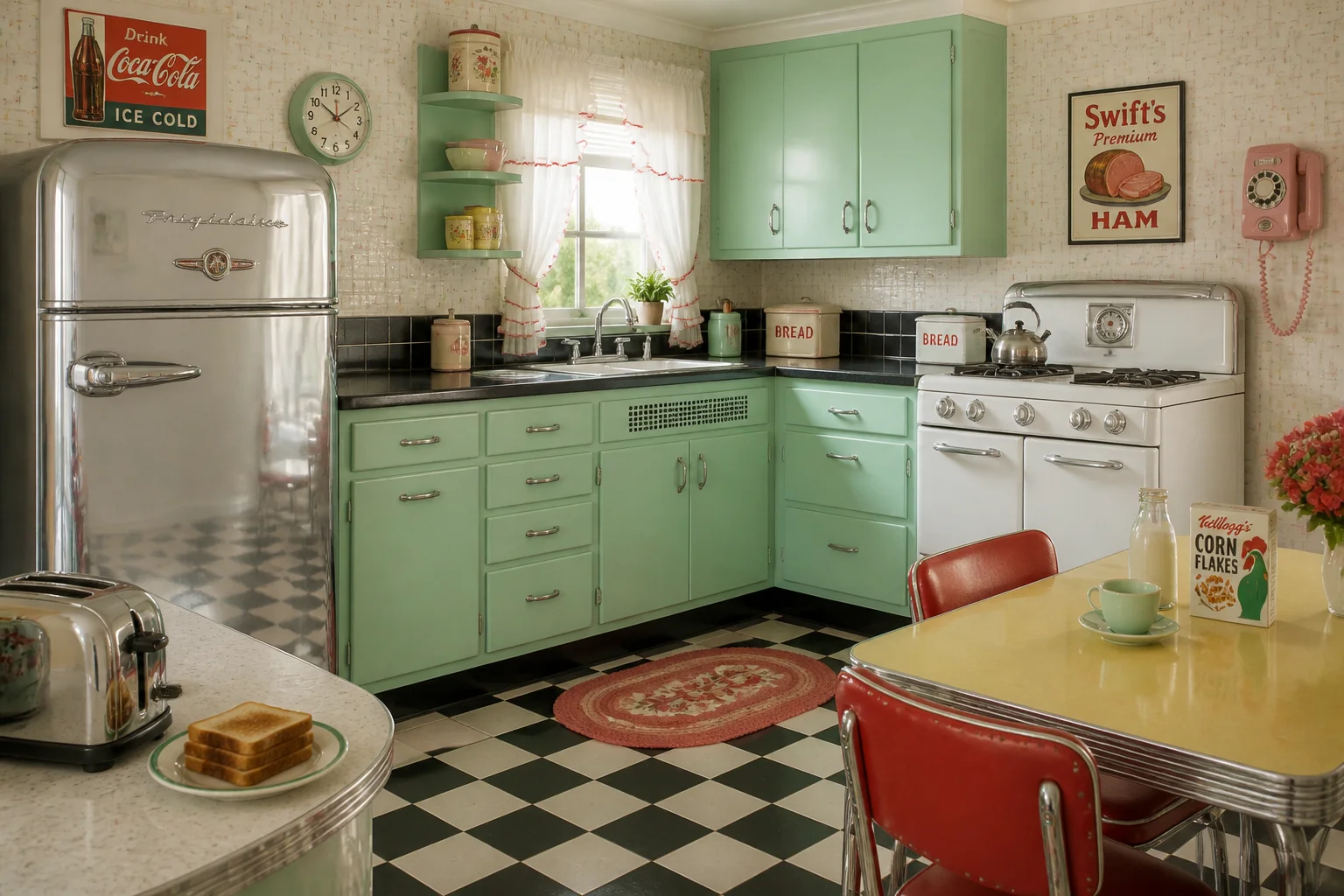
The 1950s household looked dramatically different from the one before the war. Refrigerators, washing machines, vacuum cleaners, and other appliances became affordable and common, changing the daily rhythm of housework.
These labor-saving devices were marketed as tools of convenience and modern living. In practice, many historians note that they didn’t necessarily reduce women’s total workload, since standards for cleanliness and homemaking rose right alongside the new technology.
11. Fast Food and Diners Changed How Americans Ate
McDonald’s began franchising in 1955 after Ray Kroc partnered with the McDonald brothers, helping launch the fast food industry as we know it today. Classic diners, drive-in burger stands, and TV dinners also became fixtures of everyday American eating.
Convenience was the driving theme behind food in the 1950s, matching a lifestyle built around cars, suburbs, and busy families. Packaged and frozen foods surged in popularity as kitchens filled with new refrigerators and freezers to store them.
12. The Cold War Cast a Shadow Over Daily Life
Tensions between the United States and the Soviet Union defined much of America’s foreign policy and public mood throughout the decade. Nuclear anxiety became part of everyday life, with schools running “duck and cover” drills and some families building backyard fallout shelters.
This fear coexisted uneasily with the era’s prosperity and optimism. Understanding what was going on in the 1950s means recognizing that comfort at home and fear of global conflict were happening at the very same time.
13. McCarthyism Fueled a Fear of Communism at Home
Senator Joseph McCarthy led a highly publicized campaign in the early 1950s claiming that communists had infiltrated the U.S. government and other institutions. This period, often called the Second Red Scare, led to congressional hearings, blacklists, and damaged careers, particularly in government, academia, and Hollywood.
Many of McCarthy’s specific accusations were later discredited, and he was formally censured by the Senate in 1954. Still, the broader climate of suspicion he helped create shaped American political culture for years afterward.
14. The Space Race Began With Sputnik
In October 1957, the Soviet Union launched Sputnik, the first artificial satellite, and the news stunned the American public. The launch triggered real concern that the U.S. was falling behind in science and technology.
In response, the U.S. created NASA in 1958 and poured new funding into science and math education. This moment marked the true beginning of the space race, one of the defining rivalries of the Cold War era.
15. The Polio Vaccine Was a Major Public Health Turning Point
Polio outbreaks had terrified American parents for years, sometimes closing swimming pools and movie theaters during summer epidemics. Jonas Salk’s polio vaccine, announced as safe and effective in 1955, was one of the most celebrated medical breakthroughs of the decade.
Mass vaccination campaigns that followed dramatically reduced polio cases across the country. It stands as one of the clearest examples of science reshaping ordinary family life during the 1950s.
16. Segregation Shaped Daily Life for Black Americans
For Black Americans, especially in the South, the 1950s meant living under Jim Crow laws that enforced segregation in schools, housing, transportation, and public spaces. This reality stood in sharp contrast to the suburban prosperity often associated with the decade.
Housing discrimination, including practices like redlining, also kept many Black families out of the new suburbs entirely. Any honest look at 1950s American culture has to include this deep and painful inequality alongside the era’s more comfortable images.
17. The Civil Rights Movement Began Gaining National Momentum
The 1950s saw pivotal civil rights milestones, including the Supreme Court’s 1954 Brown v. Board of Education decision declaring school segregation unconstitutional. The 1955–56 Montgomery Bus Boycott, sparked by Rosa Parks’ arrest, further galvanized the movement and helped bring Martin Luther King Jr. to national prominence.
These events didn’t end segregation, and progress met fierce resistance in many places. They did, however, lay crucial groundwork for the broader civil rights victories of the 1960s.
18. Fashion Had Its Own Recognizable Uniform
Fashion in the 1950s leaned toward polished, structured looks. Women’s styles often featured full skirts, cinched waists, and tailored silhouettes, popularized in part by designers like Christian Dior.
Men typically wore suits or button-down shirts even for casual outings, while teenagers began carving out their own look with jeans, leather jackets, and poodle skirts. These styles have become such enduring shorthand for the decade that they still define “1950s aesthetic” in costumes and design today.
19. Movies, Drive-Ins, and Mass Entertainment Thrived
Despite competition from television, Hollywood remained a powerful cultural force throughout the 1950s. Studios experimented with widescreen formats and 3-D films to lure audiences back into theaters.
Drive-in movie theaters, perfectly suited to car culture, became especially popular with families and teenage couples alike. Entertainment in the 1950s also included radio, live variety shows, and the earliest stirrings of televised sports as regular home viewing.
20. The Baby Boom Reshaped Schools and Neighborhoods
Birth rates surged after World War II and stayed high throughout the 1950s, a trend now known as the baby boom. This generation of children, the Baby Boomers, drove massive demand for new schools, pediatric care, children’s products, and family-sized suburban housing.
Toy companies, cereal brands, and children’s television programming all expanded rapidly to meet this new market. The sheer size of this generation would go on to shape American culture, politics, and the economy for decades after the 1950s ended.
21. Consumer Credit Made the American Dream Feel Attainable
Credit cards, installment plans, and easier mortgage terms allowed 1950s families to buy homes, cars, and appliances without paying full price upfront. This shift toward buying on credit helped fuel the decade’s consumer boom and made the suburban lifestyle accessible to a much wider swath of the middle class.
It also introduced many households to long-term debt as a normal part of financial life. This pattern of spending laid groundwork for the credit-driven consumer economy that defines American life today.
The 1950s Weren’t as Simple as Nostalgia Suggests
It’s easy to see why the 1950s get remembered as a simpler, happier time. Economic growth was real, suburban life did expand opportunity for many families, and popular culture from the era still feels comforting and familiar.
But “simple” undersells what was actually happening. Cold War fear, racial injustice, and rigid social expectations for women and teenagers were just as much a part of daily life as diners and drive-ins. The real story of 1950s America is more interesting, and more complicated, than the postcard version, and that complexity is exactly what makes the decade worth understanding on its own terms rather than through rose-tinted glasses.
Frequently Asked Questions
What was life like for the U.S. in the 50s?
Life for the U.S. in the 50s combined real prosperity with real tension. Many families enjoyed rising wages, new suburban homes, and modern conveniences like televisions and washing machines, while the country simultaneously grappled with Cold War fears, McCarthyism, and racial segregation that shaped daily life very differently depending on who you were.
What happened in the 1950s in America?
Major events included the Korean War (1950–1953), the rise of McCarthyism, the Brown v. Board of Education ruling in 1954, the Montgomery Bus Boycott in 1955–56, the launch of Sputnik in 1957, and the creation of NASA in 1958, alongside rapid suburban growth, rock and roll's emergence, and the postwar baby boom.
What are 10 characteristics of the 1950s?
Common characteristics include suburban expansion, rising consumerism, television's rapid adoption, car culture, conformity to social norms, the nuclear family ideal, Cold War anxiety, the baby boom, segregation alongside early civil rights activism, and the birth of rock and roll and teenage culture.
What was life like for women in the 1950s?
Postwar media and advertising promoted homemaking as the ideal role for women, and many left wartime jobs to focus on family life. In practice, though, a significant number of women, particularly in working-class households, continued working outside the home throughout the decade, so experiences varied more than the stereotype suggests.
What does conformity in the 1950s mean?
Conformity in the 1950s refers to the strong social pressure to fit in with mainstream norms around dress, behavior, family structure, and even political opinion. Sociologists at the time, including David Riesman and William Whyte, wrote extensively about how suburban and corporate life encouraged Americans to blend in rather than stand out.
What is the 1950s era often called?
The 1950s are frequently referred to as a postwar era, an age of conformity, or even a golden age of American prosperity, though historians increasingly note that these labels oversimplify a decade that also included significant inequality and political fear.
What are some fun facts about the 1950s?
Television ownership jumped from about 9% of U.S. households in 1950 to nearly 90% by decade's end, McDonald's began franchising in 1955, the Salk polio vaccine was declared safe and effective in 1955, and the Interstate Highway System was authorized in 1956, forever changing how Americans traveled.
What was family life like in the 1950s?
Idealized 1950s family life centered on a working father, a homemaker mother, and multiple children living in a single-family suburban home, an image heavily promoted by television and advertising. Real family life was more diverse, including working mothers, extended households, and families who didn't have access to the suburban prosperity often shown in the media.

Alex Warren
Related Articles