
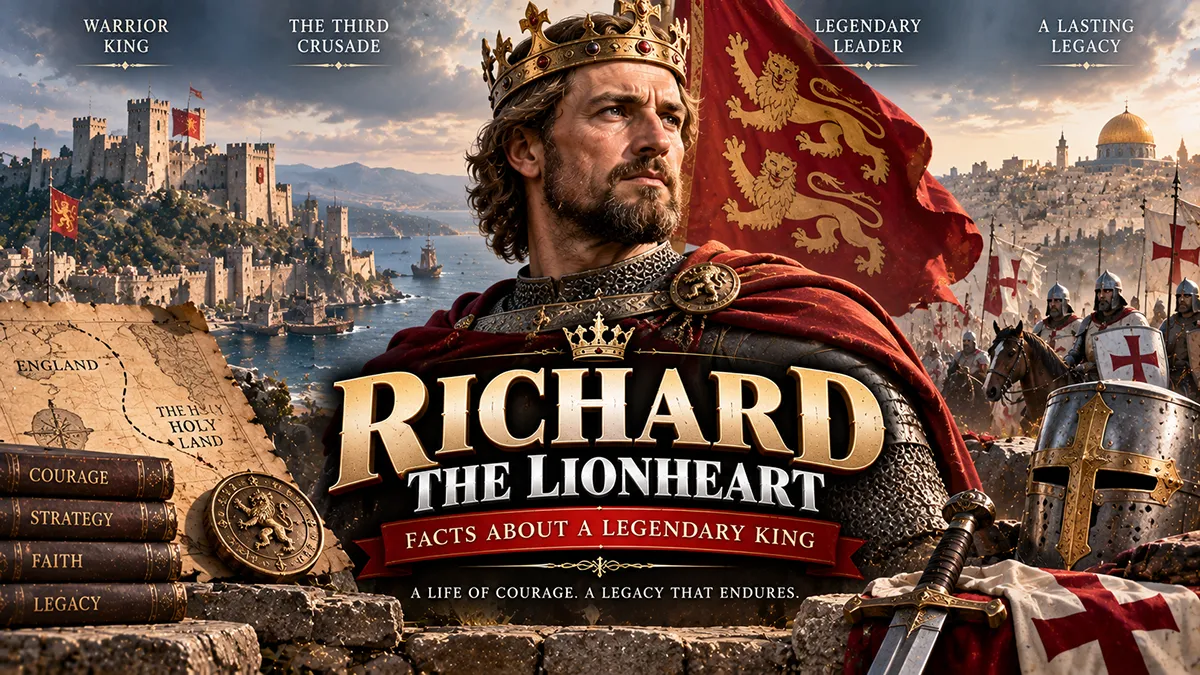
When most people hear the name Richard the Lionheart, they picture a golden-haired crusader riding out of a storybook, sword raised against the desert sun.
He’s the king who haunts Robin Hood tales, the noble monarch whose return everyone in Sherwood Forest seems to be waiting for. But behind the legend was a real, complicated, often ruthless medieval ruler who spent almost no time in the country he supposedly loved so much.
This post separates the fairytale from the facts. We’ll walk through who Richard the Lionheart really was, why he earned his famous nickname, what he actually accomplished, and why historians still argue about whether he deserves the word “great” at all.
TL;DR: Richard the Lionheart was a 12th-century King of England, feared crusader, and reluctant ruler who spent barely six months of his ten-year reign on English soil, yet became one of history’s most enduring legends.
1. Richard the Lionheart Was the Third Son of Henry II and Eleanor of Aquitaine
Richard I, later nicknamed Richard the Lionheart, was born in 1157 to King Henry II of England and Eleanor of Aquitaine. He wasn’t originally destined for the throne, since he had two older brothers, William and Henry the Young King. Fate, family feuding, and early deaths eventually cleared his path to becoming King of England.
His parents ruled over a sprawling territory sometimes called the Angevin Empire, stretching from the Scottish border down through western France. Richard grew up inside one of history’s richest and most powerful families, famous for its ambition and infighting. Understanding this chaotic household is essential to understanding who Richard the Lionheart became.
2. He Was Born in England but Barely Called It Home
Richard was born at Beaumont Palace in Oxford, so technically, yes, England’s most famous crusader king was English by birth. That said, his upbringing was thoroughly French. He was raised largely in the Duchy of Aquitaine, his mother’s homeland, and spent most of his childhood and adult life on the continent rather than in England.
This matters when people ask “who was Richard the Lionheart” expecting a quintessentially English hero. In reality, his identity, language, and loyalties were shaped far more by France than by the island he technically ruled.
3. His Nickname “Coeur de Lion” Reflected His Reputation as a Warrior
The epithet most people know him by, Richard the Lionheart, comes from the French “Richard Coeur de Lion.” It wasn’t an official title handed out at his coronation. It was a nickname that grew out of his reputation on the battlefield, first as a young duke crushing rebellions in Aquitaine and later as a crusading commander in the Holy Land.
Some versions of the legend claim the name came from a dramatic, possibly embellished story of Richard killing a lion with his bare hands. Historians generally treat that tale as later medieval folklore rather than a verified event. The more grounded explanation is simply that contemporaries saw him as fierce, fearless, and lion-like in combat.
4. Why Was Richard Called the Lionheart, Exactly?
Digging a bit deeper into why Richard was called the Lionheart, chroniclers of his own era were already using the phrase during his lifetime or shortly after his death. It reflected both his personal bravery in battle and his skill as a military tactician. He led charges himself rather than staying safely behind his troops, which was unusual enough for a king to be remarkable.
It’s worth noting the nickname was about martial courage, not necessarily kindness or wisdom. Richard the Lionheart earned his name through sieges, charges, and ruthless campaigns, not through gentle diplomacy or administrative genius.
5. Did Richard the Lionheart Speak English?
This is one of the most searched questions about him, and the honest answer is almost certainly not, at least not fluently. Richard’s native tongue was Old French, specifically a dialect close to what was spoken in Anjou and Poitou, and he likely also used the langue d’oc common in Aquitaine. The nobility of England in this period spoke Anglo-Norman French, not the English used by common people.
So while Richard I was legally King of England, he probably couldn’t have held a conversation in the English language of his own peasants and townsfolk. This surprises a lot of people, but it was completely normal for Norman and Angevin kings of this era.
6. He Became Duke of Aquitaine Before He Ever Wore a Crown
Long before he was king, Richard was invested as Duke of Aquitaine in 1172, a title that came through his mother Eleanor. He was also, at various points, associated with the Duchy of Normandy, another key piece of the family’s continental holdings. These titles gave him real military experience early, since Aquitaine’s nobles were notoriously difficult to control.
Ruling as Duke of Normandy and Duke of Aquitaine taught Richard the siege warfare and cavalry tactics that would later define his crusading campaigns. By the time he became king, he was already a seasoned, battle-hardened commander.
7. He Rebelled Against His Own Father
Richard’s relationship with Henry II was tense for most of his life. In 1173 to 1174, he joined his brothers and even his mother in an open rebellion against his father, a conflict historians call the Revolt of 1173 to 1174. The rebellion failed, and Richard eventually reconciled with Henry, but only on the surface.
Tensions flared again in the late 1180s, this time with Richard allying with King Philip II of France against his own father. Henry II died in 1189, reportedly worn down by years of betrayal from his sons. It’s a messy, very human backdrop for a king later remembered as a fairytale hero.
8. He Was Crowned King Richard I of England in 1189
Following Henry II’s death, Richard was crowned King of England on September 3, 1189, becoming Richard I, King of England. This is the moment people usually mean when they search for king Richard of Lionheart or king Richard the Lionheart, though the coronation itself was a fairly standard medieval affair rather than the stuff of legend.
Almost immediately, Richard began preparing for something much bigger than governing England day to day: joining the Third Crusade. Ruling England was, in many ways, a formality he needed to secure before heading off to war.
9. He Spent Almost His Entire Reign Outside England
Here’s a fact that surprises a lot of people researching Richard the Lionheart: despite being one of England’s most celebrated kings, he spent only around six months of his roughly ten-year reign actually in England. The rest of the time, he was in France, the Holy Land, or, as we’ll get to, held prisoner in central Europe.
For Richard, England was primarily a source of money and manpower for his continental wars and crusading ambitions. This is a big reason historians debate whether he was a genuinely good king for England, versus a good king for his own military reputation.
10. He Sold Off Royal Rights and Titles to Fund the Third Crusade
Crusading was extraordinarily expensive, and Richard needed cash fast. He famously sold castles, offices, and even entire towns’ rights to raise money for his expedition to the Holy Land. He’s said to have remarked that he would have sold London itself if he could have found a buyer, a quote often repeated by chroniclers, though it should be treated as a colorful anecdote rather than a verbatim, documented statement.
This fundraising spree tells you a lot about his priorities. The crusade mattered more to Richard than the day-to-day stability of his English kingdom.
11. He Led the Third Crusade Alongside Philip II of France
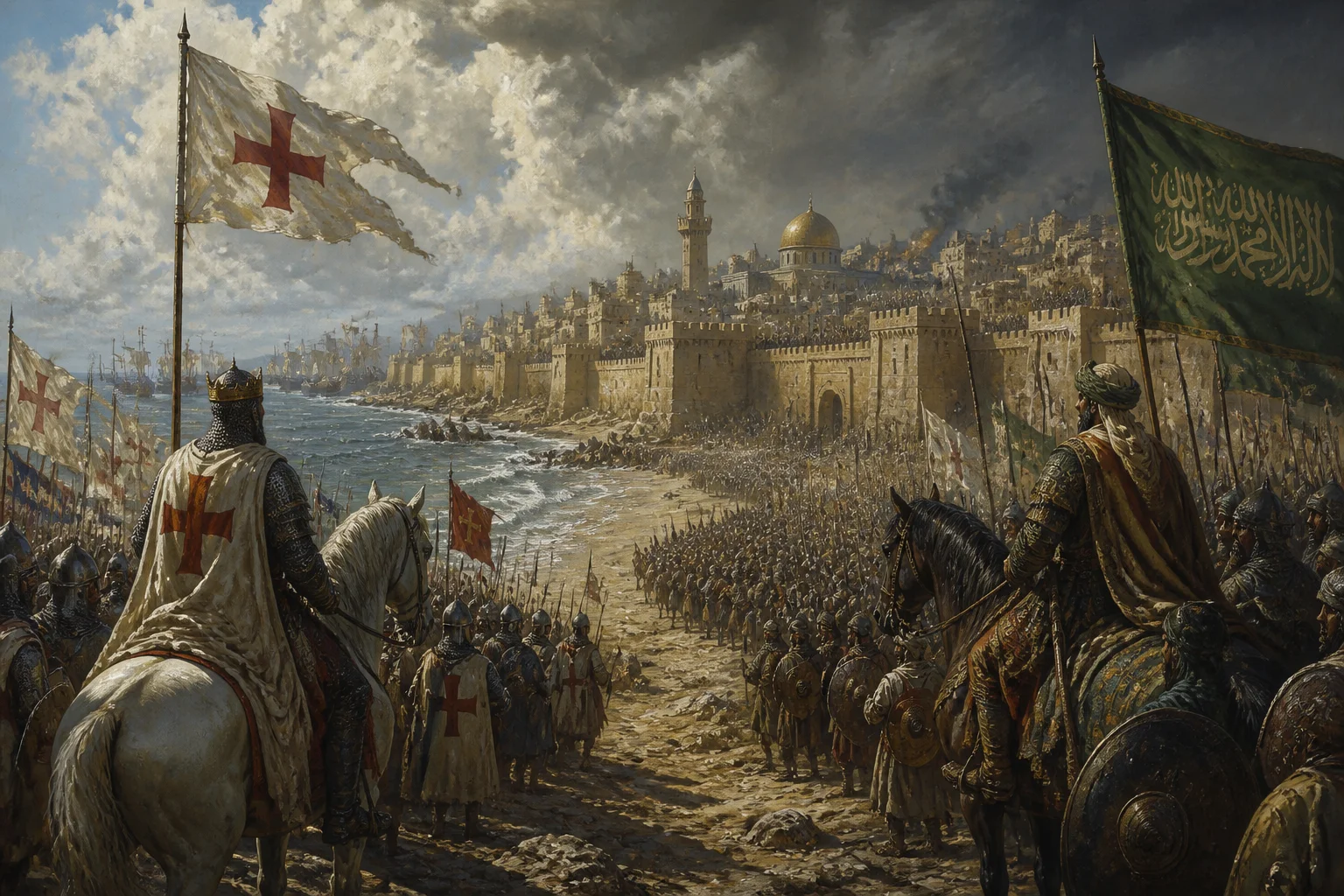
In 1190, Richard the Lionheart set out on the Third Crusade, joining forces with King Philip II of France and, initially, Holy Roman Emperor Frederick Barbarossa. The goal was to recapture Jerusalem, which had fallen to the forces of Saladin in 1187. This crusade is the centerpiece of Richard’s historical fame and the reason he’s remembered as “Richard the Lionheart crusader” in so many retellings.
The alliance between Richard and Philip was uneasy from the start, and it grew worse as the campaign dragged on. Philip eventually returned to France early, leaving Richard as the crusade’s primary Christian commander.
12. He Captured the City of Acre in 1191
One of Richard’s major military achievements was helping capture the coastal city of Acre in July 1191, after a grueling siege that had already been underway before he arrived. Acre became a crucial foothold for crusader forces along the Levantine coast. It was a genuine strategic victory and a strong demonstration of Richard’s siege warfare skills.
This success cemented his reputation among fellow crusaders as a formidable battlefield leader. It’s also where some of the crusade’s darker chapters began.
13. The Massacre at Acre Remains One of His Most Controversial Acts
After the city’s surrender, Richard ordered the execution of a large number of Muslim prisoners at Acre, an event widely recorded by chroniclers of the time. Historians still debate the exact numbers and the precise justification given, but the massacre is well documented and remains one of the darkest moments of his career. It’s a stark reminder that Richard the Lionheart’s fame as a heroic crusader coexists with brutal, well-documented violence.
Any honest look at Richard’s legacy has to include this event. It complicates the fairytale image considerably and shows why modern historians resist painting him as a simple hero.
14. His Rivalry With Saladin Became the Stuff of Legend
Richard’s opponent in the Holy Land was Saladin, the Ayyubid sultan who had united much of the Muslim Near East. The two never actually met face to face, despite countless later stories and paintings suggesting otherwise. Their communication happened through envoys, truces, and the occasional exchange of gifts, alongside plenty of open warfare.
Despite the fighting, both leaders reportedly held a degree of mutual respect, at least according to later medieval chroniclers on both sides. This respectful-rivals narrative has been romanticized over the centuries, but the core outline, two skilled commanders locked in a prolonged and costly standoff, is historically grounded.
15. He Never Recaptured Jerusalem
Despite years of campaigning, sieges, and battles, Richard the Lionheart never actually retook Jerusalem for the crusader states. He came close geographically at points, reportedly within sight of the city, but chose not to attempt an assault he believed he couldn’t hold long-term. It was a pragmatic military decision, but it meant the crusade’s central goal was never achieved.
This is an important fact for anyone assuming the Lionheart king triumphantly liberated the Holy City. The reality was a costly, ultimately incomplete campaign that nonetheless secured some Christian access and territory along the coast.
16. He Negotiated the Treaty of Jaffa With Saladin
In September 1192, Richard and Saladin agreed to the Treaty of Jaffa, a truce that ended the Third Crusade’s fighting. The treaty allowed Christian pilgrims access to Jerusalem while leaving the city itself under Muslim control. It wasn’t a total victory for either side, but it brought a practical, if temporary, peace.
Soon after securing this agreement, Richard began his long journey home. That journey turned out to be far more dangerous than anyone expected.
17. He Married Berengaria of Navarre
The wife of Richard the Lionheart was Berengaria of Navarre, whom he married in 1191 on the island of Cyprus, en route to the Holy Land. Berengaria came from the Kingdom of Navarre in northern Spain, and the marriage appears to have been arranged largely for political alliance purposes. The couple had no surviving children, and Richard spent very little time with her over the course of their marriage, making it one of history’s quieter counterparts to the more dramatic famous breakups throughout history.
Berengaria never even set foot in England during Richard’s reign, which tells you a lot about how little the marriage resembled a storybook royal romance. She’s sometimes called “the only English queen never to visit England,” though she did visit briefly after his death.
18. He Was Captured and Held for Ransom on His Way Home
After leaving the Holy Land, Richard’s ship ran into trouble, and he was forced to travel overland through hostile territory in Central Europe. He was captured near Vienna in December 1192 by Duke Leopold V of Austria, reportedly because of old grudges from the crusade. Leopold then handed Richard over to Holy Roman Emperor Henry VI, who held him for a hefty ransom.
This is one of the wildest true stories connected to Richard the Lionheart, a king captured and imprisoned by a fellow European ruler. It sounds like something out of fiction, but it’s well documented in contemporary records.
19. England Paid an Enormous Fortune to Free Its King
The ransom demanded for Richard’s release was staggering, roughly 100,000 marks of silver, an amount equivalent to several times the English crown’s annual income. Special taxes were levied across England, church treasures were melted down, and Eleanor of Aquitaine personally worked to raise the funds. Richard was finally released in early 1194 after over a year in captivity.
This episode placed enormous financial strain on England, another reason historians question how good a king Richard truly was for his own subjects. The people who never saw him ruling in person were nonetheless taxed heavily to fund both his crusade and his ransom.
20. His Brother John Tried to Seize the Throne While He Was Away
While Richard was crusading and then imprisoned, his younger brother John, later King John of England, attempted to consolidate power for himself. John allied at times with King Philip II of France and tried to prevent Richard’s return. When Richard finally came back to England in 1194, he moved quickly to reassert control, though he eventually forgave John rather than punishing him severely.
This family drama, full of betrayal and reconciliation, later fed directly into the Robin Hood legends, where a heroic King Richard is abroad while a scheming Prince John misrules in his absence.
21. He Died From a Crossbow Wound at the Siege of Châlus
Richard the Lionheart’s death came not in some epic crusading battle, but during a relatively minor siege in France. In March 1199, while besieging the castle of Châlus-Chabrol over a dispute with a rebellious vassal, Richard was struck in the shoulder by a crossbow bolt. The wound became infected, and he died on April 6, 1199, at around 41 years old.
According to some chroniclers, Richard forgave the crossbowman who shot him before he died, though as with many deathbed stories from this era, the precise details can’t be fully verified. It’s a strikingly unglamorous end for a king so wrapped in legend.
22. His Body Was Buried in Three Different Places
Following medieval custom for important nobles, Richard’s body was divided for burial. His heart was interred at Rouen in Normandy, his entrails were buried at Châlus near where he died, and the rest of his body was laid to rest at Fontevraud Abbey in France, alongside his father Henry II. This practice wasn’t unusual for high-status figures of the period, though it can seem strange to modern readers.
Notably, Richard was not buried in England, a fitting final detail given how little time he actually spent there. Even in death, his story remained thoroughly continental.
23. Was Richard the Lionheart a Good King?
This is genuinely one of the most debated questions about him, and it doesn’t have a simple answer. As a military commander, Richard was widely respected, even by his enemies, and his crusading exploits made him a celebrated figure across medieval Europe. As an actual administrator of England, though, his record is much shakier.
He was largely an absentee ruler who treated England mainly as a source of taxation for his wars abroad. Whether you consider him a good king often depends on whether you’re judging him as a warrior-king or as a governor of his own realm, and historians remain split on that balance.
24. His Legend Grew Through Robin Hood Folklore
Much of what people imagine when they picture the Lionheart king actually comes from later medieval and Victorian storytelling rather than strict historical record. The Robin Hood legends, which cast Richard as the rightful, noble king wrongfully kept from his throne by Prince John, only fully developed centuries after Richard’s actual reign. These stories cemented his image as a chivalrous, fair, almost mythical monarch.
In reality, Richard likely never crossed paths with any Robin Hood figure, and his actual governance of England was far messier than the folklore suggests. Still, this storytelling tradition explains why so many people today search for “England’s fairytale king” when thinking of Richard the Lionheart.
25. His Name Traveled the World in Translation
Richard the Lionheart’s fame spread widely enough that his nickname was translated into many European languages. In Dutch, he’s known as Richard Leeuwenhart, while German sources call him Richard Löwenherz. These translated epithets show just how far his reputation as “the lionhearted” king spread across medieval and later European culture, well beyond England and France.
Some modern searchers also encounter spelling variations like “Richard Leonheart” or “Richard the Lionhart,” which are simply informal misspellings of the same historical figure. There’s no separate historical person hiding behind these alternate spellings.
26. He Still Stands Guard Outside the Houses of Parliament
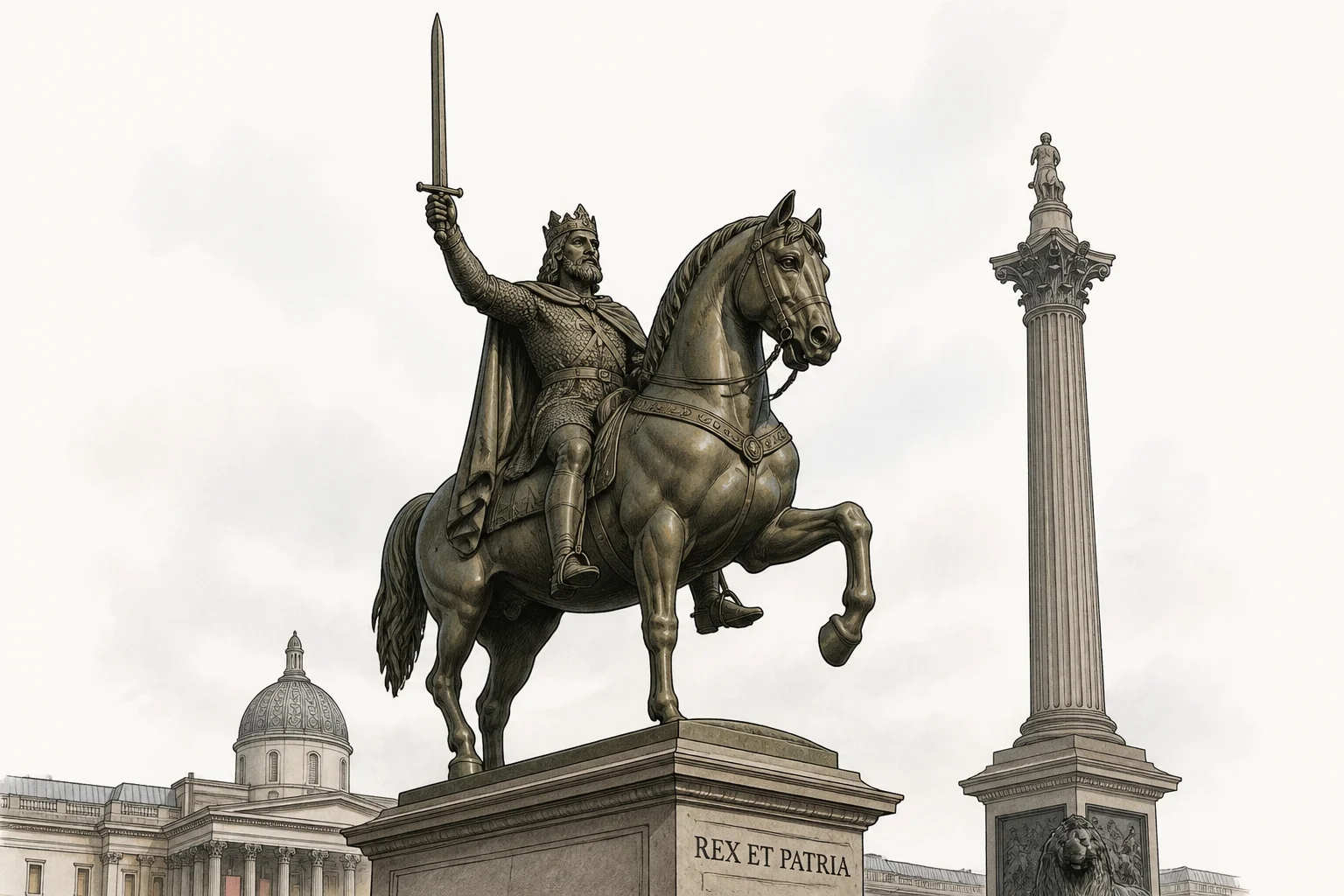
A bronze equestrian statue of Richard the Lionheart, created by sculptor Carlo Marochetti, has stood outside the Houses of Parliament in London since the 19th century. It’s a striking symbol of how Victorian Britain chose to remember him, as a bold, heroic warrior-king rather than an absentee ruler who drained England’s treasury. The statue remains a popular tourist landmark today.
This enduring monument is a good example of how history and myth-making work together. The real Richard was complicated, but the statue tells a simpler, more flattering story.
27. Modern Pop Culture Still Borrows His Name
Richard the Lionheart’s legendary status means his name and imagery keep resurfacing in modern entertainment, sometimes in unexpected places. For example, some Teenage Mutant Ninja Turtles media features a character called King Lionheart, a nod that borrows the instantly recognizable “lionheart” branding rather than depicting the historical king directly. It’s a small but telling sign of how deeply the nickname has embedded itself in popular culture, centuries after the real Richard died, and why he still ranks among history’s most recognized figures.
From animated shows to video games to historical fiction, the Lionheart name continues to signal courage, nobility, and adventure. That staying power says a lot about how effectively medieval chroniclers and later storytellers built his legend.
The Real Richard, Beyond the Legend
Richard the Lionheart was never quite the simple fairytale hero later generations wanted him to be. He was a brilliant, ruthless military commander, a mostly absent king, a devoted crusader, and, at times, a genuinely brutal figure whose actions at places like Acre can’t be waved away. He was also undeniably brave, resourceful, and larger than life, which is exactly why his legend outlived the messier historical truth.
Understanding the real King Richard I of England means holding both sides together: the celebrated warrior and the neglectful ruler, the chivalrous legend and the documented violence. That fuller picture is far more interesting than the storybook version, and honestly, it’s a better tribute to how complicated real medieval kingship actually was.
Frequently Asked Questions
Who was King Richard of Lionheart?
King Richard of Lionheart, more accurately called Richard I, King of England, ruled from 1189 to 1199. He was the son of Henry II and Eleanor of Aquitaine, and he earned the nickname "Lionheart" (Coeur de Lion) for his bravery and skill as a military commander, particularly during the Third Crusade. Despite being King of England, he spent most of his reign in France and the Holy Land rather than on English soil.
Why was Richard called the Lionheart?
Richard was called the Lionheart because of his reputation for fearless, aggressive leadership in battle, both as a young duke suppressing rebellions in Aquitaine and later as commander of crusader forces in the Holy Land. Contemporary chroniclers used variations of the phrase during or shortly after his lifetime. It reflected his courage and ferocity, not any official royal title.
Did Richard the Lionheart speak English?
Almost certainly not fluently. Richard's native language was Old French, likely a dialect from Anjou or Poitou, and he also would have used the langue d'oc common in Aquitaine. English nobility of the era typically spoke Anglo-Norman French rather than the English used by common people, and Richard was no exception.
Was Richard the Lionheart a good king?
It depends on the measure. As a military leader, he was widely admired, even by his enemies, and his crusading exploits made him one of medieval Europe's most famous warriors. As an administrator of England, though, he was largely absent, spending only around six months of his ten-year reign there, and he heavily taxed the kingdom to fund his wars and ransom.
Who was the wife of Richard the Lionheart?
Richard married Berengaria of Navarre in 1191 on Cyprus, during his journey to the Third Crusade. The marriage appears to have been primarily political, the couple had no surviving children, and Berengaria reportedly never visited England while Richard was alive.
What did Richard the Lionheart actually do?
Richard is best known for leading the Third Crusade, capturing the city of Acre, negotiating the Treaty of Jaffa with Saladin, and building a formidable reputation as a battlefield commander. He also spent years fighting for and defending his family's continental territories, including Aquitaine and Normandy, and he was famously captured and held for ransom on his journey home from the crusade.
Is Richard the Lionheart the same as Richard the Great?
No. "Richard the Great" is not a genuine historical epithet used for Richard I; his actual historical nickname is Richard the Lionheart. People sometimes search this phrase by confusing him with other historical rulers who carry "the Great" as an epithet, such as Alfred the Great.
Is the TMNT character King Lionheart based on the real Richard the Lionheart?
Not directly. Some Teenage Mutant Ninja Turtles media features a character called King Lionheart, which simply borrows the famous "lionheart" name to signal courage and nobility, rather than depicting the historical King Richard I of England.

Alex Warren
Related Articles