
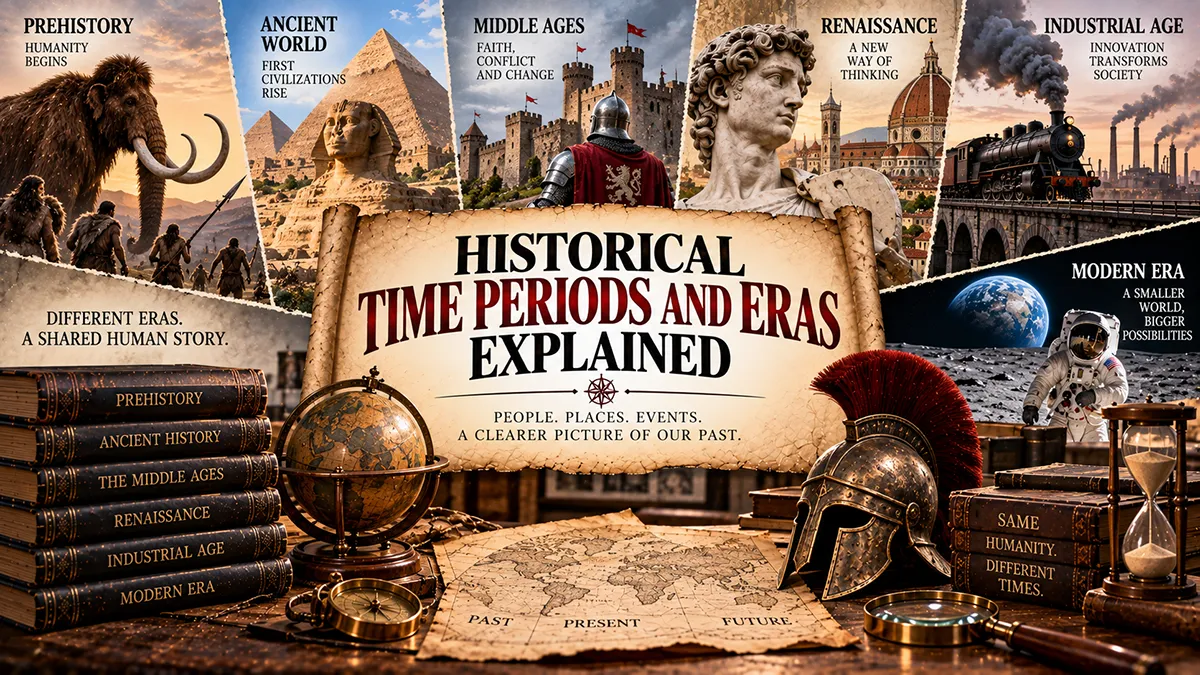
Ask five different historians to name all the “ages” of history and you’ll likely get five different answers. Some will start with the Stone Age, others will jump straight to “ancient” civilizations, and a few will insist the whole idea of neatly boxed-off eras is a modern invention layered on top of a much messier past. All of them are right, in a way.
This guide walks through the major historical time periods in order, from the earliest stone tools to the digital present, and explains how and why historians carve up the past the way they do. Along the way, we’ll bust a few myths, including the idea that any single era was objectively the “best” one to live in.
TL;DR: Historians divide the past into eras like the Stone Age, Classical Antiquity, the Middle Ages, and the Industrial Age based on shared technology, culture, or power structures, but these boundaries are useful labels, not hard scientific facts.
What Is a “Time Period” in History, Exactly?
A time period, or era, is simply a stretch of time that historians group together because it shares certain defining features. That could be a technology (the Bronze Age), a dominant culture or empire (the Roman era), or a broad intellectual movement (the Enlightenment). The label is a tool for organizing knowledge, not a line someone drew in the sand the moment it began.
There’s no fixed rule for how many years a period must span. Some historical eras, like the Victorian era, cover a single monarch’s reign of a few decades. Others, like the Stone Age, stretch across millions of years. This is one reason people searching for “how many years in an era” rarely find a single clean answer.
Different frameworks exist side by side, too. There’s the classic three-age system (Stone, Bronze, Iron), the Western academic sequence (ancient, medieval, modern), and region-specific timelines like Chinese dynastic history or the Islamic Golden Age. None of these systems is more “correct” than the others; they’re just different lenses for the same underlying history.
Geologic Eras vs. Historical Eras: Don’t Mix Them Up
It’s worth pausing on a common point of confusion. Geologists also use the word “era,” but on a wildly different scale. The geologic time scale divides Earth’s 4.5-billion-year history into eons, eras, periods, and epochs, such as the Mesozoic Era or the current Holocene epoch.
Those geologic eras can last tens or hundreds of millions of years, which is why they’re often cited as the answer to “what is the longest era” in any real sense. Human historical epochs, like the Renaissance or the Gilded Age, are almost unimaginably shorter by comparison. When people talk about “ages of humanity” or “eras of human history,” they mean the cultural and political timeline, not the geologic one.
Why Historians Draw Lines Between Eras (and Why They Often Disagree)
Periodization, the technical term for slicing history into named chunks, is a scholarly convenience rather than a discovered fact. Nobody woke up in the year 500 CE and announced the Middle Ages had begun. Historians assigned that label centuries later to describe a broad set of political and cultural shifts.
This is also why the boundaries between historical periods are fuzzy and frequently debated. The so-called “Dark Ages,” for instance, is a myth-tinged nickname for the Early Middle Ages that modern historians largely avoid, since it wrongly implies Europe went dark on learning and culture entirely. Meanwhile, other civilizations, from China to Mesoamerica, had their own golden ages and “dark ages” running on completely different calendars.
So when you see slightly different start and end dates for the same era across different sources, that’s normal. It reflects genuine scholarly disagreement, not sloppy research.
Historical Time Periods at a Glance
Before diving into the details, here’s a simplified timeline of the ages of history most commonly referenced in Western-oriented history writing, listed in order:
- The Stone Age (Paleolithic, Mesolithic, Neolithic)
- The Bronze Age
- The Iron Age
- Classical Antiquity (Ancient Egypt, Greece, Rome, and contemporaries)
- Late Antiquity
- The Middle Ages (Early, High, and Late)
- The Renaissance
- The Age of Exploration
- The Reformation and Scientific Revolution
- The Enlightenment
- The Industrial Revolution
- The Victorian Era
- The Gilded Age and Belle Époque
- The World War Era (WWI, Interwar, WWII)
- The Cold War
- The Information/Digital Age
- The Contemporary Era
Keep in mind this is a Western-centric skeleton. A genuinely global history of the world would run parallel timelines for the Han and Tang dynasties in China, the Gupta Empire in India, the Islamic Golden Age, West African empires like Mali and Songhai, and Indigenous civilizations across the Americas. Now let’s look at each major period in more depth.
1. The Stone Age (c. 3.3 Million–3300 BCE)
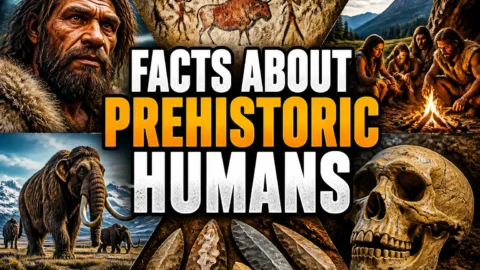
The Stone Age is the longest chapter in human history by far, covering the period when tools were primarily made of stone. It’s typically split into the Paleolithic (Old Stone Age), Mesolithic (Middle Stone Age), and Neolithic (New Stone Age), tracking the shift from nomadic hunting and gathering to early farming.
The Neolithic Revolution, when humans began domesticating plants and animals, is arguably one of the most transformative shifts in our species’ story. It set the stage for permanent settlements, which eventually made everything that followed possible.
2. The Bronze Age (c. 3300–1200 BCE)
Named for the widespread use of bronze, an alloy of copper and tin, this era saw the rise of the first great river-valley civilizations: Mesopotamia, Egypt, the Indus Valley, and China. Writing systems, organized states, and long-distance trade networks all took shape during this time.
The Bronze Age ended abruptly in many regions around 1200 BCE in an event historians call the Bronze Age Collapse. Its exact causes are still debated, with climate change, invasions, and internal unrest all cited as likely contributing factors.
3. The Iron Age (c. 1200–550 BCE, Varies by Region)
As iron-working spread, it gradually replaced bronze as the metal of choice for tools and weapons, largely because iron ore was more widely available. The exact start and end dates shift depending on the region, since ironworking spread unevenly across the ancient world.
This period saw the rise of new powers like Assyria, and later, the classical civilizations that would dominate the following centuries.
4. Ancient Egypt (c. 3100–30 BCE)
Ancient Egypt’s roughly 3,000-year run makes it one of the most durable civilizations in the history of the ancient world, and its longevity often puts it in the conversation when people debate the oldest countries in the world. It’s typically broken into the Old, Middle, and New Kingdoms, punctuated by “intermediate periods” of political fragmentation.
The civilization finally came under Roman control in 30 BCE, after the death of Cleopatra VII, closing out one of history’s longest continuous cultural traditions.
5. Ancient Mesopotamia (c. 3500–539 BCE)
Often called the “cradle of civilization,” Mesopotamia (in modern-day Iraq) was home to the Sumerians, Akkadians, Babylonians, and Assyrians, one of several remarkable ancient civilizations that laid the groundwork for later empires. This region produced some of the earliest known writing (cuneiform), law codes, and cities.
It’s a strong reminder that the history of ancient time wasn’t confined to the Mediterranean; some of the most important developments in human history happened well before Greece or Rome existed.
6. Classical Antiquity: Ancient Greece (c. 800–146 BCE)
Ancient Greece gave the world foundational ideas in philosophy, democracy, theater, and mathematics, largely through city-states like Athens and Sparta. The Classical period (roughly 500–323 BCE) is often singled out as the peak of this cultural flourishing.
Greek influence didn’t end with conquest. It spread widely under Alexander the Great and continued to shape Roman and later European culture for centuries afterward.
7. Ancient Rome (c. 753 BCE–476/1453 CE)
Rome’s story runs from a small city-state through the Roman Republic to the sprawling Roman Empire. The Western Roman Empire fell in 476 CE, but the Eastern half, known as the Byzantine Empire, endured until 1453 CE.
Roman law, engineering, and language (Latin gave rise to most modern Romance languages) left an imprint still visible today. It remains one of the most frequently referenced periods when people search for the ancient period or ancient history time period more broadly.
8. Late Antiquity (c. 3rd–8th Century CE)
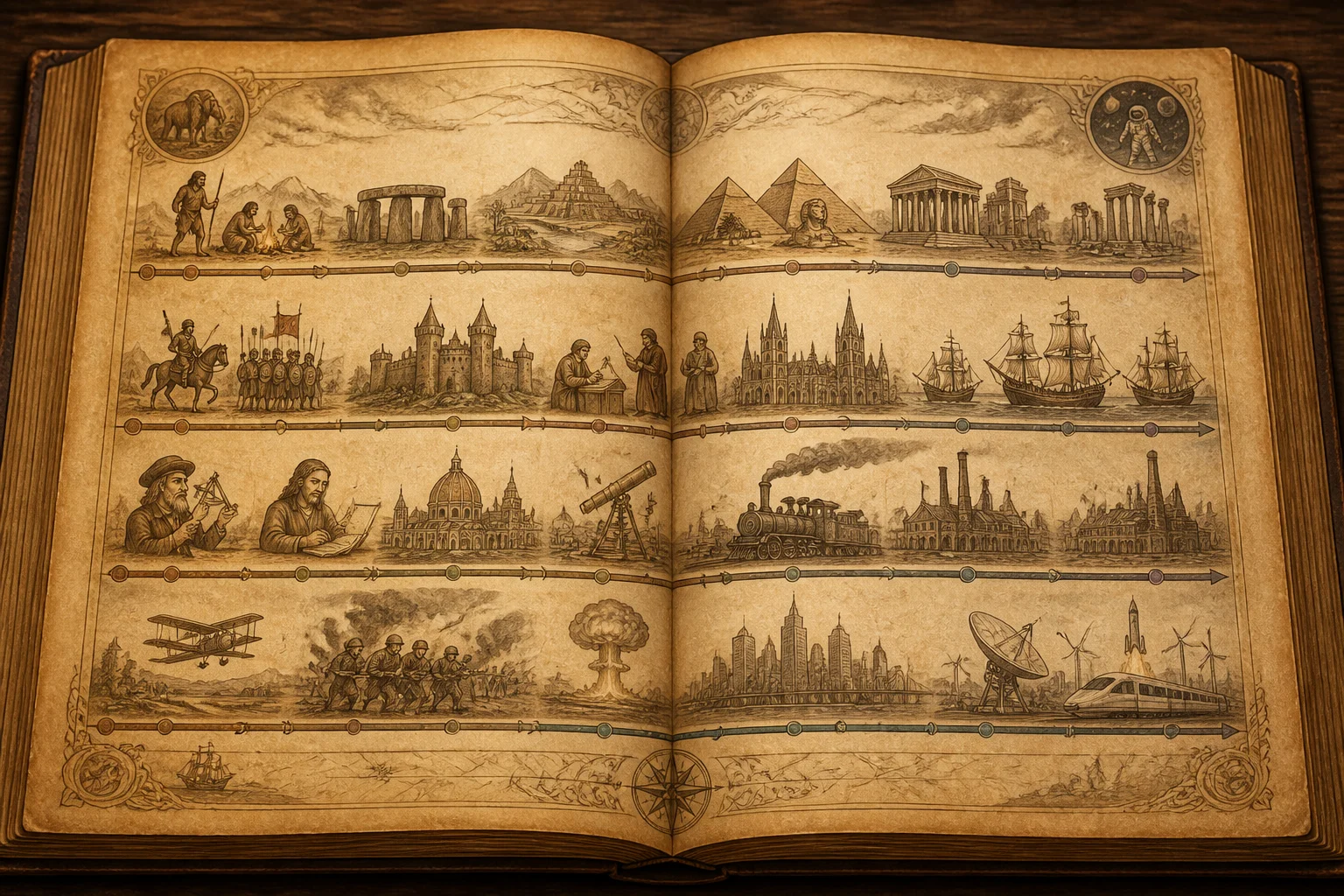
This transitional era bridges the classical world and the medieval one. It covers the decline of Rome in the west, the rise of Christianity as a dominant force, and the emergence of new powers like the early Islamic Caliphates.
Late Antiquity is a good example of how historical periods overlap rather than snap cleanly from one to the next.
9. The Early Middle Ages (c. 500–1000 CE)
Sometimes still called the “Dark Ages” in casual usage, this label is misleading and largely rejected by modern historians. Learning, trade, and culture continued in this period, particularly in the Byzantine Empire, the Islamic world, and monastic centers across Europe.
This was also the age of the Vikings, the Carolingian Empire under Charlemagne, and the gradual spread of feudal political structures across Western Europe.
10. The High Middle Ages (c. 1000–1300 CE)
Europe’s population and economy grew significantly during this era, fueling the construction of great cathedrals, the founding of the earliest universities, and the Crusades. Centralized monarchies began to take firmer shape in places like England and France.
It’s often considered the high point of medieval European civilization before crisis struck in the following century.
11. The Late Middle Ages (c. 1300–1500 CE)
This period was defined by upheaval: the Black Death killed an estimated one-third to one-half of Europe’s population in the mid-1300s, while the Hundred Years’ War dragged on between England and France. Despite the turmoil, this era also planted the seeds of the Renaissance that followed.
It’s a useful reminder that periods of crisis and periods of creativity often overlap more than clean-cut timelines suggest.
12. The Renaissance (c. 1350–1600 CE)
Meaning “rebirth,” the Renaissance began in Italian city-states like Florence and Venice before spreading across Europe. It’s associated with a renewed interest in classical Greek and Roman learning, along with an explosion of art, science, and humanist philosophy, the same creative surge that produced works like the Mona Lisa.
It’s worth noting the Renaissance wasn’t a sudden light switch after a supposedly dark medieval period; many of its intellectual roots trace directly back to medieval scholarship and Islamic preservation of classical texts.
13. The Age of Exploration (c. 1400s–1600s)
Also called the Age of Discovery, this period saw European powers, especially Portugal and Spain, launch long-distance sea voyages that reshaped global trade and politics. It led directly to sustained contact between Europe and the Americas, with devastating consequences for Indigenous populations through conquest, disease, and colonization.
This era permanently connected previously separate regions of the globe, for better and for considerably worse.
14. The Reformation (c. 1517–1648)
Sparked largely by Martin Luther’s challenges to the Catholic Church starting in 1517, the Reformation split Western Christianity into Catholic and various Protestant branches. It fueled decades of religious conflict, culminating in wars like the devastating Thirty Years’ War (1618–1648).
Its effects reached well beyond religion, reshaping politics, education, and national identities across Europe.
15. The Scientific Revolution (c. 1543–1687)
Bookended loosely by Copernicus’s heliocentric theory and Newton’s laws of motion, this period transformed how people understood the natural world. Figures like Galileo, Kepler, and Newton, often ranked among the smartest people in history, established observation and mathematics, rather than tradition alone, as the basis for knowledge.
This intellectual shift laid essential groundwork for the Enlightenment that followed.
16. The Enlightenment (c. 1685–1815)
Also called the Age of Reason, the Enlightenment championed rational thought, individual rights, and skepticism toward inherited authority. Thinkers like Locke, Voltaire, and Kant helped shape political ideas that would fuel both the American and French Revolutions.
Many core assumptions in modern democracy and science trace directly back to this era of history.
17. The Industrial Revolution (c. 1760–1840)
Starting in Britain, the Industrial Revolution transformed economies from agrarian and handcraft-based systems into mechanized, factory-driven ones. Steam power, textile mills, and later railroads reshaped where and how people lived and worked.
It’s genuinely hard to overstate how much this single period reshaped daily life, and its second wave (roughly the late 1800s) brought electricity, steel, and mass production into the mix as well.
18. The Victorian Era (1837–1901)
Named for Britain’s Queen Victoria, this era combined rapid industrial and imperial expansion with strict social norms. It’s often stereotyped as purely repressed and buttoned-up, but it was also a period of major scientific breakthroughs, from Darwin’s theory of evolution to early photography and telegraphy.
British global influence, for better and worse through colonialism, peaked heavily during this stretch.
19. The Gilded Age and Belle Époque (c. 1870–1914)
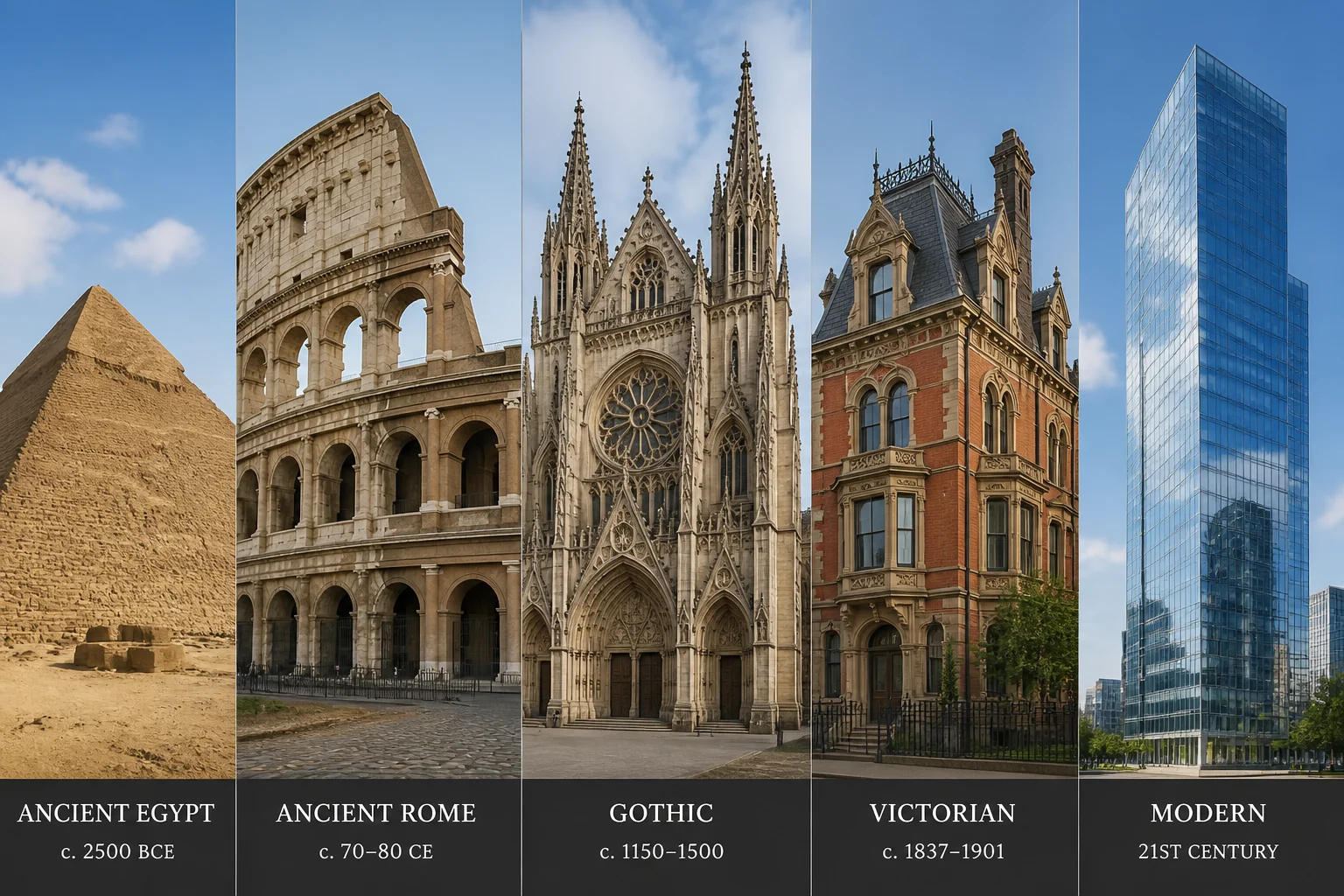
In the United States, this period is known as the Gilded Age, marked by rapid industrial growth alongside sharp inequality and political corruption, an era that produced some of the richest and most powerful families in history. In Europe, the roughly equivalent stretch is called the Belle Époque, a period of relative peace, optimism, and artistic flourishing before the First World War.
Both labels capture a similar tension: genuine progress sitting right alongside genuine problems.
20. World War I and Its Aftermath (1914–1918 into the 1920s)
The First World War reshaped borders, toppled empires (including the Russian, Austro-Hungarian, and Ottoman Empires), and introduced industrialized warfare on a horrifying new scale. Its aftermath included the Treaty of Versailles, the Russian Revolution, and deep economic instability across much of Europe.
Many historians treat this as the true starting point of the “modern” 20th century.
21. The Interwar Period (1918–1939)
Sandwiched between the two World Wars, this period saw the Roaring Twenties give way to the Great Depression after the 1929 stock market crash. It also witnessed the rise of authoritarian movements, including fascism in Italy and Nazism in Germany, that would drive the next global conflict.
It’s a compact but pivotal era that’s easy to overlook between two much larger wars.
22. World War II (1939–1945)
The deadliest conflict in human history, World War II involved most of the world’s nations and resulted in tens of millions of deaths, including the Holocaust’s systematic genocide of six million Jews and millions of other victims. It ended with the defeat of Nazi Germany and Imperial Japan, and the first and only use of nuclear weapons in warfare.
Its aftermath directly shaped the geopolitical map, and the era, that came next.
23. The Cold War (1947–1991)
This decades-long standoff between the United States and the Soviet Union never erupted into direct war between the two superpowers, but it fueled proxy conflicts, an arms race, and the Space Race. It ended with the fall of the Berlin Wall in 1989 and the Soviet Union’s dissolution in 1991.
Much of the current global political order still traces its roots to decisions made during this period.
24. The Information Age / Digital Age (c. 1970s–Present)
Driven by the rise of computers, the internet, and eventually smartphones, this era transformed how humans communicate, work, and access knowledge. Some historians date its start to the personal computer boom of the 1970s and ’80s, while others point to the internet’s mainstream adoption in the 1990s.
It’s one of the few eras on this list that many of us have lived through in real time.
25. The Contemporary Era (21st Century)
We’re technically still living inside this one, which makes it the hardest to define with any real hindsight. Some scholars use “contemporary era” loosely for the post-Cold War period onward, while others reserve it strictly for the 21st century.
Whatever label eventually sticks, historians generally need distance from an era before they can name and define it with real confidence.
Time Periods in United States History
Zooming into a single country’s timeline shows how these broader eras get subdivided further. US history is commonly broken into periods like the Colonial Era, the Revolutionary Era, the Antebellum period, the Civil War and Reconstruction, the Gilded Age, the Progressive Era, the Great Depression, the postwar boom, the Cold War era, and the modern/contemporary period.
Each of these nested inside the larger global framework covered above. It’s a useful example of how “time periods in history” can operate on multiple zoom levels at once, global, regional, and national.
A Quick Note on European Historical Eras
Much of the terminology above, Renaissance, Enlightenment, Victorian, is drawn specifically from European history and later applied more broadly. That’s worth flagging, because periods of European history don’t map neatly onto the histories of Asia, Africa, or the Americas.
China’s dynastic cycles, the Islamic Golden Age, and the rise and fall of empires across Africa and the Americas each ran on their own timelines, with their own defining turning points. A genuinely complete history of the world weaves all of these together rather than treating the European sequence as the default.
What Time Period Are We In Right Now?
This is one of the more common questions people ask, and the honest answer is that there’s no single agreed-upon name yet. Depending on who you ask, we’re living in the Information Age, the Digital Age, the Contemporary Era, or, in geologic terms some scientists have proposed, the Anthropocene.
That uncertainty isn’t a flaw in the system. Historians generally need decades or centuries of distance before they can identify an era’s defining features and give it a lasting name, so it makes sense that our current moment doesn’t have one yet.
Is There a “Best” Time Period to Live In? (Let’s Bust This Myth)
Searches for the “best historical time periods” or the “coolest time periods in history” are common, and it’s a fun question to daydream about. But it’s worth being honest: there’s no objectively best era, because every period involved serious trade-offs.
The Renaissance produced extraordinary art, but life expectancy was short and disease was rampant. The Victorian era brought major scientific progress, but also deep inequality and limited rights for women and minorities. Even the modern era, with its medical advances and technology, comes with its own serious challenges.
Rather than crowning one “best era in history,” it’s more accurate to say each period offered a different mix of opportunity and hardship. What counts as a golden age often depends heavily on who you were, where you lived, and how much privilege you held at the time.
Why These Bygone Eras Still Shape Our World
Every bygone era, from the first Stone Age tools to the Cold War’s nuclear tension, left fingerprints on the world we live in now. Our laws borrow from Rome, our calendars borrow from ancient astronomy, and our political ideals borrow heavily from the Enlightenment.
Understanding historical time periods isn’t just an academic exercise; it’s a way of recognizing patterns that keep recurring, from technological leaps to social upheavals. The next time someone asks what time period we’re in now, you’ll at least know why historians are still arguing about the answer.
Frequently Asked Questions
What are the main time periods in history?
Most overviews of world history move through the Stone Age, Bronze Age, and Iron Age, then Classical Antiquity, the Middle Ages, the Renaissance, the Enlightenment, the Industrial Revolution, and finally the modern and contemporary eras. This is a simplified, largely Western-oriented sequence; other regions had parallel timelines with their own defining periods.
What time period are we in right now?
There's no single official name yet. Depending on the source, today is described as the Information Age, the Digital Age, the Contemporary Era, or the Anthropocene in geologic terms, since historians usually need decades of hindsight before a period gets a lasting label.
How many ages or eras are there in history?
It depends entirely on which system you use. The three-age system counts three (Stone, Bronze, Iron), while broader historical frameworks list a dozen or more periods from antiquity through today, and the geologic time scale uses an entirely separate set of eras spanning millions of years.
What is the difference between an era, an age, and a period?
In everyday historical writing, these terms are largely interchangeable and describe a defined stretch of time with shared characteristics. Some fields use them more precisely, such as geology, where "era" refers to a specific formal division of the geologic time scale.
Was there really a best time period in history to live in?
Not objectively, no. Every historical era involved a mix of advantages and serious hardships, such as shorter life expectancy, limited rights, or lack of medical care, so what counts as a "best" era usually depends on personal values and who you would have been within that society.
What era came after the Renaissance?
The Renaissance flowed into the Age of Exploration, the Reformation, and the Scientific Revolution, which together set the stage for the Enlightenment in the 17th and 18th centuries.
What came after the Industrial Revolution?
The Industrial Revolution gave way to the Victorian era and the Gilded Age/Belle Époque, followed by the upheavals of World War I, the Interwar Period, and World War II in the 20th century.
Why do historians disagree about exact dates for historical eras?
Periodization is a scholarly tool for organizing the past, not a fact discovered in the historical record itself. Because eras blend into one another gradually and different regions changed at different paces, historians often set slightly different start and end dates for the same period.

Alex Warren
Related Articles