
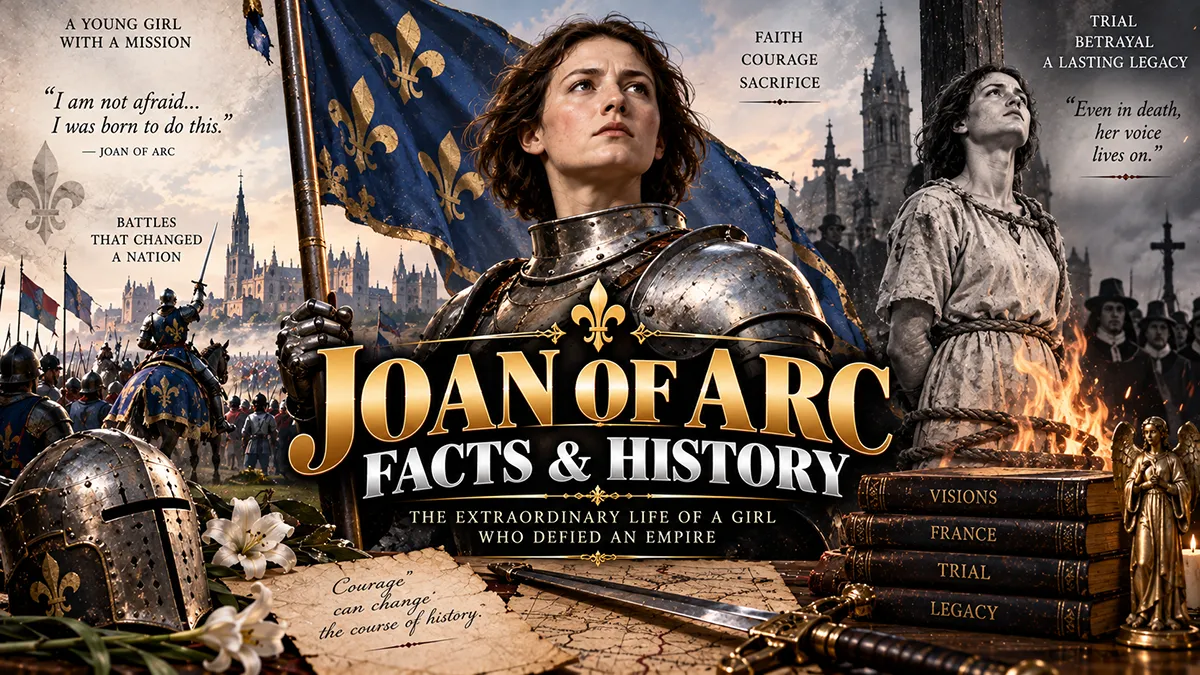
Few figures in medieval history sound more like legend than fact: a teenage peasant girl who claimed to hear the voice of God, talked her way into a royal court, put on armor, and turned the tide of a war that had dragged on for nearly a century.
Much like Richard the Lionheart, whose real story is often buried under fairy-tale retellings, Joan of Arc was a real, extensively documented historical person, and her story is stranger and more remarkable than most myths could invent.
This guide separates the verified history from the legend, working through her real name, her age, her military record, her trial, and the miracles attributed to her.
Whether you’re here for a school project, general curiosity, or because you’ve seen her name spelled a dozen different ways online, you’ll find the full, accurate picture below.
TL;DR: Joan of Arc was a real 15th-century French peasant girl turned military leader who helped save France during the Hundred Years’ War, was burned at the stake at about 19, and was later declared innocent and made a saint.
Joan of Arc Quick Facts
Before diving into the full list, here’s a snapshot of who she was and what she did.
- Real name: Jeanne d’Arc (anglicized as Joan of Arc; also written Joan d’Arc or Joan de Arc)
- Born: around 1412, in Domrémy, a small farming village in northeastern France
- Died: May 30, 1431, in Rouen, at roughly 19 years old
- Famous for: Leading French troops to lift the Siege of Orléans and helping crown Charles VII during the Hundred Years’ War
- Known as: The Maid of Orléans (“La Pucelle d’Orléans”)
- Canonized: As a Catholic saint in 1920
Was Joan of Arc Real? Setting the Record Straight
Yes, Joan of Arc was a genuine historical figure, not a folk tale or legend invented later. Her existence and actions are backed by an unusually rich paper trail for the medieval period, including trial transcripts, letters, and eyewitness testimony collected during a posthumous retrial.
The historical Joan of Arc is documented through the minutes of her 1431 trial for heresy, financial and military records from the French royal court, and the testimony of dozens of witnesses gathered in the 1450s when the case against her was reopened. Historians treat her as one of the best-recorded ordinary people of the entire Middle Ages, precisely because of the legal scrutiny she faced. So while parts of her story have been mythologized over the centuries, the core historical Joan of Arc is not in serious doubt among scholars.
Her Name and Why It’s Spelled So Many Ways
One reason so many people search for “Joan d’Arc,” “Joan de Arc,” “Jean of Arc,” or even “Joan of Ark” is that her name has been translated, anglicized, and misspelled for centuries. Understanding the original French helps clear up the confusion.
1. Her real name was Jeanne d’Arc, not “Joan Arc”
In French records, she is called Jeanne d’Arc or sometimes Jeanne Darc, since spelling wasn’t standardized in the 1400s. “Joan of Arc” is simply the English translation that became standard, which is why the title “Joan Arc” (missing the “of”) is a common but incorrect shorthand.
2. “D’Arc” likely came from her father’s name
Her father was Jacques d’Arc, a farmer and minor local official in Domrémy. The family surname is the source of both “Joan d’Arc” and “Joan de Arc,” two spellings that show up constantly in modern searches for the same person.
3. English and French spellings have blended over time
Variants like “Jean of Arc,” “John of Arc,” “Jon of Arc,” and “Jone of Ark” are all modern misreadings or mishearings of the same name. There was only ever one historical figure behind all these spellings, a French teenager, not a man named John or Jean.
4. She is sometimes confused with a male name because of “Jean”
In French, “Jean” is a common male name, which leads some people to search “John of Arc” by mistake. Joan of Arc was unambiguously female, a detail that was actually central to the accusations made against her at trial.
Early Life: From Farm Girl to Visionary
Her path from an obscure village to the royal court is one of the most dramatic accomplishments of the medieval era.
5. She was born around 1412 in a small farming village
Joan of Arc was born in Domrémy, a small town in the Lorraine region of northeastern France. Because parish birth records from that era are incomplete, historians estimate her birth year from later trial testimony rather than a surviving certificate.
6. She grew up during the Hundred Years’ War
By the time Joan was a child, France and England had already been fighting on and off for generations over the French throne. Her home region was contested territory, which meant she grew up surrounded by real wartime instability, not distant rumors of it.
7. She was illiterate for most of her life
Like the vast majority of medieval peasants, Joan could not read or write. Trial records indicate she later learned to sign her own name, but she dictated her letters to scribes throughout her career.
8. She said she began hearing voices around age 13
According to her own testimony, Joan described hearing what she believed were the voices of saints, including Saint Michael, Saint Catherine, and Saint Margaret. She said these voices urged her to support Charles VII and drive English forces out of France.
9. Historians still debate the nature of her visions
Modern doctors and historians have proposed various explanations over the years, including religious devotion, migraine-related phenomena, or other medical conditions, but no diagnosis is settled or provable from a distance of six centuries. It’s worth being cautious here: claiming a definitive modern diagnosis for a 15th-century person is speculation, not established fact.
10. She left home to seek out the future king
At around 16 years old, Joan traveled to Vaucouleurs and then to the royal court at Chinon to reach Charles VII, the uncrowned heir to the French throne. This was an extraordinary journey for a peasant girl with no formal standing, which is part of why her story stood out even to contemporaries.
The Warrior Maid: Military Achievements
This is the heart of what Joan of Arc is famous for, and what most people mean when they ask what she actually did.
11. She convinced Charles VII to give her troops
After being questioned by clergy and court officials to test her sincerity, Joan persuaded Charles VII to grant her a small military role. This alone was remarkable, since a teenage girl commanding any authority in a medieval army was almost unheard of.
12. She dressed and armed herself as a soldier
Joan wore male soldier’s clothing and armor, cut her hair short, and rode with troops, a practical choice for safety and mobility. This decision would later become one of the central charges used against her at trial.
13. Her signature achievement was lifting the Siege of Orléans in 1429
Orléans was a critical French city under siege by English forces, and its fall likely would have been disastrous for the French cause. Joan’s arrival and the campaign she took part in helped break the siege, a turning point that earned her the title “Maid of Orléans.”
14. She fought alongside experienced captains, not alone
Joan is often pictured as a lone warrior, but in reality she operated alongside seasoned military commanders who led the actual tactics. Her role combined symbolic leadership, morale-boosting presence, and participation in campaigns, rather than sole command of every decision.
15. She was wounded in combat
During the Orléans campaign, Joan was struck by an arrow, and she was wounded again in a later battle near Paris. These injuries are documented in contemporary accounts and show she was genuinely present in dangerous frontline situations.
16. She helped get Charles VII crowned king
Following the success at Orléans, Joan escorted Charles VII to Reims Cathedral, the traditional site of French coronations, where he was crowned King Charles VII in July 1429. This was arguably her most important political accomplishment, since it legitimized his claim to the throne in the eyes of the French public.
17. Her military career lasted little more than a year
From her first campaign in 1429 to her capture in 1430, Joan’s active military involvement spanned roughly 14 months. It’s a strikingly short window for someone whose name is still recognized worldwide centuries later.
18. She was captured at Compiègne in 1430
During a military engagement at Compiègne, Joan was captured by Burgundian forces allied with the English. She was eventually sold to the English, who saw her as a serious political and propaganda threat.
Trial, Death, and Alleged Miracles
The end of Joan’s life is just as historically significant as her military campaigns, and it’s the part most heavily documented in primary sources.
19. She was tried for heresy, not witchcraft in the modern sense
Her 1431 trial in English-controlled Rouen focused on charges including heresy and wearing men’s clothing, which church authorities framed as defying the natural order. It was as much a political trial aimed at discrediting Charles VII as it was a religious one.
20. She had no formal legal defense
Joan faced a tribunal of clergy without a trained advocate to represent her, and she answered questions from memory and personal conviction alone. Given her lack of education, her recorded responses during interrogation are often cited as remarkably sharp and composed.
21. She was burned at the stake at about 19 years old
Joan was executed in the marketplace of Rouen on May 30, 1431. Her age at death is estimated at around 19, based on the same testimony historians use to estimate her birth year.
22. Several “miracles” or prophecies are attributed to her, though they aren’t independently verifiable
Accounts from her time describe her identifying Charles VII in a crowd despite disguise, and predicting details like being wounded in battle. These stories come from testimony and chronicles rather than physical evidence, so they’re best understood as part of the historical record of what people believed and reported, not confirmed supernatural events.
23. She was posthumously retried and declared innocent in 1456
Twenty-five years after her execution, a new trial ordered by the Catholic Church examined the original case and formally overturned the heresy conviction. This retrial is one of the main reasons historians have such detailed testimony about her life, since dozens of witnesses who had known her were interviewed.
Legacy: Sainthood and a Lasting Symbol
Joan’s story didn’t end with her death, and her legacy has continued to grow across art, religion, and national identity.
24. She was canonized as a saint in 1920
Nearly 500 years after her execution, Pope Benedict XV declared Joan of Arc a saint. She’s now venerated as one of the patron saints of France, and her feast day is celebrated on May 30.
25. Her height and appearance remain genuinely unknown
Despite plenty of online claims about “how tall Joan of Arc was,” there is no reliable contemporary record of her exact height, weight, or detailed physical appearance, unlike some of the tallest people in history whose measurements were meticulously recorded and verified. Portraits made during her lifetime don’t survive, and later paintings are artistic interpretations, not accurate depictions.
26. She became a lasting symbol of French national identity
Joan of Arc has been invoked by French political and cultural movements for centuries, sometimes for very different causes. She remains one of the most recognized historical figures associated with French patriotism and resilience.
27. She has inspired centuries of art, plays, and film
From medieval chronicles to modern movies, Joan of Arc’s life has been retold constantly, which is part of why so many different spellings and interpretations of her name circulate today. Each retelling tends to emphasize different aspects of her story, from religious devotion to military heroism to teenage defiance.
Why Joan of Arc Still Matters
Joan of Arc’s importance doesn’t rest on any single dramatic moment, but on the unusual combination of factors in her short life. A teenage girl with no formal education or military training helped change the course of the Hundred Years’ War, influenced the legitimacy of a king, and was executed for it, only to be exonerated and eventually declared a saint.
That combination of real political consequence and enduring symbolism is rare in medieval history. It’s also why her story keeps getting retold, researched, and occasionally distorted into legend.
The most useful way to approach Joan of Arc today is with the same myth-busting curiosity used throughout this piece. Take the documented trial records and military history seriously, treat the miraculous claims as part of the historical record of belief rather than proven fact, and appreciate her as what she really was: an extraordinary, well-documented young woman who left a permanent mark on European history.
Frequently Asked Questions
What did Joan of Arc do?
Joan of Arc was a French peasant girl who, at around 17, convinced the future King Charles VII to let her lead troops during the Hundred Years' War. She played a key role in lifting the Siege of Orléans in 1429 and helped Charles VII reach his coronation at Reims, before being captured, tried, and executed in 1431.
Was Joan of Arc real?
Yes. Joan of Arc is one of the most thoroughly documented ordinary people of the medieval period, thanks to surviving trial transcripts from 1431 and a posthumous retrial in the 1450s that gathered testimony from people who knew her personally.
When was Joan of Arc born?
Historians estimate Joan of Arc was born around 1412 in Domrémy, a small village in northeastern France, based on testimony given at her later trials rather than a surviving birth record.
What was Joan of Arc’s real name?
Her name in French was Jeanne d'Arc. 'Joan of Arc' is the standard English translation, which is why you'll also see variants like Joan d'Arc or Joan de Arc used online.
What was Joan of Arc famous for?
She is most famous for leading French forces to break the English siege of Orléans in 1429 and for helping secure the coronation of Charles VII, both major turning points in the Hundred Years' War.
How old was Joan of Arc when she died?
Joan of Arc was approximately 19 years old when she was executed in Rouen on May 30, 1431. Her exact birth date isn't recorded, so her age is an estimate based on trial testimony.
How tall was Joan of Arc?
There is no reliable historical record of Joan of Arc's exact height. Claims about her specific height online are not backed by verified contemporary sources.
Was Joan of Arc insane?
There's no reliable way to diagnose a medieval historical figure from a distance of centuries. Joan described hearing voices she attributed to saints, and while various medical and psychological explanations have been proposed by later writers, none are proven, so it's more accurate to describe her experiences as unverified rather than to label her with a modern diagnosis.
What miracles did Joan of Arc do?
Contemporary accounts describe Joan predicting her own battle wounds and recognizing Charles VII despite him being disguised in a crowd. These stories come from testimony and chronicles of the time rather than independently verifiable evidence, so historians treat them as part of her legend rather than confirmed fact.
Why was Joan of Arc important?
Joan of Arc mattered because her military role helped shift momentum in the Hundred Years' War and legitimize Charles VII's claim to the French throne. Her later trial, execution, and posthumous exoneration also made her an enduring symbol of faith, injustice, and French national identity.

Alex Warren
Related Articles