
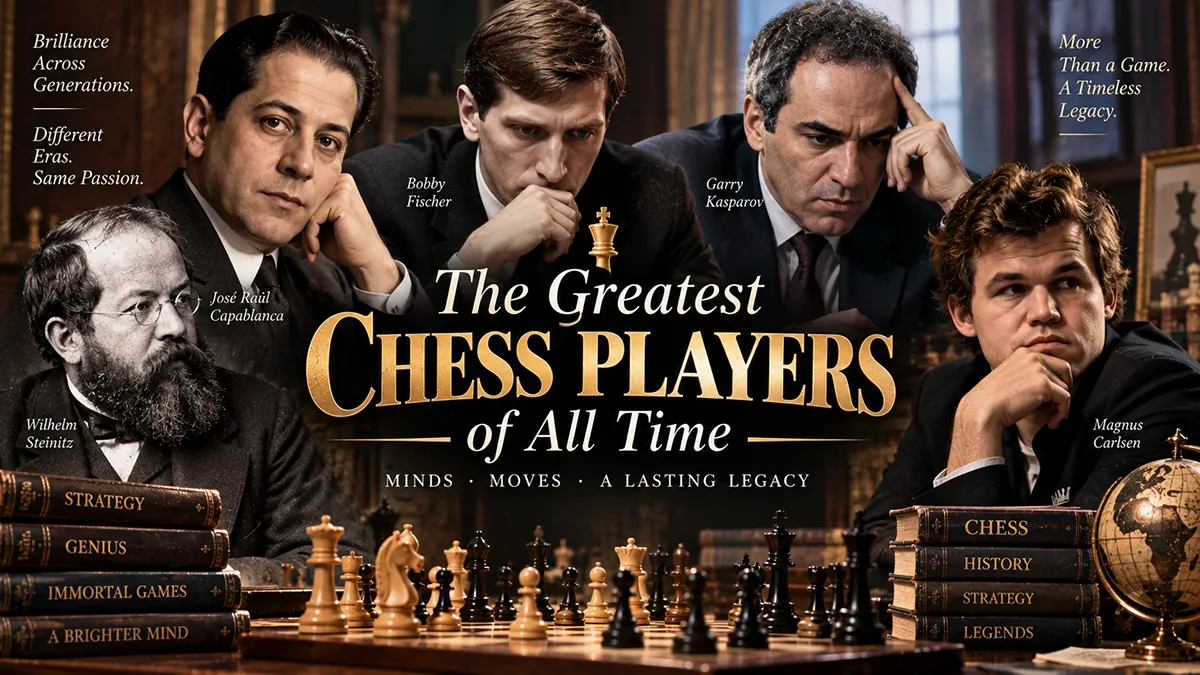
Ask ten chess fans who the greatest chess player of all time is, and you'll likely get ten different answers, plus a lengthy argument about how to even measure "greatness." Do you count peak rating? Longevity? Dominance over rivals? Influence on how the game is played today? Each measuring stick produces a different champion, which is exactly why this debate has raged for more than a century.
This list doesn't pretend to settle the argument once and for all. Instead, it walks through 21 of the best chess players in history, explains what made each one special, and separates the well-documented facts from the myths that have crept into chess folklore over the years.
TL;DR: There's no single, universally agreed-upon "best chess player ever" — but a shortlist including Kasparov, Carlsen, Fischer, Capablanca, and Lasker dominates virtually every serious ranking.
How Do You Measure Chess Greatness?
Before diving into the rankings, it's worth understanding why this question is so contentious. Chess didn't have an official rating system until the Elo system was adopted by FIDE in 1970, which means comparing players across eras is tricky at best.
A player's peak rating, their number of years as world champion, their winning percentage against contemporaries, and their lasting influence on chess theory all matter. Some players get ranked highly because they dominated their era so thoroughly that no rival came close. Others earn their spot because they changed how the entire game is understood and played.
With that context in mind, here are 21 of the greatest chess players of all time, organized roughly by historical era and impact rather than a rigid statistical formula.
1. Magnus Carlsen
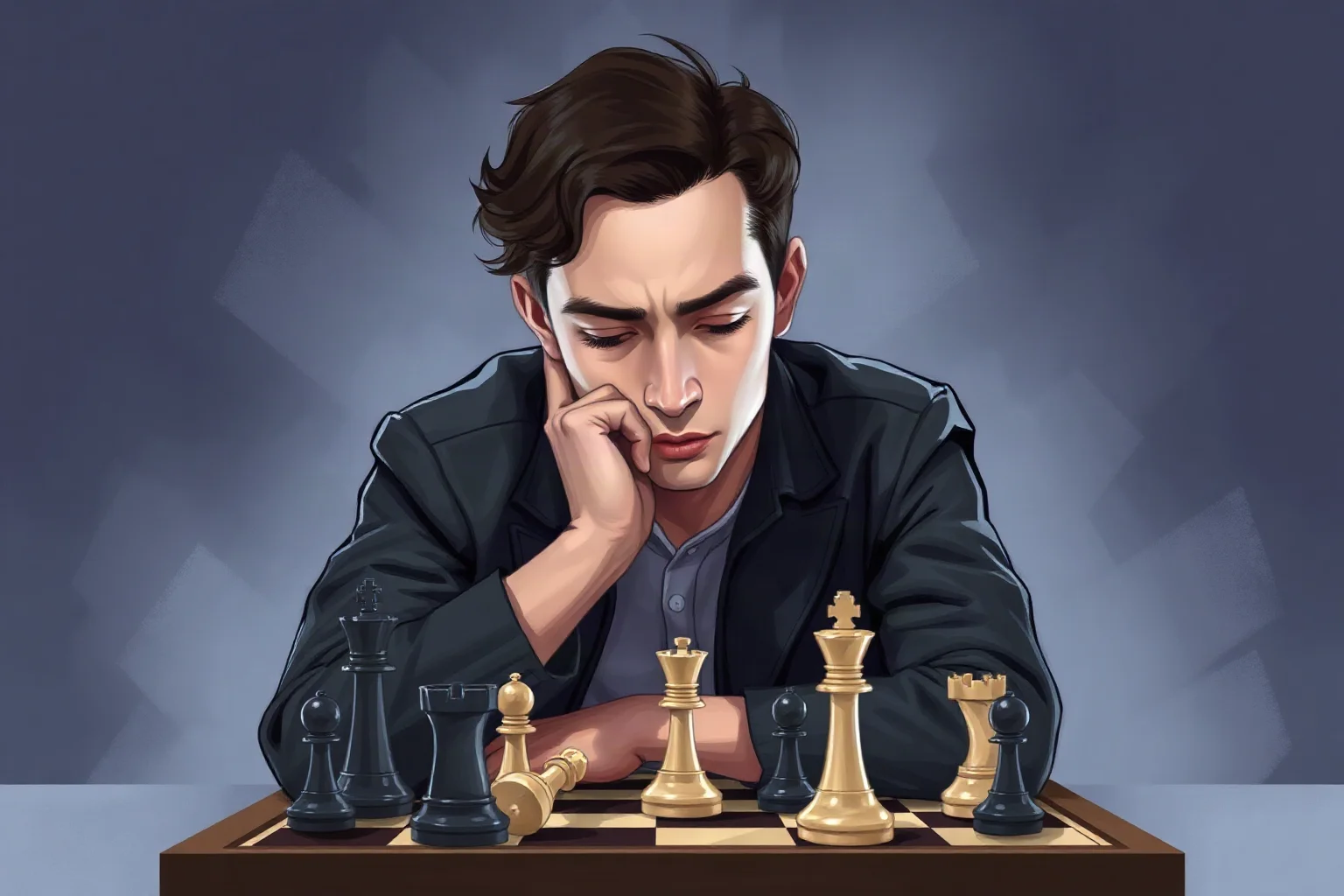
Magnus Carlsen is, by rating alone, the highest rated chess player of all time, having reached a peak classical Elo of 2882 in 2014. The Norwegian became the youngest player ever to reach world number one at age 19, and he held the World Chess Championship title from 2013 until voluntarily relinquishing it in 2023.
Carlsen's game is famous for relentless positional pressure rather than flashy tactics, grinding opponents down in positions many grandmasters would have accepted as drawn. He remains active and dominant in rapid and blitz formats, which keeps the "is Magnus Carlsen the best chess player in history" debate very much alive today.
2. Garry Kasparov
Garry Kasparov held the World Chess Championship from 1985 to 2000, making him the youngest world champion in history at the time, at age 22. He is best remembered for his ferocious attacking style, his intense rivalry with Anatoly Karpov, and his high-profile 1997 matches against IBM's Deep Blue computer.
Kasparov's peak rating of 2851 stood as the record for over a decade before Carlsen surpassed it. Many consider him the greatest chess player of all time based purely on the sheer weight of his tournament dominance through the 1980s and 1990s.
3. Bobby Fischer
Bobby Fischer remains one of the most famous chess players ever, largely thanks to his legendary 1972 World Championship win over Boris Spassky in Reykjavik. That match, dubbed the "Match of the Century," became a Cold War cultural flashpoint watched around the world.
Fischer's brilliance is well documented, but so is his troubled later life, including erratic public statements and years away from competitive chess. It's a myth that he was simply unbeatable his entire career; his dominance was real, but it was concentrated in a relatively short, spectacular stretch before he abandoned top-level competition.
4. Anatoly Karpov
Anatoly Karpov held the World Championship title from 1975 to 1985 and remained one of the world's top players for two more decades after that. His style was famously suffocating and positional, squeezing opponents in ways that felt almost inevitable once the game reached a certain stage.
Karpov's rivalry with Kasparov produced five World Championship matches between 1984 and 1990, one of the longest and most intense head-to-head sagas in chess history. His tournament record from the late 1970s through the 1980s is considered one of the most dominant stretches by any player.
5. José Raúl Capablanca
José Raúl Capablanca, the Cuban world champion from 1921 to 1927, was nicknamed the "Chess Machine" for his uncanny ability to find the correct move with seemingly effortless clarity. His endgame technique is still taught to students today as a model of precision.
It's often claimed Capablanca went years without losing a single game, and while his losses were genuinely rare for long stretches, framing him as literally unbeatable oversimplifies a career that did include defeats. Still, few players in history have combined natural talent and technical purity quite like he did.
6. Emanuel Lasker
Emanuel Lasker held the World Chess Championship for 27 years, from 1894 to 1921, the longest reign of any world champion in history. That statistic alone makes a strong case for him as one of the best chess players ever, regardless of era.
Lasker was also a mathematician and philosopher, and he approached chess with a psychological edge, often playing moves designed to unsettle opponents rather than simply the objectively "best" move. His longevity at the top remains a record that no modern champion has come close to matching.
7. Mikhail Tal
Mikhail Tal, world champion from 1960 to 1961, is remembered as chess's great romantic attacker, a player who sacrificed material with dazzling, often unsound-looking combinations that somehow worked out anyway. His nickname, the "Magician from Riga," captures how contemporaries felt playing against him.
Computer analysis has shown that some of Tal's famous sacrifices weren't objectively sound, but that misses the point of his legacy. He proved that psychological pressure and complications could be a weapon just as powerful as pure calculation.
8. Wilhelm Steinitz
Wilhelm Steinitz is widely credited as the first official World Chess Champion, holding the title from 1886 to 1894. More importantly, he's considered the father of modern positional chess theory, moving the game away from purely romantic, sacrifice-heavy play toward structured strategic principles.
Many of the ideas Steinitz pioneered, like the importance of pawn structure and the accumulation of small advantages, remain foundational to how chess is taught today. Without his theoretical groundwork, later positional players like Capablanca and Karpov may never have developed their styles.
9. Alexander Alekhine
Alexander Alekhine, world champion from 1927 to 1935 and again from 1937 until his death in 1946, was known for his ferocious combinational attacks and deep opening preparation. He famously dethroned Capablanca in 1927, a result many considered a genuine upset at the time.
Alekhine's personal life, including his conduct during World War II, remains a subject of historical scrutiny and debate rather than settled consensus. On the board, though, his contributions to opening theory and attacking chess are undeniable.
10. Mikhail Botvinnik
Mikhail Botvinnik became the first Soviet-trained World Chess Champion in 1948 and held the title across three separate reigns until 1963. He's often called the father of the Soviet chess school, a training system that produced an extraordinary run of world champions for decades.
Botvinnik combined deep scientific preparation with a fighting spirit, and he was among the first top players to systematically study his opponents' games in advance. His influence as a teacher and mentor to future champions may be just as important as his own championship record.
11. Paul Morphy
Paul Morphy was an American player who, in the late 1850s, defeated virtually every strong player in Europe and the United States before retiring from competitive chess at just 22 years old. He's sometimes called an unofficial "world champion" of his era, though no formal title existed at the time.
Morphy's rapid development, sharp tactical eye, and clean attacking style were decades ahead of his contemporaries. His brief but blazing career is a big reason he's still mentioned among the great chess players despite never competing in an official world championship.
12. Vasily Smyslov
Vasily Smyslov held the World Chess Championship from 1957 to 1958 and remained a top-tier grandmaster for an astonishing five decades. His harmonious, technically sound style earned admiration from fellow grandmasters even when it didn't grab headlines the way flashier players did.
Smyslov's longevity is remarkable: he was still competing at an elite level into his sixties and seventies, reaching a Candidates final as late as 1984. Few players in chess history have sustained world-class strength for that long.
13. Tigran Petrosian
Tigran Petrosian, world champion from 1963 to 1969, earned the nickname "Iron Tigran" for his famously defensive, almost impenetrable style of play. He was a master of prophylaxis, the art of anticipating and neutralizing an opponent's plans before they even began.
Critics sometimes called his style overly cautious, but Petrosian's approach was calculated rather than timid. He simply preferred to eliminate danger before it materialized, a philosophy that made him extraordinarily difficult to beat.
14. Boris Spassky
Boris Spassky held the World Championship from 1969 to 1972, before losing the title to Bobby Fischer in that historic Reykjavik match. Spassky is often remembered through the lens of that single loss, but he was a genuinely versatile, universal player capable of both sharp attacks and solid positional chess.
His graceful conduct during the politically charged 1972 match, including a widely reported moment of applauding one of Fischer's brilliant moves, added to his reputation as a good-natured competitor. That sportsmanship shouldn't overshadow just how strong a champion he was in his own right.
15. Viswanathan Anand
Viswanathan Anand became India's first grandmaster and went on to win the World Chess Championship five times between 2000 and 2012. He was also one of the fastest calculators in chess history, earning the nickname "The Lightning Kid" early in his career.
Anand's success helped ignite a massive chess boom in India, inspiring a generation of young players who would later become elite grandmasters themselves. His versatility across classical, rapid, and blitz formats made him one of the most complete players of his generation.
16. Vladimir Kramnik
Vladimir Kramnik famously ended Garry Kasparov's 15-year reign atop the chess world by defeating him in a 2000 World Championship match, using deep opening preparation to neutralize Kasparov's aggressive style. It remains one of the most significant upsets in modern chess history.
Kramnik held the unified World Championship title until 2007 and continued to compete at the elite level for years afterward. His strategic, preparation-heavy approach became a blueprint for how future challengers approached championship matches.
17. Judit Polgar
Judit Polgar is widely regarded as the strongest female chess player in history, reaching a peak ranking of eighth in the world overall in 2005, a feat no other woman has matched. She famously defeated multiple reigning and former world champions, including Kasparov, over her career.
Polgar never played in a Women's World Championship, choosing instead to compete exclusively in the open field against the world's best players. Her success remains a landmark reference point whenever the conversation turns to talent, training, and gender in chess.
18. Levon Aronian
Levon Aronian has spent much of the 21st century among the top handful of players in the world, known for his creative, resourceful play and deep opening ideas. Though he never won a World Championship title, he's been a fixture in Candidates Tournaments for nearly two decades.
Aronian's imaginative style has produced some of the most celebrated individual games of the modern era. His consistency at the elite level over such a long span places him firmly among the great chess players of his generation, even without the championship crown.
19. Fabiano Caruana
Fabiano Caruana became the first American to challenge for the World Chess Championship since Bobby Fischer, taking Magnus Carlsen to a tiebreak in their 2018 match. He also reached the number two spot in the world rankings with a rating that briefly approached Carlsen's peak figures.
Caruana is known for his deep, computer-assisted opening preparation and marathon-level stamina in long games. His rise represented a genuine American resurgence at the very top of world chess.
20. Hikaru Nakamura
Hikaru Nakamura has long been one of the world's elite classical players, but he's arguably had an even bigger impact as the most dominant online blitz and bullet chess player of the streaming era. His rapid-fire style and online popularity have introduced millions of new fans to top-level chess.
Nakamura's classical resume includes multiple U.S. Championship titles and a peak world ranking inside the top ten. His influence on how modern audiences consume and engage with chess content is arguably unmatched among his peers.
21. Ding Liren
Ding Liren became China's first World Chess Champion in 2023, defeating Ian Nepomniachtchi in a dramatic tiebreak after Magnus Carlsen declined to defend his title. His championship win capped a rise that included a record-breaking 100-game unbeaten streak in classical chess between 2017 and 2018.
Ding's methodical, resilient style reflects the strength of China's rapidly growing chess infrastructure over the past two decades. As reigning world champion, his career is still being written, but his place among the sport's elite is already secure.
So, Who Is the Greatest Chess Player of All Time?
After all this, you might be hoping for a definitive answer, but chess history simply doesn't offer one. If you weigh peak rating most heavily, Magnus Carlsen's case is very strong. If total dominance over rivals and depth of tournament record matters most to you, Garry Kasparov is hard to beat.
If longevity at the very top is your standard, Emanuel Lasker's 27-year reign is almost untouchable. And if cultural impact and sheer legend matter, Bobby Fischer's Cold War triumph still looms larger than almost anything else in the sport's history.
What's clear is that the "best chess player ever" conversation isn't really a contest with one right answer. It's an ongoing, evolving argument that shifts every time a new player pushes the boundaries of what's possible on the board, which is exactly what makes chess history endlessly fascinating.
Final Thoughts
Chess has been played in something close to its modern form for over 500 years, and it's only had a handful of truly transformative players in that span. The 21 names on this list represent different eras, different styles, and often wildly different philosophies of how the game should be played.
What ties them together is a documented, verifiable record of dominance, innovation, or influence that changed chess for everyone who came after them. Whether you crown Carlsen, Kasparov, Fischer, or someone further down this list as your personal pick, you're in good company either way.
Frequently Asked Questions
Who are considered the best chess players of all time?
Most rankings of the best chess players of all time center on a shortlist that includes Magnus Carlsen, Garry Kasparov, Bobby Fischer, Anatoly Karpov, José Raúl Capablanca, and Emanuel Lasker. Each is credited for different reasons, from Carlsen's record peak rating to Lasker's unmatched 27-year world championship reign.
Who is the greatest chess player of all time?
There's no single agreed-upon answer, since "greatest" can mean peak rating, longevity, or dominance over rivals. Garry Kasparov and Magnus Carlsen are the two names most commonly cited, with Kasparov favored for tournament dominance and Carlsen for holding the highest classical rating ever recorded.
Is Magnus Carlsen the best chess player in history?
Magnus Carlsen holds the highest classical Elo rating ever recorded, at 2882, and has been the top-ranked player in the world for most of the last decade. Whether he's the outright "best ever" depends on which criteria you value, since Garry Kasparov's era-long tournament dominance still gives him a strong rival claim.
Who was the greatest chess player ever based on rating alone?
Based purely on peak classical Elo rating, Magnus Carlsen is the highest rated chess player of all time. It's worth noting that Elo ratings weren't standardized by FIDE until 1970, so earlier champions like Capablanca and Lasker can't be directly compared using the same scale.
How many times was Garry Kasparov world chess champion?
Garry Kasparov held the World Chess Championship title continuously from 1985 to 2000, one of the longest unified reigns in modern chess history. He remained ranked world number one for most of that period and well beyond it.
Did Bobby Fischer ever lose a chess game?
Yes, Bobby Fischer lost games throughout his career, including early losses before his famous rise and even a loss in game one of his legendary 1972 World Championship match against Boris Spassky. He was an exceptional player, not a literally unbeatable one, and treating him as flawless oversimplifies his real record.
Who is the most famous chess player in history?
Bobby Fischer is arguably the most famous chess player in history to the general public, largely due to his headline-grabbing 1972 World Championship victory during the Cold War. Garry Kasparov and Magnus Carlsen are also extremely well known, especially among contemporary audiences.
Which world chess champion held the title the longest?
Emanuel Lasker holds the record for the longest reign as World Chess Champion, holding the title for 27 years between 1894 and 1921. No player since has come close to matching that length of dominance.

Alex Warren
Related Articles