
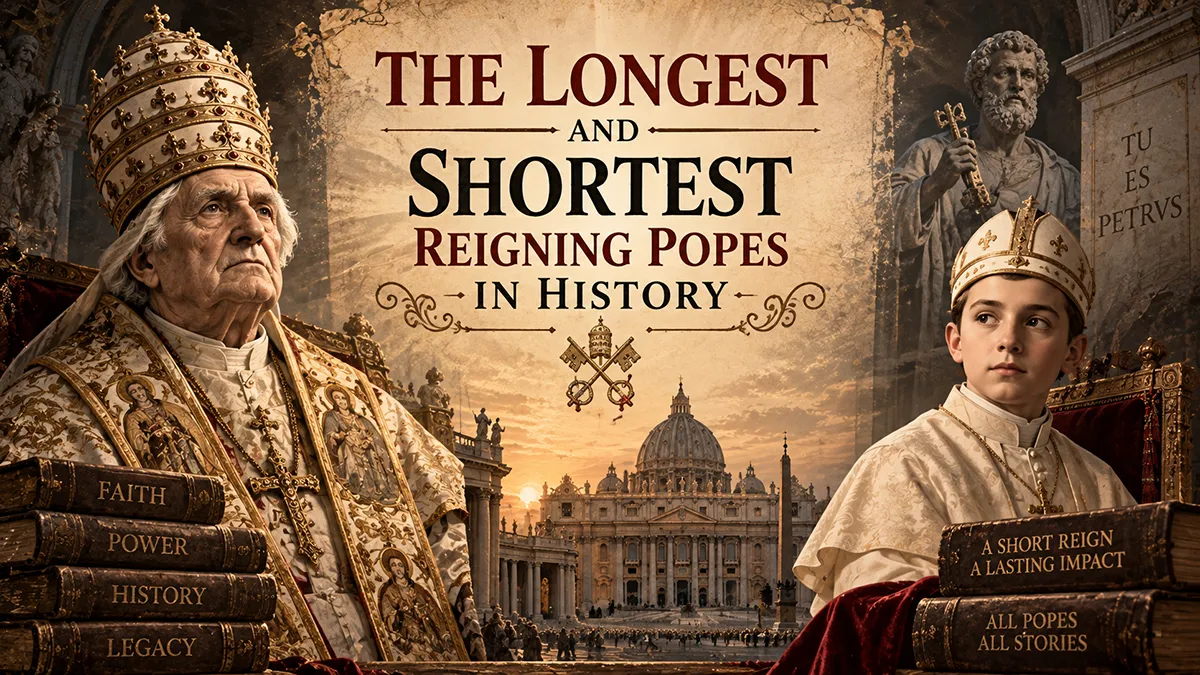
The papacy is one of the oldest continuously operating institutions in the world, and unlike a president or prime minister, a pope doesn’t serve a fixed term.
He serves for life, or until he chooses to step down, which makes the range of papal reigns wildly uneven. Some popes shaped the Church for a generation or more, while others didn’t even outlast a bad cold.
In this guide, we’re counting down the longest-serving popes in history and the shortest reigning popes on record, plus digging into why the 10th century in particular produced so many fleeting papacies.
We’ll also bust a few myths along the way, because a lot of “facts” about early popes are more legend than verified history, much like many of the record-breaking claims surrounding historical geniuses with the highest estimated IQs.
TL;DR: Pope Pius IX holds the longest verified reign at nearly 32 years, while Pope Urban VII holds the shortest at just 13 days, and the gap between them says a lot about how chaotic — and how stable — the papacy has been at different points in history.
How Long Does a Pope Serve, Exactly?
There’s no term limit written into canon law for how long a pope serves. A pope holds the office from the moment he accepts election until death, or until he freely resigns, which is rare but not unheard of. Pope Benedict XVI’s resignation in 2013 was the most famous modern example, but it wasn’t unprecedented.
Because there’s no mandatory retirement age or fixed term, papal reigns have ranged from over three decades to barely two weeks. Age at election, health, and the political turbulence of the era all play a role. A pope elected young and healthy in a stable century might reign for 20-plus years, while a pope elected old, sick, or into a violent power struggle might not survive the winter.
On average, historians estimate the typical papal reign has lasted somewhere around 7 to 8 years across the roughly 2,000-year history of the office. That average masks huge variation, though, which is exactly why the extremes on both ends are so fascinating.
The Longest-Reigning Popes in History
When people ask who is the longest-reigning pope, they’re almost always asking about the longest reign that can be historically verified, since the papacy’s very first occupant is a special case we’ll address separately. Here are the popes whose reigns have run the longest, based on well-documented church records.
1. Pope Pius IX (1846–1878) — 31 Years, 7 Months
Pope Pius IX holds the record for the longest confirmed papal reign, serving just over 31 years and 7 months. His papacy spanned enormous upheaval, including the loss of the Papal States during Italian unification and the First Vatican Council in 1869–1870. He’s also remembered for defining the dogma of papal infallibility.
2. Pope John Paul II (1978–2005) — 26 Years, 5 Months
John Paul II is the longest-reigning pope of the modern era and the third longest overall. Elected in 1978 after the unusually short papacy of John Paul I, he traveled more widely than any pope before him and played a visible role in the collapse of Communism in Eastern Europe, cementing his place among the most recognized historical figures of the 20th century. His reign is a major reason so many people searching for the longest-serving pope land on his name.
3. Pope Leo XIII (1878–1903) — 25 Years, 5 Months
Leo XIII succeeded Pius IX and served for over 25 years, guiding the Church through the industrial age. He’s best known for the encyclical Rerum Novarum, which addressed workers’ rights and laid groundwork for modern Catholic social teaching.
4. Pope Pius VI (1775–1799) — 24 Years, 6 Months
Pius VI reigned through the French Revolution, one of the most hostile periods for the Church in centuries. He was eventually taken prisoner by French forces and died in captivity in 1799, a dramatic end to a remarkably long papacy.
5. Pope Adrian I (772–795) — 23 Years, 10 Months
Adrian I served nearly 24 years in the 8th century, making him the longest-reigning pope of the early medieval period. He worked closely with Charlemagne and helped shape the political alliance between the papacy and the Frankish kingdom.
6. Pope Pius VII (1800–1823) — 23 Years, 5 Months
Pius VII followed Pius VI and had his own turbulent relationship with a French emperor, this time Napoleon. He was held under house arrest for years but outlasted Napoleon’s empire and returned to Rome to finish a reign of over 23 years.
7. Pope Alexander III (1159–1181) — 21 Years, 11 Months
Alexander III’s reign was defined by conflict with Holy Roman Emperor Frederick Barbarossa and a rival papal claimant. Despite the instability, he presided over the Third Lateran Council and helped formalize the rules for papal elections.
8. Pope Sylvester I (314–335) — 21 Years, 11 Months
Sylvester I served during the reign of Emperor Constantine, a pivotal era when Christianity moved from a persecuted faith to an favored imperial religion. Record-keeping from this early period is thinner than in later centuries, so exact dates carry more uncertainty than for popes after the medieval era.
9. Pope Leo I, “The Great” (440–461) — 21 Years
Leo I is remembered for reportedly persuading Attila the Hun not to sack Rome, and for his theological influence at the Council of Chalcedon. His 21-year reign helped cement the authority of the Bishop of Rome as a leading voice in Christian doctrine.
10. Pope Urban VIII (1623–1644) — 20 Years, 11 Months
Urban VIII’s nearly 21-year reign is best remembered today for his role in the trial of Galileo Galilei. He was also a major patron of Baroque art and architecture, commissioning significant work across Rome.
11. Pope Clement XI (1700–1721) — 20 Years, 5 Months
Clement XI’s reign stretched over two decades in the early 18th century, a period marked by theological disputes and shifting European alliances following the War of the Spanish Succession.
12. Pope Pius XII (1939–1958) — 19 Years, 7 Months
Pius XII led the Church through the entirety of World War II and into the early Cold War. His nearly 20-year papacy remains one of the most studied and debated of the 20th century.
What About Saint Peter?
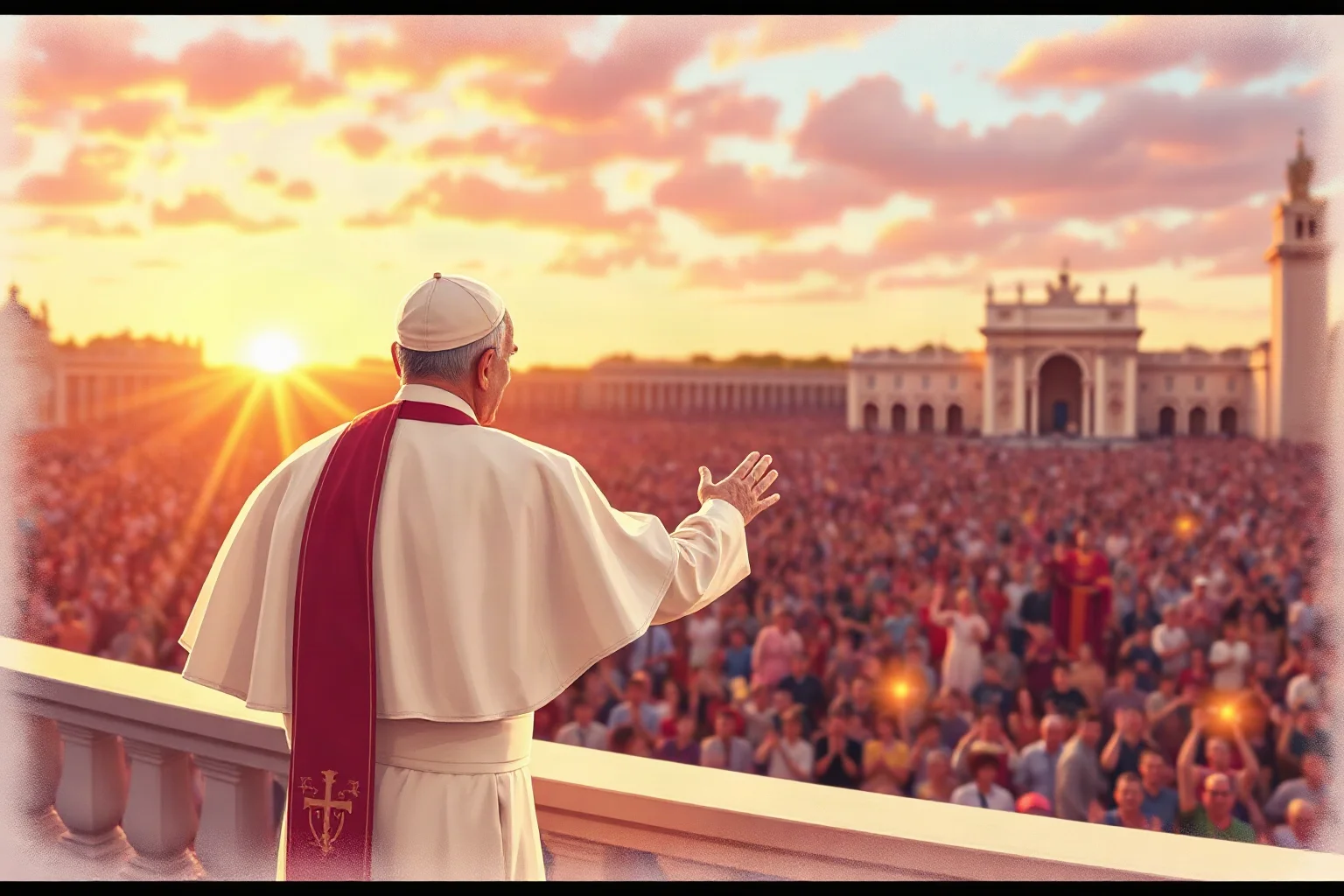
Tradition holds that Saint Peter, regarded as the first pope, led the early Christian community in Rome for roughly 34 to 37 years before his martyrdom, which would make his reign longer than Pius IX’s. This is worth flagging clearly, though: the historical record for the first century is thin, and the exact dates of Peter’s leadership in Rome aren’t independently verifiable the way later papacies are.
Because of that uncertainty, most rankings of the longest-reigning popes — including this one — treat Pius IX as the longest verified reign and note Peter’s traditional tenure as a separate, faith-based claim rather than a documented historical fact. It’s a good reminder to stay skeptical of tidy round numbers from the ancient world, the same skepticism historians bring to legendary age claims among the oldest people in history.
The Shortest Papal Reigns in History
Now for the other end of the spectrum. If you’ve searched for the shortest pope reign, the shortest reigning pope, or the shortest term as pope, these are the names that come up again and again in historical records.
13. Pope Urban VII (1590) — 13 Days
Urban VII holds the record for the shortest confirmed papal reign in history at just 13 days. He was elected in September 1590 but fell ill with malaria almost immediately and died before he could even be formally installed as pope. He’s the answer most historians give when asked which pope served the shortest.
14. Pope Boniface VI (896) — 15 Days
Boniface VI reigned for about 15 days in April 896, during one of the most violent stretches of papal history. He died of illness, but his brief tenure was quickly followed by more turmoil, including a successor whose own election was later declared invalid.
15. Pope Celestine IV (1241) — 17 Days
Celestine IV was elected during a bitter standoff between the papacy and Holy Roman Emperor Frederick II. Already in poor health at his election, he died just over two weeks later, and the papal seat then sat vacant for nearly two years afterward.
16. Pope Sisinnius (708) — 20 Days
Sisinnius was already seriously ill with gout when he was elected in January 708. He managed to serve for roughly 20 days, reportedly using much of that time simply trying to organize repairs to Rome’s city walls before his death.
17. Pope Theodore II (897) — 20 Days
Theodore II’s reign lasted about 20 days in December 897, right in the thick of the chaotic period historians later nicknamed the “saeculum obscurum,” or dark age of the papacy. His short time in office was spent partly rehabilitating the reputation of a predecessor who had been posthumously put on trial.
18. Pope Marcellus II (1555) — 22 Days
Marcellus II reigned for 22 days in the spring of 1555 and was known for wanting to reform clerical abuses within the Church. He died of what was likely a stroke before he could act on most of his plans.
19. Pope Damasus II (1048) — 23 Days
Damasus II served for roughly 23 days in the summer of 1048 before dying, possibly from malaria, a common hazard for popes arriving in Rome from cooler climates during warmer months.
20. Pope Pius III (1503) — 26 Days
Pius III was elected in September 1503 already suffering from poor health, including a leg ailment. He died less than a month later, making way for the far longer and more consequential reign of his successor, Julius II.
21. Pope Leo XI (1605) — 27 Days
Leo XI reigned for 27 days in April 1605 and earned the nickname “Papa Lampo,” or “lightning pope,” because of how quickly his brief tenure came and went. He caught a chill during his installation ceremonies and never recovered.
22. Pope-Elect Stephen (752) — Died Before Consecration
This one is a genuine historical curiosity. A priest named Stephen was elected pope in March 752 but died of a stroke roughly three or four days later, before he was ever consecrated as bishop of Rome. Because he was never formally installed, the Vatican’s official list doesn’t count him as a numbered pope, which is why later popes named Stephen carry numbering that seems slightly off from what you’d expect.
It’s worth mentioning that the most famous short papacy in living memory belongs to Pope John Paul I, who served just 33 days in 1978. That’s longer than any of the ten reigns above, so it doesn’t crack the all-time shortest list, but it’s the clear answer if you’re specifically looking for the shortest reigning pope in the 20th century.
Why the 10th Century Produced So Many Short-Lived Popes
If you’ve searched for a tenth century pope or the popes of the 10th century, there’s a reason that era keeps coming up in connection with brief, chaotic reigns. Historians often call the late 9th through 10th centuries the “saeculum obscurum,” Latin for “the dark age,” and it’s widely regarded as the papacy’s most turbulent stretch.
During this period, powerful Roman noble families effectively controlled who became pope, treating the office as a political prize rather than a spiritual calling. Popes were installed, deposed, imprisoned, and in several documented cases murdered, often within months of taking office. Boniface VI and Theodore II, both on our shortest reigns list, come directly from this unstable window.
The chaos eased somewhat by the mid-11th century as reform-minded clergy pushed to separate papal elections from local Roman political control. Still, the 10th century remains the go-to example whenever historians want to illustrate just how unstable the papacy could get when politics overtook doctrine.
Fastest and Slowest Papal Elections in History
A related but distinct question people often ask is about the shortest time to elect a pope, or on the flip side, what was the longest pope election in history. These questions are about the conclave process itself, not how long a pope then reigned once chosen.
On the fast end, several papal elections in history were resolved in a matter of hours once cardinals were locked in conclave, particularly in earlier centuries before formal balloting procedures were standardized. In the modern era, Pope Pius XII was elected in under a day in 1939, and Pope John Paul I was elected within a single day of voting in 1978.
The longest papal election, by contrast, wasn’t a conclave in the modern sense at all. After Pope Clement IV died in 1268, the cardinals gathered in Viterbo, Italy, and could not agree on a successor for nearly three years. Legend holds that frustrated townspeople eventually removed the roof of the building to pressure the cardinals, and food rations were cut to speed things along.
The deadlock finally ended in 1271 with the election of Pope Gregory X, and the ordeal was so embarrassing that Gregory later issued formal rules, called Ubi periculum, establishing the stricter conclave procedures that evolved into the system still used today.
So, What’s the Average Reign of a Pope?
Given the extremes we’ve just covered, from 13 days to over 31 years, it’s fair to wonder what a “typical” papal reign actually looks like. Based on the roughly 265 or so popes recognized by the Church across two millennia, historians commonly estimate the average reign at somewhere around 7 to 8 years.
That average is skewed by a handful of very long reigns at one end and a cluster of extremely short ones at the other, particularly during politically unstable centuries. Modern popes, elected under more standardized health screening and a more stable political environment, have tended to serve longer than the historical average, though there are always exceptions.
Final Thoughts on the Papacy’s Longest and Shortest Reigns
The spread between the longest-serving pope and the shortest reigning pope tells a bigger story than just a list of numbers. It reflects centuries of shifting political power, medical knowledge, and the sheer unpredictability of electing an elderly cleric to lead one of the world’s oldest institutions.
Whether a pope served for three decades like Pius IX or barely two weeks like Urban VII, each reign is a snapshot of the era that produced it. That’s really what makes papal history worth digging into: it’s not just about faith, it’s a two-thousand-year record of politics, health, and human ambition playing out inside one continuous office.
Frequently Asked Questions
How long does a pope serve?
A pope serves for life unless he resigns, since the papacy has no fixed term or mandatory retirement age. In practice, reign lengths have varied enormously, from just 13 days to more than 31 years, depending on the pope's age, health, and the political stability of his era.
Who is the longest-reigning pope in history?
Pope Pius IX holds the longest verified papal reign, serving just over 31 years and 7 months from 1846 to 1878. Tradition credits Saint Peter with an even longer tenure of roughly 34 to 37 years, but that period isn't historically documented in the same way, so Pius IX is generally cited as the longest-serving pope on record.
What is the shortest papal reign in history?
Pope Urban VII had the shortest confirmed reign of any pope, serving just 13 days in September 1590 before dying of malaria. He is widely considered the answer to which pope served the shortest amount of time in the office's documented history.
Who had the shortest reigning papacy in the 20th century?
Pope John Paul I served just 33 days in 1978 before his death, making him the shortest reigning pope of the 20th century. His reign is longer than any of the all-time shortest ten, but it remains the shortest of the modern era.
What was the longest papal election in history?
The longest papal election followed the death of Pope Clement IV in 1268, when cardinals gathered in Viterbo, Italy, and took nearly three years to choose Pope Gregory X in 1271. The deadlock was so notorious that it led to the creation of stricter conclave rules still influencing papal elections today.
What is the shortest amount of time it’s taken to elect a pope?
Some historical papal elections were resolved within a matter of hours once cardinals convened, particularly in earlier centuries. In the modern era, both Pius XII in 1939 and John Paul I in 1978 were elected within about a day of voting beginning.
What is the average reign of a pope?
Across roughly 265 recognized popes and about two thousand years of history, the average papal reign is estimated at around 7 to 8 years. That figure is heavily skewed by a small number of very long reigns and a cluster of extremely short ones during politically unstable periods.
Why were there so many short-reigning popes in the 10th century?
The 10th century, part of a period historians call the saeculum obscurum, was marked by powerful Roman noble families controlling papal elections for political gain. This led to popes being installed, deposed, and in some cases killed within months, producing several of the shortest papal reigns on record.

Alex Warren
Related Articles