

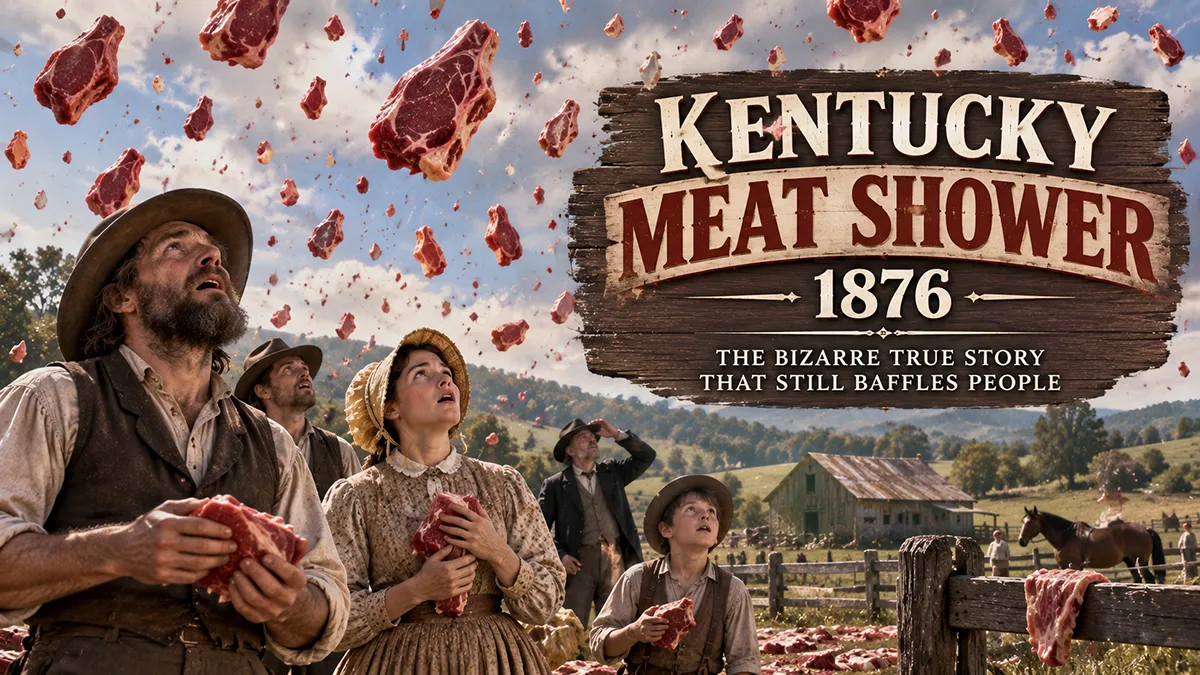
Picture a quiet spring morning in rural Kentucky. The sky is clear, there’s no storm in sight, and a farmer’s wife is outside doing chores when suddenly, without warning, chunks of raw meat start falling from the sky and landing all around her.
It sounds like the setup for a tall tale or a scene straight out of a cartoon, but according to multiple newspaper accounts from the time, something very much like this actually happened in Bath County, Kentucky, on March 3, 1876.
The event became known as the Kentucky meat shower, and nearly 150 years later, people are still trying to figure out exactly what caused meat to fall from a clear sky that day.
Was it a freak weather event, a mass biological accident, or something else entirely? Let’s dig into the historical record, separate the documented facts from the legend, and take a myth-busting look at one of the strangest weather stories in American history.
TL;DR: In 1876, chunks of meat reportedly rained down on a Kentucky farm from a clear sky, and while the event was real and documented, the most credible explanation points to vultures, not a supernatural or unexplainable phenomenon.
What Actually Happened on March 3, 1876
The story centers on the property of a farmer named Allen Crouch, near a small community called Olympian Springs in Bath County, Kentucky. According to accounts published in newspapers at the time, Crouch’s wife was outside making soap when flakes and chunks of a fleshy, meat-like substance began falling from the sky around her.
The material reportedly fell over an area roughly the size of a few backyards, with pieces ranging from small, snowflake-sized flecks to chunks several inches across. There was no storm, no dead animal overhead, and no obvious source for the debris. Witnesses described it as resembling fresh meat, and some pieces were said to still be relatively soft and moist when they landed.
Word of the strange event spread quickly through the small farming community, and it wasn’t long before local newspapers picked up the story. From there, it made its way into larger regional papers, and the tale of meat literally raining down from a Kentucky sky became a topic of fascination well beyond the state’s borders.
The People Who Witnessed the Meat Shower
Mrs. Crouch is typically credited as the primary witness, since she was reportedly outside and directly exposed to the falling material when it happened. Other family members and neighbors are said to have observed the aftermath, including the scattered pieces of meat covering the ground and nearby fencing.
According to period reports, a couple of local men who heard about the incident were bold enough to taste small pieces of the fallen substance. They apparently compared the flavor to either mutton or venison, though it’s worth noting these accounts come from secondhand newspaper reporting rather than a controlled scientific tasting.
It’s also worth remembering that 1876 was long before smartphones, lab-grade forensic testing, or instant fact-checking. Much of what we know about eyewitness reactions comes from newspaper reporters relaying stories after the fact, which means some embellishment over the retelling is entirely possible.
What Was the Meat, Exactly?
This is where the Kentucky meat shower gets genuinely interesting from a historical and scientific standpoint. Samples of the fallen material were reportedly collected and sent off for examination, since naturally, people wanted to know what exactly had rained down on the Crouch farm.
According to accounts of the investigation, at least one physician examined samples early on, and additional pieces were later reviewed by scientists interested in the phenomenon. Descriptions of the material included references to muscle tissue, cartilage, and lung tissue, suggesting the meat likely came from an animal source rather than any kind of hoax material like paper or fabric.
Some later analysis reportedly suggested the tissue resembled lung and muscle matter consistent with a large mammal, though the specific species identified in various retellings has varied depending on the source. This inconsistency is part of why historians urge caution before treating any single 19th-century lab conclusion as the definitive final word.
The Vulture Theory: The Leading Scientific Explanation
Of all the explanations proposed over the decades, the one that has held up best among scientists and historians involves large birds, specifically vultures. Black vultures and turkey vultures were common in the region, and both species are known for a rather unglamorous survival behavior.
When threatened, disturbed, or simply overloaded with food, vultures can regurgitate large amounts of partially digested carrion. This is a documented defensive and physiological behavior, not folklore, and it allows the birds to lighten their load quickly if they need to take flight in a hurry.
The theory goes that a large group of vultures may have been flying at height over the Crouch farm, possibly startled by something below, and released a mass amount of regurgitated meat as they scattered. Because the material fell over a fairly small, concentrated area rather than spreading widely, this lines up reasonably well with a flock passing overhead rather than a broader atmospheric event.
Why the Vulture Explanation Makes Sense
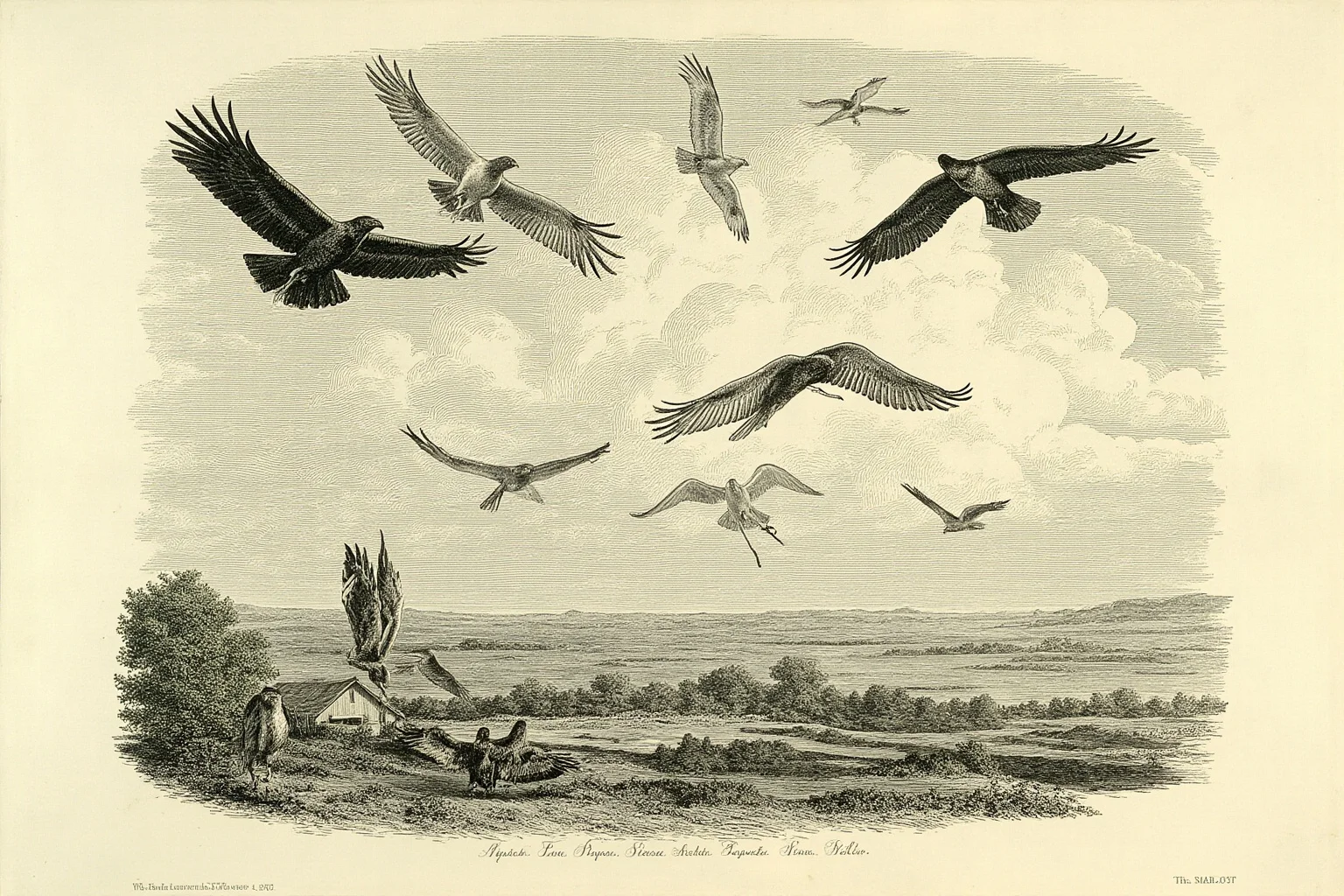
The vulture theory isn’t just a modern guess pulled out of thin air. It was actually proposed relatively soon after the event by people examining the physical evidence, since the described tissue types were consistent with partially digested animal remains rather than fresh butchered meat.
Vultures are also known to travel in large groups, sometimes called committees or wakes depending on whether they’re perched or feeding, and a flock passing directly overhead could plausibly explain a sudden, localized shower of fallen matter. This kind of behavior has been documented in other contexts, even if it rarely makes headlines the way the Kentucky case did.
It’s also a far less exotic explanation than some of the wilder theories that circulated afterward, which is part of why it has remained the leading scientific account. Extraordinary claims deserve careful scrutiny, and “a flock of vultures regurgitated carrion while flying overhead” requires far less speculative leap than some of the alternatives.
Other Theories That Have Been Proposed
The Meteorological Theory
Some 19th-century commentators speculated that unusual atmospheric conditions, perhaps a small tornado, updraft, or freak wind pattern, could have lifted animal remains from a slaughterhouse or dead livestock somewhere nearby and deposited them on the Crouch property. This kind of debris transport by strong wind is scientifically possible in theory, but there’s no strong evidence tying it specifically to this case.
At the time, weather science was still fairly limited, so “an unexplained wind phenomenon” was a convenient catch-all for anything strange happening in the sky. Without solid supporting evidence, this theory has largely taken a back seat to the vulture explanation among modern researchers.
The Hoax Theory
Given how strange the story sounds, it’s natural to wonder whether the whole thing might have simply been fabricated or exaggerated by locals looking for attention, or by newspapers looking to sell copies. Sensational stories were common in 19th-century American journalism, and outlets often leaned into strange or shocking tales to boost circulation.
However, the fact that physical samples were reportedly collected and examined by more than one investigator makes a pure hoax less likely, since fabricating consistent, examinable animal tissue across multiple accounts would have been a fairly elaborate undertaking for a rural farming community in 1876. That doesn’t rule out some exaggeration in the retelling, but it does suggest something physical genuinely fell from the sky that day.
The Sensationalized Human Tissue Claim
One of the more startling claims that circulated after the initial event suggested the tissue might have come from human remains rather than an animal. This claim added a macabre twist to an already bizarre story and helped the tale spread even further in the following weeks.
However, this particular claim was never substantiated with credible evidence, and most researchers who have revisited the case treat it as sensationalized speculation rather than a serious scientific conclusion. It’s a good reminder that not every claim attached to a historical event deserves equal weight, especially when it emerged amid a media frenzy eager for shocking details.
How the Story Spread Across the Country
Once local Kentucky papers reported on the strange meat shower, the story quickly traveled through the wider American newspaper network of the era, which regularly reprinted odd or noteworthy stories from other regions. This was the same era often mythologized as the Wild West, when tall tales, tabloid-style reporting, and genuine frontier news traveled together through the same newspaper columns, often blurring the line between fact and legend. Readers as far away as the East Coast reportedly encountered accounts of the Kentucky meat rain within weeks of the original event.
The timing also mattered. In an era without radio, television, or the internet, unusual regional stories like this one served as a form of entertainment and conversation fuel, spreading through word of mouth and newspaper syndication rather than instant digital sharing. That slower spread likely allowed some embellishment to creep into the story with each retelling.
Other Historical Accounts of Meat Falling From the Sky
The Kentucky meat shower of 1876 is by far the most famous American case of meat falling from the sky, but it isn’t the only strange precipitation story in recorded history. Reports of unusual substances falling during storms, including fish, frogs, and even colored rain, have appeared in historical records across different centuries and regions.
Many of these “strange rain” events share a similar explanation pattern, usually involving strong winds, waterspouts, or animals being lifted and later dropped from height. Fish and frog falls, for example, are often attributed to waterspouts pulling small creatures from ponds or shallow water before depositing them elsewhere as the wind weakens. These oddities are a reminder that nature can produce both the bizarre and the devastating, from a backyard meat shower to catastrophic events like the 1931 China floods, one of the deadliest natural disasters ever recorded.
While true meat rain incidents are far rarer than fish or frog falls, the general pattern of “something unusual falls from the sky and locals struggle to explain it” is a recurring theme throughout weather folklore. The Kentucky case simply happens to be one of the best documented and most enduring examples of this pattern involving actual animal tissue.
Why This Story Still Captures Attention Today
Part of the enduring appeal of the Kentucky meat shower is its sheer strangeness combined with the fact that it isn’t purely fictional folklore. Unlike many tall tales, this event was reported in contemporary newspapers and involved physical samples that were actually examined, which gives it a level of historical grounding that pure legend usually lacks.
The story also taps into a very human fascination with the unexplained. Even with a reasonably solid scientific explanation available, there’s something irresistible about the image of raw meat falling from a clear Kentucky sky onto an unsuspecting farm family.
Modern retellings across blogs, videos, and social media have kept the story alive, often for its shock value rather than its scientific nuance. That’s exactly why it’s worth revisiting the actual historical record rather than just the most viral version of the tale.
Separating Fact From Myth
So what do we actually know with reasonable confidence? We know that in March 1876, newspapers reported that a substance resembling meat fell from the sky onto property in Bath County, Kentucky, and that samples were collected and examined by more than one investigator.
We also know the leading, most scientifically plausible explanation involves vultures regurgitating carrion while flying overhead, a documented behavior in these birds that fits the physical evidence better than most alternative theories. What we don’t know for certain is the exact species of animal involved, whether every detail in every newspaper account was reported with complete accuracy, or whether some embellishment crept in as the story spread.
That combination, a real, physically documented event paired with genuine scientific uncertainty about the finer details, is exactly why the Kentucky meat shower remains such a compelling historical curiosity rather than either a fully solved case or a debunked myth. Much like myth-busting the popular narratives around the greatest empires in history, separating fact from legend here means accepting a messier, more nuanced version of events than the tidy story that gets repeated online. It sits in that fascinating middle ground where most oddly-true history lives.
The Legacy of the Kentucky Meat Shower
Today, the 1876 meat rain is often cited in lists of bizarre weather events and unexplained historical mysteries, sometimes without much context about the vulture explanation that makes it far less mysterious than it first appears. It has also become something of a point of local historical pride in parts of Kentucky, a strange but memorable footnote in the state’s history.
The event is a useful reminder that history is full of stories that sound impossible at first glance but turn out to have grounded, if unusual, explanations once you dig into the record. It’s also a good lesson in healthy skepticism, since the most viral version of a story isn’t always the most historically accurate one.
Whether you find the vulture explanation satisfying or still prefer a bit of mystery in your history, there’s no denying that for one strange afternoon in 1876, the sky over a small Kentucky farm really did seem to rain meat.
Final Thoughts
The Kentucky meat shower of 1876 is a rare case where a genuinely strange historical event holds up under scrutiny while still resisting a perfectly tidy explanation. The core facts, meat-like material falling from a clear sky onto the Crouch farm, appear to be rooted in real contemporary reporting rather than pure invention.
The most credible explanation available today points to vultures rather than anything supernatural, but the story’s staying power comes from just how wonderfully strange it sounds regardless of the science behind it. It’s a perfect example of how real history can be just as bizarre, and far more interesting, than exaggerated legend.
Frequently Asked Questions
What caused the Kentucky meat shower of 1876?
The most widely accepted explanation among historians and scientists is that a large flock of vultures flying overhead regurgitated partially digested carrion, which fell over the Crouch family's Bath County farm. This behavior is well documented in vultures and fits the physical evidence better than other theories proposed at the time.
Is meat falling from sky a real, documented phenomenon?
Genuine cases of meat falling from the sky are extremely rare, but the 1876 Kentucky incident was reported in contemporary newspapers and involved physical samples that were examined afterward. While isolated, it's treated as a real historical event rather than pure folklore, with a plausible natural explanation involving vultures.
Where exactly did the 1876 Kentucky meat rain happen?
The event occurred near Olympian Springs in Bath County, Kentucky, on the farm of Allen Crouch on March 3, 1876. His wife was reportedly outside doing chores when the fall occurred.
Did anyone actually eat the meat that rained from the sky?
According to period newspaper accounts, a couple of local men tasted small pieces of the fallen material and compared the flavor to mutton or venison. These reports come from secondhand 19th-century journalism, so they should be treated as historical color rather than verified fact.
Was the Kentucky meat shower a hoax?
A pure hoax seems unlikely, since multiple samples of animal tissue were reportedly collected and examined by different investigators, which would have been hard to fake consistently. Some exaggeration in the retelling is possible, but the core event appears to have genuinely occurred.
Has anything similar to the Kentucky meat shower happened elsewhere?
True meat rain events are rare, but history includes other reports of unusual objects falling from the sky, such as fish and frogs, usually explained by waterspouts or strong winds lifting small creatures before dropping them elsewhere. The Kentucky case remains one of the most documented examples specifically involving animal tissue.

Alex Warren
Related Articles





