

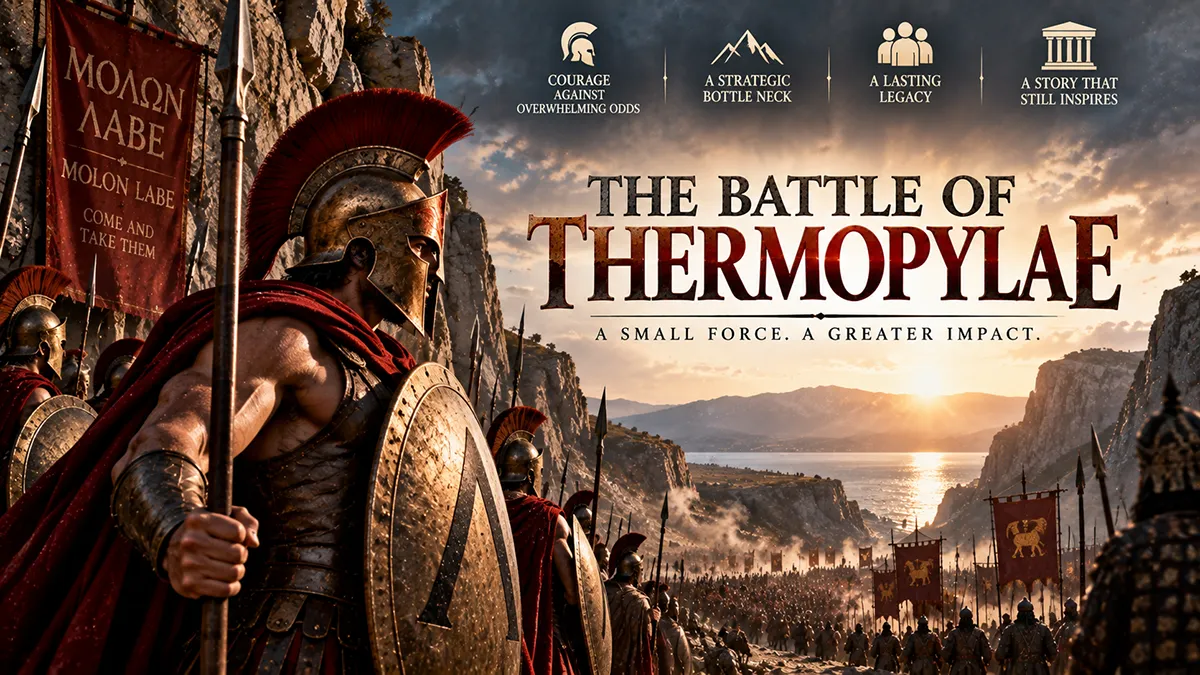
Few battles in world history have inspired as many movies, memes, and myths as the Battle of Thermopylae. Most people know the outline: a small band of Spartans supposedly held off an entire empire, died to the last man, and became legends. But the real story is stranger, messier, and arguably more impressive than the Hollywood version.
This guide walks through what actually happened at Thermopylae, why the battle started, who really won, and why historians still call it a turning point more than 2,500 years later. We’ll also separate the verified history from the legend that grew up around it.
TL;DR: The Battle of Thermopylae was a tactical Persian victory in 480 BCE, but the Greek stand bought crucial time and became a symbol of resistance that helped Greece ultimately win the wider war against Persia.
What Was Thermopylae? Setting The Scene
Thermopylae was not a city or a kingdom — it was a narrow coastal pass in central Greece, squeezed between steep mountains and the sea. The name itself is Greek, roughly translating to “hot gates,” a reference to nearby hot sulfur springs. In 480 BCE, this narrow corridor became the site of one of the most famous battles in ancient history.
The pass mattered because it was one of the few routes a massive land army could use to move from northern Greece into the southern Greek city-states. Whoever controlled Thermopylae controlled access to the heartland of Greece, including Athens and the Peloponnese. That geography is the entire reason the battle happened where it did.
Why Did The Battle Of Thermopylae Start?
The battle was part of the larger Greco-Persian Wars, a decades-long conflict between the Persian Empire and various Greek city-states. By 480 BCE, the Persian king Xerxes I was leading a massive invasion of Greece, partly to punish Athens and Sparta for supporting earlier Greek rebellions against Persian rule, and partly to expand his empire’s reach into Europe.
Ancient sources, particularly the Greek historian Herodotus, describe Xerxes assembling a huge multinational army and navy drawn from across the Persian Empire. Modern historians debate the exact size of this force, since ancient figures were often wildly exaggerated. What’s not in dispute is that it was significantly larger than anything the fractured Greek city-states could muster on their own.
A coalition of Greek states, uneasy allies at the best of times, decided they needed to make a stand somewhere north of Athens to buy time. Thermopylae’s narrow terrain made it the obvious chokepoint. A small defending force there could, in theory, neutralize Persia’s overwhelming numerical advantage.
Sparta Vs Persia: The Armies Face Off
The Greek force at Thermopylae was a coalition, not just Spartans. Ancient sources put the total Greek contingent at several thousand troops, including soldiers from Thespiae, Thebes, Corinth, and other city-states, alongside the Spartans and their allied Peloponnesian troops.
Sparta’s contribution is where the legend begins. King Leonidas I led a personal guard of 300 Spartan citizen-soldiers, chosen specifically for the mission. This is the origin of the famous “300 Spartans” number that has echoed through pop culture ever since.
On the Persian side, Xerxes commanded a force drawn from dozens of subject peoples across his empire, supported by a large fleet moving along the coast. The exact size remains debated among historians, with ancient claims of over a million men now widely considered exaggerated. Most modern estimates suggest a force in the tens of thousands, still vastly outnumbering the Greeks at the pass.
The 300 Spartans Battle: Myth Vs Reality
The “300 Spartans” story has become shorthand for heroic last stands, thanks in large part to the 2006 film “300” and the graphic novel that inspired it. It’s worth being clear about what’s historically supported and what’s dramatic invention.
It is true that Leonidas brought exactly 300 Spartan soldiers, and that this elite force fought and died at Thermopylae. It is also true that the Greek coalition force at the pass was much larger than 300 when the battle began, likely numbering several thousand before most withdrew.
What’s not historically verified includes many details popularized by modern retellings: monstrous Persian soldiers, supernatural elements, and overly simplified political villains. Herodotus, our main ancient source, wrote decades after the battle and mixed careful reporting with dramatic storytelling, so even the ancient account should be read with some caution.
The core of the 300 story that historians do accept is this: a small, highly trained force chose to fight a rearguard action against impossible odds, and their sacrifice became a powerful symbol almost immediately in the ancient world.
Battle At Thermopylae Summary: How It Unfolded
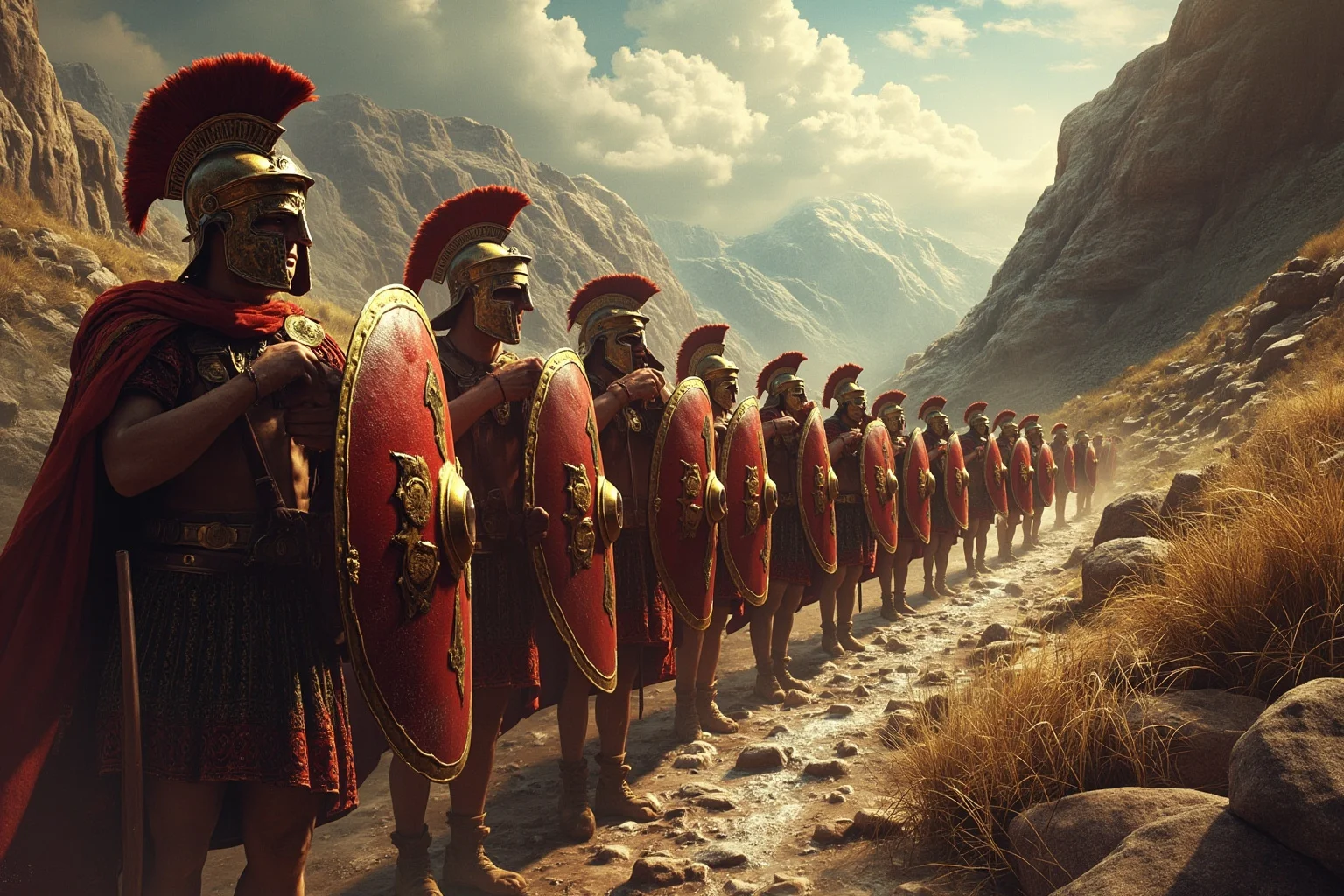
The fighting lasted roughly three days in August 480 BCE. For the first two days, the Greeks used the narrow terrain to their advantage, fighting in tight formation with long spears and overlapping shields, a style Persian troops with lighter weapons and shorter spears struggled to break.
Herodotus records repeated Persian assaults, including an attack by Xerxes’ elite Immortals, all failing to dislodge the Greek line. The pass was simply too narrow for Persia’s numbers to matter, and the Greeks inflicted heavy casualties while holding their position.
The turning point came when a local Greek man named Ephialtes reportedly showed the Persians a mountain path that circled around the pass, allowing a Persian detachment to outflank the defenders. Once Leonidas learned his position had been compromised, he made a decision that cemented the battle’s legendary status.
Most of the Greek coalition troops were sent away to preserve the army for future fighting. Leonidas, his 300 Spartans, roughly 700 Thespians, and a group of Thebans stayed behind to hold the pass as long as possible. This rearguard fought to the death, buying critical time for the retreating Greek forces.
Who Won The Battle Of Thermopylae?
In strictly tactical terms, Persia won the Battle of Thermopylae. Xerxes’ forces broke through the pass, killed the defending rearguard, and continued their advance into central Greece, eventually burning Athens later that year.
But military historians have long pointed out that tactical victories and strategic victories aren’t always the same thing, a distinction that shows up again and again across history, from Thermopylae to some of the major battles of WWI. The delay at Thermopylae gave the rest of Greece precious extra time to organize a naval defense and prepare for the battles still to come.
That’s why the honest answer to “who won the Battle of Thermopylae” comes with an asterisk: Persia won the fight, but the stand at Thermopylae arguably helped set up Greece’s eventual win in the wider war.
What Was The Outcome Of The Battle Of Thermopylae?
The immediate outcome was grim for the Greeks. Leonidas and his rearguard were killed, the pass fell, and the Persian army marched south largely unopposed. Athens was evacuated and later burned, a devastating blow to one of Greece’s most powerful city-states, and a scene of a capital going up in flames that echoes centuries later in events like the burning of the White House in 1814.
However, the wider war didn’t end there. Later in 480 BCE, a Greek navy won a decisive victory at the Battle of Salamis, crippling Persian naval power. The following year, Greek land forces won the Battle of Plataea, effectively ending the Persian invasion of mainland Greece for good.
So while Thermopylae itself ended in Persian success, it was one chapter in a war that ultimately swung in Greece’s favor. The outcome of Thermopylae is best understood as a costly delay rather than a final defeat.
Why Was The Battle Of Thermopylae Important?
This is the question that separates Thermopylae from countless other ancient battles that history has largely forgotten. Several factors combined to make it genuinely significant, not just dramatically memorable.
First, the delay it caused had real strategic value. Every day the Persian advance was held up at the pass was a day the rest of Greece could use to prepare ships, fortify positions, and organize a unified response.
Second, it demonstrated that Persia’s massive army was not unbeatable. A small, well-organized force had inflicted serious losses on the invaders and held the line for days, a psychological boost that rippled through the Greek world.
Third, the story of the last stand became a powerful piece of Greek identity and propaganda almost immediately. It reinforced the idea that free Greek citizens fighting for their homeland could outmatch a much larger imperial force, a narrative that helped rally the fractured city-states into continued resistance.
What Was Significant About The Battle Of Thermopylae Beyond The Battlefield
The significance of Thermopylae extends well past 480 BCE. Ancient Greek writers, orators, and later Roman historians repeatedly referenced the battle as an example of duty, sacrifice, and resistance against overwhelming odds.
A famous epitaph, often attributed to the poet Simonides, was reportedly inscribed near the site honoring the fallen defenders. While the exact wording and attribution are debated among historians, the tradition itself shows how quickly the battle became a cultural touchstone rather than just a military footnote.
This pattern, turning a tactical defeat into a lasting symbol, is unusual in military history. Most losing battles fade from memory, but Thermopylae did the opposite, growing more meaningful over time.
Consequences Of The Battle Of Thermopylae
The direct military consequence was the Persian occupation of Athens and much of central Greece for a period in 480 BCE. This was a real and painful loss for the Greek states involved, not a minor setback.
But the indirect consequences mattered more in the long run. The time bought at Thermopylae allowed the Greek fleet to prepare properly for the Battle of Salamis, where a smaller Greek force used the narrow straits, much like the pass at Thermopylae, to defeat Persia’s navy decisively.
The combined effect of Salamis and the later Battle of Plataea forced Xerxes to abandon his campaign against mainland Greece. Persia never again seriously threatened to conquer the Greek mainland, and the Greek city-states, particularly Athens, entered a period of growing confidence and cultural achievement in the decades that followed.
In that sense, the consequences of Thermopylae ripple all the way into the classical Greek golden age, since a Persian conquest would have almost certainly reshaped or erased the political and cultural developments that came afterward.
Facts About Thermopylae Worth Knowing
Beyond the headline story, there are several details about the battle that often get lost in popular retellings. These help paint a fuller, more accurate picture of what actually happened.
The Greek coalition at Thermopylae was never just 300 men; it included several thousand troops from multiple city-states before the final stand. The famous number refers specifically to the Spartan contingent, not the entire defending force.
Leonidas was a Spartan king, not just a general, and led one of Sparta’s two royal houses. His decision to stay and fight, rather than retreat with the bulk of the army, is one of the most analyzed command decisions in ancient military history.
The Thespians and Thebans who stayed alongside the Spartans are often overlooked in modern retellings, yet ancient sources credit them as part of the final defense. Their sacrifice is just as historically significant, even if it’s less famous.
The battle took place at the same time as a related naval engagement at Artemisium, where the Greek fleet also fought Persian forces to a costly draw. The two battles were part of a coordinated Greek strategy to slow the Persian advance on both land and sea.
The Legacy Of Thermopylae In Modern Culture
Thermopylae’s afterlife in art, literature, and film is almost as interesting as the battle itself. From ancient Greek monuments to the 2006 film “300,” the story has been retold and reshaped to fit the values of whatever era is telling it.
Modern retellings often lean into dramatic, stylized violence and simplified good-versus-evil framing, which makes for compelling entertainment but shouldn’t be mistaken for careful history. The real battle involved complex alliances, political calculations, and a Greek coalition that included far more than just Spartans.
Understanding the gap between the ‘300 story’ popularized by modern media and the historically supported account is part of appreciating why Thermopylae still fascinates people. The truth doesn’t need much embellishment; a small force delaying an empire for days, at great cost, is remarkable enough on its own.
Why Thermopylae Still Matters Today
Thermopylae endures in popular imagination because it captures something universal: the idea that determination and tactical skill can, at least temporarily, offset a massive disadvantage in numbers or resources, a theme that echoes in other historic sieges, such as the Siege of Leningrad during World War II. That idea resonates far beyond ancient Greece.
It’s also a useful case study in how history and myth intertwine. Studying Thermopylae carefully teaches us to appreciate a genuinely important ancient battle while staying skeptical of exaggerated numbers, invented dialogue, and dramatized details that have accumulated over centuries of retelling.
Whether you first heard about it through a history class, a documentary, or a stylized action movie, the Battle of Thermopylae remains one of the clearest examples in ancient history of how a single stand can shape the course of a much larger war.
Frequently Asked Questions
What was the Battle of Thermopylae?
The Battle of Thermopylae was a battle fought in 480 BCE between a coalition of Greek city-states and the invading Persian Empire under King Xerxes I. It took place at a narrow coastal pass in central Greece and is best known for the last stand of King Leonidas and his 300 Spartan soldiers.
Who won the Battle of Thermopylae?
Persia won the Battle of Thermopylae in tactical terms, breaking through the pass and advancing into central Greece. However, the Greek defense delayed the Persian army long enough to help set up later Greek victories at Salamis and Plataea, so the battle is often framed as a strategic setback for Persia despite its battlefield success.
Why was the Battle of Thermopylae important?
The Battle of Thermopylae was important because it delayed the Persian invasion, gave the rest of Greece time to prepare, and showed that a smaller, well-organized force could inflict serious losses on a much larger imperial army. It also became a lasting symbol of resistance that helped unify Greek city-states against Persia.
How many soldiers were actually at Thermopylae, not just the 300 Spartans?
While Leonidas famously led 300 Spartans, the full Greek coalition force at Thermopylae numbered several thousand troops from city-states including Thespiae, Thebes, and Corinth. Most withdrew before the final stand, leaving the Spartans, about 700 Thespians, and a group of Thebans to fight to the end.
What was the outcome of the Battle of Thermopylae?
The immediate outcome was a Persian victory: the pass fell, Leonidas and his rearguard were killed, and Persian forces advanced to occupy and later burn Athens. The broader outcome, though, was a delay that helped Greece regroup and ultimately defeat Persia's invasion later that year and the next.
What were the main consequences of the Battle of Thermopylae?
The battle's direct consequence was a temporary Persian occupation of parts of central Greece, including Athens. Its longer-term consequences included buying time for the Greek fleet's victory at Salamis and contributing to the eventual Greek win at Plataea, which ended Persia's invasion of mainland Greece.
Is the ‘300’ movie based on a true story?
The 2006 film '300' is loosely based on real historical events, but it heavily dramatizes and exaggerates many details for entertainment. The core facts, that 300 Spartans under Leonidas fought a Persian army at Thermopylae, are historically supported, but much of the film's imagery and dialogue is fictionalized.
Why did the Battle of Thermopylae start in the first place?
The battle started as part of the Greco-Persian Wars, when King Xerxes I launched a massive invasion of Greece to expand Persian control and punish Greek states that had resisted Persian rule. Thermopylae's narrow pass was chosen by the Greeks as a strategic chokepoint to slow the Persian advance.
What are some interesting facts about Thermopylae?
Thermopylae's name means 'hot gates,' referencing nearby hot springs, and the battle occurred alongside a related naval clash at Artemisium. The famous 300 Spartans were only part of a much larger Greek coalition force, and much of what we know comes from the ancient historian Herodotus, writing decades after the events.

Alex Warren
Related Articles





