
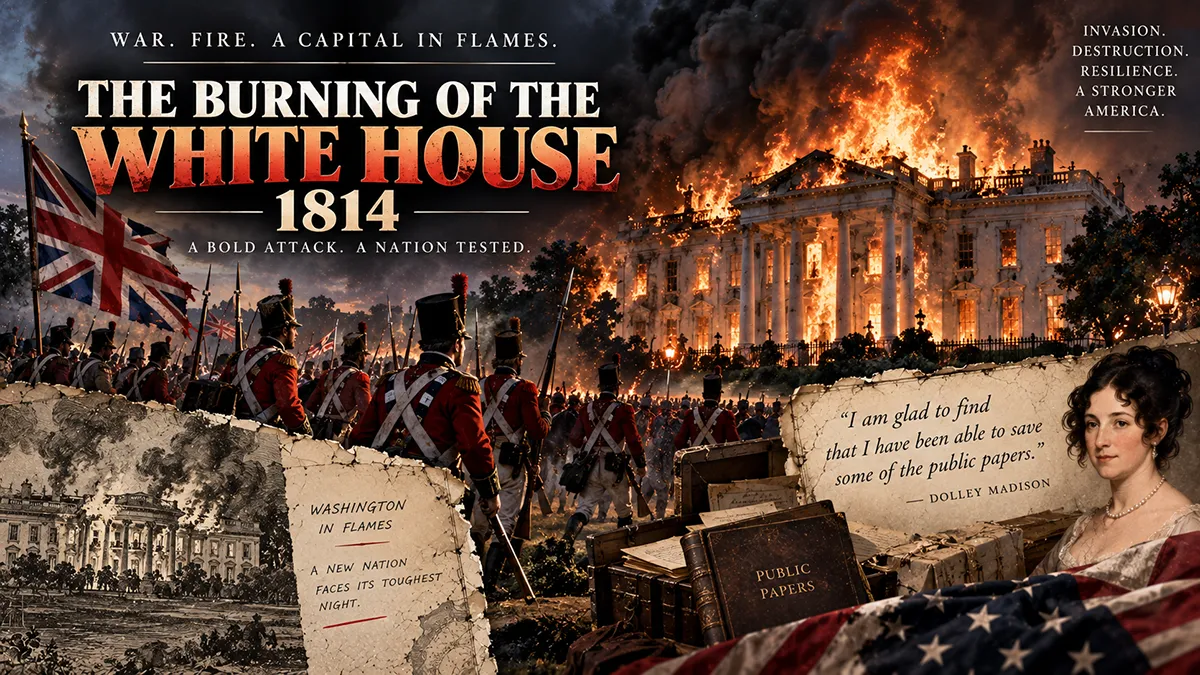
On a sweltering summer night in 1814, flames lit up the sky over Washington, D.C. British troops had just marched into the young nation’s capital, and within hours the President’s House, the Capitol, and several other government buildings were engulfed in fire.
It remains one of the only times in American history that a foreign power has occupied and destroyed the seat of the U.S. government.
This is the story of how it happened, why it happened, and what it meant for a country still finding its footing less than 40 years after declaring independence.
TL;DR: On August 24, 1814, British troops marched into Washington during the War of 1812 and set fire to the White House, the Capitol, and other public buildings in retaliation for earlier American raids, gutting the president’s home before First Lady Dolley Madison had barely escaped with its treasures.
What Was Happening in 1814? The War of 1812 Explained
By 1814, the United States and Great Britain had been at war for two years. The War of 1812 grew out of disputes over British interference with American shipping, the impressment of American sailors into the Royal Navy, and British support for Native American resistance on the frontier.
America declared war in June 1812, hoping to press its case while Britain was distracted fighting Napoleon in Europe. That gamble looked shaky by 1814. Napoleon had abdicated in the spring, freeing up thousands of seasoned British troops and ships to focus on the American war.
Washington D.C. in the War of 1812 was a strange target on paper. It was a small, swampy, unfinished city of roughly 8,000 people, with little military or economic value compared to Baltimore or New York. But it was the symbolic heart of the United States government, which made it exactly the kind of target the British wanted.
Why Did the British Burn Washington, D.C.?
The short answer is retaliation. Earlier in the war, American forces had burned government buildings in York (present-day Toronto), then part of British Canada, during a raid in 1813. British commanders wanted to answer that attack in kind.
Major General Robert Ross and Vice Admiral Sir Alexander Cochrane led the campaign that became known as the burning of Washington DC in the War of 1812. Their orders were to strike a demoralizing blow against the American government, not to hold the city permanently.
There’s a persistent question people ask: why did the British burn Washington D.C. instead of just occupying it? The answer is that the British never intended a long-term occupation. Their goal was destruction and humiliation, a way of showing the American public that their government couldn’t protect its own capital.
The Road to Washington: The Battle of Bladensburg
Before the British could reach the capital, they had to get past whatever defense the Americans could scrape together. That defense collapsed at the Battle of Bladensburg on August 24, 1814, just outside Washington.
American militia, poorly trained and poorly led, broke ranks quickly under pressure from disciplined British regulars. The rout was so swift and embarrassing that it later earned the nickname the “Bladensburg Races.” President James Madison himself was nearby, making him the only sitting U.S. president to come under direct enemy fire during wartime.
With the battle lost, the road into Washington lay open. British troops marched into the city that same evening, setting the stage for what became the most infamous single day in the history of the American capital.
August 24, 1814: The Day the White House Burned
August 24, 1814 is the date most people mean when they ask when the White House was burned down. British soldiers entered a mostly evacuated city, with government officials and residents fleeing ahead of their arrival.
According to accounts from the period, the troops first went to the Capitol building, then set their sights on the President’s House. Soldiers reportedly found a table still set for dinner, evidence of how quickly the household had fled.
British troops piled furniture and set fires throughout the building before moving on. The White House fire in 1814 gutted the interior completely, leaving only the smoke-blackened exterior walls standing. It was a stunning, deliberate act meant to send a message far beyond Washington’s city limits.
Dolley Madison’s Daring Escape
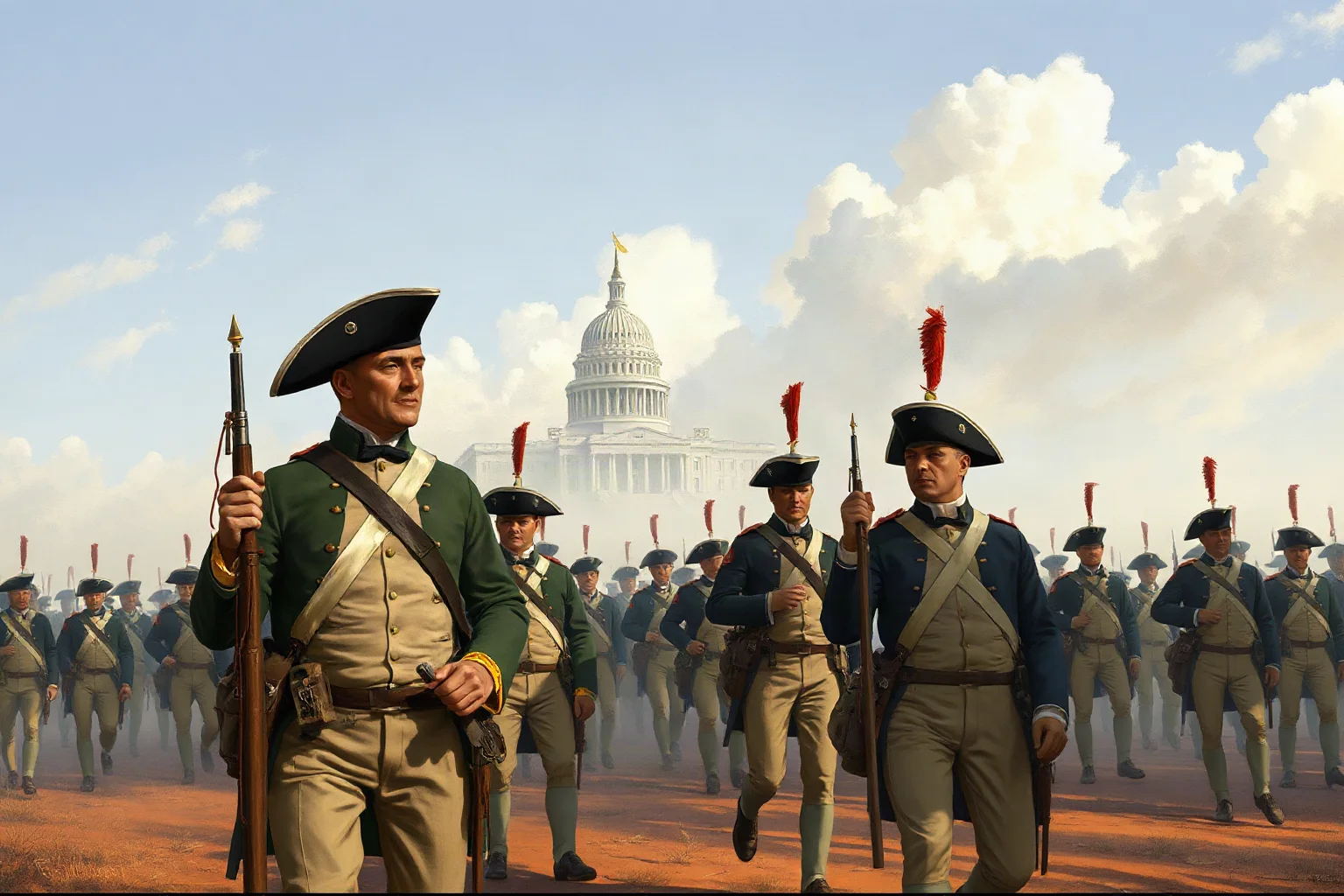
First Lady Dolley Madison became one of the most memorable figures connected to this event. As British forces closed in, she stayed behind as long as she safely could, overseeing the evacuation of valuables from the President’s House.
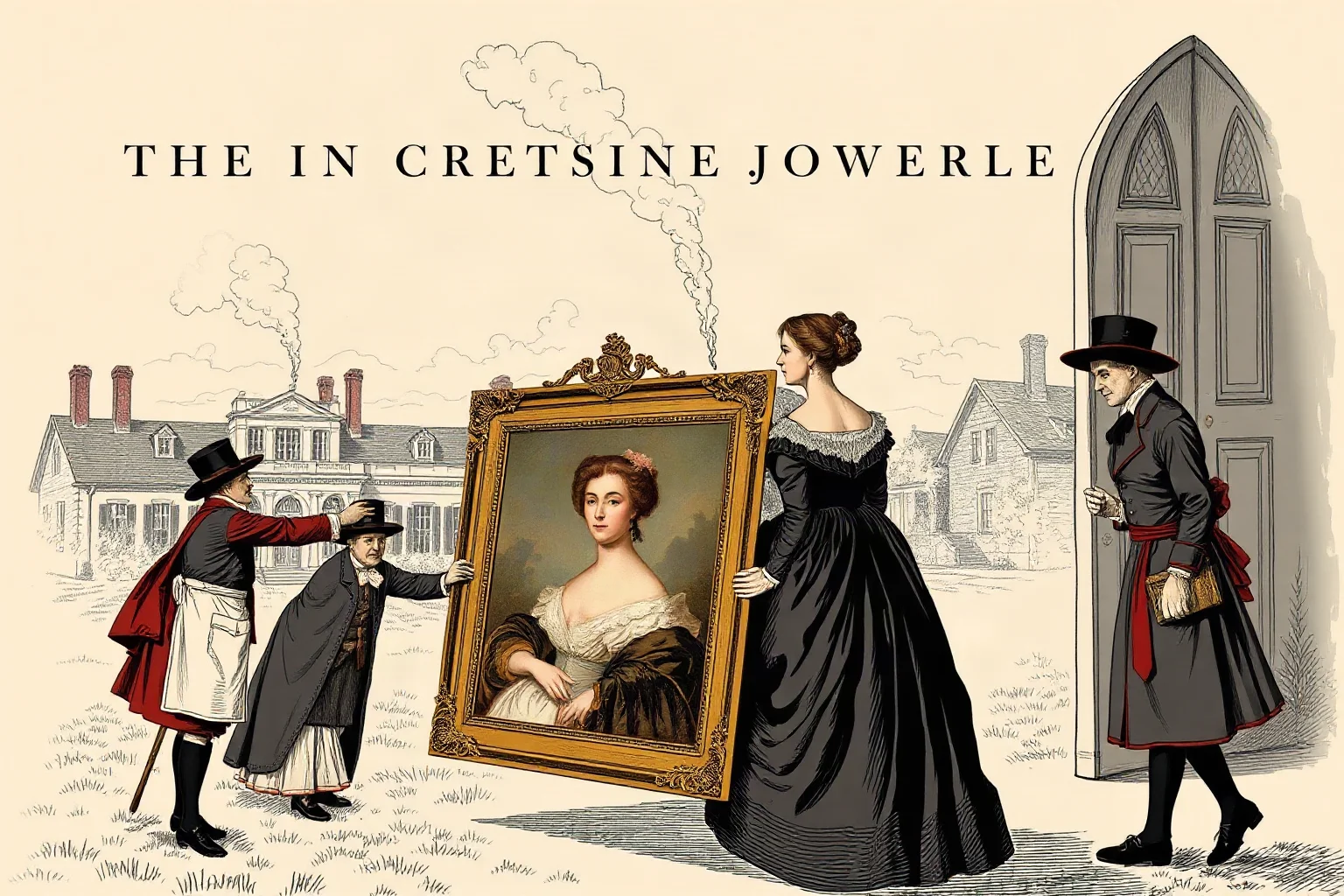
Historical accounts credit her with insisting that the full-length portrait of George Washington be saved before she fled. The painting was reportedly removed from its frame and carried to safety, a detail that has become one of the most retold moments of the entire episode.
Dolley Madison left the White House only hours before British troops arrived, escaping across the Potomac with a small group of aides and enslaved household staff. Her calm handling of the crisis helped cement her reputation as a resourceful and composed figure during one of the young nation’s darkest days.
What Else Did the British Burn?
The burning of the White House in 1814 wasn’t an isolated act. British forces also torched the Capitol building, including the Senate and House chambers and the Library of Congress housed inside it at the time.
The Treasury Building and the War Department were burned as well. Other structures, including some private buildings, were damaged in the chaos, though British commanders generally tried to limit destruction to public property.
A sudden, violent storm rolled through Washington the following day. Some historians suggest it may have helped extinguish lingering fires and likely discouraged the British from staying much longer, though the storm alone wasn’t the reason they left.
Did the White House Ever Fully Burn Down? Separating Fact from Myth
A lot of people ask a version of “did the White House ever burn down” and picture the entire structure reduced to rubble. That’s not quite accurate. The interior was destroyed, and the roof collapsed, but the exterior stone walls of the building largely survived the fire. Much like the enduring myths surrounding the Lost Colony of Roanoke, popular imagination often stretches a dramatic historical event well beyond what the record actually supports.
Those surviving walls became the foundation for the reconstruction that followed. In that sense, today’s White House is technically the same structure, rebuilt around its original 1792 shell, rather than an entirely new building.
So when people search “did the British burn the White House” or “did white house burn down,” the honest answer is yes, it was set on fire and gutted, but the core stone walls endured. That’s part of why the rebuilding was possible in a relatively short amount of time.
Rebuilding the White House
James Madison and his successor, James Monroe, oversaw the restoration effort. Original architect James Hoban, who had designed the President’s House in the 1790s, was brought back to lead the reconstruction.
Work began in 1815 and the building was ready for occupancy by 1817, when President Monroe moved in, though finishing touches continued for a few more years. The famous semicircular South Portico and North Portico were actually added later, in the 1820s, as part of ongoing improvements rather than the immediate post-fire rebuild.
The speed of the reconstruction mattered symbolically. It sent the message that the burning had wounded but not broken the American government, and that the young republic intended to keep going.
Was the White House Always White? Busting a Persistent Myth
Here’s a myth worth clearing up, because it comes up constantly in searches about the White House of 1812. Many people believe the building got its name and its white color because it was painted white to cover fire and smoke damage after 1814.
That’s not true. The house was already built from grayish sandstone that had been whitewashed with a lime-based mixture since the 1790s, well before the fire, partly to protect the porous stone from moisture and freezing damage.
After the 1814 fire, workers did repaint and reapply whitewash to cover scorch marks during reconstruction, so the fire is loosely connected to the building’s appearance. But the structure was called “the White House” informally even before the burning, and the name became official much later, under Theodore Roosevelt in 1901.
The White House’s Other Brush With Fire: 1929
The 1814 fire is the most famous, but it wasn’t the only serious fire at the White House. In 1929, during Herbert Hoover’s presidency, an electrical fire broke out in the West Wing, and it’s a moment that generates its own steady stream of searches asking who burned down the White House in 1929.
To be clear, this fire wasn’t the result of an attack or sabotage. It started from an overheated flue during renovation work and caused significant damage to the West Wing, including the Oval Office area at the time.
Firefighters managed to contain the blaze, and Hoover reportedly stayed calm, continuing to work while crews fought the fire nearby. The West Wing was subsequently rebuilt, and the incident is a useful reminder that the White House has faced more than one fire in its history, for very different reasons.
Why the Burning of Washington Still Matters
The burning of Washington D.C. remains a rare example of a foreign power capturing and damaging the capital of the United States. It’s often overshadowed in popular memory by later battles of the War of 1812, like the defense of Baltimore that inspired “The Star-Spangled Banner” just weeks later.
The significance of the burning of Washington D.C. lies partly in how the country responded. Rather than folding under the humiliation, American forces rallied, successfully defended Baltimore, and the war ended in early 1815 without either side gaining major new territory.
The episode is a striking reminder that the nation’s most recognizable government buildings were once genuinely vulnerable, not just symbolically but physically. It also shows how a single, dramatic event can ripple through national memory for more than two centuries, much as the Red Scare reshaped the country’s civil liberties debates for generations afterward.
The Bigger Picture of 1812 to 1814
It helps to remember that the White House burning didn’t happen in isolation. The war dragged on with mixed results for both sides for over two years before British attention turned seriously toward the Chesapeake region.
British naval raids along the Chesapeake Bay had already unsettled the area for months before the march on Washington. The August 1814 campaign, sometimes called the Chesapeake Campaign, combined the attack on Washington with a follow-up assault on Baltimore that ultimately failed.
Understanding this wider context helps explain why the burning of the White House happened when it did. It wasn’t a random act of vandalism, but a calculated military and psychological strike within a much larger, grinding war.
Closing Thoughts
The burning of the White House in 1814 remains one of the most dramatic single episodes in American history, a night when the young nation’s capital burned and its government scattered into the countryside. Yet within a few years, the building rose again from its own blackened walls, a little scarred but very much standing.
That resilience, more than the fire itself, may be the real lesson of August 24, 1814. The event is worth remembering not just as a story of destruction, but as a turning point that tested, and ultimately strengthened, the institutions it was meant to break.
Frequently Asked Questions
When was the White House burned down?
The White House was burned down on the night of August 24, 1814, during the War of 1812, when British troops set fire to the building shortly after defeating American defenders at the Battle of Bladensburg.
Who burned the White House?
British troops under Major General Robert Ross, supported by naval forces led by Vice Admiral Sir Alexander Cochrane, set fire to the White House and other government buildings in Washington, D.C.
Why did the British burn down the White House?
The attack was largely retaliation for the American burning of government buildings in York (Toronto) in 1813, and it was meant to humiliate the U.S. government by destroying the symbolic heart of its capital.
Did the White House ever fully burn down?
Not entirely. The 1814 fire destroyed the interior and roof, but the original exterior stone walls survived and were used as the foundation for the building's reconstruction between 1815 and 1817.
How many times has the White House burned?
The White House has experienced two major fires: the deliberate 1814 burning by British forces during the War of 1812, and an accidental electrical fire in the West Wing in 1929 during Herbert Hoover's presidency.
Who burned down the White House in 1929?
No one burned the White House in 1929 in the sense of an attack. That year's fire was accidental, caused by an overheated flue in the West Wing during renovation work, and firefighters contained it before it spread further.
What happened to the White House in August 1814?
In August 1814, British forces marched into Washington, D.C. after winning the Battle of Bladensburg and set fire to the White House, the Capitol, and other public buildings, gutting their interiors.
Was the White House always white, or was it painted after the fire?
The building was whitewashed as early as the 1790s to protect its porous stone, long before the 1814 fire. Workers did repaint it during post-fire reconstruction, but the white color and nickname predate the burning.
How long did it take to rebuild the White House after the fire?
Reconstruction began in 1815 under original architect James Hoban, and President James Monroe was able to move back into the building by 1817, though decorative finishing work continued for a few more years.
Where was Dolley Madison during the burning of the White House?
Dolley Madison stayed at the White House as long as she safely could, arranging for valuables including a famous portrait of George Washington to be saved, before fleeing across the Potomac hours before British troops arrived.

Alex Warren
Related Articles