
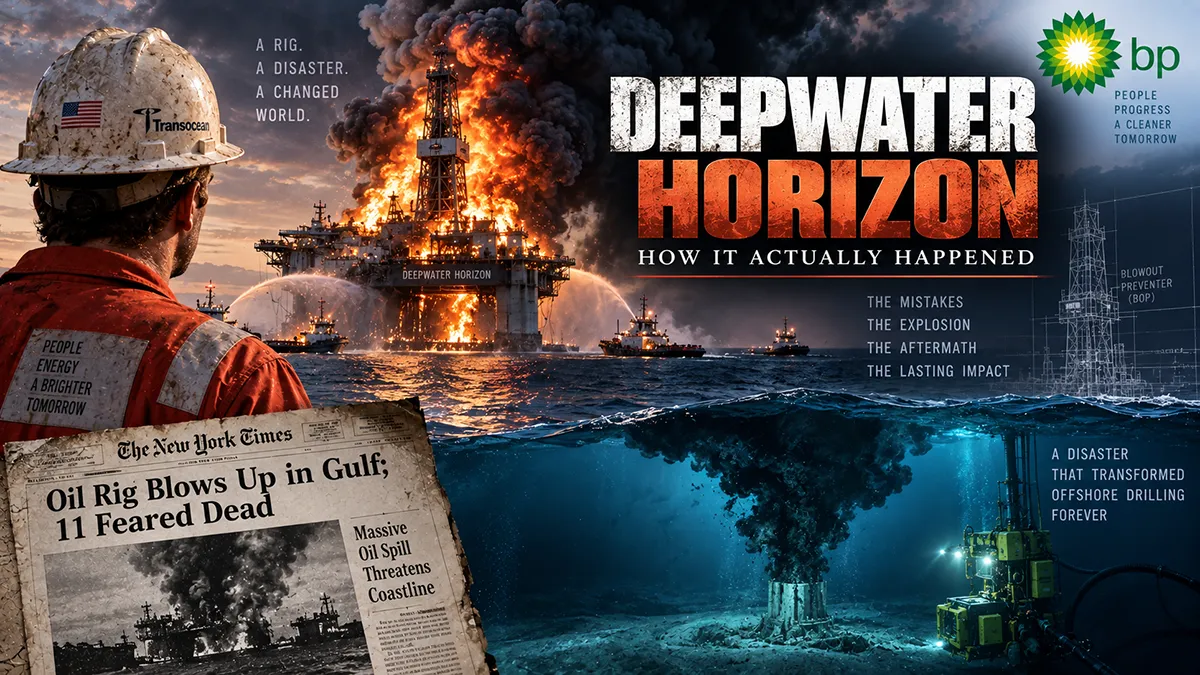
On the night of April 20, 2010, a drilling rig floating in the Gulf of Mexico erupted into a fireball visible for miles. Eleven men never came home. Over the following three months, the world watched live camera feeds of oil gushing from the seafloor in what became the largest accidental marine oil spill in history.
It’s a story that got the Hollywood treatment a few years later, which means a lot of what people “know” about Deepwater Horizon is a mix of real history and dramatic license.
So let’s separate the two, walk through exactly what caused the explosion, and clear up some of the most-searched confusion — including whether the well is still leaking today.
TL;DR: Deepwater Horizon exploded on April 20, 2010, after a series of preventable engineering and judgment failures let gas surge up an improperly sealed well, and the resulting spill dumped roughly 4.9 million barrels of oil into the Gulf of Mexico over 87 days before the well was permanently sealed that September.
What Was Deepwater Horizon?
Deepwater Horizon wasn’t a ship or an oil platform bolted to the seafloor — it was a semi-submersible, dynamically positioned drilling rig, built in 2001 by Hyundai Heavy Industries in South Korea. It was owned and operated by Transocean, the world’s largest offshore drilling contractor, and leased to the oil giant BP to drill exploratory wells in deep water.
At the time of the disaster, it was drilling the Macondo Prospect, a deepwater oil deposit about 41 miles off the coast of Louisiana. The rig floated in roughly 5,000 feet of water, and the well itself stretched more than 13,000 feet beneath the seafloor — a genuinely extreme feat of engineering even before anything went wrong.
You may also see this event written as “Deep Water Horizon,” “Deepwater Horizons,” or even garbled as “Blackwater Horizon” or “Bluewater Horizon.” They’re all the same rig and the same disaster — just different ways people remember or mistype the name.
Is Deepwater Horizon Based on a True Story?
Yes — the 2016 film Deepwater Horizon, starring Mark Wahlberg as chief electronics technician Mike Williams, is based on real events. It draws heavily on a 2010 investigative article by David Barstow, David Rohde, and Stephanie Saul in The New York Times, titled “Deepwater Horizon’s Final Hours,” which pieced together survivor accounts of the rig’s last day.
The broad strokes are accurate: the well did kick, the rig did explode, and workers really did have to jump from a burning rig into the Gulf. That said, films compress timelines and dramatize dialogue for pacing, so it shouldn’t be treated as a documentary transcript of every scene and exchange.
There’s no verified “Deepwater Horizon 2” sequel — searches for one likely stem from confusion with other disaster films or simple curiosity about whether the story continues. The real story, however, continued for years in courtrooms rather than on screen.
When Did Deepwater Horizon Happen? A Timeline
The explosion happened on the night of April 20, 2010, at approximately 9:45 p.m. local time. The rig burned for about 36 hours before sinking to the Gulf floor on April 22, 2010, roughly 5,000 feet below the surface near the wellhead it had been drilling.
Eleven crew members died in the initial blast, and 17 others were injured, out of 126 people aboard at the time. The remaining crew evacuated via lifeboats and the water itself, some jumping directly into the Gulf to escape the flames.
The well itself wasn’t sealed until months later. After several failed containment attempts, BP achieved a “static kill” in early August 2010, and the relief well finally allowed engineers to declare the Macondo well permanently sealed on September 19, 2010 — about five months after it began.
What Caused the Deepwater Horizon Explosion?
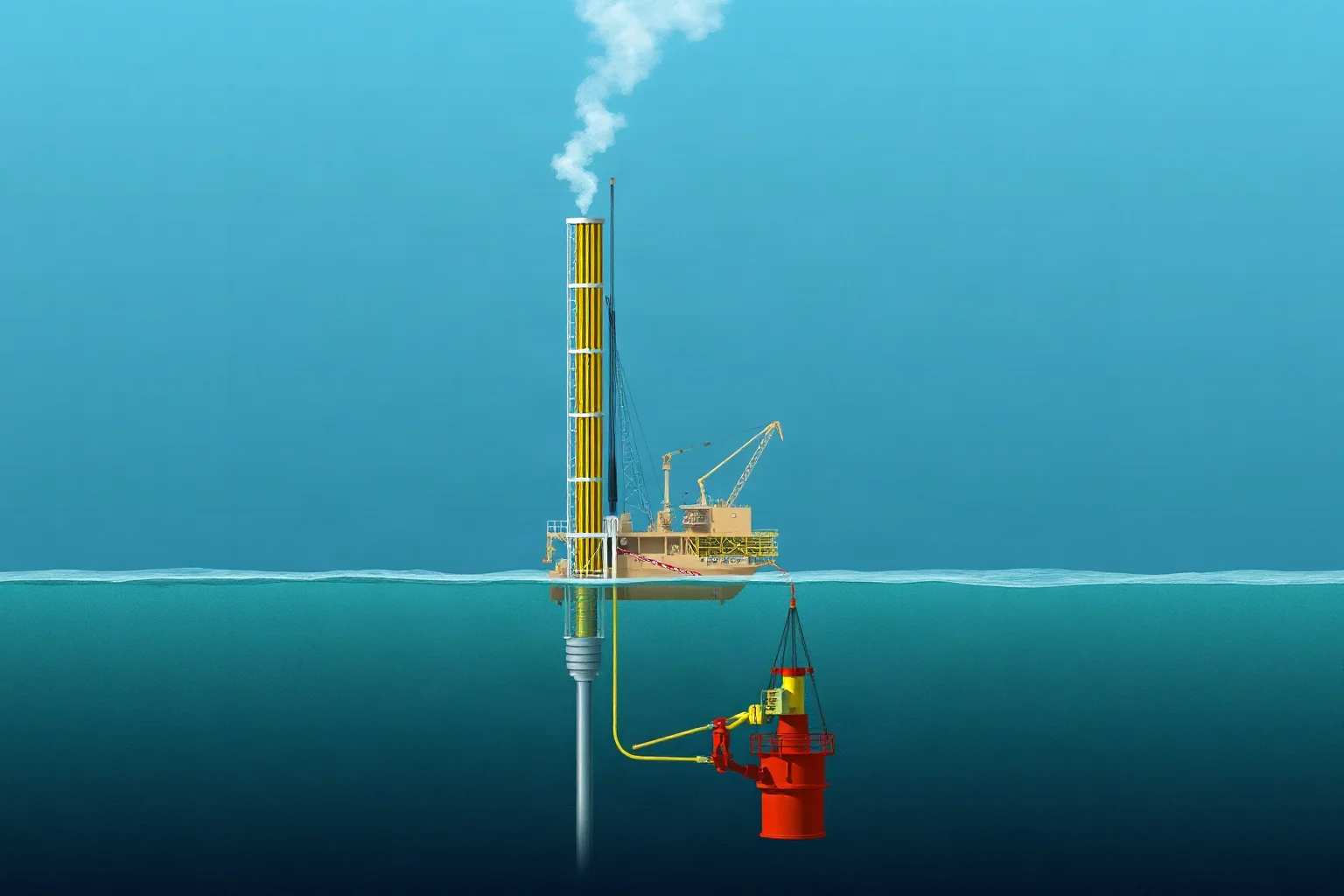
This is the part that gets flattened into a single sentence a lot, but the real answer is a chain of failures, not one dramatic mistake. Multiple investigations — including a Presidential commission, a joint Coast Guard/federal regulatory board inquiry, BP’s own internal review, and the U.S. Chemical Safety Board — all converged on a similar picture.
The short version: gas and oil under enormous pressure found a path up the well because the barriers meant to contain it failed, one after another, and the equipment designed as a last resort to stop exactly this kind of event also failed. Here’s how that actually unfolded.
The Cement Job That Failed
Shortly before the blowout, Halliburton (BP’s cementing contractor) had pumped cement to the bottom of the well to seal it off from the surrounding rock and hydrocarbons. This cement barrier is one of the most basic safety steps in well construction — it’s meant to physically block oil and gas from migrating up the wellbore.
Investigators later concluded that this cement job likely failed to create an effective seal, letting hydrocarbons find a channel upward. Later testing and analysis pointed to problems with the cement slurry design and how it was placed, though the exact technical cause remained a subject of debate between BP, Halliburton, and independent investigators.
The Negative Pressure Test
Before removing the heavy drilling mud that was holding the well in check, the crew ran what’s called a negative pressure test — a check meant to confirm the well was actually sealed. The test produced confusing, inconsistent readings that, in hindsight, indicated the well was not properly sealed at all.
Rig personnel and BP well site leaders ultimately interpreted the troubling results as a “false positive” caused by an unrelated technical quirk, and decided to proceed. Investigators later identified this misreading as one of the most critical human-judgment failures in the entire sequence of events.
The Blowout Preventer That Didn’t Prevent Anything
Every deepwater well has a blowout preventer, or BOP — a massive stack of valves sitting on the seafloor that’s supposed to be the final safeguard, capable of sealing the well shut in an emergency. Deepwater Horizon’s BOP, built by Cameron International, failed to seal the well once the crew realized hydrocarbons were surging upward.
Investigators found multiple contributing issues, including a battery problem and a bent pipe section that likely prevented the emergency “blind shear ram” from cutting through and sealing the drill pipe correctly. Whatever the precise mechanical reason, the last line of defense simply didn’t do its job when it mattered most.
Put together, that’s the honest answer to “what caused the Deepwater Horizon disaster”: a failed cement barrier, a misread pressure test, and a blowout preventer that couldn’t stop the flow once gas was already rushing toward the surface.
What Is “Mud” in Deepwater Horizon — And Why It Mattered
If you’ve watched the film or read about the disaster, you’ve probably heard characters talk about “mud” like it’s a major plot point — because it genuinely was. Drilling mud isn’t dirt; it’s a specially engineered, heavy fluid pumped down a well to counteract the pressure of oil and gas trying to push upward.
As long as heavy mud fills the well, its weight keeps hydrocarbons safely below the surface. The trouble at Macondo started when crews began replacing that heavy mud with lighter seawater, as is normal procedure once a well is believed to be sealed with cement, in preparation to temporarily abandon the well for later production.
With the cement barrier compromised and the protective mud column being removed, there was nothing left heavy enough to hold back the surge of gas rushing up the pipe. That’s the physical trigger behind the blowout — not a single spark, but a loss of the pressure control that mud and cement are both supposed to provide.
The Night of the Explosion
Once gas broke through, it raced up the riser pipe connecting the wellhead to the rig, thousands of feet above. When that gas reached the rig floor and hit an ignition source, it triggered a massive explosion, followed by a fire that engulfed much of the structure.
Survivors described chaos in the dark and smoke-filled corridors, alarms failing to function properly, and crew members making split-second decisions to jump nearly 60 to 100 feet into the Gulf rather than wait for rescue. Some workers were killed instantly in the blast; others died from injuries in the hours that followed.
The rig burned for roughly a day and a half despite firefighting efforts from responding vessels, and it ultimately sank on April 22, 2010. At that point, the disaster shifted from a rig fire and rescue operation into an entirely different kind of crisis: an uncontrolled well gushing oil into the Gulf of Mexico, a mile beneath the surface.
What Caused the Deepwater Horizon Oil Spill? How Much Oil Was Released
It’s worth being precise here, because the explosion and the oil spill are technically two connected but distinct problems. The explosion destroyed the rig and killed 11 people; the spill happened because the underlying well kept flowing uncontrolled from the seafloor for nearly three months afterward.
With the rig gone and the wellhead damaged, oil and gas continued gushing from the broken riser and wellhead equipment on the ocean floor. Early government and BP estimates badly understated the flow rate, and it later became one of the most scrutinized numbers in the entire disaster.
The federal government’s final estimate put the total spill at approximately 4.9 million barrels of oil, or about 210 million gallons, released into the Gulf of Mexico. That makes it, by many measures, one of the worst man-made disasters in history, surpassing the 1979 Ixtoc I spill in the same body of water.
The spill lasted 87 days in total, from the April 20, 2010 explosion until the well was capped on July 15, 2010, with the relief well operation finishing the job by mid-September. Oil washed up on shorelines across Louisiana, Mississippi, Alabama, and Florida, affecting fisheries, wetlands, and wildlife across the Gulf Coast for years afterward.
Is Deepwater Horizon Still Leaking Today?
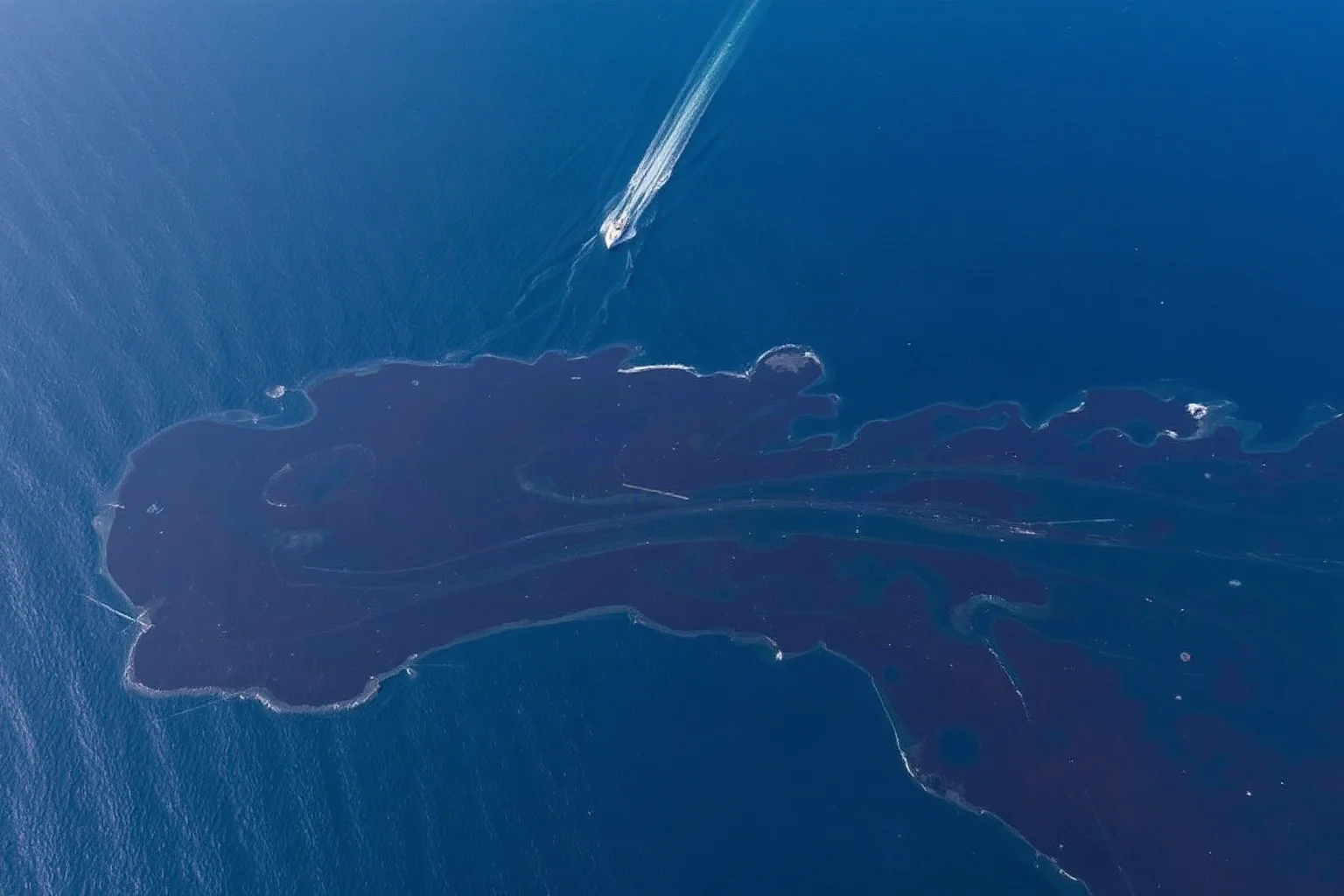
This is one of the most common questions people still search, and the short answer is no — the Macondo well itself was permanently sealed in September 2010 and has not been reported as leaking since. Engineers confirmed the well was “effectively dead” after completing a relief well that intersected the original wellbore and pumped it full of cement.
Some of the ongoing confusion comes from a completely different, much smaller incident nearby: the Taylor Energy oil spill site, located off the Louisiana coast, which has been slowly leaking since an underwater mudslide toppled a platform there back in 2004. That leak is unrelated to BP’s Macondo well but is sometimes mixed up with Deepwater Horizon in casual conversation and search results.
It’s also true that the Gulf of Mexico has natural seafloor oil seeps that existed long before 2010 and continue independently of any spill. So while tar balls occasionally still turn up on Gulf beaches, that isn’t evidence the Deepwater Horizon well itself is actively leaking today.
Where Is the Deepwater Horizon Wreck Now?
After burning for about a day and a half, the rig’s wreck sank to the Gulf floor near the original wellhead, roughly 5,000 feet below the surface. It remains there today, resting on the seabed in the same general area where it once floated above the Macondo Prospect.
Unlike some famous shipwrecks, the Deepwater Horizon wreck isn’t a tourist or diving destination — its depth alone puts it far beyond recreational diving range, and the site sits within a zone that was heavily affected by oil, chemical dispersants, and years of scientific monitoring. Researchers have studied the surrounding seafloor extensively to track long-term ecological recovery, rather than the wreck itself being a point of interest.
The Aftermath: Investigations, Blame, and Billions in Penalties
In the years following the spill, investigators, courts, and Congress worked to pin down exactly who was responsible and how much accountability each party bore. BP, as the well’s operator, took the largest share of blame and financial liability, but Transocean and Halliburton were also cited for contributing failures in the official investigations.
BP eventually pleaded guilty to federal criminal charges, including felony manslaughter counts related to the 11 deaths, and agreed to pay over $4 billion in criminal penalties. Combined with civil settlements, cleanup costs, and compensation to individuals and Gulf states, BP’s total costs from the disaster eventually exceeded $65 billion — among the largest corporate liability payouts in U.S. history.
The disaster also reshaped offshore drilling regulation. It led to the breakup and reorganization of the federal agency that had overseen offshore leasing and safety, new well-design and blowout preventer testing requirements, and tighter scrutiny of cementing and pressure-testing procedures industry-wide.
Why Deepwater Horizon Still Matters
Deepwater Horizon isn’t just a dramatic movie premise or a headline from over a decade ago — it stands among the biggest events in American history and a case study in how small, individually survivable mistakes can stack into a catastrophe when there’s no reliable final safeguard, much like the Great Molasses Flood of 1919 that devastated Boston’s North End. A flawed cement job, a misread test, and a malfunctioning blowout preventer each might not have been fatal alone.
Together, they killed 11 workers and triggered an environmental crisis whose full ecological toll is still being studied today. Understanding what actually happened — rather than the shorthand version — is part of honoring what those investigations, and those lost lives, ultimately revealed.
Frequently Asked Questions
When did Deepwater Horizon happen?
The explosion happened on the night of April 20, 2010, and the rig sank two days later, on April 22, 2010, in the Gulf of Mexico about 41 miles off the Louisiana coast.
What caused the Deepwater Horizon explosion?
A combination of failures caused it: a cement barrier at the bottom of the well didn't properly seal it, the crew misread a critical negative pressure test as a false alarm, and the rig's blowout preventer failed to shut in the well once gas surged upward and ignited.
How much oil was spilled in the Deepwater Horizon disaster?
The federal government's final estimate is approximately 4.9 million barrels of oil (about 210 million gallons), making it the largest accidental marine oil spill in history.
Is Deepwater Horizon still leaking today?
No. The Macondo well was permanently sealed via a relief well in September 2010 and hasn't been reported to leak since; ongoing leaks people sometimes hear about are usually from the unrelated, much smaller Taylor Energy site nearby.
Is Deepwater Horizon based on a true story?
Yes, the 2016 film is based on real events and draws heavily on a New York Times investigation into the rig's final hours, though some dialogue and scenes are dramatized for the screen.
What is the ‘mud’ referenced in Deepwater Horizon?
Drilling mud is a heavy engineered fluid pumped into a well to counteract the pressure of oil and gas below; removing it too early, after a faulty cement job, allowed gas to surge upward and trigger the blowout.
How long did the Deepwater Horizon oil spill last?
The well flowed uncontrolled for 87 days, from the April 20, 2010 explosion until it was capped on July 15, 2010, with the relief well finishing the permanent seal by mid-September 2010.
How many people died in the Deepwater Horizon explosion?
Eleven crew members were killed in the initial explosion, and 17 others were injured, out of 126 people aboard the rig at the time.

Alex Warren
Related Articles