

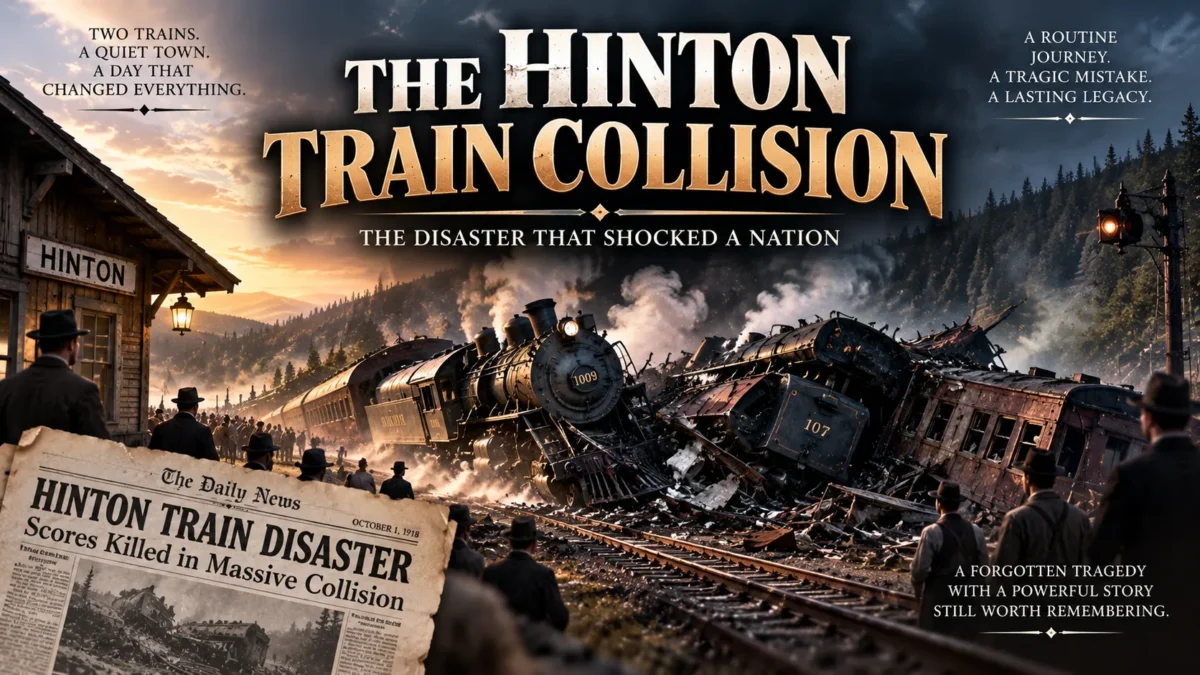
On a cold February evening in 1986, two trains hurtled toward each other on a single stretch of track near Hinton, Alberta. What followed was one of the deadliest rail disasters in modern Canadian history, and one that investigators concluded was almost entirely preventable.
The Hinton train collision didn’t happen because of a freak mechanical failure or an unavoidable act of nature; it happened because of a chain of small, human, and organizational failures that lined up in exactly the wrong way.
This post walks through what actually happened, what the official inquiry found, and why so many people still get key details of the story wrong. We’ll also look at how this single crash reshaped railway safety rules across an entire country.
TL;DR: The 1986 Hinton train collision killed 23 people when a CN freight train ran past stop signals into the path of a VIA Rail passenger train, and the investigation that followed exposed systemic safety failures that led to lasting reforms in Canadian rail travel.
What Happened at Hinton on February 8, 1986
The Hinton train crash occurred on the afternoon of February 8, 1986, on the Canadian National Railway (CN) mainline near the town of Hinton, Alberta, roughly 285 kilometres west of Edmonton. It was a Saturday, and the track in question was a single-line section near a location called Dalehurst, just east of Hinton itself.
A westbound Canadian National freight train and an eastbound VIA Rail passenger train were both scheduled to use that same stretch of single track at different times, coordinated through a system of signals. Instead, the two trains ended up occupying the same section of track at the same moment, and they met each other head-on at considerable speed.
The force of the impact was catastrophic. Locomotives and cars were thrown from the rails, freight cars loaded with grain and other cargo spilled across the right-of-way, and fire broke out in the wreckage, complicating rescue efforts in the freezing Alberta winter.
The Two Trains on a Collision Course
The passenger train involved was VIA Rail’s Super Continental, a well-known long-distance service that carried travelers across the Canadian west. It was carrying passengers and crew when it entered the single-track section near Hinton as scheduled.
The other train was a CN freight consist, made up of multiple locomotives at the head end pulling a long line of freight cars. Under the signaling rules in place at the time, the freight train was required to stop or slow well before reaching the section of track occupied by the passenger train.
It did not. The freight train passed a series of signals that should have warned its crew to slow down and eventually stop, and it continued at speed onto track that was already occupied by the VIA train coming the other way.
Counting the Cost: Casualties and Immediate Response
The collision killed 23 people, making it one of the worst rail disasters in Canada in decades. The dead included members of both train crews as well as passengers traveling aboard the VIA Rail service that day.
Dozens more people were injured, some seriously, and emergency crews from Hinton and surrounding communities faced a difficult response in harsh winter conditions. Wreckage, fire, and spilled cargo all complicated the rescue.
The scale of the tragedy made national headlines across Canada almost immediately. It also raised an urgent question that wouldn’t be fully answered for months: how could a freight train simply run past the signals meant to prevent exactly this kind of accident?
Launching an Inquiry: The Foisy Commission
Because of the severity of the Hinton train accident and the public demand for answers, the federal government established a formal Commission of Inquiry. The inquiry was led by Mr. Justice René P. Foisy, and it became commonly known afterward as the Foisy Commission.
The commission’s job was not simply to assign blame to the crew in the cab that day. It was tasked with understanding the full chain of events, the working conditions of the crews involved, and whether the railway’s own operating practices had helped set the stage for disaster.
Over the course of its work, the inquiry heard extensive testimony from railway employees, CN management, signal engineers, and safety experts. Its final report went well beyond a simple technical explanation of the crash.
What the Investigation Found: Signals, Speed, and a Fatal Oversight
At the most basic level, the inquiry confirmed that the freight train’s crew failed to respond to signals indicating that the track ahead was occupied. Those signals were functioning correctly, according to the investigation, which meant the failure was one of human response rather than equipment malfunction.
The freight train continued past at least one, and by some accounts more than one, signal that should have prompted the crew to slow down or stop completely. By the time the trains were on a collision course, there was no way to avoid the impact.
Importantly, the inquiry did not stop at the signal failure itself. It pushed further, asking why an experienced crew would miss multiple warnings in a row, and that question opened the door to a much bigger set of findings about how CN operated its trains and managed its workers.
The Human Factor: Fatigue, Scheduling, and Crew Culture at CN
One of the most significant outcomes of the Foisy Commission was its focus on crew fatigue and scheduling practices, rather than treating the crash as simply a case of one distracted employee. Railway crews at the time, including at CN, often worked under unpredictable call schedules that made it difficult to get consistent, quality rest.
The inquiry examined how these scheduling practices could contribute to reduced alertness on the job, even for experienced railway workers. This was a notable shift in how the industry, and the public, understood rail safety; it moved the conversation away from purely individual blame and toward the systems that put workers in difficult positions.
The commission’s findings also touched on broader questions about training, supervision, and communication between crew members inside the locomotive cab. All of these factors, taken together, painted a picture of a safety system with real gaps, not just one unlucky moment of human error.
Busting the Myths: What People Get Wrong About the Hinton Train Crash
Over the years, several oversimplified versions of the Hinton train collision story have circulated, and it’s worth separating fact from assumption. One common myth is that the crash was caused by a mechanical or signal system failure; the investigation found the signals were working as intended, and the failure was in the crew’s response to them.
Another myth suggests the disaster came out of nowhere, with no prior warning signs about safety at CN. In reality, the inquiry’s findings about fatigue and scheduling suggested that the underlying conditions for this kind of accident had likely existed for some time before that February day.
It’s also worth being cautious about any claims that reduce the tragedy to a single simple cause, such as blaming one person entirely. Official findings pointed to a combination of factors, and responsible reporting on this event should reflect that complexity rather than a tidy, single-villain narrative.
Could Technology Have Prevented the Hinton Collision?
At the time of the crash, the rail corridor near Hinton relied on a signal system that depended on crews correctly observing and obeying visual signals. There was no automatic system in place that would forcibly stop a train if the crew failed to respond to a stop signal.
This absence became a major talking point after the disaster. Automatic train control or train stop systems, which can intervene when a crew misses a signal, were already used in some rail networks elsewhere in the world by the mid-1980s.
The Foisy Commission’s report raised serious questions about why such fail-safe technology wasn’t more widely deployed on Canadian mainlines carrying both freight and passenger traffic. That question became one of the driving forces behind the safety changes that followed.
The Aftermath: Rail Safety Reforms Born From Tragedy
The Hinton train collision became a turning point for railway regulation in Canada. In the years following the disaster, the federal government and the railway industry moved toward stronger oversight of crew scheduling, fatigue management, and signal compliance.
This push aligned with a broader movement toward the Railway Safety Act, which reshaped how rail safety was regulated in Canada in the years after Hinton. The new framework placed more emphasis on proactive safety management rather than relying solely on after-the-fact accident investigations.
Railways also began paying closer attention to the science of fatigue, recognizing that unpredictable shift patterns could genuinely impair a worker’s ability to respond correctly to critical signals. These changes didn’t happen overnight, but Hinton is widely cited as one of the key events that accelerated them.
The Legacy of Hinton Today
Decades later, the Hinton train accident is still referenced in discussions of Canadian transportation safety history. It’s frequently cited alongside other major rail incidents when regulators or researchers discuss the evolution of fatigue management rules for transportation workers generally, not just railway employees.
The crash also remains a case study in how a single catastrophic event can force an entire industry to confront uncomfortable truths about its own operating culture. For CN and for Canadian railways more broadly, Hinton became a reference point for what happens when scheduling pressures and safety oversight fall out of balance.
Today, near Hinton, Alberta, the memory of the collision persists in local and railway history, even as the physical scars of the wreck have long since been cleared from the tracks. The rail corridor remains active, but the lessons drawn from that day continue to influence how railways think about crew welfare and signal compliance.
Remembering the Victims
Behind every statistic in this story were real people: crew members going about their jobs, and passengers simply trying to get from one place to another on a winter weekend in 1986. The 23 people who died in the Hinton collision represented families, coworkers, and communities that were left to grieve a disaster that inquiry after inquiry made clear should not have happened.
It’s worth pausing on that human cost whenever this event is discussed, rather than treating it purely as a technical case study. The safety reforms that followed matter because they honor the reality that this loss came at a preventable cost.
Any retelling of the Hinton train crash owes those victims an accurate account, one that resists the urge to simplify or sensationalize what actually happened on those tracks.
Closing Thoughts
The Hinton train collision stands as a sobering reminder that large-scale disasters rarely come down to a single mistake, a lesson echoed in tragedies like the Great Molasses Flood in Boston, where a chain of small failures created outsized devastation. It took a missed signal, a fatigued crew, and a railway culture that hadn’t yet reckoned with the risks of its own scheduling practices to bring two trains together on the same stretch of track.
The Foisy Commission’s work turned that tragedy into a catalyst for real change, pushing Canadian railways toward better fatigue management, stronger oversight, and renewed attention to signal compliance technology. That legacy is really the most important part of this story.
Understanding what happened near Hinton in 1986, without myths or oversimplification, helps make sure the lessons learned from that day continue to matter for the safety of everyone who rides the rails today.
Frequently Asked Questions
What was the Hinton train collision?
The Hinton train collision was a head-on crash between a Canadian National Railway freight train and a VIA Rail passenger train near Hinton, Alberta, on February 8, 1986. It occurred after the freight train failed to stop or slow at signals indicating the track ahead was occupied, resulting in a collision that killed 23 people.
What caused the Hinton train crash?
Investigators found that the freight train's crew failed to respond to functioning signals warning them the track was occupied. The official Foisy Commission of Inquiry also pointed to broader contributing factors, including crew fatigue and scheduling practices at CN, rather than blaming a single isolated mistake.
How many people died in the Hinton train accident?
23 people died in the collision, including crew members from both trains and passengers aboard the VIA Rail service. Dozens more people were injured in the crash and its aftermath.
Where did the Hinton collision take place?
The crash happened on the Canadian National Railway mainline near Dalehurst, just east of the town of Hinton, Alberta, roughly 285 kilometres west of Edmonton, on a single-track section shared by both trains.
What changed after the Hinton train collision?
The disaster helped drive major reforms in Canadian rail safety, including greater federal attention to crew fatigue management, stricter oversight of scheduling practices, and renewed interest in automatic signal compliance technology. It's often cited as an influence on the strengthening of national railway safety regulation in the years that followed.
Was the Hinton train collision preventable?
Yes, according to the official inquiry. The Foisy Commission concluded that a combination of missed signals, crew fatigue, and gaps in CN's operating and scheduling practices contributed to the disaster, meaning the collision resulted from preventable systemic failures rather than an unavoidable accident.

Alex Warren
Related Articles





