

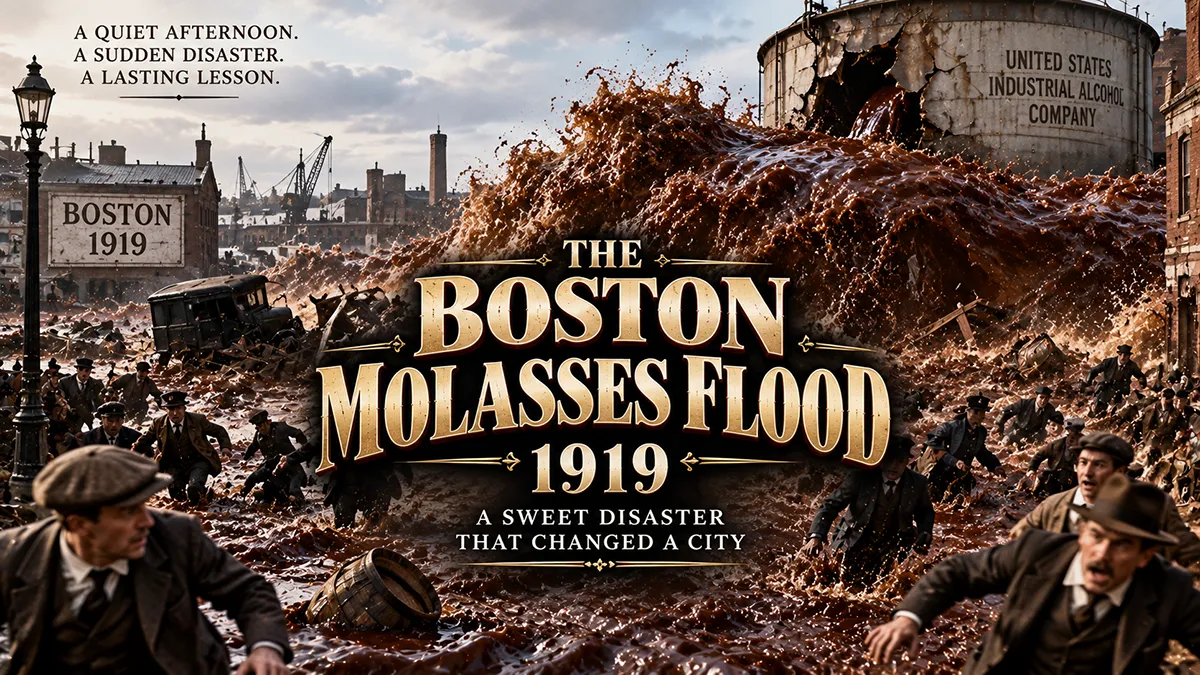
Most disaster stories from the early twentieth century involve fire, flood, or explosion in some familiar form. The Boston molasses disaster is stranger than almost any of them, because the villain was a sticky, sweet, seemingly harmless kitchen staple.
On January 15, 1919, a massive steel tank of molasses ruptured in Boston’s North End, sending a wall of syrup through city streets at a speed and force that still seems hard to believe.
This wasn’t a quirky footnote or an urban legend blown out of proportion. The great molasses flood was a real industrial disaster with a real death toll, a real cause rooted in shoddy engineering, and a real legacy that changed how buildings and industrial tanks are regulated in Massachusetts. Let’s separate the myths from the historical record and walk through exactly what happened.
TL;DR: On January 15, 1919, a poorly built molasses storage tank in Boston’s North End burst and sent a deadly wave of molasses through the neighborhood, killing 21 people and injuring about 150 in one of the strangest industrial disasters in American history.
What Was the Molasses Flood, Exactly?
The Boston molasses flood, also called the Great Molasses Flood or the Boston molasses disaster of 1919, was the catastrophic failure of a giant molasses storage tank owned by the United States Industrial Alcohol Company. The tank stood near Boston Harbor in the North End, a densely packed working-class neighborhood full of homes, businesses, and a firehouse.
When the tank gave way, it released an estimated 2.3 million gallons of molasses in a matter of seconds. The resulting wave tore through the neighborhood, destroying buildings, crushing a section of elevated train track, and killing 21 people.
It remains one of the deadliest industrial accidents in Massachusetts history, and one of the most unusual disasters anywhere in the United States, standing alongside other biggest events in American history.
Why Was There So Much Molasses in Boston?
It might seem odd that a city would need millions of gallons of molasses in one place, but in the early 1900s this made perfect industrial sense. Molasses was a key raw material for producing industrial alcohol, which in turn was used to manufacture munitions during World War I. The United States Industrial Alcohol Company, known as USIA, ran a distillery in East Cambridge and needed a steady, massive supply chain feeding it.
Boston’s North End was ideal for this purpose because it sat right on the harbor, allowing ships loaded with molasses from the Caribbean to dock and unload directly into storage. The company built its enormous tank at 529 Commercial Street specifically to hold shipments until they could be piped or hauled to the distillery. This is the essential backstory behind why molasses Boston 1919 became such an unlikely flashpoint for tragedy.
The Tank: How Big Was It, Really?
The scale of the molasses storage tank is genuinely staggering. It stood about 50 feet tall and roughly 90 feet in diameter, and when full it could hold up to 2.5 million gallons of molasses. That is an enormous quantity of liquid held in a single steel structure, sitting just yards from homes, workplaces, and a busy waterfront street.
The tank had been built quickly in late 1915, largely to take advantage of wartime demand for industrial alcohol. Speed mattered more to the company than careful engineering review, and that decision would prove disastrous. Understanding how big the molasses tank was helps explain why its failure was so violent rather than a simple leak or spill.
Warning Signs Before the Disaster
Almost from the moment it was filled, the tank showed troubling signs. Neighborhood residents reported hearing rumbling and groaning noises coming from inside the steel walls, and some recalled seeing molasses ooze from seams in the tank’s structure. Children reportedly collected dripping molasses with sticks, treating the leaks as a strange kind of curiosity rather than a warning.
Instead of addressing these signs, the company’s response was reportedly to paint the tank brown, so that the leaking molasses would be less noticeable. This detail is often cited in histories of the disaster, including Stephen Puleo’s well-regarded account “Dark Tide,” which reconstructed the molasses flood of 1919 in detail using period records and survivor accounts. The tank’s groans and leaks were treated as a cosmetic problem rather than a structural emergency.
January 15, 1919: The Day of the Flood
January 15, 1919 started as an unseasonably warm winter day in Boston, with temperatures climbing well above what was typical for mid-January. Some historical accounts note the temperature had risen sharply from bitter cold just days earlier. This sudden warmth is often discussed as a contributing factor, since rapid temperature swings can stress metal structures already under strain.
Around 12:30 in the afternoon, workers and residents near the waterfront heard a deep rumbling sound, followed by a noise many later described as similar to machine gun fire. That sound was almost certainly the rivets of the tank shearing off in rapid succession as the structure gave way. Within moments, the tank’s steel walls burst open entirely.
The Wave That Followed

What came next has often been called a molasses tidal wave, and while the phrase sounds almost comical today, the reality was anything but. Witnesses described a wave of molasses roughly 25 feet high at its peak, moving through the streets at an estimated 35 miles per hour. That speed is fast enough to outrun a person on foot, which is part of why so many people could not escape it.
The wave carried enormous chunks of the ruptured steel tank along with it, along with debris from destroyed buildings. It knocked a nearby firehouse off its foundation, crushed structural supports for the elevated railway, and swept away horses, wagons, automobiles, and people. As the molasses spread, it slowed and thickened, trapping anyone caught in its path rather than simply washing past them.
The Human Toll of the Boston Molasses Disaster
The molasses flood deaths numbered 21 in total, a mix of adults and children, along with several horses that were caught in the wave. Roughly 150 more people were injured, some with broken bones and severe lacerations, others with lasting respiratory damage after inhaling molasses. Rescue workers described the grim, exhausting task of searching through waist-deep syrup for survivors and victims alike.
The thickness of the molasses made everything harder. It slowed rescue efforts to a crawl, muffled cries for help, and made it nearly impossible to move quickly through the wreckage. Some victims were not recovered for days, and the physical work of searching for them left rescuers themselves coated head to toe and utterly exhausted.
What Caused the Great Molasses Flood?
So what actually caused the great molasses flood? The short answer is engineering failure driven by corporate haste. Investigations after the disaster found that the tank had never been properly tested before it was filled with molasses, and its steel walls were too thin to safely hold the pressure of a full load.
Engineers later determined the steel used contained too little manganese, making it more brittle and prone to fracture, especially in cold weather followed by a rapid warm-up. The tank had also been filled to near capacity shortly before the failure, adding fresh pressure on already stressed seams. Some researchers have also pointed to possible fermentation inside the tank creating additional internal pressure, though this remains a secondary and less certain factor compared to the well-documented structural defects.
The Legal Battle Known as the Molasses War
The aftermath of the disaster produced one of the largest and most complex civil lawsuits in Massachusetts history up to that point. More than 100 individual claims against the United States Industrial Alcohol Company were consolidated into a single case, a legal fight that came to be nicknamed the molasses war by the press covering it. Victims’ families and injured survivors sought damages for the company’s negligence in building and maintaining the tank.
The company initially tried to blame the explosion on anarchist sabotage, a claim that reflected the tense political atmosphere of 1919 but was not supported by evidence.
A court-appointed auditor spent years reviewing engineering reports and testimony before ultimately ruling against the company in 1925. USIA was ordered to pay out roughly $600,000 in damages, a substantial sum that helped push Massachusetts toward much stricter engineering oversight for large industrial structures.
How Did They Clean Up the Molasses Flood?
Cleaning up an entire neighborhood coated in hardened, sticky syrup was its own enormous undertaking. Crews used salt water pumped from Boston Harbor to help break down and rinse away the molasses from streets, and sand was spread to give workers and rescue vehicles traction on the slippery surfaces. It reportedly took weeks of scrubbing before the North End’s streets, homes, and harbor waters were even close to clean.
According to local lore that has been repeated for decades, the harbor itself supposedly ran brown for months afterward, and some residents claimed you could still smell molasses on hot summer days for years.
These details are widely repeated but are difficult to verify with hard evidence, so they’re best treated as enduring local legend rather than confirmed fact. What is well documented is that the cleanup required a coordinated, exhausting, multi-week effort from the Boston Fire Department, Navy personnel, Red Cross volunteers, and ordinary residents.
Common Misspellings, Nicknames, and Mix-Ups
Because the event sounds so unusual, it’s often searched and written about under a variety of spellings, including “mollases flood,” “molassis flood,”, “malasses flood,” and “molassess flood.” All of these refer to the same historical event: the Boston molasses flood of January 1919. There is no separate disaster hiding behind these spelling variations.
It’s also sometimes mislabeled as a “maple syrup flood” or simply a “syrup flood,” likely because molasses and maple syrup are both thick, dark, sweet liquids in the popular imagination.
However, the tank held molasses specifically, a byproduct of sugar refining used for industrial alcohol production, not maple syrup. The mix-up is understandable, but it’s worth clearing up for anyone researching the actual event.
Was There Really a Molasses Flood in Boston?
Given how strange the story sounds, it’s fair for people to wonder, was there a molasses flood in Boston, or is this an exaggerated legend? The event is thoroughly documented through contemporary newspaper coverage, court records from the resulting lawsuit, and later historical research including Puleo’s book “Dark Tide,” which is often referenced in searches like “dark tide molasses flood 1919.” The physical damage, injuries, and deaths were extensively covered at the time and confirmed through the legal proceedings that followed.
This was not an urban myth invented later for entertainment value. It was a genuine, well-documented molasses disaster that reshaped safety regulation in the region for decades afterward.
Where Did the Molasses Flood Happen?
The molasses flood boston location was the North End neighborhood, specifically around Commercial Street near Boston Harbor. This was a densely populated working-class area at the time, home to many Italian immigrant families, along with warehouses, a firehouse, and elevated train infrastructure. The tank’s placement so close to homes and businesses is part of why the human toll was so severe.
Today, the site is part of Boston’s Langone Park, near the harbor walk in the North End. It’s a peaceful green space now, giving little visual hint of the devastation that once occurred there.
The Great Molasses Flood Plaque
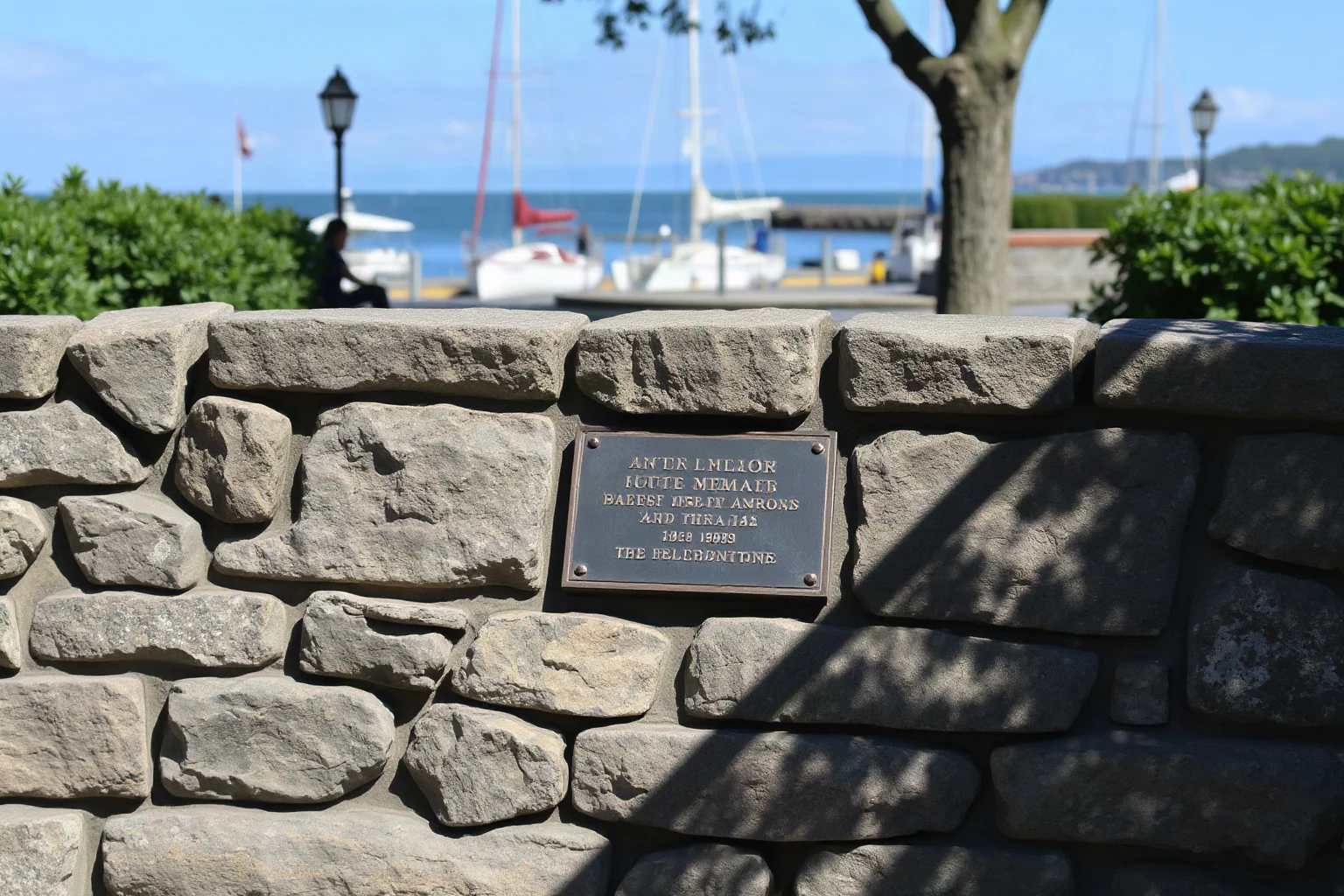
For decades, there was little formal public marker acknowledging the disaster at the actual site. That changed when a small memorial plaque was installed near Langone Park, commemorating the lives lost in the flood. The great molasses flood plaque briefly explains the disaster and serves as a quiet, easy-to-miss reminder for locals and visitors walking through the area.
It’s a modest marker for an event that caused such enormous damage, but it remains one of the only physical acknowledgments of the disaster at the actual historical site. Many visitors say they had no idea the flood happened until they happened upon the plaque themselves.
The Lasting Legacy of the 1919 Boston Molasses Tragedy
The 1919 Boston molasses tragedy directly influenced how Massachusetts approached construction oversight going forward. In the years following the lawsuit, the state introduced stricter requirements for engineers to certify calculations and for construction plans to be reviewed by qualified professionals before large industrial structures could be built.
This shift is frequently cited by historians of engineering ethics as an early example of disaster-driven regulatory reform, the kind of quiet turning point found among historical events that changed the world.
The case is still referenced today in engineering ethics courses as a cautionary tale about cutting corners on safety testing to save time and money, much like the botched repair behind Japan Airlines Flight 123, the deadliest single-aircraft plane crash in history.
It’s a sobering reminder that industrial negligence doesn’t need to involve anything explosive or obviously hazardous to cause tremendous harm. Sometimes it just takes a giant tank of something as ordinary as molasses.
Remembering an Unusual American Disaster
The Boston molasses flood occupies an odd place in American history, often treated as a piece of trivia because of how unlikely it sounds. But behind the strange premise is a serious story about corporate negligence, working-class immigrant communities bearing the cost of that negligence, and a legal battle that helped push safety regulation forward. Twenty-one people lost their lives, and many more were injured, in a disaster that was ultimately preventable.
When you walk through Boston’s North End today, past Langone Park and its quiet harbor views, it’s worth remembering what happened there on that unusually warm January afternoon in 1919. The molasses flood deserves to be remembered not as a punchline, but as a genuine historical tragedy with real lessons still relevant to how we build and regulate large structures today.
Frequently Asked Questions
What was the 1919 Boston molasses tragedy?
The 1919 Boston molasses tragedy refers to the collapse of a massive molasses storage tank in Boston's North End on January 15, 1919. The failure released roughly 2.3 million gallons of molasses in a wave that killed 21 people and injured about 150 others.
When did the Boston molasses flood happen?
It happened on January 15, 1919, around 12:30 in the afternoon, on an unusually warm winter day in Boston's North End neighborhood.
What caused the great molasses flood?
Investigators found that the tank's steel was too thin and low in manganese to safely hold its load, and it had never been properly load-tested before use. A rapid rise in temperature that day, combined with a recent full filling of the tank, added stress that the weak structure could not withstand.
How many people died in the molasses flood?
Twenty-one people died in the disaster, along with several horses caught in the wave. About 150 more people were injured, some seriously.
Where did the great molasses flood happen?
The disaster took place in Boston's North End, near Commercial Street along Boston Harbor, at the site of a molasses storage tank owned by the United States Industrial Alcohol Company. The location is now part of Langone Park.
How big was the molasses tank?
The tank stood about 50 feet tall and 90 feet in diameter, with a capacity of roughly 2.5 million gallons of molasses when full.
How did they clean up the molasses flood?
Crews used salt water pumped from Boston Harbor to break down and rinse the molasses from streets and buildings, while sand was spread for traction. The cleanup, involving firefighters, Navy personnel, Red Cross volunteers, and residents, reportedly took weeks.
Was there really a molasses flood in Boston?
Yes, it's a thoroughly documented historical event, confirmed through contemporary news coverage and a lengthy civil lawsuit against the tank's owner, the United States Industrial Alcohol Company. It is not an urban legend, despite how unusual it sounds.
Why is the lawsuit called the ‘molasses war’?
Journalists nicknamed the lengthy legal battle the 'molasses war' because it consolidated more than 100 individual claims against the United States Industrial Alcohol Company into one sprawling case, which took years to resolve before the company was found liable in 1925.

Alex Warren
Related Articles